Fisher
The fisher (Pekania pennanti) is a medium-sized carnivorous mammal native to North America's boreal and mixed forests, and the only living member of its genus. Often mistakenly called a fisher cat, it is a member of the mustelid, or weasel, family. This elusive, forest-dwelling creature is notable for its ability to prey on porcupines and its unique reproductive cycle. Once heavily trapped for its valuable fur, leading to local extinctions, fisher populations have rebounded in many areas due to conservation efforts, though habitat loss and climate change remain significant threats, particularly for isolated western populations.
Physical Description and Adaptations
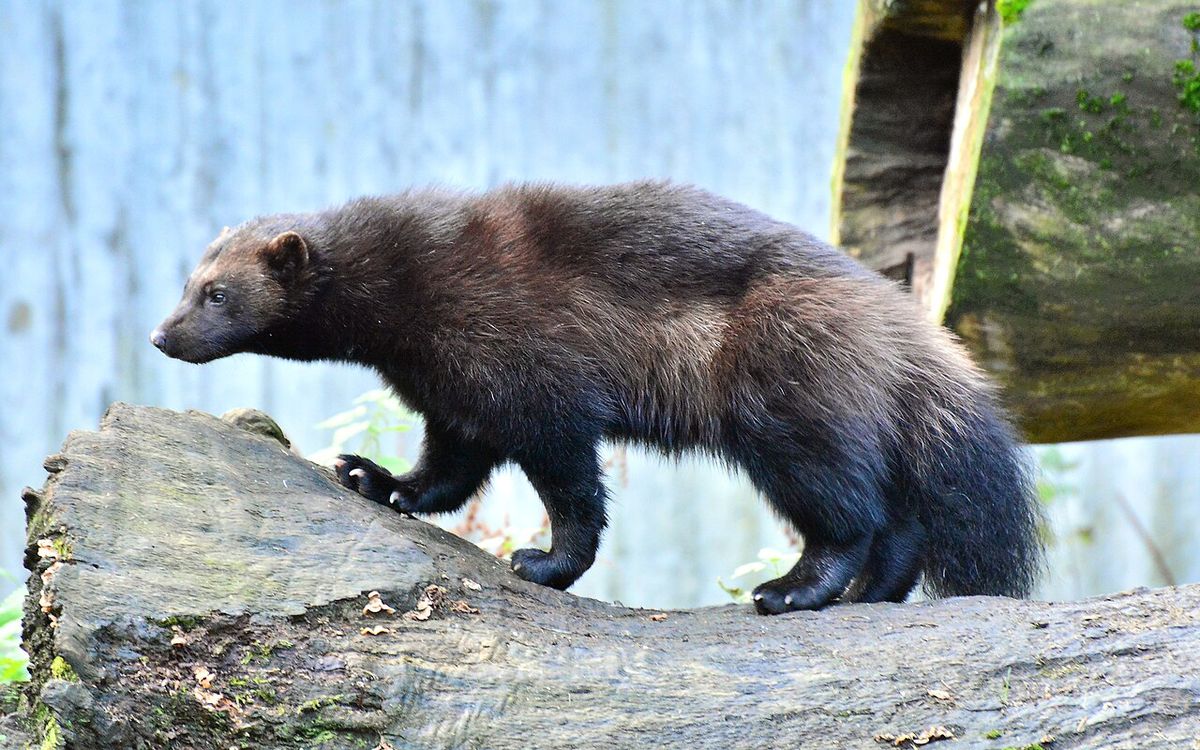
The fisher has a long, slender, low-slung body typical of the weasel family, with short legs, a bushy tail, and rounded ears. Males are significantly larger than females, a trait known as sexual dimorphism. Males measure 90 to 120 centimetres in total length and weigh 3.5 to 6.0 kilograms, while females are 75 to 95 centimetres long and weigh 2.0 to 2.5 kilograms. The fisher's luxurious fur varies seasonally, being densest and glossiest in winter, ranging from deep brown to black, often with hoary-gold or silver guard hairs on the head and shoulders. In summer, the coat becomes more mottled and may lighten considerably as the animal moults.
Several physical adaptations make the fisher an adept forest dweller. It has large feet that facilitate movement over snow, and its five toes on each foot feature unsheathed, retractable claws. Coarse hairs grow between the pads and toes of its hind paws, providing added traction on slippery surfaces. Most remarkably, the fisher possesses highly mobile ankle joints that can rotate its hind paws almost 180 degrees, granting it the rare mammalian ability to climb down trees head-first. A circular patch of hair on the central pad of the hind paws marks plantar glands, which give off a distinctive odour thought to be used for scent marking, especially during the breeding season.
Habitat and Behaviour
Fishers are creatures of the deep forest, showing a strong preference for large tracts of continuous mature coniferous or mixed forest. They require areas with substantial overhead cover, typically greater than 80 percent, and avoid open habitats with less than 50 percent cover. They are particularly associated with old-growth forests, as female fishers need large trees with cavities for denning. Forest floors with abundant coarse woody debris are also favoured. In western regions, they often select riparian woodland habitats, especially where regular fires have cleared understory debris. Fishers tend to avoid areas with deep, uncompacted snow, which impedes their movement.
Behaviourally, fishers are generally solitary and crepuscular, meaning they are most active at dawn and dusk, though they remain active year-round. They establish home ranges that vary in size with the season and habitat quality, from about 6.6 square kilometres in summer to over 20 square kilometres in winter. Male and female territories often overlap, with males dominating larger areas to increase mating opportunities. Females are least active during pregnancy but increase their movements after their kits are born. As primarily terrestrial hunters, fishers spend most of their time on the forest floor, though they are competent and agile climbers when necessary.
Diet and Hunting
Fishers are opportunistic generalist predators with a diet that reflects the availability of prey in their forest homes. Their primary prey is the snowshoe hare, and they are one of the very few animals that successfully and regularly hunt porcupines. Contrary to its common name, the fisher rarely eats fish. Its diet is supplemented with a wide variety of other small to mid-sized mammals including squirrels, wood rats, martens, and raccoons. They will also consume birds, insects, carrion, and occasionally fruits, nuts, berries, and mushrooms. Analysis of stomach contents has even revealed evidence of larger animals like deer, likely scavenged.
The fisher's predation on porcupines is legendary but often misunderstood. Popular stories of fishers flipping porcupines to attack their soft undersides are exaggerated. Instead, observational studies show that fishers make repeated, careful biting attacks on the porcupine's face, a process that can take 25 to 30 minutes to kill the animal. Fishers have also been documented preying on other predators. Research in Maine recorded over a dozen confirmed cases of fishers killing Canada lynx, typically by delivering a powerful bite to the neck of a lynx bedded down in a snowstorm. This predation was identified as a leading source of lynx mortality in the study area.
Reproduction and Life Cycle
The fisher has an unusual and nearly year-long reproductive cycle characterized by delayed implantation. Mating occurs in late March or early April. After fertilization, the blastocyst (early embryo) floats freely and does not implant in the uterine wall for about ten months. Active pregnancy begins with implantation in mid-February of the following year, followed by a gestation period of roughly 30 to 50 days. Females give birth to a litter of one to four kits, called kits, in the spring, typically from mid-March to late April. Remarkably, the female enters estrus again just 7 to 10 days after giving birth, and the cycle repeats.
Females den in the hollows of large trees. The kits are born blind, helpless, and only partially covered in fine hair. They begin to crawl at about three weeks old, open their eyes after seven weeks, and start to climb at eight weeks. For the first eight to ten weeks, they are entirely dependent on their mother's milk before transitioning to solid food. As they grow, the kits become intolerant of their litter mates around four months of age. By five months, the mother pushes them out to establish their own independent ranges. Juvenile fishers will have established their own territory by the time they are one year old, and females can begin breeding at that age.
Historical Range and Conservation
Historically, fishers were widespread across the northern forests of North America, from coast to coast in Canada and south into the northern United States. Intensive overtrapping for their valuable fur, combined with widespread loss of mature forest habitat due to logging and road building, led to severe population declines and local extinctions by the late 19th and early 20th centuries. They were virtually eliminated from the southern and eastern parts of their range, including most American states and parts of eastern Canada like Nova Scotia. Trapping restrictions enacted in the 1930s, coinciding with the end of the major logging boom, allowed remnant populations to begin a slow recovery as forests regrew.
Recovery efforts have been bolstered by active reintroduction programs. In the mid-20th century, fishers from British Columbia and Minnesota were released in Oregon. Starting in 2008, a program aimed to re-establish a self-sustaining fisher population in Washington State, with animals released on the Olympic Peninsula and in the Cascade Mountains. From 2008 to 2011, about 40 fishers were reintroduced in the northern Sierra Nevada in California. These reintroduced animals are monitored and have been shown to be reproducing. While populations in the northeastern United States and the Great Lakes region are now considered common and robust, western populations remain rare and fragmented.
Current Threats and Status
Although fisher populations have recovered significantly in eastern North America, they face ongoing and emerging threats, particularly in the western parts of their range. The rampant loss of mature forest habitat due to past unsustainable logging remains a problem, as fishers require large trees for denning. The effects of climate change, including prolonged drought and insect-caused tree mortality, are degrading fisher habitat. Climate change is also increasing the frequency, size, and severity of wildfires, which can remove critical older, cavity-bearing trees in a single event. These fires pose a significant threat throughout the fisher's range.
Additional human-caused threats include poisoning from rodenticides used in illegal marijuana cultivation operations on public lands. In some regions, legal trapping still occurs. The conservation status of the fisher varies greatly by location. In Canada, populations are generally stable and not considered at risk. In the United States, the species is common in the Northeast and Midwest. However, it is one of the rarest carnivores in the northern Rockies and on the West Coast. The isolated population in the southern Sierra Nevada, believed to number fewer than 300 adults, is listed as federally endangered under the U.S. Endangered Species Act and as threatened under California state law. Ongoing conservation work focuses on securing federal protections, influencing policies on trapping and logging, and preparing for climate change impacts.
Etymology and Taxonomy
The name 'fisher' is a misnomer, as the animal does not eat fish. The name is instead related to the word 'fitch,' an old term for the European polecat or its pelt, due to a perceived resemblance. The name came into English from colonial Dutch words like 'fisse' or 'visse.' Alternative names include 'pekan,' derived from the Abenaki language, and 'wejack,' from Algonquian languages. Its scientific name, Pekania pennanti, honours Thomas Pennant, who described the animal in 1771, though the French naturalist Buffon had described it earlier in 1765 under the name pekan.
For many years, the fisher was classified in the genus Martes along with martens. Advances in DNA analysis in 2008 revealed that while fishers and martens share a common ancestor, the fisher is distinct enough to warrant its own genus. It was reclassified into the resurrected genus Pekania, making its full scientific name Pekania pennanti. Members of the genus Pekania are distinguished by having four premolar teeth on their upper and lower jaws, whereas the genus Mustela has only three. The fisher has a total of 38 teeth. Fossil evidence indicates that ancestors of the modern fisher migrated to North America from Asia during the Pliocene epoch, between 2.5 and 5 million years ago.
Questions about Fisher
Do fishers actually eat fish?
Despite its common name, the fisher rarely eats fish. The name is historically related to the word 'fitch,' referring to the European polecat, not to piscivorous habits. Fishers are generalist predators whose diet consists primarily of small to mid-sized mammals like snowshoe hares and squirrels, and they are famous for being one of the few predators that regularly hunt porcupines. They will also eat birds, insects, carrion, and occasionally fruits and mushrooms.
Are fishers dangerous to humans or pets?
Fishers are shy, reclusive forest animals that generally avoid human contact. Unprovoked attacks on humans are extremely rare. However, like any wild animal, a fisher may attack if it feels threatened, cornered, or is protecting its young. There have been very isolated reports of fishers attacking small children. Fishers are predators and could potentially view small domestic pets, such as cats or very small dogs, as prey, particularly if they encroach on the fisher's forest territory.
Why are fishers important to the ecosystem?
Fishers function as mid-level predators in forest ecosystems. Their predation helps regulate populations of prey species like snowshoe hares and rodents. Most notably, they are a primary natural control for porcupine populations. In areas where fishers were eliminated, porcupine numbers increased dramatically, leading to extensive damage to timber crops through bark-stripping. The reintroduction of fishers has been used as a natural method to bring porcupine populations back into balance.
Where can you find fishers in Canada?
Fishers are widespread across Canada's boreal and mixed deciduous-coniferous forest belt. Their range extends from Nova Scotia and New Brunswick in the east, across Quebec and Ontario, through the Prairie provinces, to British Columbia and north into the Yukon and the southern Northwest Territories. They are present as far north as Great Slave Lake. They prefer large areas of dense, mature forest and are more common in old-growth stands that provide the large tree cavities they need for denning.
How do fishers kill porcupines?
The popular notion that fishers flip porcupines onto their backs to attack the unprotected belly is a misconception. Research and observational studies have shown that fishers kill porcupines through a careful, persistent attack on the animal's face. The fisher makes repeated, swift bites to the porcupine's face, which is less protected by quills. This process can take 25 to 30 minutes until the porcupine is subdued and killed. This method demonstrates the fisher's agility and specialised hunting technique.
Are fishers endangered?
The conservation status of fishers varies greatly by region. In most of Canada and the northeastern United States, populations have recovered from historical lows and are now considered stable and not at risk. However, in the western United States, populations are rare and fragmented. The isolated population in the southern Sierra Nevada of California is federally endangered and state-threatened, with an estimated 300 or fewer adults. Major threats to western populations include habitat loss from logging and wildfires intensified by climate change, as well as poisoning from rodenticides.
Sources: Wikipedia and current public reporting, checked by the Your Space Hamilton desk. Last updated 2026-10-18.