Union Station
Union Station is the principal railway station and intermodal transportation hub in Toronto, Ontario, and the busiest such facility in Canada. Located on Front Street West between Bay and York Streets in the city's downtown core, the station opened in 1927 and was designated a National Historic Site of Canada in 1975 for its exceptional Beaux-Arts architecture. Owned by the City of Toronto with train shed and trackage owned by provincial agency Metrolinx, it is operated by the Toronto Terminals Railway. Union Station serves as the central hub for Via Rail, Amtrak, GO Transit, and the Union Pearson Express, handling over 72 million passengers annually and acting as a critical nexus for national and regional travel.
Architectural Design and Structure
Union Station is Canada's largest and most opulent railway station, designed in the Beaux-Arts style by the Montreal firm of Ross and Macdonald with input from CPR architect Hugh Jones and Toronto architect John M. Lyle. The Historic Sites and Monuments Board of Canada cited its design in 1975 as being of national architectural significance. The building's symmetrical façade on Front Street West stretches 752 feet and is constructed of smooth beige Indiana and Queenston limestone. Its most prominent feature is a colonnaded loggia with 22 Roman Tuscan columns, each 40 feet high and weighing 75 tons. The building's heavy ornamentation, classical detailing, and formal axial symmetry are characteristic of the Beaux-Arts style. The structure comprises three connecting box masses, with the central section housing the grand interior space known as the Great Hall.
The main entrance leads into the expansive Ticket Lobby, commonly called the Great Hall, which runs 250 feet long and reaches 88 feet high at its vaulted ceiling. The space is illuminated by diffused natural light from clerestory windows and large arched windows at each end. The ceiling is constructed of coffered Guastavino tiles, while the walls are faced with Zumbro stone from Missouri and the floors are Tennessee marble laid in a herringbone pattern. A cornice within the hall is carved with the names of many Canadian destinations served by the Grand Trunk and Canadian Pacific railways at the time of construction. The Great Hall now primarily serves Via Rail and Amtrak passengers, housing ticket desks, a business class lounge, and the station's grand clock.
Transportation Services and Concourses
Union Station functions as the central hub for multiple rail services, making it the second-busiest railway station in North America. The Union Pearson Express offers a direct rail link to Toronto Pearson International Airport from a platform west of the main building. The station is also integrated with the Toronto Transit Commission's subway and streetcar system at the adjacent Union subway station. Passengers connect to GO Transit services through several concourses. The 62,000 square foot York Concourse opened in 2015 to supplement access to western platforms. The revitalized Bay Concourse reopened in July 2021 after a multi-year closure, featuring numerous departure screens and Presto fare devices. A new South Concourse, under construction as of 2023, will eventually link the south ends of the Bay, Via, and York Concourses.
The GO Transit Union Station Bus Terminal is located in the nearby CIBC Square and is connected to the rail station by a 40 metre enclosed walkway above Bay Street. The station's 23 train platforms are housed within a large train shed south of the main building. The shed, a variation of the Bush train shed design by A. R. Ketterson, was substantially renovated beginning in 2010, with its central portion replaced by a glass atrium designed by Zeidler Architecture. Platform 3, the northernmost platform, underwent a heritage restoration and reopened in January 2022. Freight trains from both Canadian National and Canadian Pacific railways also occasionally pass through tracks on the south side of the shed.
Historical Development
The history of Union Station dates to 1858 with the opening of Toronto's first union station, a wooden structure shared by several railways west of the current site. A second station opened on the same location in 1873 and was later rebuilt in 1896. The Great Toronto Fire of 1904 destroyed the block immediately east of this station, which the Grand Trunk Railway subsequently acquired. In 1905, the Grand Trunk and Canadian Pacific railways decided to proceed with designing and constructing a third, grander union station. The Toronto Terminals Railway was incorporated in 1906 to build and operate the new station as a joint venture between the two rail companies. Construction began in 1914 but faced significant delays due to the First World War's impact on materials and labour, as well as the Grand Trunk's financial troubles from its transcontinental railway project.
Although the station's headhouse and office wings were structurally complete by 1920, the station did not open for another seven years while the complex system of approach tracks was finalized. During this period, the bankrupt Grand Trunk Railway was nationalized and merged into the Canadian National Railways in 1923, which assumed its ownership stake in the Toronto Terminals Railway. The station was officially opened by Prince Edward, Prince of Wales, on August 6, 1927, in a ceremonial ribbon-cutting event attended by Prime Minister William Lyon Mackenzie King, British Prime Minister Stanley Baldwin, and Ontario Premier George Howard Ferguson. The Prince was the first person to step off a train into the new station and quipped about its cathedral-like grandeur.
Neighbourhood Context and Connections
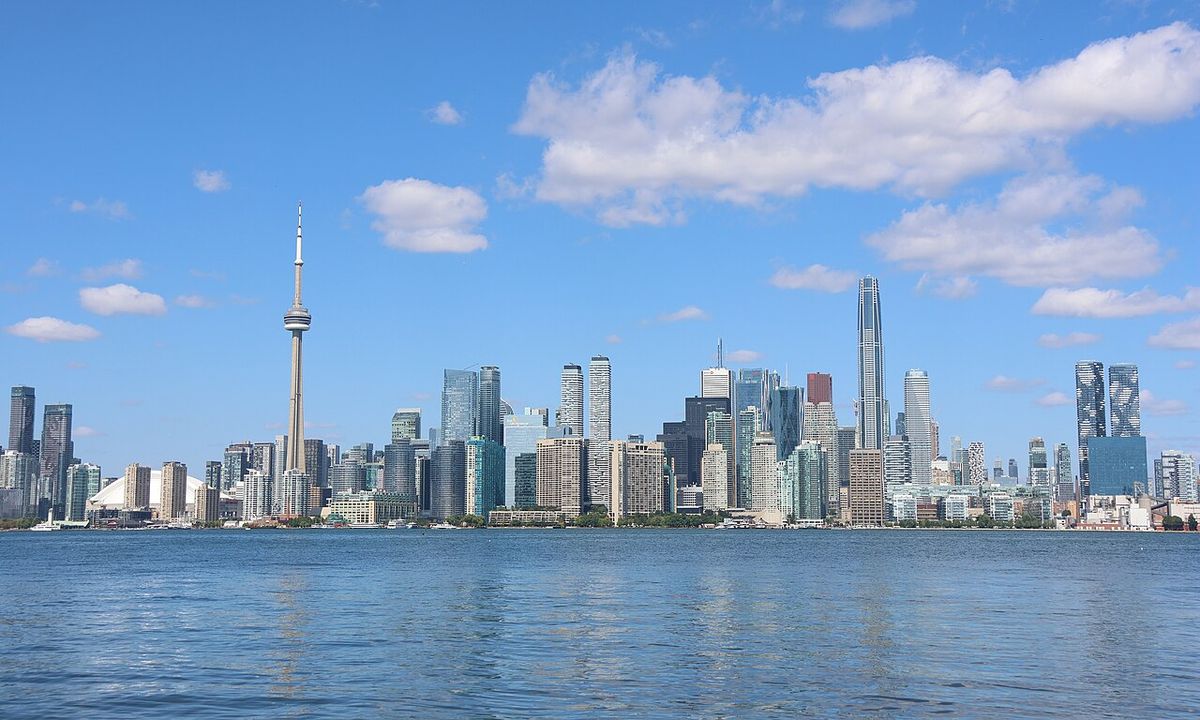
Union Station is situated at the heart of downtown Toronto's business district, with the city's Entertainment District beginning directly across Bay Street. Its columned façade faces north towards the city's core, directly opposite the historic Fairmont Royal York Hotel, which is connected via an underground passageway. The station is surrounded by major landmarks and corporate towers, including the Dominion Public Building to the east, Brookfield Place, Royal Bank Plaza, and Telus Harbour. Many nearby attractions, including Scotiabank Arena, Rogers Centre, the Metro Toronto Convention Centre, and the CN Tower, were built on former Railway Lands and are directly accessible from the station via the SkyWalk enclosed pedestrian bridge. The SkyWalk, considered part of Toronto's underground Path network, also provides access to the Union Pearson Express platform.
The station's location provides easy core access for road traffic via the southern end of the Gardiner Expressway, which runs between the station and Lake Ontario. The area continues to evolve, with future plans including a Path bridge link on the east side to the Backstage Condominium at Esplanade and Yonge Street. The station itself is transforming into a major civic destination beyond its transportation role, hosting seasonal festivals and integrating retail and dining options. Its central positioning makes it a primary gateway for visitors to Toronto's key cultural, sporting, and business districts.
Modern Revitalization and Public Programming
In recent years, Union Station has undergone a significant revitalization to expand its capacity and modernize its facilities while preserving its heritage character. Major projects have included the renovation of the Bay Concourse, the construction of the new York Concourse, and the ongoing development of the South Concourse. The train shed renovation, which restored heritage elements and added a large glass atrium, was a central component of this effort. The station now houses over 30 new retailers and restaurants, evolving into a shopping and dining destination in addition to its transportation function. It is open daily from 5:30 am to 12:45 am, welcoming over 300,000 visitors each day.
A key aspect of the station's contemporary identity is its robust calendar of free public events. The flagship program is Union Summer, presented by TD Bank, which transforms the station's outdoor plaza into a summer festival for 63 days. The 2026 season, running from June 8 to August 9, featured over 120 free musical performances, local food vendors, and cultural activities set against the backdrop of the CN Tower. Other events, such as day parties and community walks, further establish the station as a dynamic public space. This programming aligns with the station's stated goal of becoming one of the world's most engaging civic destinations, leveraging its famous architecture and central location to host citywide celebrations.
Ownership, Operation, and Significance
Union Station has a unique ownership and operational structure. The City of Toronto owns the station building itself, while the provincial transit agency Metrolinx owns the train shed and the trackage. Train movement along the Union Station Rail Corridor, Canada's largest and busiest, is directed and controlled by the Toronto Terminals Railway. This entity is a joint venture historically owned by the Canadian National Railway and Canadian Pacific Railway, stemming from the station's original construction partnership. This arrangement manages the complex interplay of inter-city, regional, and freight rail services that converge at the hub.
The station's national significance is considerable and varied. It is a critical piece of transportation infrastructure, handling more than half of all Canadian inter-city rail passengers and serving as the central node in the densely travelled Quebec City, Windsor Corridor. Its architectural grandeur, recognized through its National Historic Site and Heritage Railway Station designations, represents an era of expansive national rail development and urban growth. A 2026 international survey ranked it fifth among the world's most luxurious and high performing rail hubs, the only Canadian station in the top 20. As both a historic monument and a modern, multimodal transit centre, Union Station remains an indispensable gateway to Toronto and a symbol of Canadian railway heritage.
Questions about Union Station
What is the best way to find my way around Union Station?
Union Station is a large, sprawling hub, so allowing extra time to get oriented is recommended, especially if catching a train. The station is organized with distinct concourses for different services: the Great Hall for Via Rail and Amtrak, the York and Bay concourses for GO Transit, and a separate platform west of the main building for the Union Pearson Express. Clear signage and numerous departure screens help guide passengers. The station is also connected to the TTC subway and streetcars, and an indoor Google Street View map is available online to help plan a route through the complex.
What are Union Station's hours of operation?
Union Station is open daily from 5:30 am until 12:45 am. However, the operating hours for individual retail shops, restaurants, and ticket counters within the station may vary. Passengers should check the schedules for their specific train service, as train operations continue according to their published timetables, which may include services outside the general building hours. The station's public events, such as the Union Summer festival, also have their own specific operating schedules.
How do I get from Union Station to Toronto Pearson Airport?
The Union Pearson Express provides direct, dedicated rail service between Union Station and Toronto Pearson International Airport. The UP Express platform is located a short walk west of the main station building, accessible via the SkyWalk enclosed pedestrian bridge. The trip typically takes about 25 minutes. This service offers a convenient alternative to road traffic and connects directly with the other rail and transit services available at Union Station.
Is Union Station accessible for people with mobility needs?
Yes, Union Station is designed to be accessible. The station and its connected pathways, including the SkyWalk, are barrier free for mobility devices. The revitalized concourses and platforms include elevators, ramps, and accessible washrooms. Public events like Union Summer also prioritize accessibility, offering physically accessible sites, varied seating, and accommodations such as captioned movie screenings. For specific inquiries, visitors can contact station management directly.
What major attractions are within walking distance of Union Station?
Many of Toronto's top attractions are within easy walking distance or directly connected to Union Station. The CN Tower, Rogers Centre, and Scotiabank Arena are all accessible via the SkyWalk. The Metro Toronto Convention Centre and the Hockey Hall of Fame in Brookfield Place are also nearby. The Fairmont Royal York Hotel is directly across Front Street, connected by an underground passage. The waterfront, the Entertainment District, and the financial district are all immediately adjacent to the station.
What was the gun range at Union Station?
From 1927 until 2008, Union Station housed a gun range on its seventh floor. Originally operated for Canadian Pacific Railway and Canadian National Railway police to practice, it eventually opened to members of the public as the Canadian National Recreation Association handgun club. The City of Toronto closed the range in 2008 as a symbolic gesture supporting its efforts to reduce gun violence in the city. This unique feature reflected the station's historical role as a workplace for railway security personnel.
Sources: Wikipedia and current public reporting, checked by the Your Space Hamilton desk. Last updated 2026-10-18.