Malton, Mississauga
Malton is a distinct neighbourhood in the northeastern part of the city of Mississauga, Ontario, Canada, situated to the northwest of Toronto. It is bounded by Highway 427 to the east, the Brampton city limits to the north, roughly Airport Road to the west, and a second CN rail line and Toronto Pearson International Airport to the south. This industrial legacy, coupled with its strategic location as a major transportation node, has made Malton a crucial economic hub within the Greater Toronto Area and a primary point of settlement for successive waves of immigrants to Canada. Today, it is a densely populated, culturally diverse community with a unique history separate from the rest of Mississauga, governed as part of Ward 5 together with the Britannia Woods area.
Geography and boundaries
Malton occupies a unique geographic position within Mississauga, physically separated from the city's other neighbourhoods by major industrial zones and airport infrastructure. Its formal boundaries are Highway 427 to the east, the Brampton city limit marked by a Canadian National Railway line to the north, approximately Airport Road to the west, and a second CN line and the vast lands of Toronto Pearson International Airport to the south. This isolation means Malton does not directly adjoin any other Mississauga community, though it shares a border with Toronto's Rexdale neighbourhood east of Highway 427. The area's original settlement core is located at the northwest corner of Airport and Derry Roads, known historically as the "Four Corners." Mimico Creek flows through the neighbourhood, and notably, all local roads are named after cities in the United Kingdom. Together with the Britannia Woods area, Malton comprises Mississauga's Ward 5, a political designation that reflects its distinct community identity within the larger city.
Historical development from settlement to police village
The land that became Malton was part of the Second Purchase from the Mississauga Indians in 1818, which added 34,556 acres to Toronto Township. The village itself began to be settled around 1819 or 1820, with early pioneers including Richard Halliday, a blacksmith and innkeeper who named the settlement after Malton in North Yorkshire, England. Joseph Tomlinson, who arrived in August 1820 to claim a 100-acre land grant, built a cabin and cleared land and roadway within 18 months to comply with his grant's conditions. Other early settlers by 1822 included Samuel and Margaret Shaw on 200 acres, Henry and Elizabeth Brocklebank, and Samuel Moore, whose father John purchased a 100-acre grant. In the 1840s, the Blanchard family cleared land northwest of the Four Corners, solidifying the Village of Malton. By 1850, with the incorporation of Toronto Township, Malton had a population of 350.
The introduction of the Grand Trunk Railway in 1854 allowed better access to Toronto markets for local farmers and Malton thrived as a result, leading to the village being subdivided in 1855. The population reached 600 by 1864. Malton was chosen as the county seat in 1867, but Brampton contested the decision and was awarded the county seat a year later. Its economic prosperity declined afterwards, as did the population, which fell to 200. The opportunity for advancement was dealt another blow when the Credit Valley Railway came to Dixie, Streetsville, Meadowvale and Churchville in 1879, bypassing Malton and causing a drop in shipping business. Malton was organized as a police village in 1914, a status it retained for decades while remaining within the boundary between Toronto Gore and Toronto Townships.
The aviation era and wartime transformation
In 1937, Malton experienced a major shift from an agricultural to an industrial economy when 13 farms were selected to become the location of a new airport. Land agents for the Toronto Harbour Commission approached farmers south of Malton to acquire land for what was named Malton Airport. A farmhouse served as the first airport terminal that year, replaced in 1939 by a new terminal building identical to one at Toronto City Centre Airport. Concurrently, National Steel Car built a manufacturing plant in 1938, producing Westland Lysanders and acting as a subcontractor for other aircraft. On November 4, 1942, the federal government expropriated National Steel Car and set up the crown corporation Victory Aircraft, which produced Avro Lancaster bombers from 1942 to 1945. Malton Airport was also the site of British Commonwealth Air Training Plan facilities during the war.
To house wartime workers, the Canadian Government expropriated the north part of the former Fred Codlin farm in 1942 and built 200 military-style houses. This development was named "Victory Village," with streets bearing war-time references: Victory Road, McNaughton Road (for General Andrew McNaughton), Churchill Road, and Lancaster Road. The Victory Community Hall was built shortly after at Victory Park and was renovated in 2010. This period established Malton's dual identity as both an airport community and a centre for advanced aircraft manufacturing, setting the stage for its postwar aerospace prominence.
Postwar aerospace prominence and municipal integration
After the war, A.V. Roe Canada Limited was established on December 1, 1945, and assumed control of Victory Aircraft. In 1946, A.V. Roe acquired Turbo Research Limited, later renamed Orenda Engines. The plant became a centre for aerospace innovation, with the Avro Jetliner making its first flight on August 10, 1949, and the CF-100 Jet Interceptor making its maiden flight on January 19, 1950. By 1958, Malton had an international reputation as a leader in aeronautical design and manufacturing, notably as the home of the famous Avro Arrow, Canada's first supersonic aircraft. On February 20, 1959, Prime Minister John Diefenbaker terminated the Avro Arrow project and the five completed aircraft were dismantled. After the cancellation, the plant was operated by de Havilland Canada starting in 1962, then Douglas Aircraft in 1965, McDonnell Douglas Canada in 1981, and Boeing Canada in 1997, before being demolished in 2005. Orenda Aerospace Division of Magellan Aerospace Corporation continues to operate at 3160 Derry Road East, and Mitsubishi Heavy Industries Canada Aerospace, a Tier 1 aerostructure manufacturer, celebrated its 10-year anniversary in Malton in May 2016.
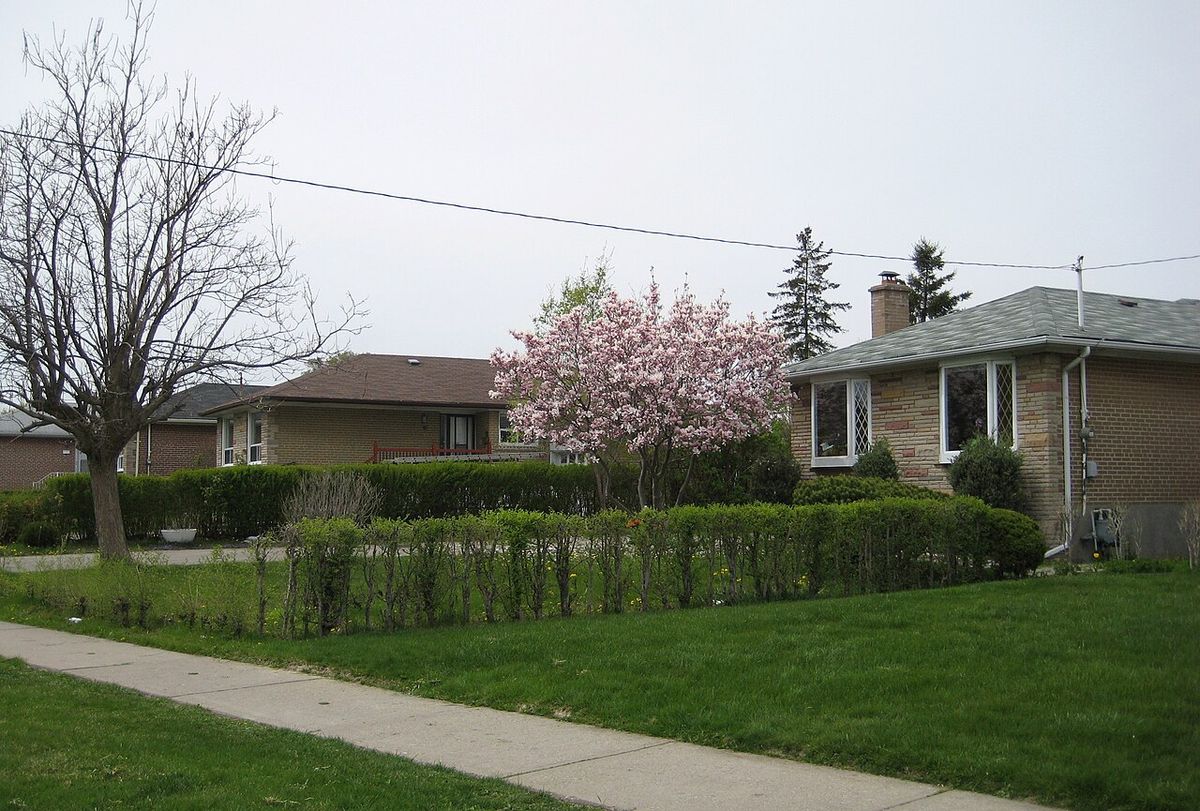
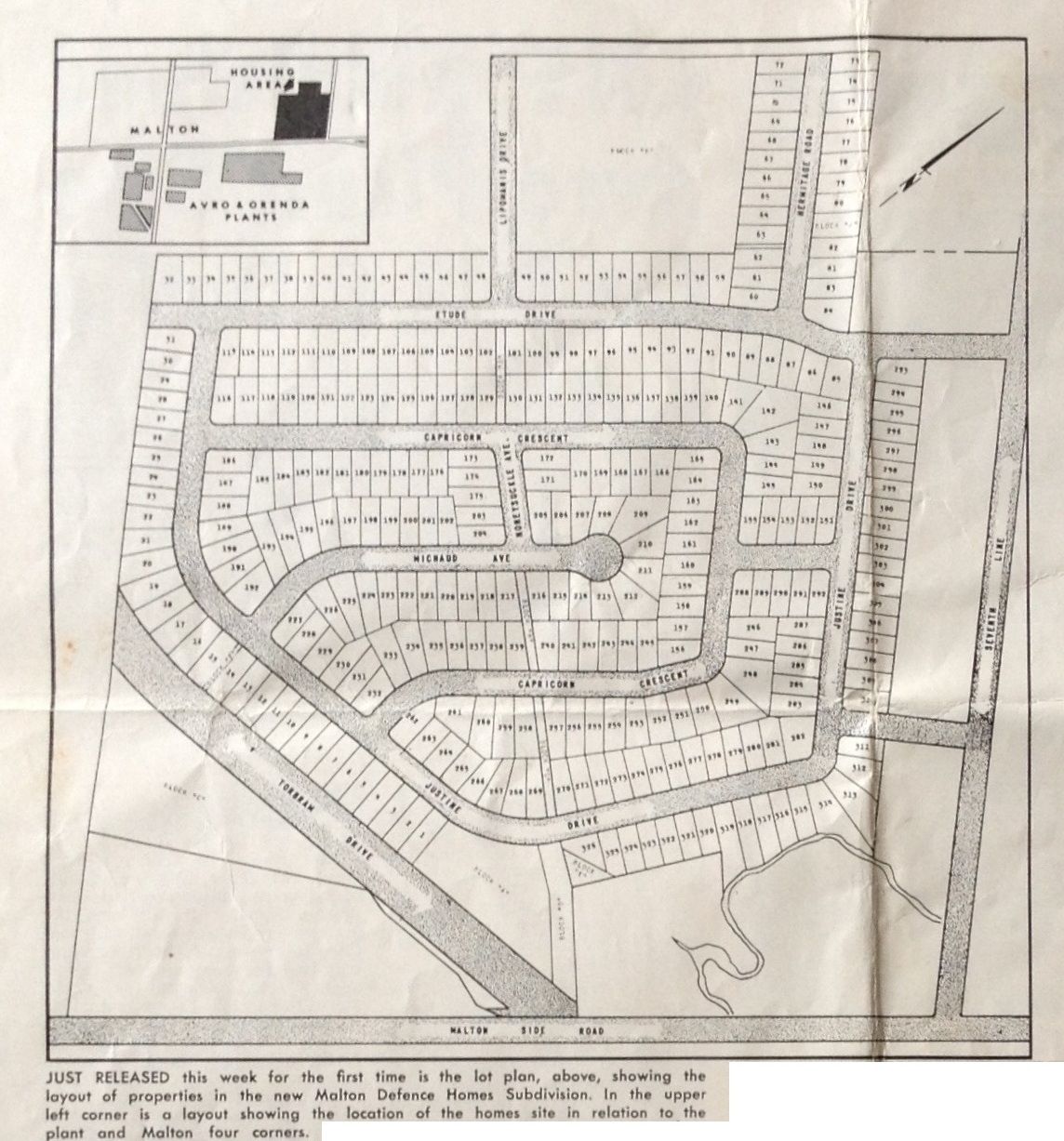
Municipally, Malton became part of Toronto Township in 1952 upon the annexation of the part of Toronto Gore south of Steeles Avenue. Toronto Township was restructured into the Town of Mississauga in 1968, which became a city in 1974. The airport continued to develop, with the Trans-Canada Airport terminal replacing the second terminal in 1949, the airport renamed Toronto International Airport in 1960, and the Aeroquay Terminal replacing the Trans-Canada Terminal in 1964. Residential subdivisions expanded during this period, including the Ridgewood subdivision built in the mid-1950s, originally called "Malton Defence Homes Subdivision," and the Marvin Heights subdivision built in the late 1950s. The Westwood subdivision started in the mid-1960s, with streets like Morning Star Drive and Darcel Avenue established by 1968, alongside other streets such as Laddie Crescent in 1967 and Darla Drive, Discus Crescent, and Lockington Crescent appearing on the 1968 voter list.
The 1969 gas explosion and modern development
On Saturday, October 25, 1969, at 2:55 PM, a natural gas line leak caused a major explosion and fire at the "Four Corners" intersection of Airport and Derry Road. The flame reached 46 metres high with heat estimated at 820 °C, and Consumer's Gas took about four hours to shut off the gas supply. Businesses destroyed included the Avronian Restaurant, Langford's Variety, Malton Hardware, Baker's Lumber, Pat's Steak on a Bun, and the Sit n' Eat restaurant. The Bank of Nova Scotia, Malton Fruit Market (later Longo's), Abell's Drug Store, and Shirley's Pool Hall were damaged. Seventy-five-year-old Jean Perigo was killed instantly and 20 other people were injured. The disaster destroyed two houses, 17 businesses, and 49 cars, left 18 families living in apartments above the stores homeless, and forced the evacuation of over 350 families. Total damage was estimated at $1.5 million, and reconstruction took place over a 10-year period at a cost of $6.5 million. The Four Corners never regained its former commercial vitality after this event.
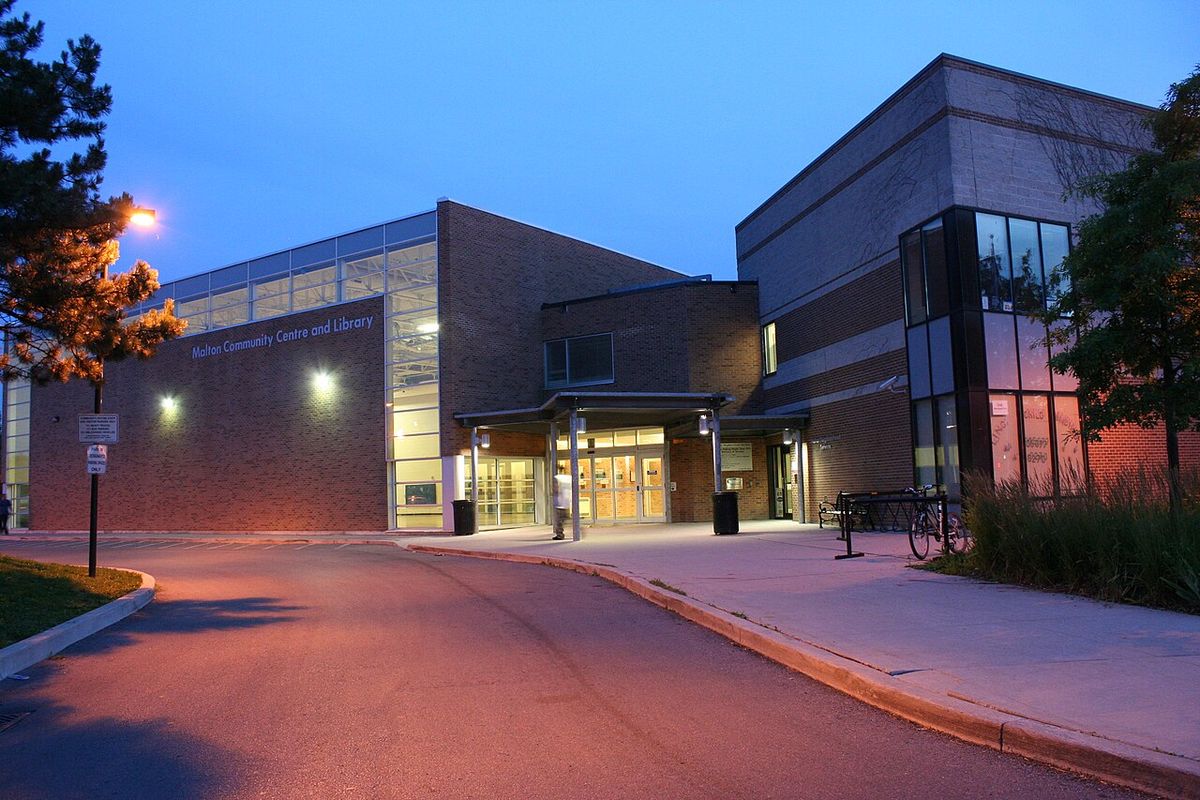
Modern development in Malton has focused on transportation and community infrastructure. A new bus terminal was built on the corner of Morning Star Drive and Goreway Drive, and an overbridge at the railway crossing on Torbram Drive was planned. Travel times on Malton Route 107 were reduced after the completion of the Mississauga Bus Rapid Transit transitway. The community gained a new pool at the community centre, while a pool in the high school was converted into the Malton Youth Hub as of 2022. Two new ambulance stations and a new fire hall were also added to serve the area. Law enforcement in Malton is provided by the Peel Regional Police, who maintain a presence in the local mall, ensuring community safety.
Demographics and immigration patterns
Malton's demographic character has been shaped directly by its proximity to Canada's busiest airport, making it a traditional first home for new immigrants. In the post-Second World War period, the neighbourhood saw significant waves of Italian and Polish immigrants establishing the community. Beginning in the 1970s and 1980s, the demographic focus shifted markedly, with immigrants from South Asia, West Africa, and the Caribbean becoming the predominant population groups, a trend that continues today. This constant influx has driven substantial population growth from the 1950s onward, contributing to Malton's reputation as one of the most culturally diverse and densely populated areas in the Greater Toronto Area. The community's evolution from a small village of 350 people in 1850 to a major urban neighbourhood is directly tied to its role as a gateway for newcomers to Canada, with the airport's presence often cited as a key reason for its popularity as an initial settlement area.
Education and schools
Malton is served by multiple public and Catholic school boards, offering education in both English and French. The Peel District School Board operates secular English-language public schools, while the Conseil scolaire Viamonde provides French-language secular public education regionally. The neighbourhood's public elementary and middle schools include Brandon Gate Public School, Corliss Public School, Darcel Avenue Senior Public School (formerly Darcel Senior Public School), Dunrankin Drive Public School (formerly Westwood Public School), Lancaster Public School (formerly Lancaster Senior Public School), Marvin Heights Public School, Morning Star Middle School (formerly Morning Star Secondary School), and Ridgewood Public School. The sole public secondary school is Lincoln M. Alexander Secondary School (formerly Westwood Secondary School), located across the road from Malton's branch of the Mississauga Library system, near Westwood Mall and the adjacent bus terminal.
The Catholic community is served by the Dufferin-Peel Catholic District School Board for English-language schools and the Conseil scolaire de district catholique Centre-Sud for French-language schools. Ascension of Our Lord Secondary School, originally built as a junior high, is Malton's only Catholic high school. Remaining elementary Catholic schools include Holy Cross Separate School, located next to Our Lady of The Airways Catholic Church. When St. Gabriel school closed in 2004, its students were incorporated into Holy Cross, which later reopened as an Adult Learning Centre. St. Raphael Elementary School is located at the north end of Woodgreen Park. Students from St. Michael School, closed in 2003, and Our Lady of the Airways School, closed in 2004, were transferred to St. Raphael's. The St. Michael's building was torn down, and Our Lady of the Airways was demolished in 2009, consolidating Catholic education in the area.
Community, sports, and recreation
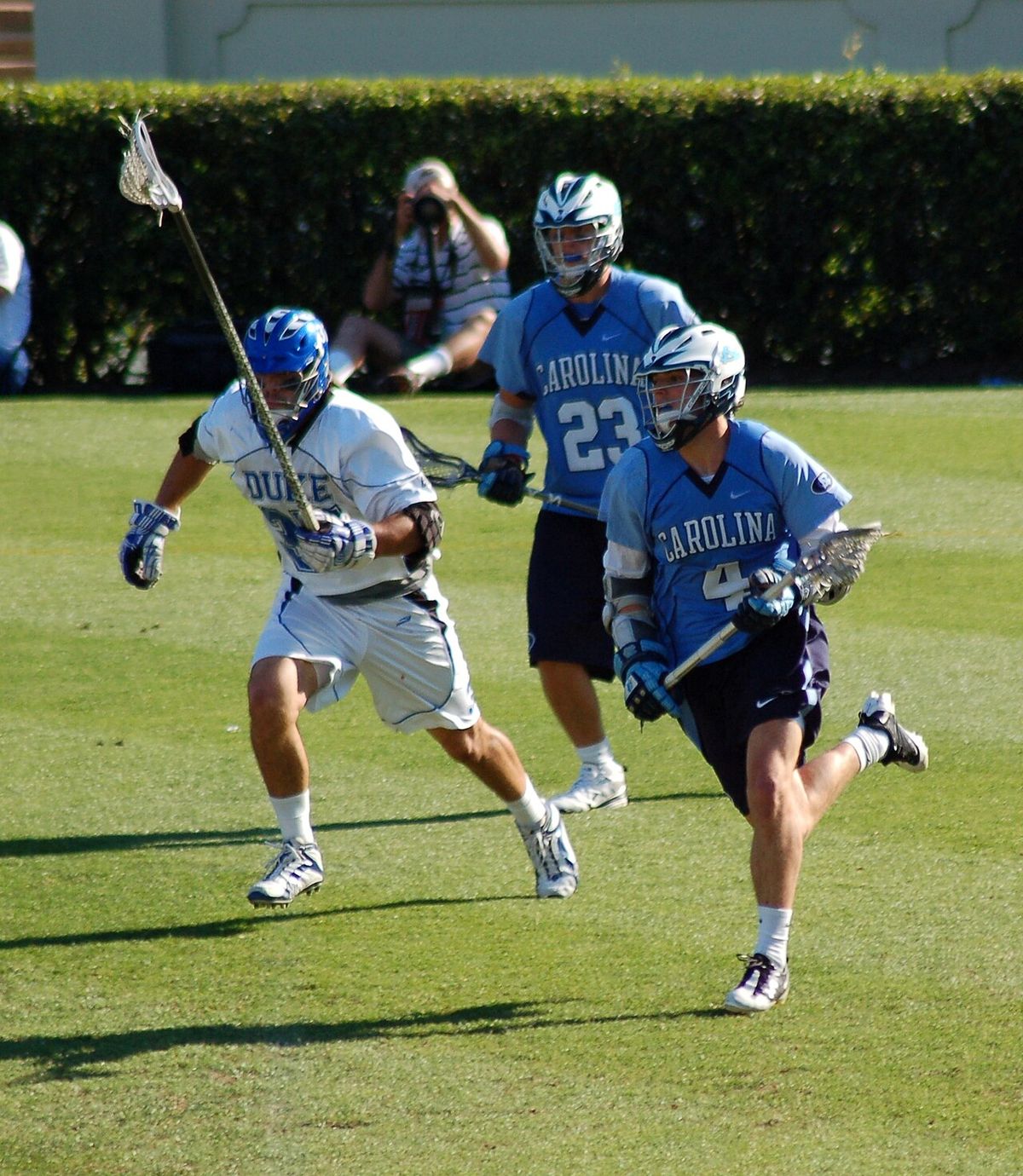
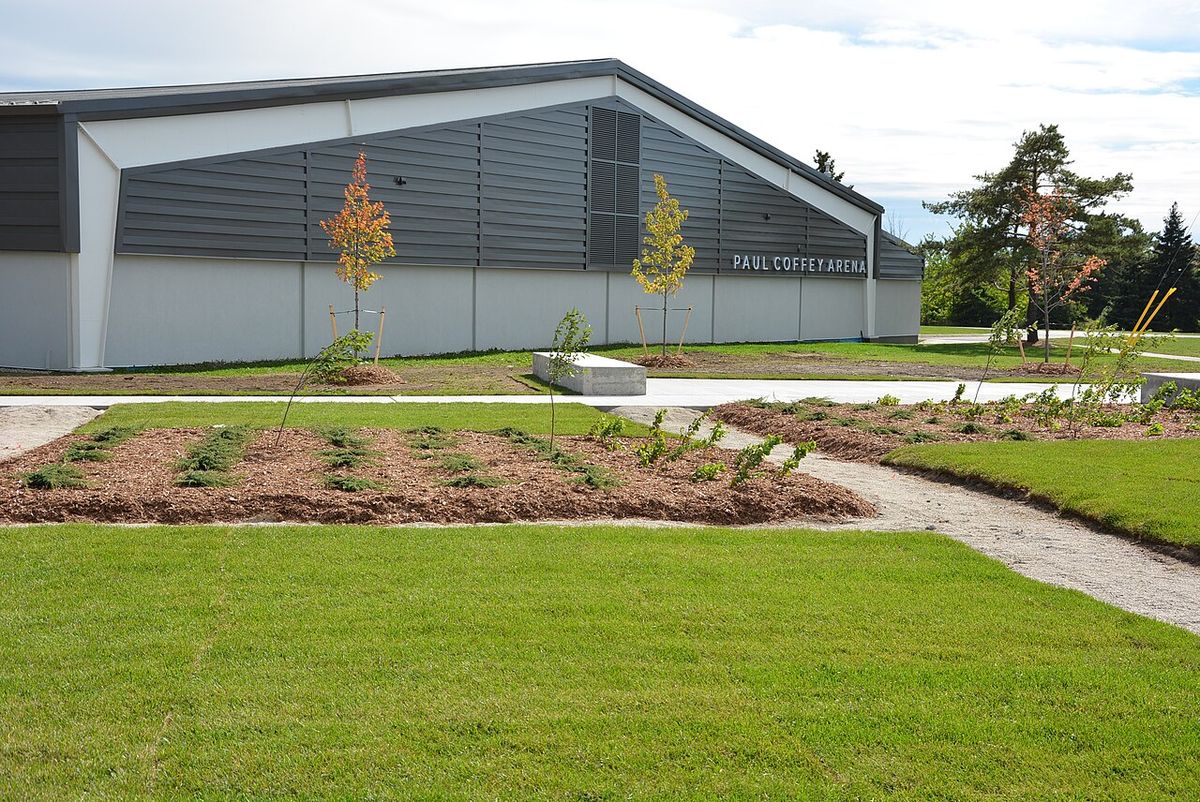
Malton has a strong history of community sports organizations and recreational facilities. The Malton Minor Hockey Association was founded in 1949 and operated until becoming defunct in 2005. Its home arena, built in 1968, was renamed the Paul Coffey Arena on September 23, 2016, in honour of the NHL Hall of Famer who grew up in the area. The Malton Renegades ran a successful minor lacrosse program before folding in 1982 when it merged with Erindale and Cawthra clubs to form Mississauga Minor Lacrosse. A Junior "C" lacrosse team also played out of the Malton Arena for a number of years. These facilities and associations have played a central role in community life for generations, fostering local athletic talent and providing gathering spaces for residents.
Notable residents
Malton has been the birthplace or childhood home of numerous notable Canadians, particularly in sports and entertainment. The list includes several Olympic athletes and professional sports figures who began their careers in local community programs like the Malton Minor Hockey Association or the Malton Bullets soccer team. Charles Allen was an Olympic hurdler, and Carlton Chambers won an Olympic gold medal in track and field. Paul Coffey became an NHL defenceman and Hockey Hall of Fame member, while Michael Peca served as captain of the Buffalo Sabres. Soccer is represented by Gerry Gray, a World Cup and Canadian Soccer Hall of Fame player, and Paul Stalteri, who played for Tottenham Hotspur. In entertainment, Devon won the Juno Award for Best Rap Recording in 1993, George Stroumboulopoulos hosted CBC Television's The Hour, and Sunny Malton is a Punjabi-Canadian rapper and music label co-owner. Other notable figures include jockey Richard Dos Ramos, basketball player Sherman Hamilton, football legend Teddy Morris, and Canadian Olympic Committee executive Chris Rudge. Community leader Greg Anaka received the Order of Canada in 1974 for his work with the Malton Memorial Recreation Association.
Questions about Malton, Mississauga
Where is Malton located in Mississauga?
Malton is located in the northeastern part of Mississauga, Ontario. It is bounded by Highway 427 to the east, the Brampton city limits to the north, roughly Airport Road to the west, and Toronto Pearson International Airport to the south. It is geographically unique as it does not directly adjoin any other Mississauga neighbourhood, being separated by the airport and industrial lands, though it does border Toronto's Rexdale area east of the 427. The oldest portion of Malton is at the northwest corner of Airport and Derry Roads.
Why is Malton historically significant to Canadian aviation?
Malton is historically significant as the birthplace of major Canadian aerospace projects. In 1937, Malton Airport was established on 13 farms, which later became Toronto Pearson International Airport. The area housed the Victory Aircraft plant during the Second World War, building Avro Lancaster bombers. After the war, A.V. Roe Canada operated there, developing pioneering aircraft like the Avro Jetliner in 1949 and the CF-100 fighter in 1950. Most famously, it was the home of the Avro Arrow, Canada's first supersonic jet, before the program's cancellation in 1959. This concentration of innovation earned Malton an international reputation in aeronautical design and manufacturing by 1958.
What happened in the 1969 Malton gas explosion?
On October 25, 1969, a major natural gas line leak caused a devastating explosion and fire at Malton's "Four Corners" intersection of Airport and Derry Road. The flame reached 46 metres high, destroying 17 businesses, two houses, and 49 cars. The disaster killed 75-year-old Jean Perigo, injured 20 others, and left 18 families homeless. Over 350 families were evacuated, and total damage was estimated at $1.5 million. Reconstruction took a decade and cost $6.5 million. The event caused long-term damage to the commercial vitality of the historic village centre, with some businesses never reopening.
What schools serve the Malton community?
Malton is served by multiple school boards. The Peel District School Board operates public schools like Lincoln M. Alexander Secondary School and several elementary schools including Marvin Heights and Ridgewood. The Dufferin-Peel Catholic District School Board operates Catholic schools, with Ascension of Our Lord Secondary School as the only Catholic high school and Holy Cross and St. Raphael as elementary schools. French-language public and Catholic education is provided regionally by Conseil scolaire Viamonde and Conseil scolaire catholique Centre-Sud, respectively. Several Catholic schools, including St. Michael and Our Lady of the Airways, were closed between 2003 and 2009.
Who are some famous people from Malton?
Malton has produced many notable figures, especially in sports. NHL Hall of Famer Paul Coffey grew up there, as did former hockey captain Michael Peca and soccer stars Paul Stalteri and Gerry Gray. Olympic athletes include hurdler Charles Allen and gold medalist Carlton Chambers. In entertainment, Juno-winning rapper Devon, CBC host George Stroumboulopoulos, and Punjabi-Canadian rapper Sunny Malton have roots in the community. Canadian Football Hall of Famer Teddy Morris also retired to a farm in Malton. Community leader Greg Anaka received the Order of Canada in 1974 for his work with the Malton Memorial Recreation Association.
How has immigration shaped modern Malton?
Immigration has fundamentally shaped Malton's modern demographic and cultural character. Its proximity to Pearson Airport made it a popular initial settlement area for newcomers. After the Second World War, waves of Italian and Polish immigrants arrived. From the 1970s and 1980s onward, the demographic shifted significantly, with immigrants from South Asia, West Africa, and the Caribbean becoming the predominant population groups. This continuous influx has driven major population growth since the 1950s and established Malton as one of the most culturally diverse communities in the Greater Toronto Area, a direct result of its role as a gateway community.
Sources and further reading
- Malton, Mississauga (Wikipedia)
- About the Riding, Mississauga-Malton (deepakanandmpp.ca)
- Neighbourhood School Guide (app.hoodq.com)
- Malton Neighbourhood Services (mnsinfo.org)
Checked by the Your Space Hamilton desk. Last updated 2026-11-01.