Lacrosse
Lacrosse is a contact team sport played with a lacrosse stick and a lacrosse ball, recognized as the oldest organized sport in North America with origins among Indigenous peoples dating to the 12th century. The modern game, extensively modified from its traditional Indigenous roots by European colonists, is governed internationally by World Lacrosse and encompasses several distinct versions including field lacrosse, box lacrosse, women's lacrosse, lacrosse sixes, and intercrosse. It holds significant cultural importance in Canada, not only as a popular participant sport but also as a symbol of the nation's sporting heritage, with deep historical ties to First Nations communities. The sport will return to the Olympic programme at the 2028 Summer Games in Los Angeles in the lacrosse sixes format.
History and origins
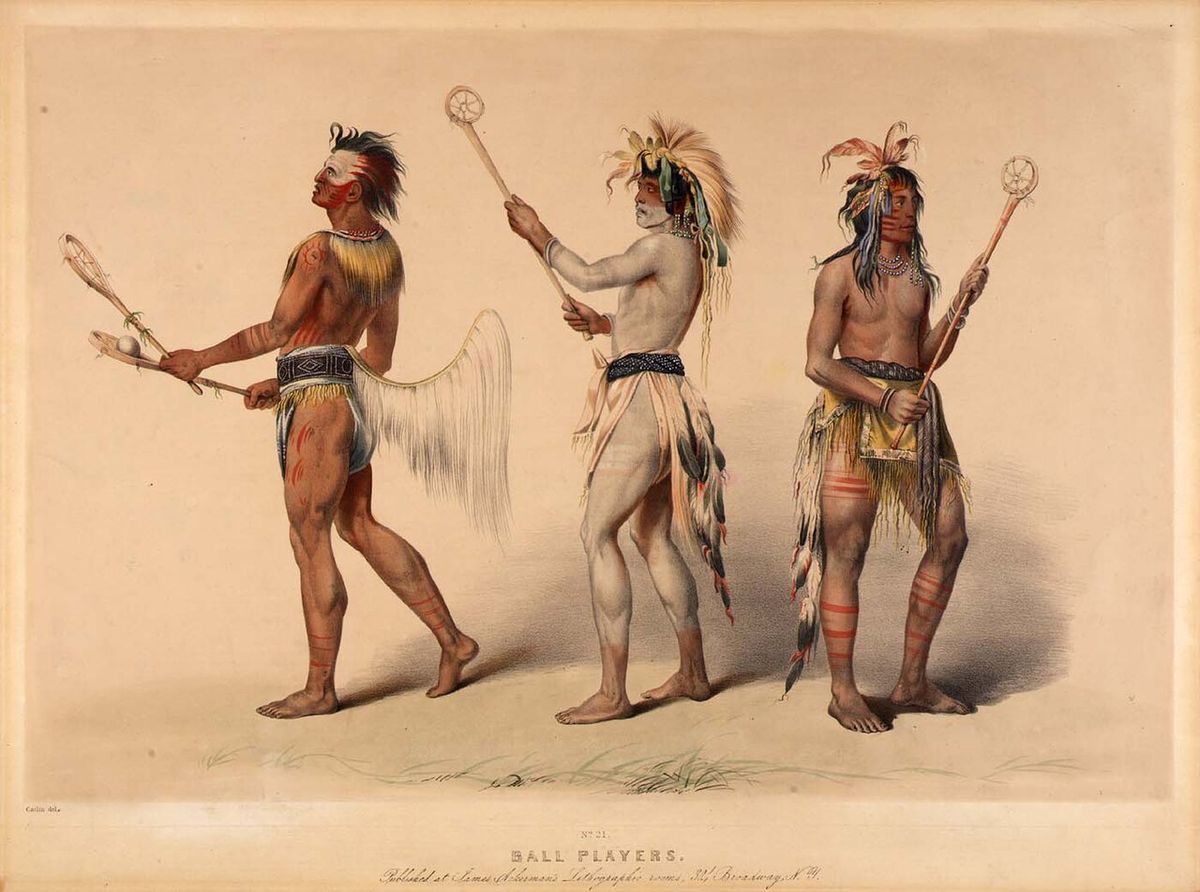
The sport of lacrosse is based on games played by various Native American communities as early as 1100 AD, with a well-established version documented by Jesuit missionary priests in the territory of present-day Canada by the 17th century. In its traditional Indigenous form, each team could consist of 100 to 1,000 men competing on a field several kilometres long, with games lasting from sunup to sundown for two or three consecutive days as part of ceremonial ritual or symbolic warfare. The French Jesuit missionary Jean de Brébeuf provided the first European record of the game, observing Wendat (Huron) tribesmen playing in present-day Ontario in 1637 and naming it 'la crosse', meaning 'the stick' in French. The game was deeply spiritual, often referred to as 'The Creator's Game' or 'baggataway', and was played to bring glory and honour to participants and their tribes, embodying the spirit of combat.
English-speaking settlers in Montreal began playing the game after observing the Mohawk people in the 1830s, leading to its formal organization. Canadian dentist William George Beers founded the Montreal Lacrosse Club in 1856 and codified the modern game in 1860, significantly shortening game length and reducing the number of players to 12 per team. The first game played under Beers's new rules occurred at Upper Canada College in 1867, resulting in a 3-1 loss to the Toronto Cricket Club. The codified sport rapidly gained popularity, spreading across the English-speaking world so that by 1900 there were dozens of men's clubs in Canada, the United States, England, Australia, and New Zealand. The women's game was introduced by Louisa Lumsden at St Leonards School in Scotland in 1890 after she witnessed it being played in Quebec, while the first women's club in the United States was established by Rosabelle Sinclair at the Bryn Mawr School in Baltimore, Maryland in 1926.
Field lacrosse
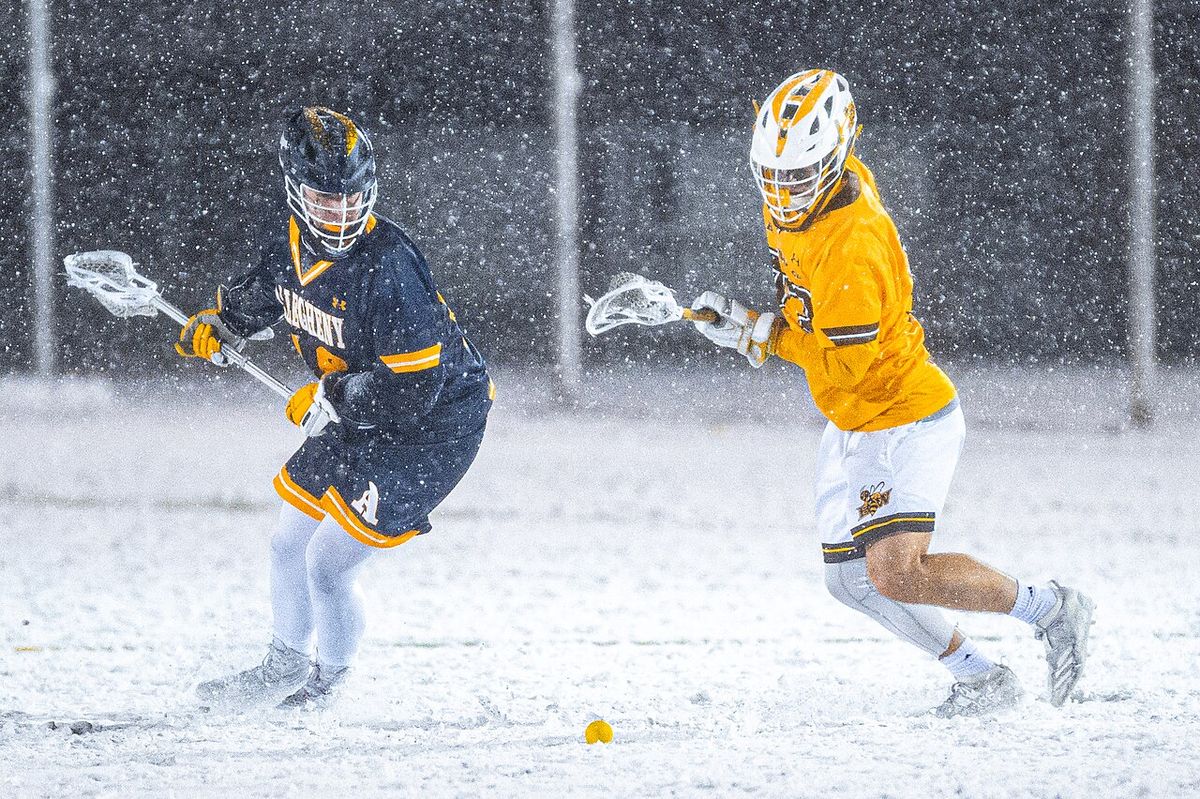
Field lacrosse is the men's outdoor version of the sport, characterized by ten players per team consisting of three attackmen, three midfielders, three defensemen, and one goalie. The field of play measures 110 by 60 yards with goals that are 6 by 6 feet set 80 yards apart, each situated inside an 18-foot diameter circular 'crease' where the goalie has special protective privileges. Players use sticks of varying lengths, with attackmen and midfielders using short sticks between 40 and 42 inches long, while a maximum of four players per team may use long sticks measuring between 52 and 72 inches, typically used by defensemen and one defensive midfielder. The game is divided into four 15-minute quarters for a total regulation time of 60 minutes, with play started by a face-off at the beginning of each quarter and after every goal where two players scrap for possession of the ball.
A critical rule is the offsides requirement, which mandates that each team must keep at least four players in its defensive zone and three in its offensive zone at all times, a violation that results in a loss of possession or a technical foul. When a team has possession, it attempts to bring the ball into its offensive zone to score a goal, with settled play typically involving six offensive players against six defenders and a goalie due to the offsides structure. Substitutions are permitted 'on the fly' through a designated area during play, and possession is awarded when the ball goes out of bounds, except on missed shots where the team with the player closest to the ball gains possession. The sport employs a system of penalties for rule violations, divided into technical fouls like offsides or holding and personal fouls concerning player safety such as cross-checking or slashing.
- Technical fouls result in either a loss of possession or a 30-second penalty.
- Personal fouls like cross-checking or illegal body checking draw penalties of one minute or longer.
- During a time-serving penalty, the offending team plays 'man down' with one fewer player.
- Releasable penalties allow the player to return if the opposing team scores during the penalty period.
- Non-releasable penalties require the player to serve the full duration regardless of goals scored.
- The goalie uses a stick with a head as wide as 12 inches for better ball stopping capability.
Box lacrosse
Box lacrosse is the indoor version of the sport, played by teams of five runners plus a goalie on an enclosed surface typically derived from an ice hockey rink with the ice removed or covered by artificial turf. The game was introduced in Canada during the 1930s as a means to promote business for hockey arenas outside the ice hockey season, and it rapidly grew in popularity to nearly supplant field lacrosse within the country within several years. The confined playing area, known as the 'box', creates a faster, more physical style of play accelerated by a 30-second shot clock that requires the attacking team to take a shot on goal within that time frame after gaining possession. Protective equipment is more extensive than in field lacrosse, with players wearing rib pads and larger shoulder and elbow pads, while goaltenders wear massive chest and arm protectors called 'uppers', large shin guards, and ice hockey-style masks.
The goals in traditional box lacrosse are smaller than in field lacrosse, measuring 4 feet wide and tall, though the National Lacrosse League uses goals that are 4 feet 9 inches wide. There is no offsides rule in box lacrosse, allowing players to substitute freely from their bench areas similar to ice hockey, though most players specialize in either offensive or defensive roles. Cross-checking is a legal form of contact in this version, contributing to its physical nature, and players wear a hockey helmet fitted with a specific box lacrosse cage for protection. Penalties result in the offending player being sent to a penalty box, forcing his team to play 'man-down' for the duration, with most fouls being two-minute minor penalties and serious offenses drawing five-minute major penalties. At the top professional and junior levels, participation in a fight typically results in a five-minute major penalty rather than an automatic ejection, a rule shared with ice hockey. The highest level of box lacrosse is played in the National Lacrosse League (NLL) and the Senior A divisions of the Canadian Lacrosse Association (CLA), with some rule differences between the two bodies. NLL games are played in the winter and consist of four fifteen-minute quarters, while CLA games feature three twenty-minute periods, and the NLL mandates the use of sticks with hollow shafts whereas the CLA permits solid wooden sticks. This version of lacrosse remains a central part of Canada's sporting culture, providing a fast-paced, high-scoring alternative to the field game that thrives in the country's extensive network of hockey arenas.
Women's lacrosse and other variants
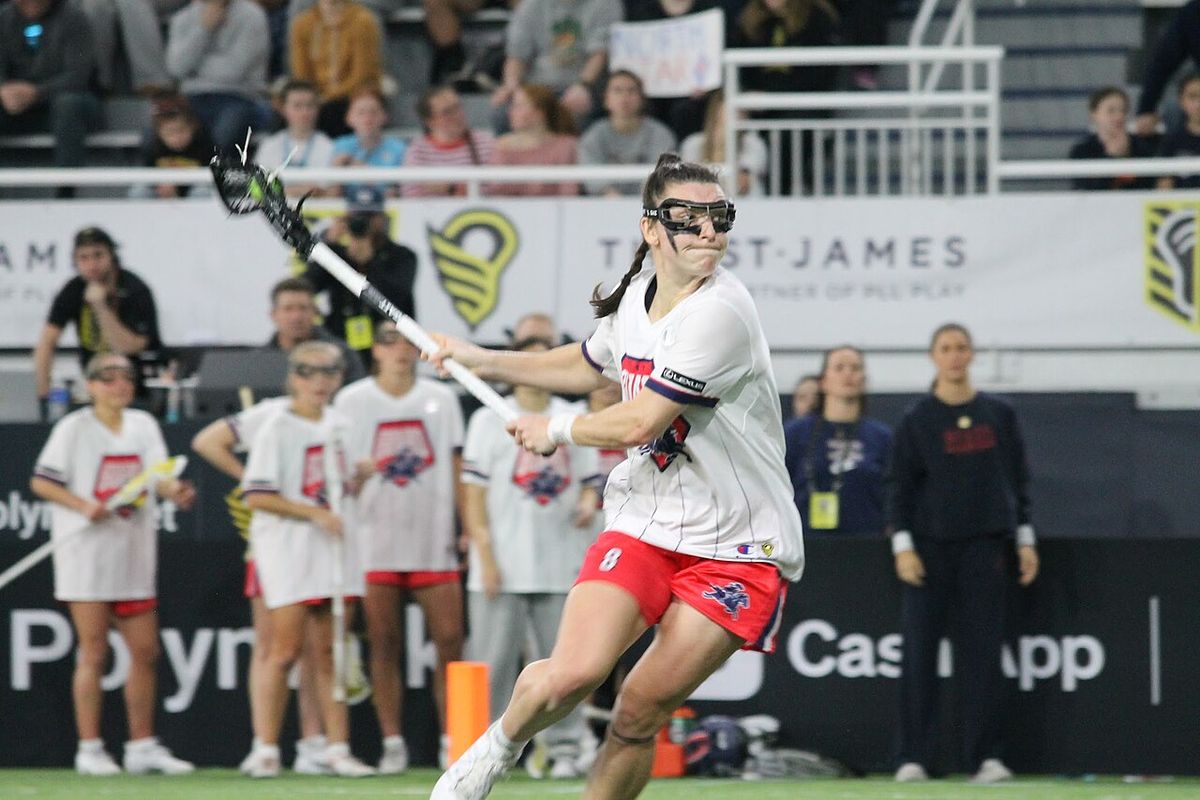
Women's lacrosse operates under significantly different rules from the men's game, most notably in its prohibition of body contact and its required equipment, which is limited to a mouth guard and eye guard for field players. The game originated with its first modern match held at St Leonards School in Scotland in 1890, introduced by headmistress Louisa Lumsden following a visit to Quebec, and it expanded to the United States with the first club at Bryn Mawr School in Baltimore in 1926. There are 12 players on a women's lacrosse team, and the field features specific boundaries including an 8-meter 'fan' in front of the goal, a 12-meter half-circle surrounding it, and a draw circle at centre field used to start play. The game begins with a 'draw' instead of a face-off, where two players stand with the ball placed between their horizontal stick heads and lift them at the whistle to gain possession.
Stick checking is permitted under strict rules at certain levels of play, but players are not allowed to have a deep pocket on their lacrosse stick, and defenders cannot stand inside the 8-meter fan for more than three seconds without being a stick's length from an opponent. In the early 21st century, discussions about requiring protective headgear to prevent concussions emerged, leading the state of Florida to become the first jurisdiction to mandate headgear in women's lacrosse in 2008. The international rules, governed by World Lacrosse, differ somewhat from those commonly used in the United States, particularly in the dimensions of the field markings, with the 8-meter fan extending to 11 meters internationally. Another popular variant is intercrosse, a non-contact form played with a completely plastic stick and a larger, softer hollow ball, often used to introduce youth to the sport and popular as a competitive adult sport in Quebec and parts of Europe.
- Intercrosse uses a standardized plastic stick and a soft, hollow ball.
- The international governing body for intercrosse hosts a World Championship every two years.
- Women's lacrosse rules prohibit body contact but allow controlled stick checking.
- A 'goal-circle violation' occurs if any player besides the goalie steps inside the goal circle.
- The 'draw' starts play at the beginning of each quarter and after every goal.
- Intercrosse fields are typically 20 meters wide by 40 meters long for adult competition.
Lacrosse sixes and Olympic inclusion
Lacrosse sixes is a streamlined variant created by World Lacrosse in 2021 specifically to facilitate the sport's return to the Olympic Games, and it is scheduled to make its Olympic debut at the 2028 Summer Olympics in Los Angeles. Played outdoors with six players per side, the format features similar rules for men and women while preserving some differences in allowable contact, and it is designed for a faster pace with a shorter game time to fit multi-sport event schedules. A key rule change is that face-offs occur only at the start of each quarter, with play restarted after goals by the goalie taking the ball out of the net, and a 30-second shot clock is enforced to maintain continuous action. All players in lacrosse sixes are required to play both offense and defense, and rosters are limited to 12 players, with the use of long crosses prohibited to standardize equipment and increase game flow. This format has been adopted as the standard for lacrosse at multi-sport events, chosen for its inclusivity, pace, and spectator appeal, which were critical factors in the International Olympic Committee's decision to reinstate the sport. Lacrosse has a prior Olympic history, having been contested as a medal sport at the 1904 St. Louis and 1908 London Games and featured as a demonstration event at the 1928, 1932, and 1948 Summer Olympics. The adoption of lacrosse sixes represents a strategic evolution for the international federation, aiming to secure the sport's long-term place on the Olympic programme by presenting a modern, compact version suitable for global television audiences.
International governance and competition
International lacrosse is governed by World Lacrosse, an organization formed in August 2008 from the merger of the men's International Lacrosse Federation and the women's International Federation of Women's Lacrosse Associations, which changed its name from the Federation of International Lacrosse (FIL) in May 2019. World Lacrosse uniquely recognizes First Nations bands and Native American tribes as sovereign nations within its membership structure, reflecting the sport's Indigenous origins and its ongoing cultural significance. The federation currently has 62 member nations and oversees all major world championships, including those for field, box, and women's lacrosse, coordinating a calendar that has seen the sport expand significantly beyond its traditional strongholds in Canada and the United States. While historically concentrated in North America, the United Kingdom, and Australia, lacrosse has recently flourished in Europe and East Asia, with new national teams establishing competitive programmes.
World Lacrosse organizes several flagship world championships, each held on a four-year cycle, to crown global champions in the sport's various disciplines. The premier events include the World Lacrosse Men's Championship and the World Lacrosse Women's Championship for field lacrosse, the World Lacrosse Box Championships for the indoor game, and the Under-19 World Lacrosse Championships for both men and women. These tournaments serve as the pinnacle of international competition, driving development and increasing the sport's global profile, particularly in the lead-up to its Olympic return. The federation's governance ensures standardized rules across its membership, promotes the development of lacrosse sixes for Olympic inclusion, and supports the growth of intercrosse as a recreational and educational tool worldwide.
| Championship | Discipline | Frequency |
|---|---|---|
| World Lacrosse Men's Championship | Field lacrosse | Every four years |
| World Lacrosse Women's Championship | Field lacrosse | Every four years |
| World Lacrosse Box Championships | Box lacrosse | Every four years |
| Under-19 World Lacrosse Championships | Field lacrosse (men & women) | Every four years |
Questions about Lacrosse
What are the origins of lacrosse?
Lacrosse originates from games played by various Indigenous peoples of North America as early as 1100 AD, with documented versions present by the 17th century. French Jesuit missionary Jean de Brébeuf recorded the game being played by Wendat (Huron) tribesmen in present-day Ontario in 1637, giving it the name 'la crosse'. The traditional Indigenous game involved large teams of up to 1,000 men on fields several kilometres long, played over multiple days as part of ceremonial ritual or symbolic warfare. It was known as 'The Creator's Game' or 'baggataway' and held deep spiritual significance within communities.
What is the difference between field lacrosse and box lacrosse?
Field lacrosse is the outdoor version played by ten players per team on a large grass field measuring 110 by 60 yards, with games divided into four 15-minute quarters. Box lacrosse is the indoor version played on a hockey-rink-sized surface by five runners and a goalie per team, featuring a 30-second shot clock and no offsides rule, leading to a faster, more physical game. Protective equipment differs significantly, with box lacrosse players wearing more substantial padding, including rib guards, and goalies wearing massive chest protectors and hockey-style masks. Box lacrosse was developed in Canada in the 1930s to utilize hockey arenas in the off-season and quickly became the dominant form of the sport in the country.
Is women's lacrosse a contact sport?
Women's lacrosse is classified as a non-contact sport, as it does not allow deliberate body contact between players, differing fundamentally from the men's field and box versions. The rules permit controlled stick-to-stick checking under specific conditions but prohibit any form of body checking or aggressive physical confrontation. Required protective equipment reflects this, with field players mandated to wear only a mouth guard and eye guard, though discussions about requiring headgear have increased due to concussion concerns. The first women's game was played in Scotland in 1890, and the sport maintains distinct rules, including a 'draw' to start play instead of a face-off and specific field boundaries like the 8-meter fan.
When is lacrosse in the Olympics?
Lacrosse will be contested at the 2028 Summer Olympic Games in Los Angeles, marking its return as a medal sport after over a century. The sport was previously included in the Olympic programme as a medal event at the 1904 St. Louis and 1908 London Games, and it appeared as a demonstration event at the 1928, 1932, and 1948 Summer Olympics. The 2028 Olympic competition will feature the new 'lacrosse sixes' format, a faster, six-a-side variant created by World Lacrosse to meet Olympic requirements for inclusivity and pace. This format was specifically designed to secure the sport's reinstatement and ensure its long-term presence on the Olympic programme.
What is lacrosse sixes?
Lacrosse sixes is a variant created by World Lacrosse in 2021, featuring six players per side on a smaller outdoor field measuring 70 by 36 meters, designed for faster play and shorter game times. The format includes a 30-second shot clock, games played in four 8-minute quarters, and rosters limited to 12 players who must all play both offense and defense, with long crosses prohibited. Face-offs occur only at the start of each quarter, and after a goal, play restarts with the goalie taking the ball out of the net, eliminating frequent stoppages. This version will make its Olympic debut at the 2028 Los Angeles Games and is intended to be the standard for lacrosse at future multi-sport events due to its streamlined and spectator-friendly nature.
What is the governing body for international lacrosse?
International lacrosse is governed by World Lacrosse, an organization formed in 2008 from the merger of the separate men's and women's international federations and renamed from the Federation of International Lacrosse in 2019. It currently has 62 member nations and uniquely recognizes First Nations bands and Native American tribes as sovereign nations within its membership structure. World Lacrosse oversees all major world championships, including the World Lacrosse Men's Championship, Women's Championship, Box Championships, and Under-19 Championships, each held on a four-year cycle. The federation is responsible for the sport's rules, development, and its successful campaign to reinstate lacrosse in the Olympic programme for 2028.
Sources and further reading
- Lacrosse (Wikipedia)
- Landmark Conference Men's Lacrosse Schools (recruitplan.com)
Checked by the Your Space Hamilton desk. Last updated 2026-10-19.



