Wood bison
The wood bison (Bison bison athabascae) is a distinct northern subspecies of the American bison, native to the boreal forest regions of Canada and Alaska. Among the largest terrestrial animals in North America, it is characterized by its large size, dark woolly coat, and a shoulder hump positioned forward of its forelegs. Once feared extinct due to hybridization and disease, conservation efforts have helped recover the population, though it remains a threatened species in Canada. The wood bison holds significant ecological and cultural importance, representing a key species in northern ecosystems and a focus of international restoration projects from Alaska to Siberia.
Physical Description and Taxonomy
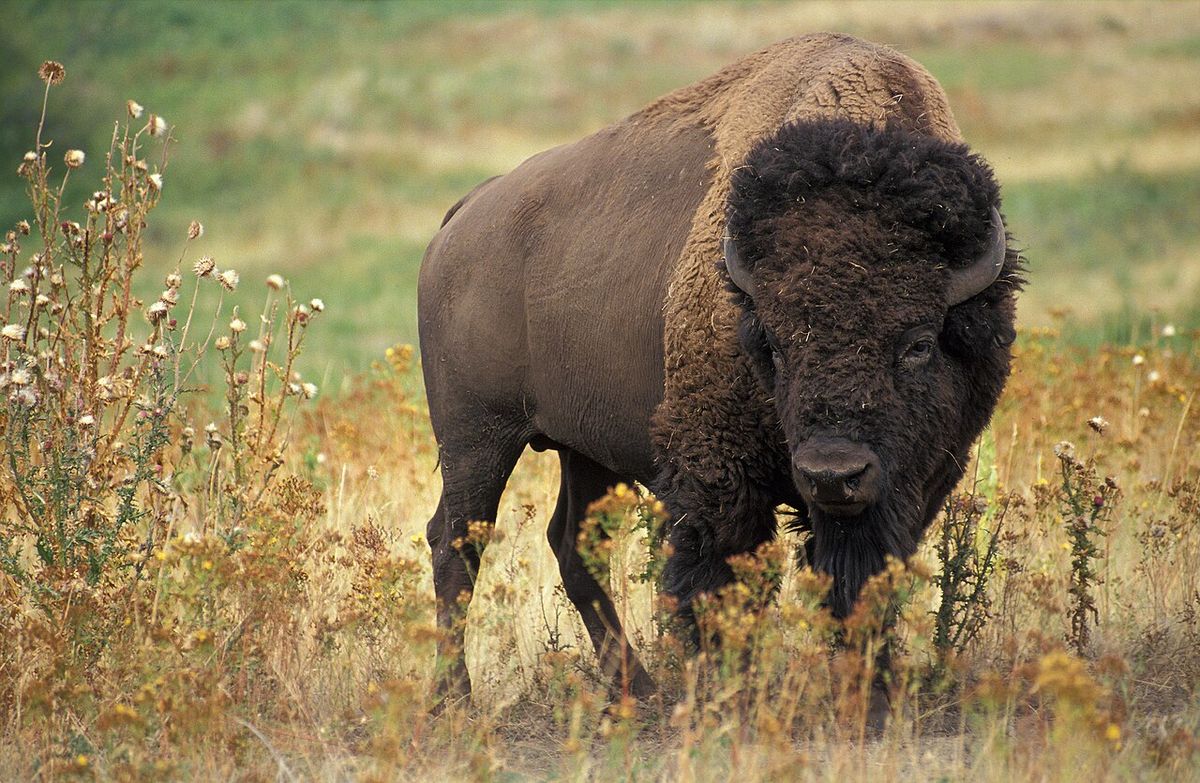
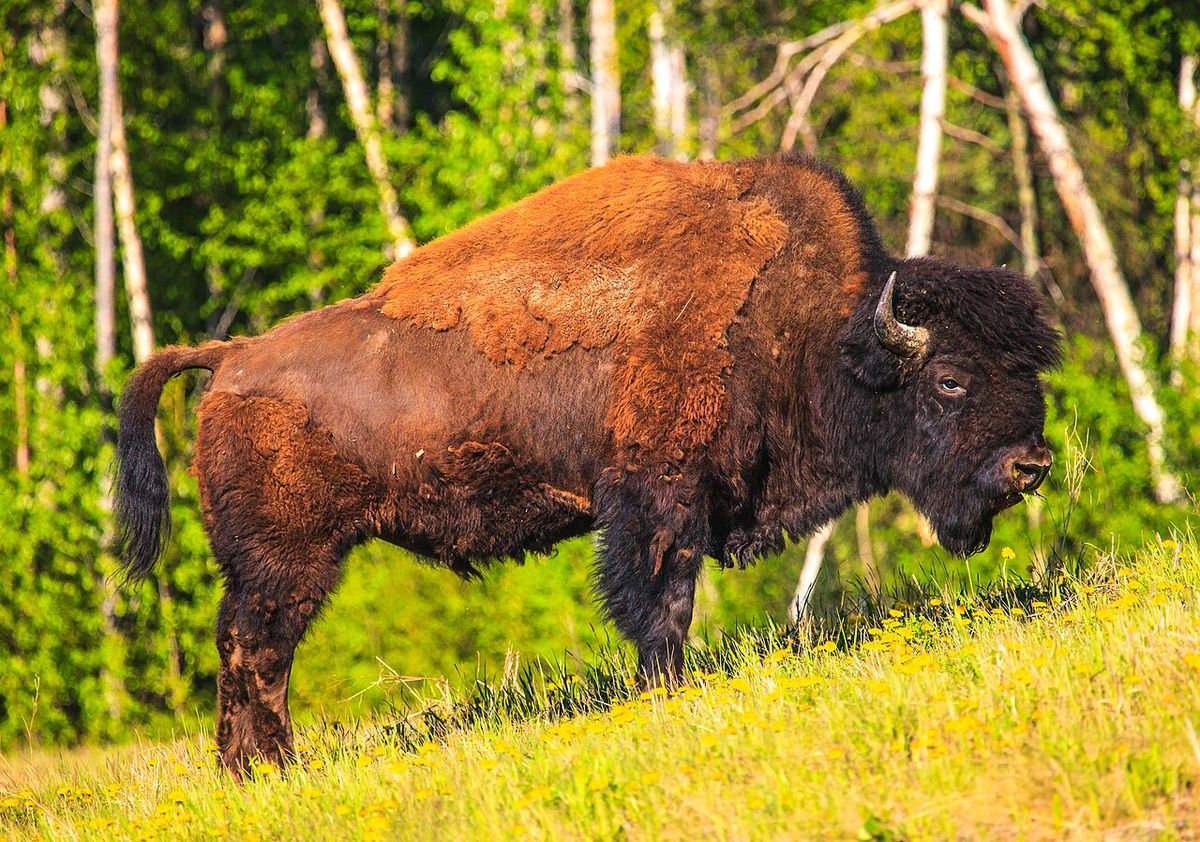
The wood bison is a massive bovid, considered potentially more primitive in its physical form than its southern relative, the plains bison. It is distinguished by its larger size and heavier build, holding the title of the heaviest and longest extant land animal in North America and Siberia. Large males have been recorded reaching lengths of 3.35 metres and weights up to 1,179 kilograms, though average weights for adult animals are typically between 443 and 513 kilograms depending on age and sex. Key physical differences from the plains bison include the position of its shoulder hump anterior to the forelegs, larger horn cores, darker and woollier hair, and less hair on the forelegs with a smaller, more pointed beard. The subspecies was formally named Bison bison athabascae by Samuel Rhoads based on a specimen from southwest of Great Slave Lake that was examined by naturalists J. Macoun and H. A. Ward. Its morphology shows closer similarities to ancestral steppe bison (Bison priscus) and Bison occidentalis than the plains bison does, and it is believed the plains bison probably evolved from a mixing of those two ancestral forms.
Habitat, Diet, and Behaviour
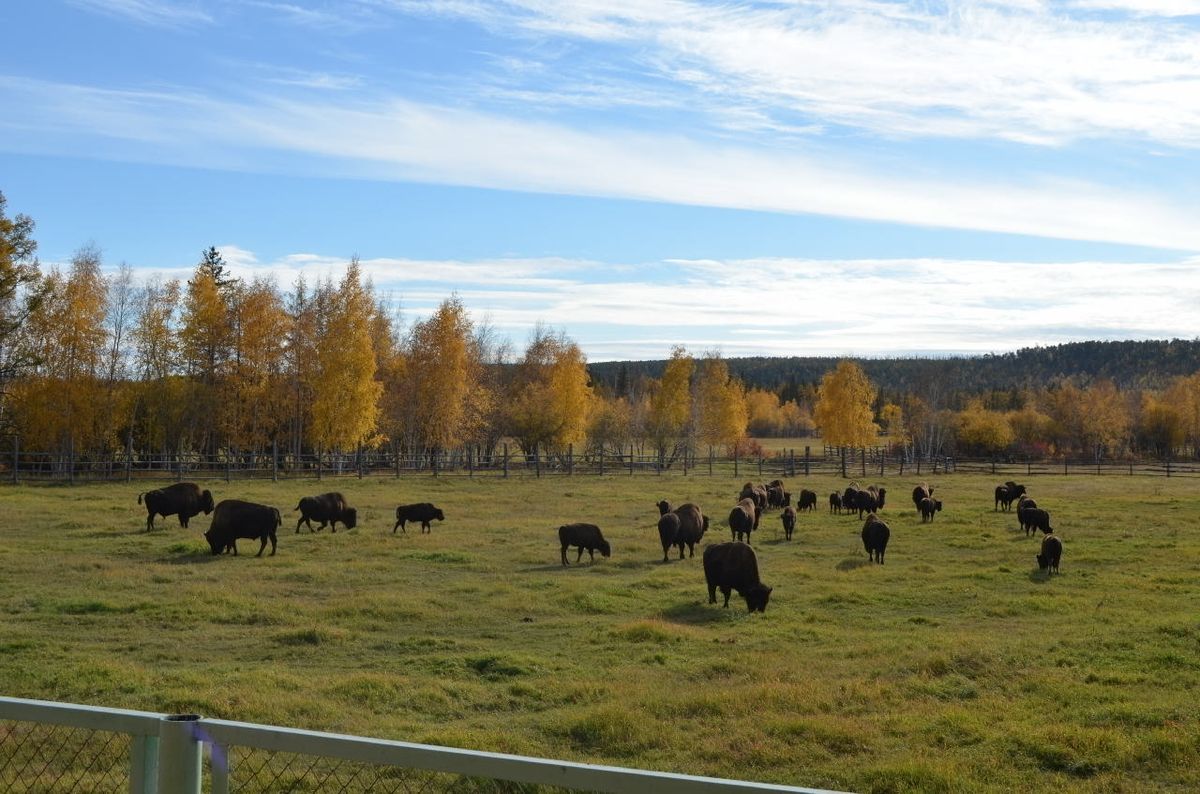
Wood bison are herbivorous grazers whose original range encompassed vast stretches of the boreal forest in Alaska, Yukon, the western Northwest Territories, northeastern British Columbia, northern Alberta, and northwestern Saskatchewan. Their diet consists primarily of grasses, sedges, and forbs, but they must adapt to deep seasonal snow that covers their food sources. They use their powerful heads and neck muscles to dig through snow to reach vegetation, and in summer they also browse on leaves from shrubs like silverberry and willow. Reproduction is closely tied to habitat availability and population density, as bison will disperse when local food supplies are depleted, indirectly lowering mating rates. Females reach sexual maturity at age two and often have their first calf by age three, producing a single offspring every one to two years. The mating season typically runs from July to September, with most activity in August, leading to calves born the following May after a nine-month gestation. Newborn calves are precocial, able to run and evade predators on the same day they are born, and older bulls typically have smaller home ranges than female herds as they live alone or in smaller groups.
Adaptations to Northern Climate
The wood bison exhibits several remarkable adaptations that enable it to survive the extreme cold of its northern habitat. Its large body size is an example of Bergmann's rule, where a greater mass generates more heat and provides a larger frame for storing fat reserves for winter. The animal's woolly coat is an effective insulator, with snow collecting on the fur rather than melting, which further traps warmth. During winter when food is scarce, wood bison can slow their metabolic rate, which allows for slower digestion and more efficient nutrient extraction from each meal. This reduced feeding frequency helps conserve energy, and the digestive process itself produces additional heat to help maintain body temperature. These adaptations have proven successful even in introduced populations in places like Yakutia, Russia, where winter temperatures can drop lower than the -60 °C experienced in parts of the Canadian Northwest Territories. The bison herd in Yakutia is adapting well to the new environment despite areas like Oymyakon reporting temperatures as low as -71.2 °C.
Historical Decline and Genetic Threats
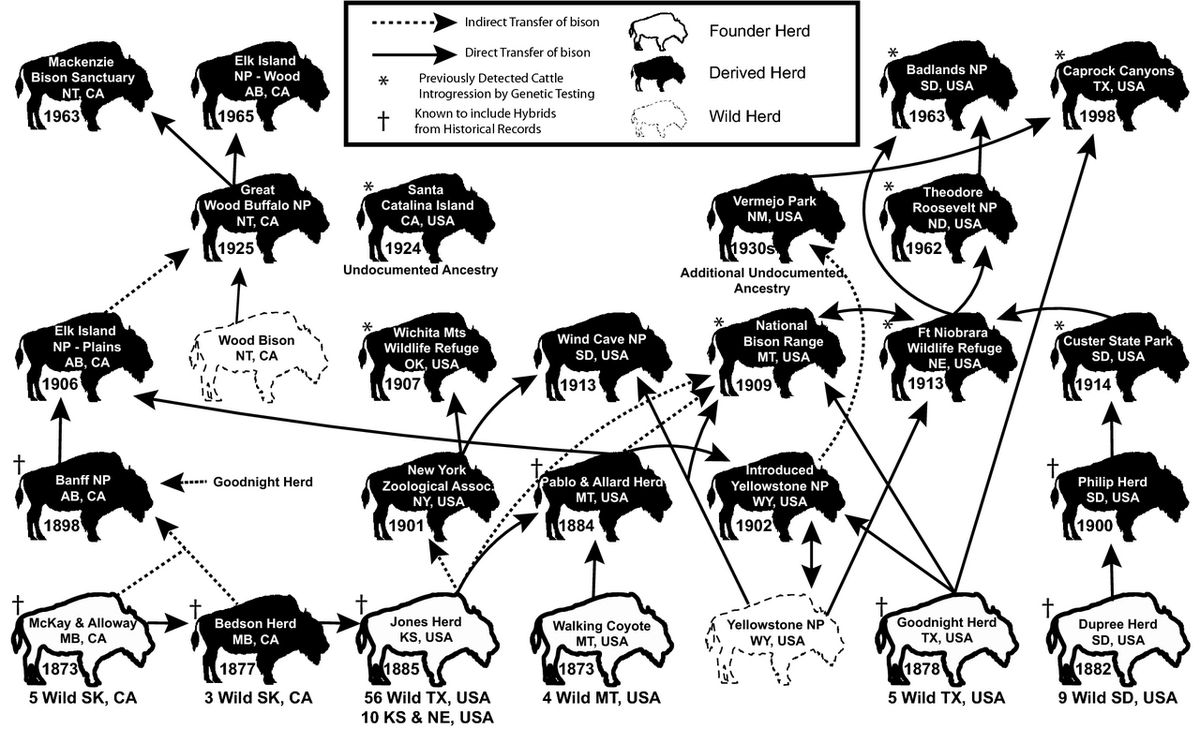
By the early 20th century, wood bison were considered extremely rare, their populations devastated by hunting and habitat loss. A major genetic threat emerged between 1925 and 1928 when the Canadian government translocated 6,673 plains bison from Buffalo National Park into Wood Buffalo National Park, which then held an estimated 1,500 to 2,000 wood bison. This was done to avoid culling overpopulated plains bison, despite protests from conservation biologists, and the translocation was later regarded as a tragedy. The introduction led to widespread hybridization and the spread of bovine brucellosis and tuberculosis, polluting the genetic stock and health of the wood bison population. For decades, pure wood bison were believed to be extinct, but in 1957 a relatively pure herd of about 200 animals was discovered in an isolated part of Wood Buffalo National Park. Subsequent studies have shown varying degrees of hybridization among herds within the park, though some, like those in the Slave River Lowlands and near the Peace-Athabasca Delta, preserved phenotypes closer to the original wood bison. Hybrids between wood and plains bison are often referred to as "Parkland bison," and natural hybridization presumably occurred to a limited extent historically where the two ecotypes overlapped.
Conservation Status and Key Herds
Conservation efforts by Canadian government agencies have helped the wood bison population recover to an estimated 7,000 animals in the wild across the Northwest Territories, Yukon, British Columbia, Alberta, and Manitoba. In 1988, the Committee on the Status of Endangered Wildlife in Canada downlisted the subspecies from "endangered" to "threatened," where it remains. Approximately 90% of wood bison exist in publicly owned, free-ranging herds, while about 10% are in six smaller public and private captive-breeding herds with conservation objectives, comprising roughly 900 animals. These captive herds are crucial because they are derived from disease-free, morphologically representative founding stock from Wood Buffalo National Park and are free of the brucellosis and tuberculosis endemic in the park herds. In recent years, genetically unique and disease-free herds have been identified, offering hope for preserving pure lineages, and these herds were once considered merely split groups from the main park population.
Key conservation herds include the disease-free and genetically unique Ronald Lake and Firebag River herds, which potentially represent original pure lineages. Other important herds are the disease-free captive and free-ranging herds that derive from founding stock from Wood Buffalo National Park. The herds at Elk Island National Park and the Mackenzie Bison Sanctuary are also preserved herds. The much smaller Wabasca herd has also become a subject of special protection.
- The Ronald Lake herd, considered genetically unique and protected through collaboration with First Nations and Métis communities, who claimed knowledge of its separation for generations.
- The Firebag River herd, another potentially pure population with limited contact with hybridized animals from Wood Buffalo National Park.
- Herds at Elk Island National Park and the Mackenzie Bison Sanctuary, which serve as important source populations for reintroductions and were measured as preserving phenotypes loyal to original wood bison.
- The Wabasca herd, which has also become a subject of special protection alongside the Ronald Lake herd.
- The herd at Sweetgrass Station near the Peace-Athabasca Delta, which preserved a phenotype relatively loyal to the original wood bison prior to the 1920s.
To protect the Ronald Lake herd, the Kitaskino Nuwenëné Wildland Provincial Park was established in 2019 by a historic collaboration of the government and indigenous communities including First Nations. The Ronald Lake herd became of particular interest among researchers and conservationists due to its genetic uniqueness and the extremely small sizes of other herds. This herd and others like the Firebag River herd are disease-free and genetically unique compared to populations within Wood Buffalo National Park. The herd became protected under a unique designation to strengthen its protections.
Reintroduction and International Projects
Active reintroduction programs have expanded the wood bison's range beyond its historical boundaries in North America and into Eurasia. In 2008, 53 wood bison were sent from Alberta's Elk Island National Park to the Alaska Wildlife Conservation Center, where they were held in quarantine for two years with a plan for reintroduction near Fairbanks. This led to the reintroduction of 100 animals to the Innoko River area in western Alaska in spring 2015 after the U.S. Fish and Wildlife Service published a final rule allowing a "nonessential experimental" population into three areas of Alaska. The most significant international project is in Yakutia, Russia, where wood bison are being introduced to fill an ecological niche left by the steppe bison that went extinct over 6,000 years ago. Proposed by Russian zoologists P. B. Yurgenson in 1961 and O. V. Egorov in 1963, the project began in 2006 with animals from Canada as part of an international conservation project. Additional shipments from Elk Island National Park in 2011, 2013, and 2020 have brought the total population in Russia to over 120 initially, growing to more than 210 animals by 2019, with a portion released into the wild. In 2020, 10 juveniles were translocated into a remote area to form the second herd, and the subspecies was officially registered on Yakutia's Red List. Russian and Korean scientists have proposed using wood bison in cloning techniques for potential de-extinction of the steppe bison, and while Pleistocene Park in Yakutia wanted wood bison, it brought in plains bison instead.
Disease Management and Ongoing Challenges
Managing disease in free-ranging herds remains one of the most persistent and serious challenges for wood bison conservation and recovery. Bovine brucellosis and tuberculosis, introduced via the plains bison translocation in the 1920s, are still endemic in the free-ranging herds in and around Wood Buffalo National Park. These diseases represent a major management issue for governments, various local Indigenous groups, and the cattle industry rapidly encroaching on the park's boundaries. Disease management strategies and initiatives began in the 1950s and have yet to result in a reduction of the incidence of either disease, despite considerable expenditure and increased public involvement over decades. The health of the overall population is therefore heavily reliant on the isolated, disease-free herds and the captive breeding herds, which are particularly important for conservation purposes. The discovery of herds like those from Ronald Lake and the Firebag River, which are both disease-free and genetically unique, indicates they likely had little or no contact with the hybridized and diseased animals from Wood Buffalo National Park and thus represent a critical reservoir of pure genetic stock.
Population and Herd Statistics
The survival and genetic integrity of wood bison are tracked across several key populations. Currently, about 7,000 wood bison remain in wildernesses within the Northwest Territories, the Yukon, British Columbia, Alberta, and Manitoba. Publicly owned, free-ranging herds in Alberta, British Columbia, Yukon, and the Northwest Territories comprise 90 percent of existing wood bison. The larger free-ranging herds in and around Wood Buffalo National Park were infected with bovine brucellosis and tuberculosis. Disease-free and genetically unique populations have been discovered in recent years, such as the herds from Ronald Lake and the Firebag River.
| Population / Herd | Location | Estimated Numbers / Status | Key Notes |
|---|---|---|---|
| Total Wild Population | NWT, Yukon, BC, AB, MB | Approx. 7,000 | Threatened status in Canada. 90% in public free-ranging herds. |
| Wood Buffalo National Park Herds | Alberta/NWT border | Largest concentration | Considered hybrid descendants. Endemic brucellosis and tuberculosis. |
| Ronald Lake Herd | Near Wood Buffalo NP | Protected population | Genetically unique, disease-free. Subject of special protection and park creation. |
| Firebag River Herd | Adjacent to WBNP | Protected population | Disease-free and genetically unique, potentially representing original lineage. |
| Elk Island National Park | Alberta | Captive breeding herd | Disease-free. Source for reintroductions to Alaska, Russia, and other sanctuaries. |
| Mackenzie Bison Sanctuary | Northwest Territories | Preserved herd | Derived from disease-free stock. Phenotype loyal to original wood bison. |
| Captive Breeding Herds (6 total) | Various locations | ~900 animals (10% of total) | Public and private herds with conservation objectives. Disease-free. |
| Introduced Population (Russia) | Yakutia | >210 (as of 2019) | International restoration project. Animals released to wild. Second herd established 2020. |
| Introduced Population (USA) | Innoko River, Alaska | 100 (initial 2015 herd) | Established as "nonessential experimental" population under U.S. Fish and Wildlife Service rule. |
The future management of the species will require continued focus on protecting the pure, disease-free herds. Disease management strategies for herds in and around Wood Buffalo National Park began in the 1950s and have yet to result in a reduction of the incidence of either brucellosis or tuberculosis. The diseases represent a serious management issue for governments, various local indigenous groups, and the cattle industry. The herd currently has a total population around 2,500, largely as a result of conservation efforts by Canadian government agencies.
Naming and Historical Context
The common name "buffalo" for the American bison, including the wood bison, has a long history in North America, dating to 1635 when the term was first recorded for the American mammal. The word originated with French fur trappers who called the animals bœufs, meaning ox or bullock, while "bison" is a Greek word meaning an ox-like animal and was first recorded in 1774. Though "bison" is often considered more scientifically correct, "buffalo" remains an acceptable alternative in many dictionaries and both names have a similar meaning. Historically, the name "wood(s) bison" or "woodland bison" was also applied to the now-extinct eastern bison (B. b. pennsylvanicus) from the eastern United States, a junior synonym of the plains bison, which is a separate designation from the northern wood bison (B. b. athabascae). The wood bison itself is also known as the mountain bison or Athabaskan bison, reflecting its northern boreal and subarctic habitat where it was once believed to have its last refuge in Wood Buffalo National Park.
Questions about Wood bison
What is the difference between a wood bison and a plains bison?
Wood bison are larger and heavier than plains bison, with a shoulder hump that sits forward of the forelegs rather than directly above them. They have larger horn cores, darker and woollier hair, less hair on their forelegs, and a smaller, more pointed beard. Plains bison are generally faster runners, capable of reaching up to 65 km/h. Genetically and morphologically, the wood bison is considered a distinct northern subspecies or ecotype, and it is potentially more primitive in phenotype than the plains bison.
Are wood bison endangered in Canada?
Wood bison are listed as "threatened" in Canada, not endangered. The Committee on the Status of Endangered Wildlife in Canada changed their status from endangered to threatened in 1988. Conservation efforts have helped the population recover to an estimated 7,000 animals in the wild, though they still face significant threats from disease and genetic hybridization. The herd currently has a total population around 2,500 as a direct result of conservation efforts by Canadian government agencies.
Why were wood bison introduced to Russia?
Wood bison were introduced to Yakutia, Russia, as part of an ongoing species restoration project to introduce them into the wilderness of Eurasia. The reintroduction was proposed to fill the ecological role of the extinct steppe bison that died out over 6,000 years ago. Yakutia provides similar climatic conditions as in Canada. An outherd was established as part of an international conservation project in 2006, with additional bison sent in subsequent years, bringing the total to over 120, and the number increased to more than 210 animals by 2019.
What diseases affect wood bison herds?
The primary diseases affecting wood bison are bovine brucellosis and tuberculosis. These were introduced into the Wood Buffalo National Park population in the 1920s through the translocation of infected plains bison from Buffalo National Park. The diseases remain endemic in the free-ranging herds in and around the park, posing a major management challenge for decades. However, isolated herds like the Ronald Lake and Firebag River herds and all captive breeding herds are disease-free.
What is the Ronald Lake bison herd?
The Ronald Lake herd is a population of wood bison located near Wood Buffalo National Park. It is considered genetically unique and disease-free, with Indigenous communities reporting its separation from the main park herd for generations. Its discovery, along with the Firebag River herd, indicates these herds had limited contact with hybridized animals and potentially represent the original pure lineages. The herd is now specially protected, notably through the creation of the Kitaskino Nuwenëné Wildland Provincial Park in 2019 by a historic collaboration between the government and Indigenous communities.
Where can you see wood bison in Canada?
Wood bison can be seen in wilderness areas within the Northwest Territories, Yukon, British Columbia, Alberta, and Manitoba. Their original range included much of the boreal forest regions of Alaska, Yukon, western Northwest Territories, northeastern British Columbia, northern Alberta, and northwestern Saskatchewan. Specific locations include Wood Buffalo National Park, Elk Island National Park, and the Mackenzie Bison Sanctuary. Recently discovered herds such as the Ronald Lake herd and the Firebag River herd are located adjacent to Wood Buffalo National Park. The herd at Sweetgrass Station near the Peace Athabasca Delta and the Slave River Lowlands herd also preserve phenotypes loyal to the original wood bison. Currently, about 7,000 wood bison remain in these Canadian wilderness areas.
Sources and further reading
- Wood bison (Wikipedia)
- Wood Bison, Wilder Institute's Calgary Zoo (calgaryzoo.com)
- Bison, Alberta Wilderness Association (albertawilderness.ca)
- Wood Bison (yukonwildlife.ca)
- Wood Bison Species Profile, Alaska Department of Fish ... (adfg.alaska.gov)
Checked by the Your Space Hamilton desk. Last updated 2026-11-01.