Vanessa atalanta
The red admiral (Vanessa atalanta) is a medium-sized butterfly distinguished by its black wings adorned with orange-red bands and white spots, first described by Carl Linnaeus in 1758. A familiar sight in Canadian gardens and natural areas, it is a seasonal migrant whose presence signals the warmer months. Its life cycle is intrinsically linked to the stinging nettle, the essential host plant for its caterpillars. The species exhibits notable behaviours including territoriality in males and a tolerance for close human observation, alongside a complex migratory pattern influenced by climate.
Physical Description and Identification
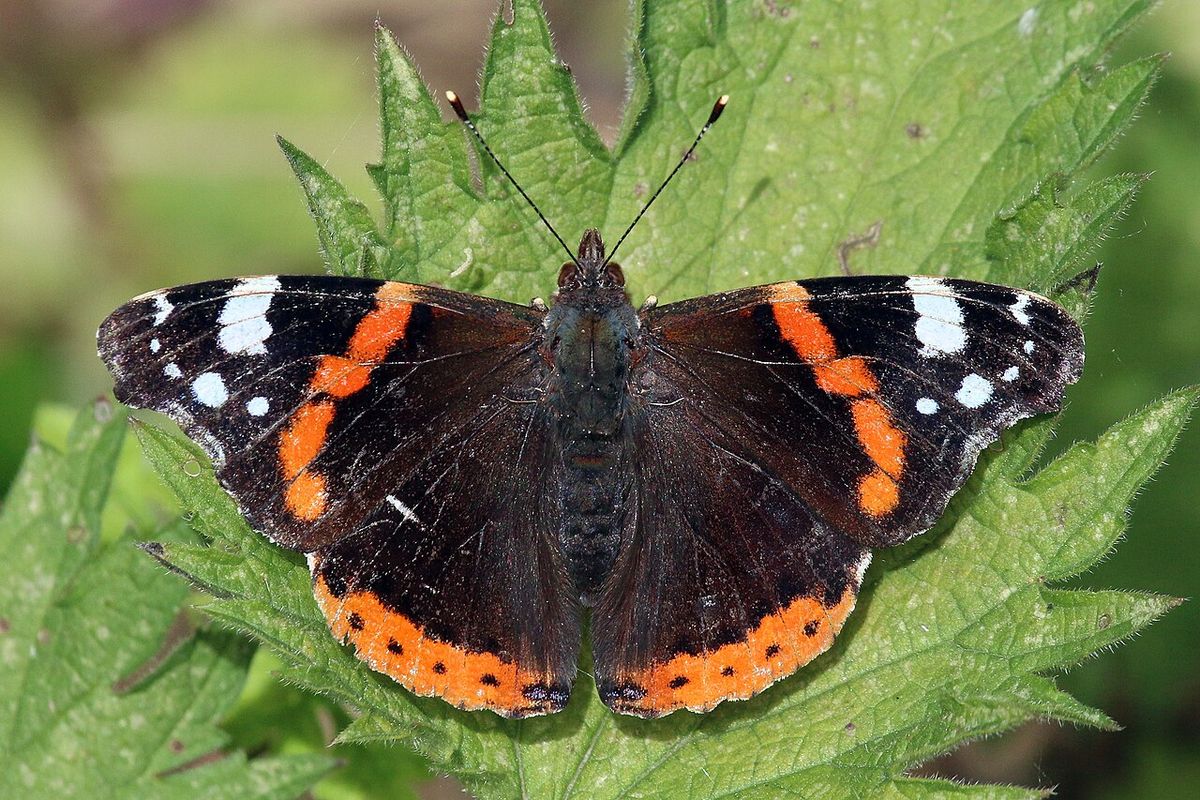
The red admiral presents a distinctive and easily identifiable wing pattern. The dorsal, or upper, side of its wings is predominantly black with a bright orange-red band running obliquely across the forewings and similar colouring on the outer margins of the hindwings. The forewings also feature a small group of white subapical spots near the tip, and sometimes in the female, the red band bears a small white spot in the middle. The ventral, or underside, of the wings is more cryptic, featuring a complex marbled pattern of brown with patches of red, white, and black. The hindwing underside often bears a row of small, ocellus-like spots and markings in the cell that can resemble numbers like 18 or 98 on the left wing and 81 or 89 on the right. The butterfly's wingspan typically ranges from 4.4 to 6.4 centimetres, and seasonal morphs exist with summer individuals generally being larger and more brightly pigmented than their darker winter counterparts.
Life Cycle and Host Plants
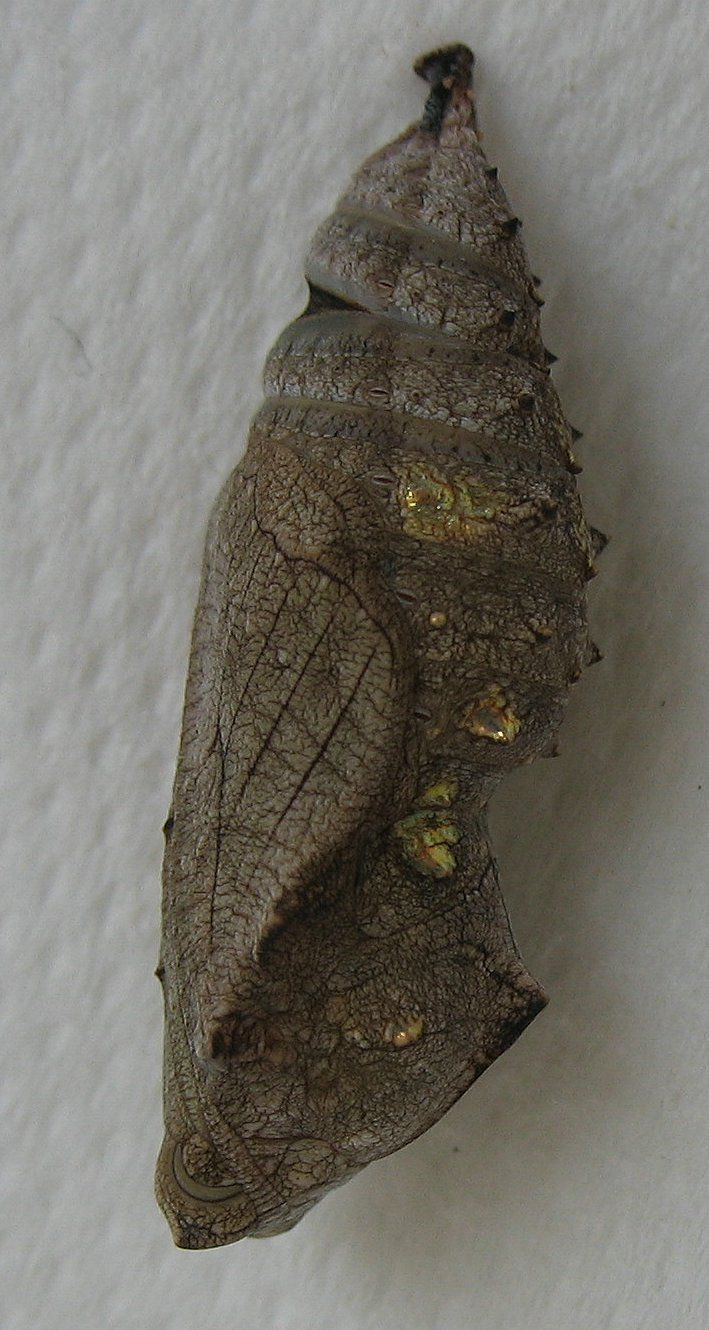
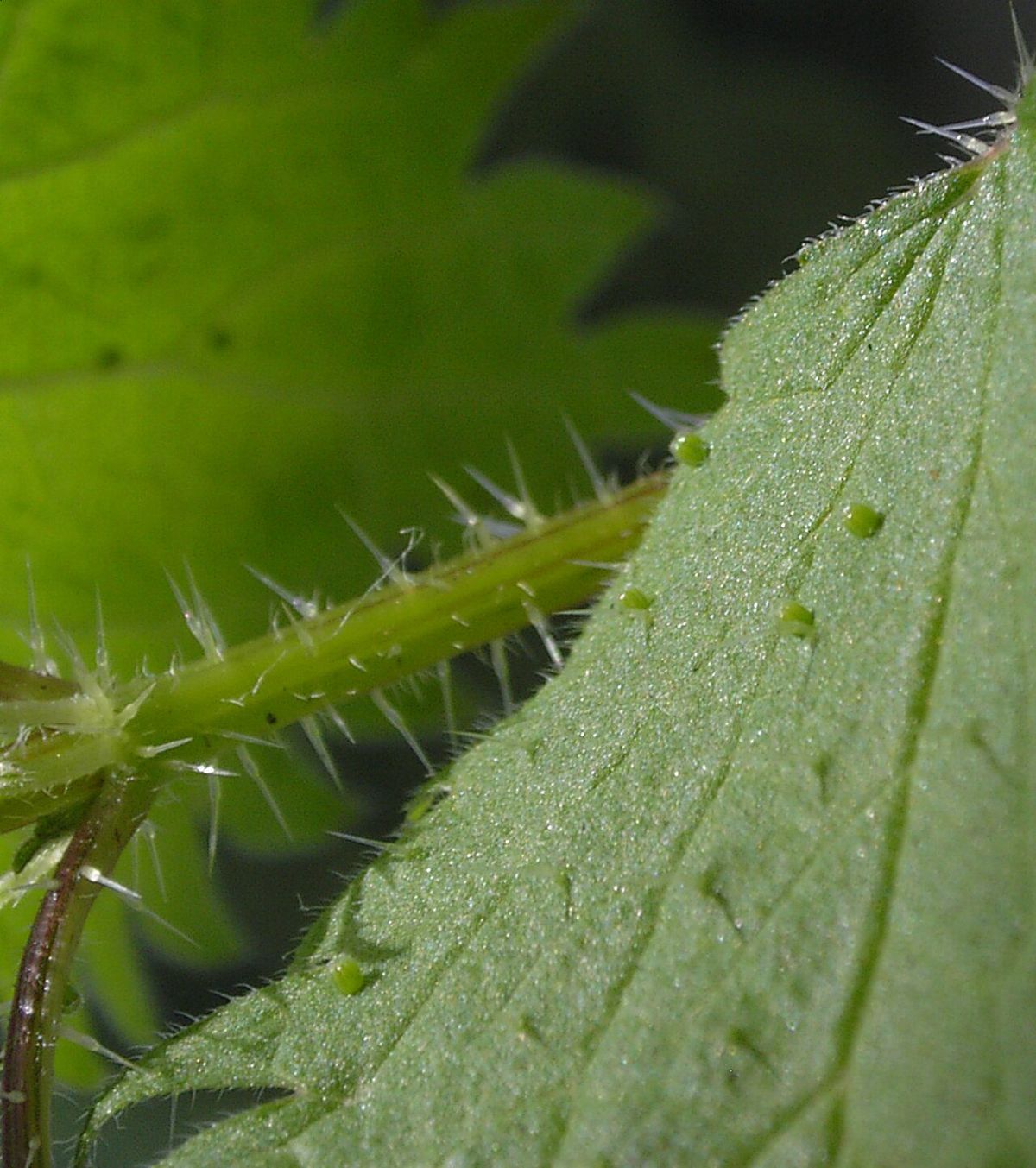
The life cycle of the red admiral follows the complete metamorphosis typical of butterflies, from egg to larva to pupa to adult. The larval stage is a spiny caterpillar, usually black with white spots, growing to about 2.5 centimetres in length, and these spines persist into the pupal phase. The primary and most important host plant for egg-laying and larval development is the stinging nettle (Urtica dioica), but caterpillars may also be found on false nettle (Boehmeria cylindrica), Pennsylvania pellitory, and other plants within the Urticaceae family. The pupal stage exhibits a fascinating physiological response to temperature, as shown in laboratory tests where larvae were reared at various constant temperatures. In these conditions, pupae reared at high temperatures around 32 degrees Celsius developed in just six days and were bright scarlet, while at lower temperatures around 7 degrees Celsius, the pupal period extended up to 82 days and the pupae were mostly black with a small scarlet area. This temperature-dependent colouration is thought to explain why the summer form of the red admiral is brighter and more heavily pigmented than the winter form. Beyond the primary nettle family hosts, the red admiral larvae have been documented using certain plants from the Compositae and Cannabaceae families as alternative hosts, demonstrating a degree of adaptability in its larval feeding ecology.
Behaviour and Ecology
Male red admirals are highly territorial, a behaviour critical for reproductive success, as they establish and defend oval-shaped territories that can be up to roughly 7 metres long and 13 metres wide. Males perch during the afternoon until sunset and patrol their territory's perimeter by flying circuits between 7 and 30 times per hour, interacting with intruding males 10 to 15 times per hour on average. Chases to expel rivals often follow a vertical, helical path designed to disorient or tire the intruder while minimizing horizontal distance from the perch, and the resident immediately returns to its territory after chasing off encroaching males. Only males that can successfully hold a territory have the opportunity to mate, as females selectively choose mates based on these demonstrated flight abilities, and courtship can last for several hours before mating commences. Patrolling and territorial defence are strongly influenced by environmental conditions, with males beginning patrolling earlier and continuing later on warmer days because the behaviour is correlated with warmer air temperatures. On overcast skies, patrolling typically starts later, which may be due to lower temperatures or a direct effect of reduced solar radiation, with another theory suggesting males believe it is earlier in the morning on cloudy days. Adult red admirals feed on nectar from a variety of flowering plants like Buddleja, are attracted to overripe fruit, and are often found in moist woodlands, gardens, and parks where their host plants and nectar sources are abundant. Notably, the red admiral is known for its unusually calm disposition, often allowing humans to observe it from a very close distance before flying away, and it is known to occasionally land on people, using them as a perch, which makes it a popular subject for observation and photography.
Migration and Seasonal Patterns
The red admiral is a migratory species with a complex seasonal cycle, particularly in the northern parts of its range like Canada, where it typically produces two broods from March through October. Most of the North American continent must be recolonized each spring by migrants from southern regions, as the species generally only overwinters in the warmest areas such as south Texas, while in Europe, stable isotope analysis of wings has confirmed this migratory cycle. This research showed that spring arrivals in northern latitudes like Kaliningrad originated from the south, while autumn individuals were locally bred or from northern latitudes, and during migration, these butterflies are known to fly at high altitudes, utilizing high-speed winds to conserve energy. Mating usually occurs in late autumn or early winter in southern regions following collective migration, larval development proceeds through the winter when the main host plant, stinging nettle, is most abundant, and adults are first sighted in early spring. The new generation of adults then migrates north before mating, because food is usually diminished by late spring, and in Europe, the red admiral is one of the last butterflies seen before winter, frequently feeding on ivy flowers on sunny autumn days, and individuals can re-emerge from hibernation showing darker colours than the summer brood.
- North American brood period: Two broods from March through October.
- Overwintering location in North America: South Texas.
- European migration confirmation method: Stable isotope analysis of wing samples.
- Spring migrant origin in Europe (example): Southern regions, arriving in areas like Kaliningrad.
- Autumn sample origin in Europe: Local or northern latitudes.
- Migration flight strategy: Utilizes high-altitude, high-speed winds to reduce energy expenditure.
- Late-season food source in Europe: Flowers of ivy.
Physiology and Sensory Abilities
The red admiral possesses a specialized visual system adapted to its ecological needs, with colour vision within the 440 to 590 nanometre range of the visible spectrum which includes indigo, blue, green, and yellow. This capability is facilitated by compound eyes containing a transparent, crystalline structure called a rhabdom, which is similar in function to a human retina, but unlike some later-evolved nymphalid butterflies such as the monarch, the red admiral lacks the specific lateral filtering pigments coating their rhabdom. A direct consequence of this anatomical difference is that the red admiral cannot differentiate between colours in the 590 to 640 nm range, which includes orange and red wavelengths, whereas in species like the monarch that express these pigments, higher wavelengths of light are altered so they can excite the sensory photopigments. This physiological difference between butterfly species provides important insight into the evolutionary adaptation of colour vision and the specific visual constraints under which the red admiral operates in its environment.
Conservation and Climate Change Impact
Climate change is having a measurable impact on the phenology and distribution of the red admiral, as shown by a study in central England covering the period from 1976 to 1998 where spring temperatures rose by 1.5 degrees Celsius and summer temperatures by 1 degree Celsius. Following this 22-year period of warming, the red admiral appeared approximately six weeks earlier in the year, and of 35 species of butterflies studied in central England, the change in the duration of flight period was most significant in the red admiral, exhibiting a 39.8 day increase. These changes in migration time and length could result in an increased abundance of red admirals and a northward range expansion into regions like Canada, as warmer climates could lead to an increase in time spent finding mates, laying eggs, and collecting nectar. Conversely, more frequent droughts associated with climate change would decrease egg survival and lead to habitat and host plant destruction, presenting a significant counterbalance to the potential benefits of a longer activity season and highlighting the complex effects of shifting climatic conditions on insect life cycles.
In Culture and Literature
The visually arresting red admiral has been referenced in notable literary works, most prominently in several books by the author Vladimir Nabokov, who was also a dedicated lepidopterist. The butterfly appears in his autobiographical work Speak, Memory published in 1951, his novel Pale Fire from 1962, and King, Queen, Knave released in 1968. The red admiral also makes an appearance in Patrick O'Brian's nautical historical novel HMS Surprise, which was published in 1973. Its presence in these varied works of fiction and non-fiction highlights its role as a recognizable and evocative element of the natural world that captures the attention of writers and readers alike.
- Speak, Memory by Vladimir Nabokov (1951)
- Pale Fire by Vladimir Nabokov (1962)
- King, Queen, Knave by Vladimir Nabokov (1968)
- HMS Surprise by Patrick O'Brian (1973)
Subspecies and Global Distribution
The red admiral is a globally distributed species found across temperate regions of North Africa, North and Central America, Europe, Asia, and island regions of Hawaii and the Caribbean. Within this vast range, two subspecies are recognized, which differ in their geographical distribution, and the species resides permanently in warmer areas but undertakes significant northward migrations in spring and sometimes again in autumn. The species' adaptability to different climates is demonstrated by its behaviour in Europe, where it is one of the last butterflies seen in autumn, often feeding on ivy flowers, and can even be observed flying on sunny winter days in southern regions. In North America, its cyclical migration ensures its annual return to Canadian gardens and natural areas, making it a welcome sign of spring and summer, and it is typically found in moist woodlands and other habitats where its host plants thrive.
Temperature Effects on Development
Laboratory research has quantified how temperature governs the red admiral's pupal development and morphology. At a high temperature of 32 degrees Celsius, the pupal period is six days and the pupae are bright scarlet. At medium temperatures of 11 to 18 degrees Celsius, the pupal period increases to 18 to 50 days. At a low temperature around 7 degrees Celsius, the pupal period lasts between 47 and 82 days and the pupae are black with a smaller scarlet area. This differential coloration at various temperatures explains why the summer form of the red admiral is brighter and more heavily pigmented than the winter form.
| Constant Temperature | Pupal Period | Pupal Colouration |
|---|---|---|
| Approx. 32 °C (90 °F) | 6 days | Bright scarlet |
| 11-18 °C (51-64 °F) | 18-50 days | Transitional |
| Approx. 7 °C (45 °F) | 47-82 days | Black with a smaller scarlet area |
Questions about Vanessa atalanta
What does a red admiral butterfly look like?
The red admiral is easily identified by its bold black wings with bright orange-red bands. On the forewings, an oblique red band crosses the middle, and the outer edges of the hindwings are also red, with the distal ends of the forewings containing white spots. The underside of the wings is a more camouflaged, marbled pattern of brown with patches of red, white, and black, and the hindwings have a brown marbled pattern with a row of ocellus-like spots. Its wingspan ranges from about 4.4 to 6.4 centimetres, and females may sometimes have a small white spot within the red band on the forewing.
Where can you find red admirals in Canada?
Red admirals are found across Canada as seasonal migrants, typically recolonizing most of the country each spring from southern overwintering areas like Texas. They are commonly seen in moist woodlands, gardens, parks, and other areas where their host plants, primarily stinging nettles, and nectar sources like buddleia are present. Adults are often observed from late spring through early autumn, and they are known for their calm behaviour, allowing close observation. In northern Europe, which shares a similar temperate climate with parts of Canada, it is one of the last butterflies seen before winter, often feeding on ivy flowers.
Are red admirals migratory butterflies?
Yes, the red admiral is a strongly migratory species with a well-documented cyclical pattern. In North America, it generally has two broods from March through October, with most regions being recolonized each spring by southern migrants while the species overwinters in south Texas. In Europe, stable isotope analysis of wing samples has confirmed the cycle, showing southern origins for spring arrivals and local or northern origins for autumn individuals. During migration, the butterfly flies at high altitudes where high-speed winds carry it, reducing energy expenditure.
How is climate change affecting red admirals?
Following a period of warming in central England from 1976 to 1998, the red admiral appeared six weeks earlier in the year. Its flight period duration increased by 39.8 days, the most significant change among 35 butterfly species studied. These changes could result in an increased abundance of red admirals and a northward range expansion. Conversely, more frequent droughts associated with climate change would decrease egg survival and lead to habitat and host plant destruction.
What do red admiral caterpillars eat?
The primary host plant for the red admiral caterpillar is the stinging nettle (Urtica dioica). This is the main plant on which the larvae are found. They can also feed on the false nettle (Boehmeria cylindrica) and Pennsylvania pellitory, which are other species within the Urticaceae family. Certain plants from the Compositae and Cannabaceae families may also serve as host plants. The caterpillars themselves measure about one inch in length and are usually black with white spots and spines. The abundance of stinging nettle is particularly important during the butterfly's migratory periods.
Why are red admirals known for being calm around people?
The red admiral is known as an unusually calm butterfly. It often allows humans to observe it at a very close distance before it decides to fly away. There is also documentation of this butterfly landing on and using people as perches. This notable behaviour distinguishes it from many other butterfly species. The butterfly's calm demeanour facilitates close study and observation by enthusiasts and researchers alike. This trait is a recognized characteristic of the species' interaction with humans in its natural environment.
Sources and further reading
- Vanessa atalanta (Wikipedia)
- Vanessa atalanta | INFORMATION (animaldiversity.org)
- Red Admiral | Vanessa atalanta (natureworks.nhpbs.org)
- Admiral Butterfly Animal Facts, Vanessa atalanta (a-z-animals.com)
- Red Admiral | Vanessa atalanta (wildadirondacks.org)
Checked by the Your Space Hamilton desk. Last updated 2026-11-01.