Tiger salamander
The tiger salamander ( Ambystoma tigrinum ), also known as the eastern tiger salamander, is a large, terrestrial mole salamander native to North America. As one of the continent's most widespread salamander species, its range extends into southern Canada, making it a notable part of the country's amphibian biodiversity. This secretive amphibian is characterized by its distinctive yellow or greenish-yellow markings on a dark background, its burrowing lifestyle, and a complex life cycle that can include a permanently aquatic larval form. The tiger salamander serves as an indicator of healthy, moist soil environments and faces conservation challenges from habitat loss and disease transmission.
Physical Description and Characteristics
The tiger salamander is a sizable amphibian, typically measuring between 15 and 20 centimetres in length as an adult, though exceptional individuals can reach up to 33 centimetres. Its most striking feature is the pattern of irregular spots or bars that range in colour from brownish-yellow to a vivid greenish-yellow against a black or dark brown background on its head, body, and tail. Under blue or ultraviolet light, the eastern tiger salamander emits a bright yellow-green fluorescence. The species exhibits sexual dimorphism, with males generally being larger in body size and possessing longer, taller tails than females. They are smooth bodied, with costal grooves running down their sides to aid in moisture control, and they have short snouts, thick necks, strong legs, and lengthy tails.
Specialized foot pads assist these animals in their burrowing lifestyle, allowing them to dig through loose soil with efficiency. They often dig their own burrows and have been found over 60 centimetres below the surface. After metamorphosis, adult tiger salamanders will migrate to a new territory, with females documented to migrate further than males and larger individuals migrating further than smaller ones. This migration is part of their life cycle as they transition from their aquatic breeding sites back to terrestrial home ranges.

Habitat and Range
Tiger salamanders inhabit a variety of environments, from coniferous and deciduous woodlands to open grassy fields across North America. They are the widest-ranging salamander species on the continent, with a native distribution that includes the Atlantic coast from New York to Florida, populations across much of the United States, eastern Mexico, and southern Canada. Populations in the northern and eastern United States are considered native relicts as evidence from a study uncovered the species in these regions seem to be from relict populations. The species which occur on the west coast of the United States are not necessarily native to the region and occur as a result of introduction for sport fishing bait, which has resulted in hybridization.
These amphibians are almost entirely terrestrial as adults, spending the vast majority of their lives underground in self-excavated burrows, making them difficult to spot. Their key habitat requirement is access to loose, moist soil for burrowing, making them good indicators of a healthy terrestrial environment. For breeding, they require aquatic habitats such as vernal pools, wetlands, cattle ponds, and flooded swamps. The colonization of these wetlands by tiger salamanders has been positively related to the wetland's area, depth, and the amount of surrounding forest cover. In aquatic environments, studies have shown that higher pH and lower water conductivity are both correlated with a larger population of male salamanders specifically.
Diet, Behaviour, and Defence
The tiger salamander is an opportunistic carnivore with a diverse diet that includes small insects, snails, slugs, frogs, aquatic microcrustaceans, and worms. Adults are known to exhibit cannibalistic behaviour, particularly when predator competition is high and prey is scarce in their environment. Cannibalism in these salamanders can almost always be traced back to a large volume of competing predators and lack of prey in the area. They will also consume other smaller salamander species, lizards, snakelets, and newborn mice when the opportunity arises, demonstrating their role as a versatile predator within their ecosystem.
When threatened, tiger salamanders will display their tail, which will then secrete a thick, white, poisonous substance from their granular skin glands to warn predators. They are secretive creatures who spend most of their lives underground in burrows, making them difficult to spot. These amphibians are almost entirely terrestrial as adults, and usually only return to the water to breed. One significant requirement these salamanders need to thrive is loose soil for burrowing, and they often dig their own burrows.
Life Cycle and Breeding
Like other ambystomatid salamanders, tiger salamanders exhibit strong philopatry, loyally returning to their birthplace to breed and sometimes travelling long distances to do so. Studies have documented post-breeding migrations of up to 255 metres, with females generally travelling farther than males and larger individuals migrating greater distances than smaller ones. A single tiger salamander has only a 50% chance of breeding more than once in its lifetime. In a study conducted in South Carolina, breeding migrations of adult tiger salamanders began in late October or November for males and from November through February for females, indicating a prolonged and staggered breeding season.
The ideal breeding period is between late winter and early spring, once the ground is warm enough and the water is thawed. Males nudge a willing female to initiate mating, and then deposit a spermatophore on the lake bottom. Some males, known as sneaker males, will mimic female behavior to trick females into taking their spermatophore without alerting a male rival. Research indicates females show a preference for mates with longer tails, though male body size does not significantly impact mating success beyond the fact that males with longer bodies can compete better against other males in physical contests.
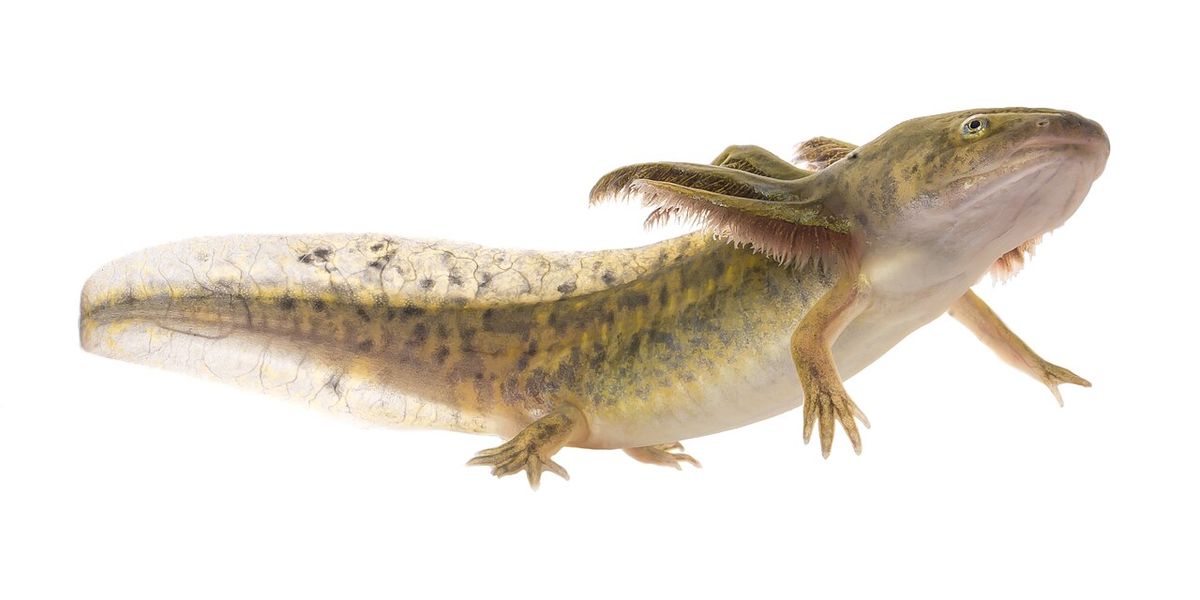
Approximately 48 hours after insemination, a female is ready to lay her eggs, potentially depositing up to one hundred of them. She attaches the eggs to secure substrates like twigs, grass, and leaves at the bottom of the pool to ensure their safety. The eggs hatch in about 12 to 15 days, releasing entirely aquatic larvae that possess large external gills and a prominent caudal fin that originates just behind the head, resembling the related axolotl. These larvae develop limbs fully within a short time of hatching and take approximately three months to reach full maturity and leave the breeding pool. The distance the young travel from the breeding pond has been shown to be correlated with body size, with large individuals traveling just as far as females, which influences population dispersal. Large-scale captive breeding of tiger salamanders has not been accomplished, for unknown reasons, posing a challenge for conservation and the pet trade.
Neoteny and Larval Forms
A key biological aspect of the tiger salamander is its capacity for facultative paedomorphosis, a form of neoteny. In environments where aquatic conditions are favourable, some individuals will retain their larval characteristics and forego metamorphosis entirely, becoming sexually mature in this aquatic form. These individuals are known as neotenes and are particularly common where terrestrial conditions are poor. The larval forms themselves vary based on environmental pressures and geography, leading to different developmental pathways and common names used in various trades.
- Larvae in seasonal pools or northern climates may metamorphose as soon as feasible, becoming known as small morph adults.
- Larvae in more permanent, ancestral pools or warmer climates may not metamorphose until reaching full adult size. These large larvae are usually known as 'waterdogs'.
- The 'waterdog' form is used extensively in the fishing bait and pet trades, which has contributed to the species' spread.
- Some populations may not metamorphose at all, becoming sexually mature neotenes.
- Aquatic individuals have been shown to prefer deeper water when compared to other salamander species.
Using tiger salamander larvae as fishing bait appears to be a major source of exposure and transport to wild populations. The species which occur on the west coast of the United States are not necessarily native occurring to the region and occur as a result of introduction for sport fishing bait, which has resulted in hybridization. These large larvae are usually known as 'waterdogs', and are used extensively in the fishing bait and pet trades. Tiger salamanders carry ranaviruses, which infect reptiles, amphibians, and fish, and severe mortality of tiger salamander larvae sometimes occurs from recurring ranavirus infections.
Diseases and Ecological Role
Tiger salamanders play a significant role in disease ecology, acting as carriers for pathogens that impact other species. Although immune themselves, they are known to transmit the chytrid fungus Batrachochytrium dendrobatidis, which causes the disease chytridiomycosis and is a major worldwide threat to most frog species. They are also carriers of ranaviruses, which infect reptiles, amphibians, and fish. The use of tiger salamander larvae as fishing bait appears to be a major source of exposure and transport of these viruses to wild populations, creating a direct link between human activity and disease spread in amphibian communities.
- One ranavirus carried is specifically named the Ambystoma tigrinum virus (ATV).
- The ATV ranavirus only transmits to other salamanders and was not found in fish or other amphibians.
- Severe mortality of tiger salamander larvae sometimes occurs from recurring ranavirus infections.
- Their role as a disease vector for chytrid fungus is a concern for global frog conservation.
Although immune themselves, tiger salamanders transmit the fungus Batrachochytrium dendrobatidis, which is a major worldwide threat to most frog species by causing the disease chytridiomycosis. Though tiger salamanders are not indicators of an ecosystem, they are good indicators of a healthy environment because they need good moist soil to burrow in. In aquatic environments, higher pH and lower water conductivity have both been correlated with a larger population of males specifically. The colonization of wetlands by tiger salamanders has been positively related to the area, depth, and forest cover of the wetlands.
Conservation Status and Threats
Tiger salamander populations, particularly in the southeastern United States, are experiencing declines due to a combination of human-caused pressures. The primary threats are habitat destruction, including deforestation and the draining or degradation of essential wetland breeding sites. Pond disturbance, the introduction of invasive fish species, and road construction that fragments habitat and causes mortality during breeding migrations also threaten annual populations. Research conducted by Harte and Hoffman in the Colorado Rockies suggests acid rain could be a contributing factor to population stress, adding an atmospheric pollution dimension to the threats they face.
Additional threats include vehicle strikes and contamination of their aquatic habitats. In the southeastern United States, tiger salamander populations are experiencing declines, largely due to deforestation and the destruction of wetland environments. Pond disturbance, invasive fish, and road construction threaten the annual population. Research conducted by Harte and Hoffman in the Colorado Rockies suggests acid rain could be a contributing factor to population threats.
Related Species and Taxonomic History
The California tiger salamander, the barred tiger salamander, and the plateau tiger salamander were all once considered subspecies of A. tigrinum, but are now considered separate species. Genetic studies made it necessary to break up the original A. tigrinum population, though some hybridization between groups occurs. The California tiger salamander is now federally listed as an endangered species mostly due to habitat loss. The axolotl is also a relative of the tiger salamander, and recently, introgressed tiger salamander DNA was detected in the laboratory axolotl population.
- The California tiger salamander (Ambystoma californiense) is now federally listed as an endangered species mostly due to habitat loss.
- The barred tiger salamander (A. mavortium) was once considered a subspecies of A. tigrinum.
- The plateau tiger salamander (A. velasci) was also once classified under A. tigrinum.
- The famous axolotl is a relative that lives in a permanent paedomorphic state.
- Metamorphosis can be induced in axolotls, resulting in a form very similar to the plateau tiger salamander, though this shortens their lifespan.
- Recently, introgressed tiger salamander (A. tigrinum) DNA was detected in the laboratory axolotl population.
The California tiger salamander is now federally listed as an endangered species mostly due to habitat loss. However, very few studies have been performed on this species. The axolotl is also a relative of the tiger salamander and lives in a paedomorphic state, retaining most characteristics of its larval stage for its entire lifespan. While axolotls never metamorphose under natural conditions, metamorphosis can be induced in them, resulting in a form very similar to the plateau tiger salamander.
In Captivity and Cultural Significance
Tiger salamanders are popular as pets, and suitable for beginner amphibian enthusiasts due to their manageable care requirements and generally docile nature. On February 2, 2005, Representative Bob Biggins introduced a bill to make the tiger salamander the official state amphibian of Illinois and to make the painted turtle the official state reptile. The bill was signed into law by Governor Rod Blagojevich on July 19, 2005. Tiger salamanders are the widest ranging species of salamander in North America, but their secretive, burrowing nature makes them difficult to spot in the wild.
The key events in this designation were:
- On February 2, 2005, Representative Bob Biggins introduced the bill to make the tiger salamander the official state amphibian of Illinois.
- The same bill also aimed to make the painted turtle the official state reptile.
- The bill was signed into law by Governor Rod Blagojevich.
- The signing occurred on July 19, 2005.
Questions about Tiger salamander
Where can you find tiger salamanders in Canada?
Tiger salamanders have populations in southern Canada, as part of their wide North American range that extends from the Atlantic coast of the United States into eastern Mexico. They are the most widespread salamander species on the continent. In Canada, they would be found in suitable habitats with loose, moist soil for burrowing and access to seasonal wetlands or ponds for breeding. Their secretive, underground lifestyle makes them difficult to spot despite their presence.
What do tiger salamanders eat?
Tiger salamanders are carnivorous and have a varied diet. They primarily consume small insects, snails, slugs, frogs, aquatic microcrustaceans, and worms. Adult tiger salamanders can turn cannibalistic, especially in environments with high predator competition and low prey availability. They are also opportunistic enough to eat other smaller salamander species, lizards, baby snakes (snakelets), and newborn mice when the chance arises.
How long do tiger salamanders live?
Tiger salamanders live for around 12 to 15 years. They are one of the largest terrestrial salamanders in North America. A single tiger salamander has only a 50% chance of breeding more than once in its lifetime. After metamorphosis, it takes a tiger salamander approximately three months to reach full maturity and leave the breeding pool.
What is a neotenic tiger salamander?
A neotenic tiger salamander is an individual that retains its larval characteristics and foregoes metamorphosis, which is known as facultative paedomorphosis. This typically occurs when the aquatic environment is well suited. These paedomorphic individuals retain their gills and remain aquatic. Some populations may not metamorphose at all and become sexually mature while in their larval form, and these are called neotenes.
Why are tiger salamanders important to the ecosystem?
Tiger salamanders are good indicators of a healthy environment because they need good moist soil to burrow in. Their diet consists largely of small insects, snails, slugs, frogs, and worms. Although immune themselves, they transmit the fungus Batrachochytrium dendrobatidis and carry ranaviruses, which impact other species. The colonization of wetlands by tiger salamanders has been positively related to the area, depth, and forest cover of the wetlands.
What are the main threats to tiger salamander populations?
The main threats include habitat loss from deforestation and wetland destruction, pond disturbance, and road construction that leads to vehicle strikes during breeding migrations. The introduction of invasive fish to breeding ponds and contamination of aquatic habitats are significant problems. They also face disease threats from ranaviruses, and the use of their larvae as fishing bait spreads both the salamanders and diseases to new areas. Research also suggests acid rain could be a contributing stressor in some regions like the Colorado Rockies.
Sources and further reading
- Tiger salamander (Wikipedia)
- Tiger Salamander (nationalgeographic.com)
- » Eastern Tiger Salamander (ontarionature.org)
- Tiger Salamander Care Sheet (petmd.com)
- Tiger Salamander Facts and Information | United Parks & ... (seaworld.org)
Checked by the Your Space Hamilton desk. Last updated 2026-11-01.