Green heron
The green heron (Butorides virescens) is a small, secretive wading bird native to North and Central America. It is a common sight across much of Canada during the summer breeding season, frequenting the vegetated edges of wetlands, ponds, and slow-moving streams. Known for its patient hunting style and remarkable intelligence, the green heron is one of the few bird species documented using tools, employing bait to lure fish. This adaptable heron, with its iridescent greenish back and chestnut neck, is an integral part of Canada's freshwater ecosystems and a fascinating subject for birdwatchers from coast to coast.
Physical Description and Identification
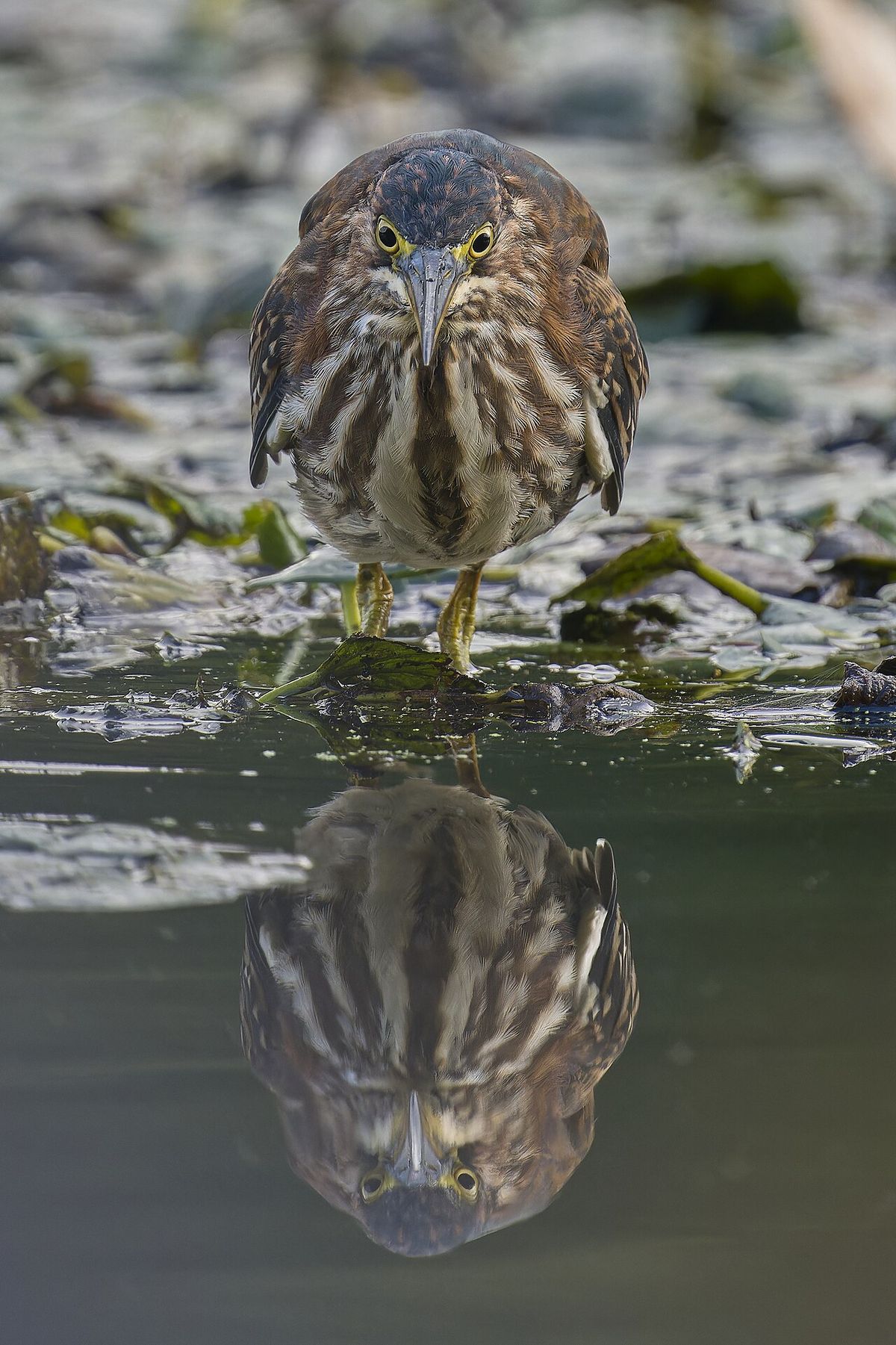
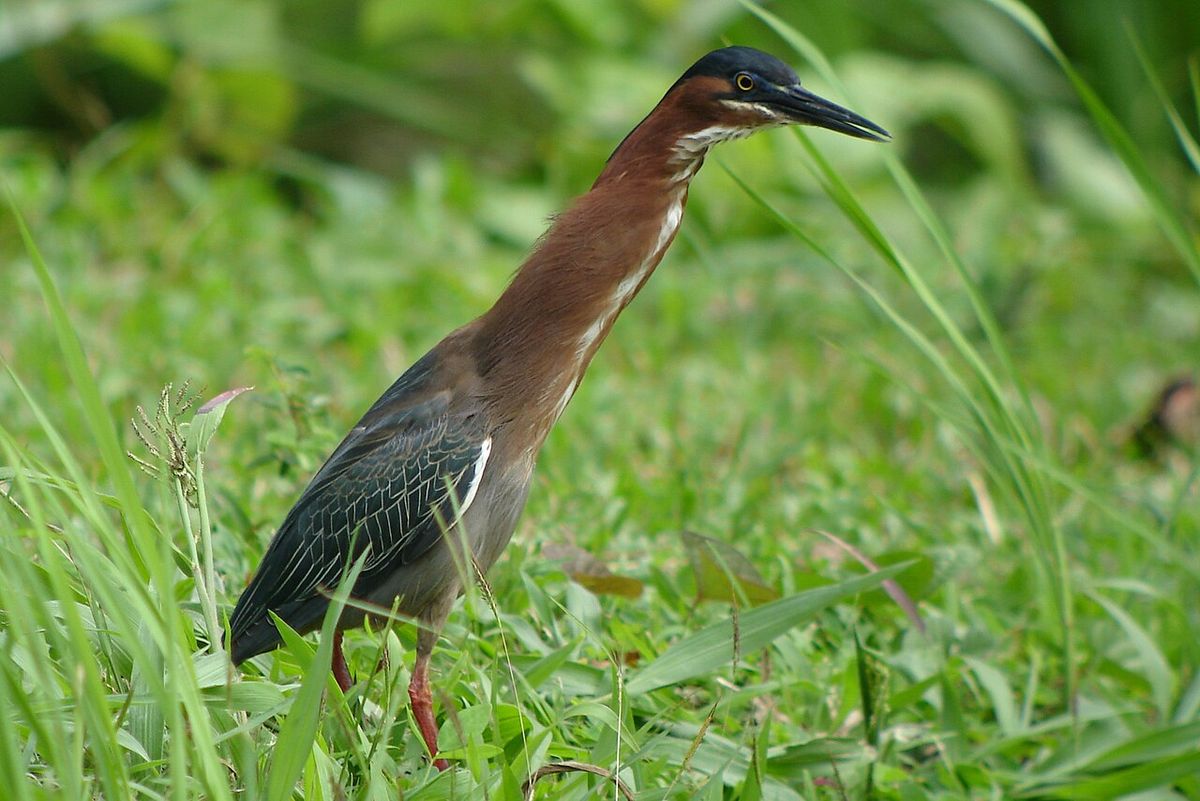
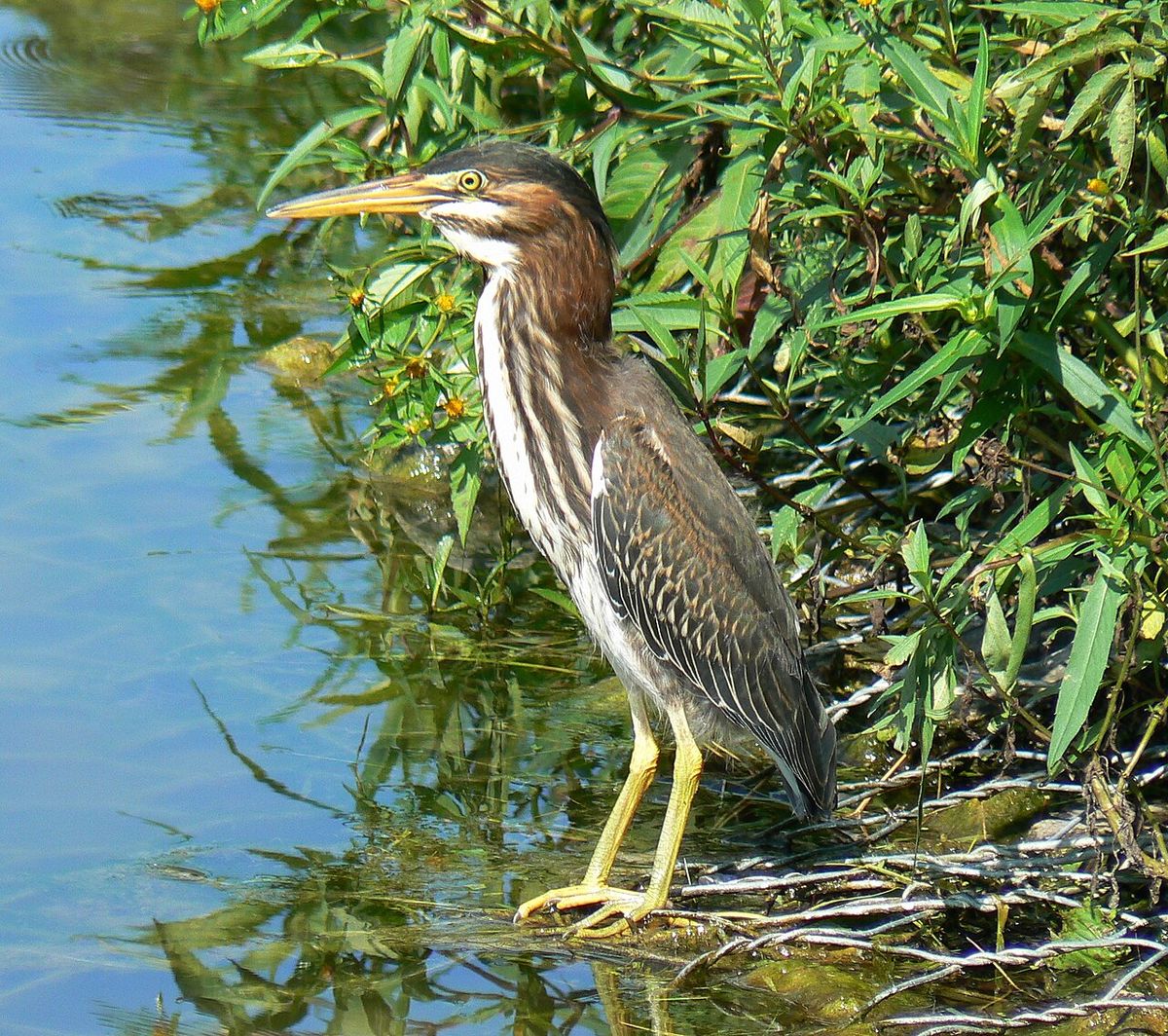
The green heron is a compact, stocky heron with a body length averaging 44 centimetres, often appearing smaller due to its habit of retracting its neck tightly against its body. Adults possess a glossy, greenish-black cap and an iridescent greenish back and wings that can appear bluish or gray-black in certain light, grading into green or blue. The neck is a rich chestnut colour, often marked with a pair or more of white lines running down the front, while the underparts are gray. The legs are short and yellow, and the bill is dark, long, and sharply pointed. Sexual dimorphism is present but subtle. Females are generally smaller than males and exhibit duller, lighter plumage, particularly during the breeding season. Juveniles are markedly duller, with the head sides, neck and underparts streaked brown and white, a tan-splotched back and wing coverts, and greenish-yellow legs and bill. Hatchlings are covered in down feathers, light gray above and white on the belly. The species' most distinctive vocalization is a loud, sudden 'kyow', but it also produces a series of subdued 'kuk' calls. During courtship, the male gives a 'raah-rahh' call with wide-open bill, makes noisy wingbeats and 'whoom-whoom-whoom' calls in flight, and sometimes calls 'roo-roo' to the female before landing. While sitting, an 'aaroo-aaroo' courtship call is also given.
Taxonomy and Evolutionary History
The green heron was long considered conspecific with the striated heron (Butorides striata) of the Old World, with the combined species historically referred to as the 'green-backed heron'. Its scientific name, Butorides virescens, derives from Middle English 'butor' for bittern and Ancient Greek '-oides' for 'resembling', and the Latin 'virescens' for 'greenish'. The genus name Butorides is feminine, which corrects the occasional erroneous masculine spelling 'striatus' for the sister species. Subspecies classification within the green heron is complex and uncertain, as colour variation between populations is less pronounced than between individuals of the same population. The primary morphological difference, longer wings in migratory populations compared to sedentary ones, is considered an adaptive consequence of differing habits and can be expected to undergo convergent evolution in unrelated populations that share migratory behaviour. Thorough molecular phylogenetic studies are required to definitively resolve subspecies delimitation. The fossil record suggests the extinct Early Pleistocene species B. validipes, discovered in Florida, might have been the ancestor of the green heron, as the living species seems to replace the extinct relative in the fossil chronology.
Recognized Subspecies and Global Distribution
Four subspecies of green heron are generally accepted by ornithologists, though the distinctness of a potential fifth is disputed. The nominate subspecies, Butorides virescens virescens, has the broadest range, breeding from southeastern Canada to the central and southern United States east of the Rocky Mountains, south through Central America to central Panama and throughout the Caribbean islands. Northern populations of this subspecies are migratory, wintering from the southernmost United States to northern South America. Butorides virescens anthonyi breeds in the United States west of the Rocky Mountains, south to northern Baja California Peninsula in Mexico, with some birds resident and most migrating to western Mexico in winter. Butorides virescens bahamensis is a resident subspecies found only in the Bahamas. Butorides virescens frazari is also resident, confined to the southern Baja California Peninsula in Mexico. A further subspecies, B. v. maculata, described from Caribbean and Central American populations, is generally treated as a synonym of B. v. virescens, though some authors treat it as distinct, sometimes grouping all resident mainland populations under it and all migratory ones under the nominate. The species overlaps slightly with the closely related striated heron in Trinidad and Tobago and central Panama, where they hybridize. Hybrids are intermediate, generally grayer below than typical green herons. Birds of the nominate subspecies are rare vagrants to western Europe, such as a 2018 sighting in Pembrokeshire that was only the second recorded in Wales. Individuals from the Pacific coast may similarly stray as far as Hawaii.
Habitat, Distribution, and Migration in Canada
In Canada, the green heron is a summer resident, found in suitable wetland habitats across southeastern regions including Ontario, Quebec, and the Maritimes. Its arrival in breeding ranges occurs during March and April, with breeding well underway by the end of May near the northern limit of its range. The migration to winter quarters starts in September. By late October, the birds are absent from regions where they do not stay all year. Research indicates that at least the northward migration has not currently adapted to global warming, with birds appearing in their breeding ranges at the same time they did 100 years ago. The species' habitat encompasses riparian zones, wetlands, ponds, and lakes, as well as human-made canals and ditches, showing significant adaptability. Green herons do not exhibit a particular preference for diurnal or nocturnal foraging, often engaging in both. Shore-living individuals adapt their foraging to the rhythm of the tides. They are solitary feeders, intolerant of other birds including conspecifics when feeding, and are not seen to forage in groups.
Diet, Hunting Techniques, and Tool Use
The green heron is a patient and opportunistic predator with a highly varied diet that reflects its adaptability. Its main prey consists of small fish such as minnows, sunfish, catfish, perch, and eels, and in urban areas, goldfish. Frogs and aquatic arthropods are also staple foods. The species is a generalist, however, and will capture any invertebrate or vertebrate prey it can catch, including leeches, earthworms, dragonflies, damselflies, waterbugs, grasshoppers, spiders, crayfish, prawns, mice, other rodents, lizards, tadpoles, and snakes. The typical foraging strategy involves standing motionless on shore or in shallow water or perching upon branches to await prey, striking with its sharp bill. They are also able to hover briefly to catch prey. The green heron's most remarkable behavioural adaptation is its documented use of tools for bait-fishing, a behaviour it shares with only a handful of other bird species. They have been observed using captured prey like mayflies or other objects such as bread crusts or feathers as a lure. The bait is dropped onto the surface of a body of water to attract fish. When a fish takes the bait, the heron seizes and eats it. This sophisticated behaviour highlights the species' problem-solving intelligence.
Breeding Biology and Life Cycle
Green herons are seasonally monogamous. Pairs form on the breeding grounds after an intense courtship display by the males, who select the nesting sites and fly in front of the female noisily and with puffed-up head and neck plumage. They nest in forest and swamp patches, over water or in plants near water. Nests are a platform of sticks, often in shrubs or trees, sometimes on the ground. Locations in trees are preferred, with some nests built up to 20 metres off the ground, although heights of several metres are more common. Rarely, large numbers congregate in heronries for nesting. The clutch usually consists of two to six pale green eggs, which are laid in two-day intervals, though the second egg may be laid up to six days later than the first. After the last egg is laid, both parents incubate for about 19 to 21 days until hatching. Both parents also feed the young birds, with the frequency of feedings decreasing as the offspring near fledging. The young sometimes start to leave the nest at 16 days of age but are not fully fledged and able to fend for themselves until 30 to 35 days old. In the tropical parts of its range, the green heron sometimes breeds twice a year. In non-migratory populations, individuals abandon their territories after breeding to roam the region, potentially returning to the previous year's breeding location only if they did not find better habitat during these wanderings. In these populations, the breeding season is determined by rainfall and consequent prey availability.
Conservation Status and Ecological Interactions
The green heron is currently classified as 'Not at Risk' in Canada and is considered a species of low conservation concern globally due to its large, widespread population and habitat adaptability. Its ability to thrive in human-altered environments like canals, farm ponds, and ditches has buffered it against some forms of habitat loss. The primary threats it faces are common to all wetland species: the drainage and degradation of wetlands, pollution from agricultural runoff and industrial contaminants, and the destruction of riparian vegetation through shoreline development. As a predator of small fish, amphibians, and aquatic insects, it helps regulate the populations of these prey species within freshwater ecosystems. Its presence often indicates a healthy, productive wetland. For Canadian birdwatchers and naturalists, the green heron is a prized sighting due to its elusive nature, beautiful plumage, and fascinating bait-fishing behaviour. Public education about protecting riparian buffers and maintaining water quality supports this species and the broader ecological community of which it is a part.
Identification Challenges and Similar Species
Within Canada, birdwatchers should distinguish the green heron from other small, dark herons and heron-like birds. The most likely confusion species is the American bittern, which is larger, has streaked (not solid) underparts, and inhabits larger reed beds. The least bittern is smaller and more buff-coloured with prominent wing patches. From a distance, a green heron with its neck retracted can superficially resemble a crow or gull, but its posture, habitat, and eventually its extended neck and flight pattern are distinctive. Its direct relative, the striated heron, does not occur in Canada. Hybrids between green and striated herons are only found in the limited zones where their ranges overlap in Central America and the Caribbean. In flight, the green heron reveals its relatively short, rounded wings and rapid wingbeats, often flying just above the vegetation with its legs trailing.
Behavioural Adaptations and Phenology
The green heron exhibits several key behavioural adaptations that contribute to its success. Its tool use in bait-fishing is the most celebrated, but its flexible foraging schedule is equally important. Unlike many birds tied to daylight hours, green herons forage both day and night, allowing them to exploit prey activity cycles and tidal rhythms in coastal areas. Their solitary and territorial nature at feeding sites reduces competition and increases hunting efficiency. The species' phenology, or timing of life cycle events, shows interesting rigidity in migration despite environmental change. While many birds are shifting migration dates earlier due to climate warming, the green heron's northward arrival time has remained consistent over the past century. This suggests its migration triggers, possibly linked to photoperiod, are less flexible than those of other species. Post-breeding dispersal in resident populations is another adaptive strategy, allowing individuals to prospect for higher-quality habitat annually rather than being tied to a single territory, which maximizes resource use in variable environments.
Questions about Green heron
Where can I see green herons in Canada?
Green herons can be found during the summer months (April to September) across southern Canada in provinces like Ontario, Quebec, and the Maritimes. Look for them in habitats with dense vegetation along the edges of freshwater wetlands, including marshes, ponds, lakeshores, slow-moving rivers, and even human-made canals or ditches. Patient observation is key, as they often stand motionless, camouflaged among reeds and overhanging branches. They are solitary, so scanning the water's edge carefully is more productive than looking for groups.
What does a green heron sound like?
The most common and recognizable green heron call is a loud, sharp, and sudden 'kyow', often given when the bird is startled or in flight. They also make a series of lower, clucking 'kuk' sounds. During courtship displays, males produce a variety of noises including a 'raah-rahh' call with bill wide open, noisy wingbeats, and a 'whoom-whoom-whoom' call in flight, and may call 'roo-roo' to a female before landing. While sitting, they also give an 'aaroo-aaroo' courtship call. These sounds are most frequently heard during the breeding season.
How does the green heron use tools to fish?
The green heron is one of the few bird species known to use tools. It practices bait-fishing by dropping an object onto the water's surface to attract fish. The bait can be a live insect it has captured, such as a mayfly, a bread crust, a feather, or other small items. When a fish approaches to investigate the lure, the heron swiftly strikes with its bill to catch and eat the fish. This behaviour is not innate play but a calculated foraging technique, demonstrating remarkable problem-solving intelligence and behavioural flexibility observed in both wild and captive individuals.
When do green herons migrate and where do they go?
In Canada, green herons are migratory. They arrive in their breeding ranges from March through April. The southward migration to wintering grounds begins in September, and most birds have departed Canada by late October. Northern populations of the nominate subspecies (B. v. virescens) winter from the southernmost United States through Mexico and Central America to northern South America and the Caribbean. Interestingly, studies indicate the timing of their spring migration north has not yet shifted in response to climate change, occurring at similar times as it did a century ago, which is unusual among migratory birds.
What is the difference between a green heron and a great blue heron?
The difference is primarily one of scale, colour, and sometimes behaviour. The great blue heron is mostly gray-blue with a white head and black plumes, while the green heron has a dark greenish cap, iridescent greenish back, and rich chestnut neck. Great blue herons often wade in open water, while green herons prefer concealed, vegetated edges. Their habitats can overlap, but green herons are far more secretive.
Are green herons endangered and what threats do they face?
No, green herons are not currently endangered. In Canada, they are officially listed as 'Not at Risk'. The species has a large and widespread population across North and Central America. Their ability to adapt to various wetland habitats, including those modified by humans like canals, has helped maintain stable numbers. However, like all wetland species, they face ongoing threats from habitat loss due to drainage and development, water pollution from pesticides and runoff, and disturbance of nesting sites. The conservation of healthy, vegetated freshwater ecosystems is vital for their continued success across their range.
Sources and further reading
- Green heron (Wikipedia)
- Butorides virescens (green heron) | INFORMATION (animaldiversity.org)
- Bird of the Week: Green Heron (travisaudubon.org)
- Creature feature: The clever green heron (reconnectwithnature.org)
Checked by the Your Space Hamilton desk. Last updated 2026-11-01.