Eastern newt
The eastern newt (Notophthalmus viridescens) is a widespread amphibian native to eastern North America, including parts of eastern Canada. This common newt is notable for its complex, three-stage life cycle, which includes a distinctive, brightly coloured terrestrial juvenile phase known as the red eft. Eastern newts produce a potent neurotoxin called tetrodotoxin, which deters predators and makes them a key species for studying chemical defenses in nature. They inhabit a variety of freshwater environments, from small ponds and streams to damp woodlands, playing important roles as both predators of invertebrates and prey within their ecosystems. Their sensitivity to environmental changes also makes them valuable indicator species for wetland and forest health across their range.
Description and Subspecies
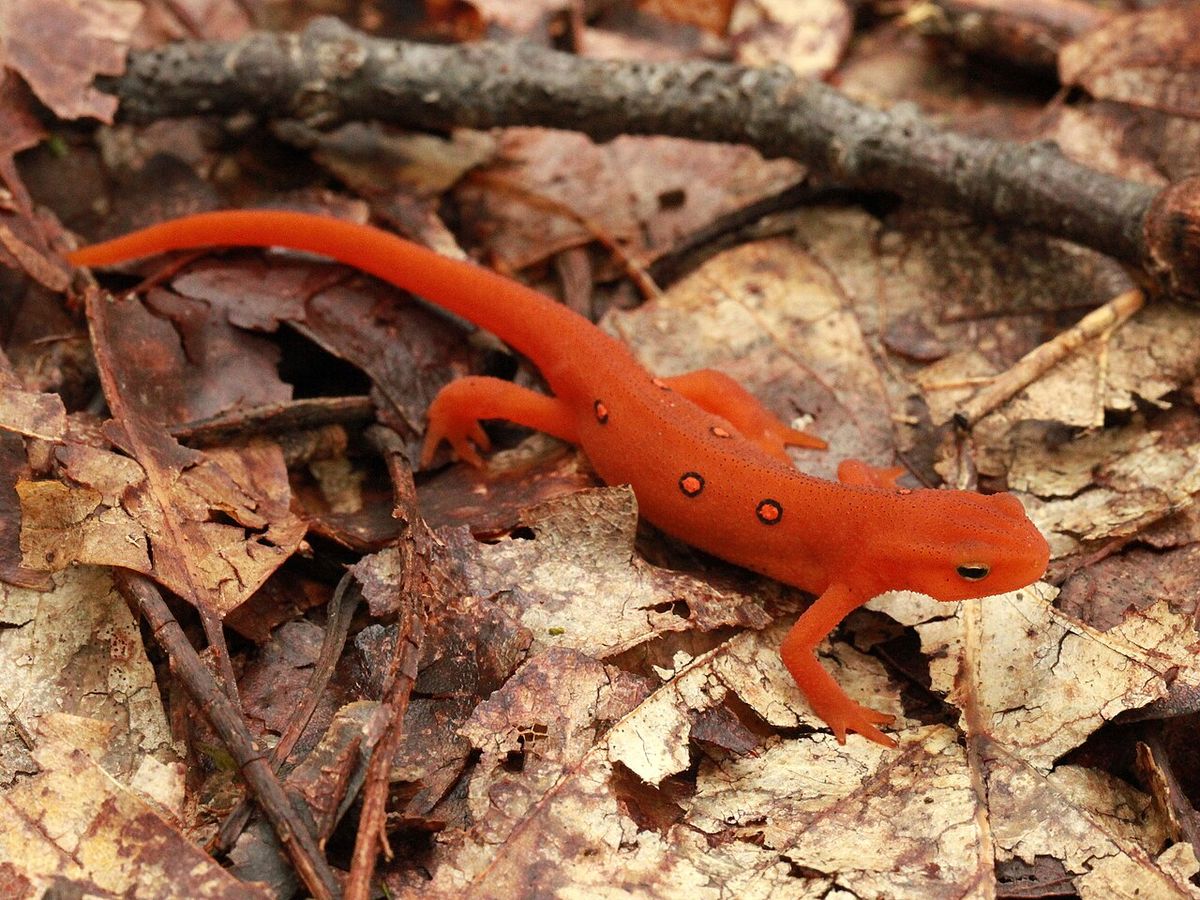
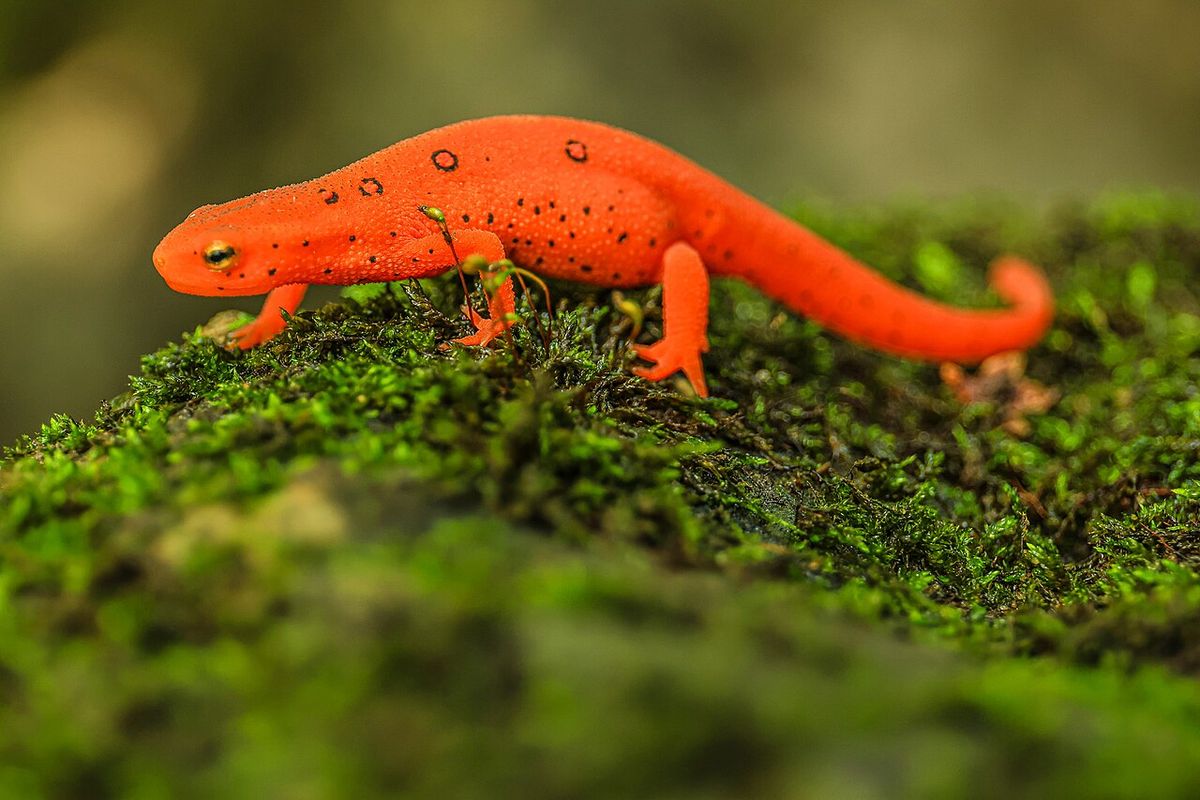
The eastern newt is a moderately sized salamander with a complex life history that influences its appearance. Adults typically reach up to 13 centimetres in length and possess a dull olive-green dorsal surface with a contrasting dull yellow belly. Their most recognizable feature is the series of black-rimmed red spots that run along their sides, a pattern retained from their juvenile stage. The species exhibits significant variation across its range, which is reflected in its four recognized subspecies. The red-spotted newt (N. v. viridescens) is the nominate and most commonly referenced subspecies, often giving the entire species its alternative name. The broken-striped newt (N. v. dorsalis) and the central newt (N. v. louisianensis) show variations in spot patterns and base colouration, with the central newt often being brown or green with fine black dots. The peninsula newt (N. v. piaropicola) is notable for its frequent neoteny, where larvae mature into breeding adults without undergoing the terrestrial red eft stage, retaining their external gills throughout life.
Life Cycle and Development
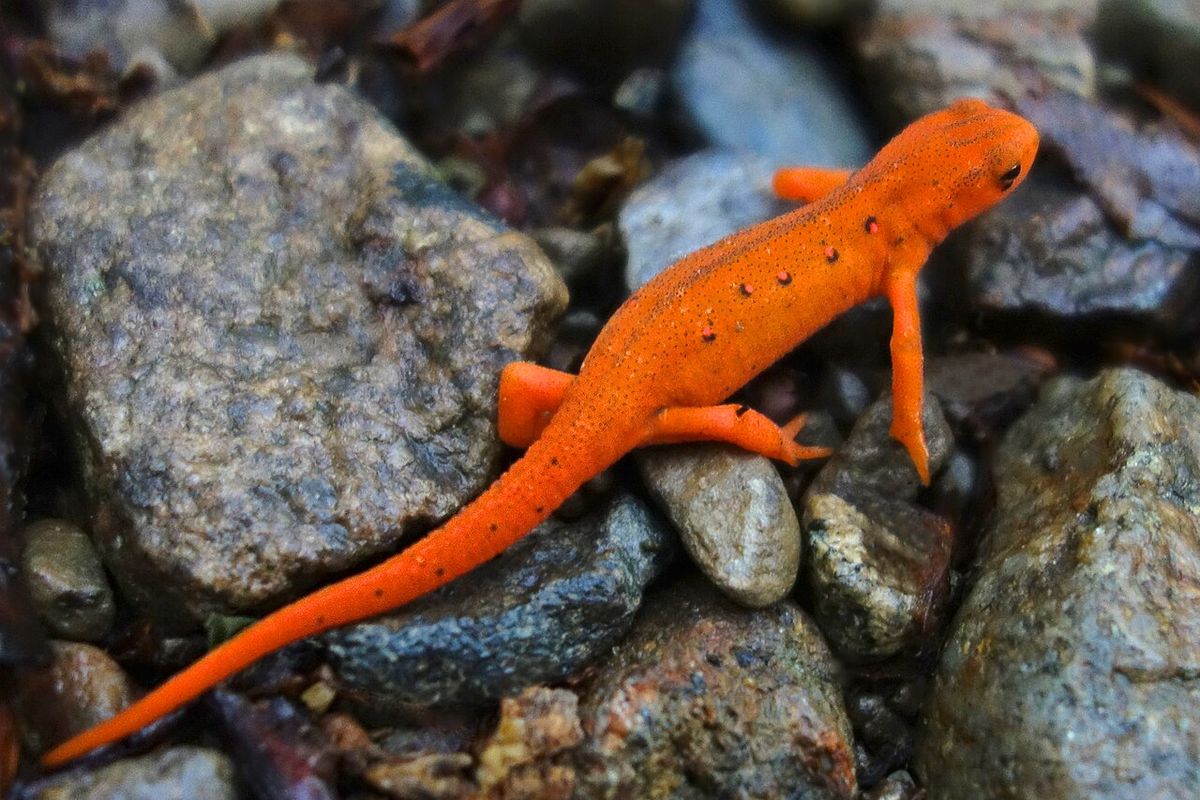
The eastern newt undergoes a remarkable metamorphosis through three distinct life stages, a process that can take several years to complete. The cycle begins with an aquatic larva, which hatches from eggs attached to submerged vegetation and possesses gills for breathing underwater. This larval stage lasts between two to five months and is characterized by high mortality rates due to predation. After this period, the larva transforms into the red eft, a bright orangish-red juvenile that leaves the water to live on land. The eft's vivid colouration, often with up to 21 black-rimmed red spots, serves as aposematic warning coloration due to its toxic skin. This terrestrial dispersal stage can last two to three years, during which the eft may travel considerable distances from its natal pond. Finally, the eft undergoes a second metamorphosis to become an aquatic adult, returning to the water to breed. In some populations, particularly the peninsula newt, the red eft stage is skipped entirely through neoteny. The entire lifespan of an eastern newt in the wild averages 12 to 15 years, though some individuals may live longer.
Habitat and Distribution
Eastern newts are highly adaptable amphibians found throughout eastern North America, from the Canadian Maritimes south to Florida and west to the Great Lakes region and eastern Texas. They thrive in a mosaic of aquatic and terrestrial habitats connected by damp corridors. Their preferred aquatic environments include shallow, vegetated ponds, quiet stretches of streams, swamps, and ditches with abundant submerged plants. These water bodies are essential for breeding and the larval and adult aquatic stages. Adjacent damp woodlands, both coniferous and deciduous, provide critical habitat for the terrestrial red eft stage and for adults during dry spells. Newts are most active on the surface during warm, rainy periods above 12 degrees Celsius and will take shelter under leaf litter or logs in dry conditions. Studies show a slight habitat preference difference between sexes, with males favouring more open aquatic areas for courtship and females spending more time in forested terrestrial areas when preparing to lay eggs. Their ability to travel overland, especially as efts, allows them to colonize new ponds and maintain genetic diversity within populations.
Diet and Feeding Behaviour
Eastern newts are carnivorous predators that play a significant role in controlling invertebrate populations within their ecosystems. Their diet shifts according to their life stage but consistently consists of small, live prey. As larvae, they consume tiny aquatic invertebrates. During the terrestrial eft stage and as adults, their menu expands considerably. Adult eastern newts feed approximately every two to three days on a wide variety of prey. Their annual energy intake is estimated at about 35,000 kilocalories, derived from consuming substantial quantities of insects, worms, snails, and other small invertebrates.
Eastern newts are carnivorous and feed on a variety of prey every two to three days. As larvae, they consume small aquatic invertebrates. Adult eastern newts eat insects, worms, snails, and other small invertebrates. Their specific prey includes insects, springtails, soil mites, small mollusks, crustaceans, young amphibians, worms, and frog eggs. They also consume a significant number of snails, beetles, ants, and mosquito larvae.
- Insects such as beetles and ants
- Springtails and soil mites
- Small mollusks and crustaceans
- Snails, which form a major part of their consumption
- Mosquito larvae, aiding in pest control
- Young amphibians and frog eggs
This predatory activity is beneficial to humans because it helps control insect populations. Eastern newts are a vital part of many ecosystems, serving as both predators and prey. Their dietary habits help maintain balance in their habitats. They are a vital link in the food web.
Behaviour and Adaptations
Eastern newts exhibit a suite of complex behaviours and physiological adaptations that enable their survival across changing environments. They are ectothermic, relying on external heat sources, and display considerable adaptability to temperature fluctuations, even surviving and breeding under winter ice. During cold months, some individuals burrow or seek shelter, though hibernation is not universal across their range. A key survival adaptation is the production of tetrodotoxin, a powerful neurotoxin secreted through their skin, which deters most predators and is the reason for their bright warning colouration. Studies have shown larvae can increase toxin production when predators like dragonflies are present. For navigation, eastern newts utilize a sophisticated magnetoreception system, likely involving biogenic magnetite, which acts as a hybrid magnetic and sun-dependent compass for homing. Their average overnight travel distance is about 15 metres, though they can traverse over 70 metres, with movement heavily influenced by humidity and precipitation. Socially, they exhibit territoriality and hierarchy, particularly among males during the breeding season when they defend areas to attract mates.
Reproduction
Eastern newts have an annual breeding cycle that typically occurs from late fall through early spring, often triggered by rainfall events that prompt migration to breeding ponds. They are polygynandrous, meaning both males and females mate with multiple partners. Males develop secondary sexual characteristics for breeding, including a deeply keeled tail and visible bumps on the inner thighs. Courtship involves the male using fanning motions of his tail to waft pheromones toward the female, with his spotted pattern serving as an additional lure. There is evidence that males show a preference for larger females. Once a female accepts a mate, the male deposits a spermatophore (a packet of sperm) onto the substrate, which the female retrieves to internally fertilize her eggs. Females can store sperm for up to ten months before laying eggs. A single female will lay a batch of 200 to 400 eggs, carefully attaching them individually to submerged vegetation or other objects. The incubation period lasts from three to eight weeks before the aquatic larvae hatch. Successful gonad development and reproduction depend on the presence of fat bodies near the developing reproductive organs.
Threats and Conservation
Despite being a widespread species, the eastern newt faces mounting conservation pressures common to many amphibians. The primary threat is habitat loss and fragmentation, particularly the draining and degradation of wetlands. Since the 1780s, over 53 percent of wetlands in the United States have been lost, severing crucial connectivity between populations. They are highly sensitive to pollution, with studies showing sublethal effects from substances like coal-tar pavement runoff, which impairs their righting ability and swimming speed. Eastern newts are also vulnerable to several emerging infectious diseases. They are known hosts for the chytrid fungi Batrachochytrium dendrobatidis and the more recently discovered and highly lethal Batrachochytrium salamandrivorans. They can also be infected by Ranavirus and the mesomycetozoan Amphibiocystidium ranae, which causes subcutaneous cysts and mortality. Climate change, invasive species, and over-collection for the pet trade present additional, compounding risks. Their status as a sensitive indicator species means population declines often signal broader environmental stress, highlighting the importance of conserving their wetland and forest habitats.
Specific documented threats to eastern newt populations include habitat fragmentation, climate change, invasive species, over-exploitation, and emergent infectious diseases. The loss of wetlands and their connectivity is a major threat, as more than 53 percent of wetlands in the United States have been lost since the 1780s. They are threatened by deforestation, habitat fragmentation, and pollution. They are highly susceptible to the newly emergent chytrid fungus Batrachochytrium salamandrivorans.
- Habitat loss: Over 53% of U.S. wetlands lost since the 1780s.
- Pollution: Sublethal toxicity from coal-tar pavement runoff.
- Disease: Infection by Batrachochytrium dendrobatidis fungus.
- Disease: Infection by Batrachochytrium salamandrivorans fungus.
- Disease: Infection by Ranavirus.
- Disease: Infection by the mesomycetozoan Amphibiocystidium ranae.
- Climate change altering habitat conditions.
- Over-exploitation for the pet trade.
Remarkable Abilities
Beyond their toxic defenses, eastern newts possess extraordinary regenerative capabilities that are a major focus of scientific research. They can fully regenerate limbs lost to injury, a process that reactivates genetic pathways similar to those used during initial limb development in embryos. This ability extends far beyond simple wound healing. Eastern newts are also capable of regenerating complex internal structures, including significant portions of their spinal cord, heart tissue, and other vital organs. This regenerative power is believed to be linked to their high retention of stem cells throughout life, which allow for the repair and regrowth of damaged tissues. These traits make the eastern newt an invaluable model organism in biomedical studies aimed at understanding tissue regeneration and potential applications for human medicine.
Population and Ecological Data
While comprehensive census data for eastern newts is limited, their population dynamics and ecological impact are understood through various behavioural and habitat studies. Their survival from egg to adulthood is low, with only an estimated two percent of larvae surviving to become terrestrial efts, due to high predation pressure in aquatic environments. Their role as both predator and prey creates a significant energy transfer within ecosystems. The table below summarizes key ecological and behavioural metrics derived from research on the species. These figures highlight the species' mobility, ecological footprint, and vulnerability. Their movement is strongly promoted by moist surface conditions, and their home range size is primarily determined by food availability and substrate humidity rather than competition or shelter.
| Metric | Typical Value or Characteristic |
|---|---|
| Average Overnight Movement | 15 metres |
| Maximum Recorded Movement | Over 70 metres |
| Annual Energy Intake | Approximately 35,000 kcal |
| Larval Survival to Eft Stage | ~2% |
| Primary Dispersal Stage | Red eft (juvenile) |
| Key Navigation Sense | Magnetoreception |
| Major Conservation Threat | Wetland loss and fragmentation |
Research has identified several key natural predators of the eastern newt across its life stages. These predators include fish, snakes, birds, and larger salamanders. The larval eastern newt is the most heavily preyed upon stage. Larvae are commonly predated on by fish, aquatic insects, and other adult newts. One study observed a Belted Kingfisher eating an eastern newt.
- Fish, which prey heavily on larvae.
- Snakes.
- Birds, such as the Belted Kingfisher (Megaceryle alcyon).
- Larger salamanders.
- Aquatic insects, particularly on larvae.
- Other adult newts, which may cannibalize larvae.
Questions about Eastern newt
Are eastern newts poisonous?
Yes, eastern newts produce a potent neurotoxin called tetrodotoxin in their skin, which serves as a defense mechanism against predators. This toxin can cause muscle paralysis and is strong enough to deter most fish, birds, and other potential threats. The bright orange-red colouration of the red eft stage acts as a warning signal (aposematism) to advertise this toxicity. It is advised not to handle them with bare hands, and they should never be ingested.
What is a red eft?
A red eft is the terrestrial juvenile stage of the eastern newt's life cycle. It is bright orangish-red with darker red spots outlined in black and lives on land for two to three years after transforming from an aquatic larva. This stage acts as a dispersal phase, allowing the newt to travel overland to find new ponds, which promotes genetic mixing in the population. The eft eventually undergoes a second metamorphosis to become an aquatic, breeding adult.
What do eastern newts eat?
Eastern newts are carnivorous and their diet changes with life stage. Larvae eat small aquatic invertebrates. Adults and terrestrial efts consume a wide variety of prey including insects, worms, snails, slugs, springtails, soil mites, small crustaceans, and even frog eggs and young amphibians. They are particularly effective consumers of snails and mosquito larvae, playing a beneficial role in controlling these populations within their ecosystems.
Why are eastern newts important to the ecosystem?
Eastern newts are a vital component of their ecosystems, serving dual roles as both predators and prey. As predators, they help control populations of insects, snails, and other invertebrates. As prey, they provide a food source for fish, snakes, birds, and larger salamanders, though their toxins limit predation. Their sensitivity to pollution and habitat degradation makes them excellent indicator species. Population health reflects the overall condition of wetland and forest habitats, alerting conservationists to environmental problems.
Where can you find eastern newts in Canada?
Eastern newts are found in the eastern provinces of Canada. They inhabit small lakes, ponds, vernal ponds, and streams or nearby wooded areas in eastern North America. They are at home in both coniferous and deciduous forests and require a moist environment with a temporary or permanent body of water. Their habitat preferences include shallow water, quiet stretches of streams, swamps, or ditches with heavy submerged vegetation and nearby damp woodlands. During the terrestrial red eft stage, they may travel far from water and are often seen in forests after a rainstorm. Adults prefer muddy aquatic habitats but will move to land during dry spells.
How long do eastern newts live?
Eastern newts have a lifespan of 12 to 15 years in the wild. Some sources note a lifespan of about 7 to 10 years, with some individuals known to live up to 15 years. Their life cycle includes three distinct stages: an aquatic larva, a terrestrial juvenile red eft, and an aquatic adult. The larval stage lasts 2 to 5 months, and the eft stage typically lasts two or three years before transforming into an adult. This extended lifespan allows them to breed over multiple seasons, as they breed once per year from late fall until early spring. Their longevity is one factor in their role as a common species in eastern North American ecosystems.
Sources and further reading
- Eastern newt (Wikipedia)
- » Red-spotted Newt (ontarionature.org)
- Eastern Newt: Reptiles & Amphibians: Species Information (maine.gov)
- Eastern Newt, BioKIDS, University of Michigan (biokids.umich.edu)
- How to Care for Your Eastern Newt (reptilesupply.com)
Checked by the Your Space Hamilton desk. Last updated 2026-11-02.