Eastern massasauga
The eastern massasauga (Sistrurus catenatus) is a small, venomous rattlesnake native to the Great Lakes region of eastern North America. In Canada, it is found only in southern Ontario, where it is the province's sole venomous snake and one of only three rattlesnake species in the country. This species is listed as threatened under both Ontario's Endangered Species Act and the federal Species at Risk Act due to significant habitat loss, road mortality, and persecution. As an umbrella species, conservation efforts for the eastern massasauga benefit a wide array of other plants and animals sharing its diverse habitat.
Description and Identification
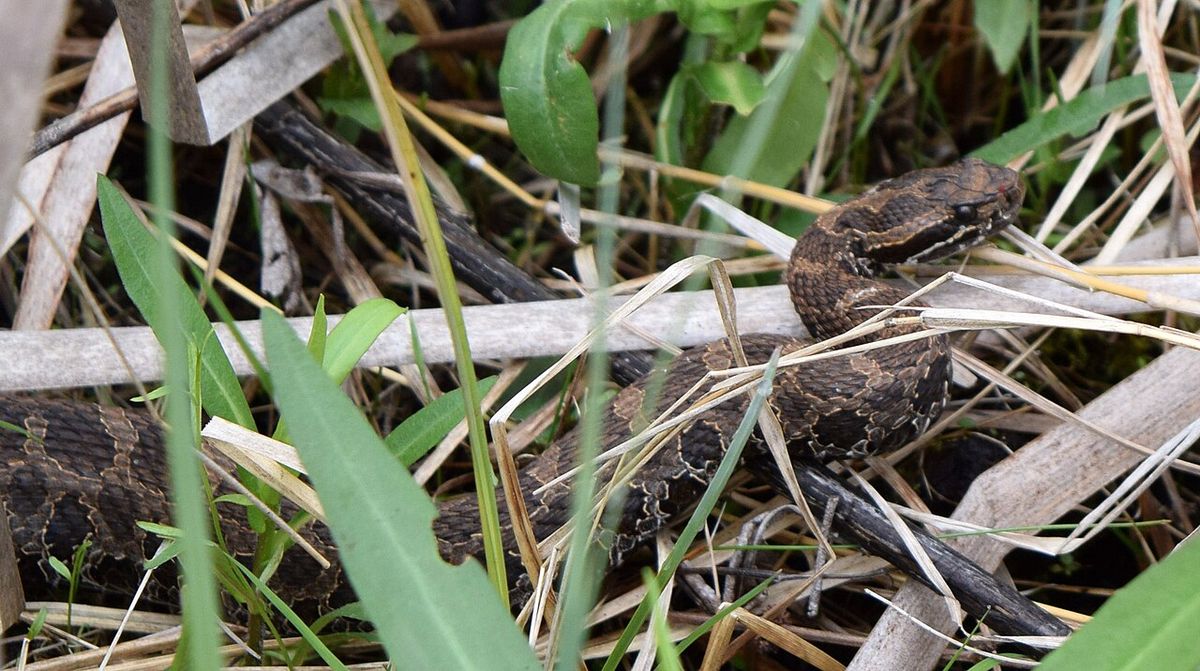
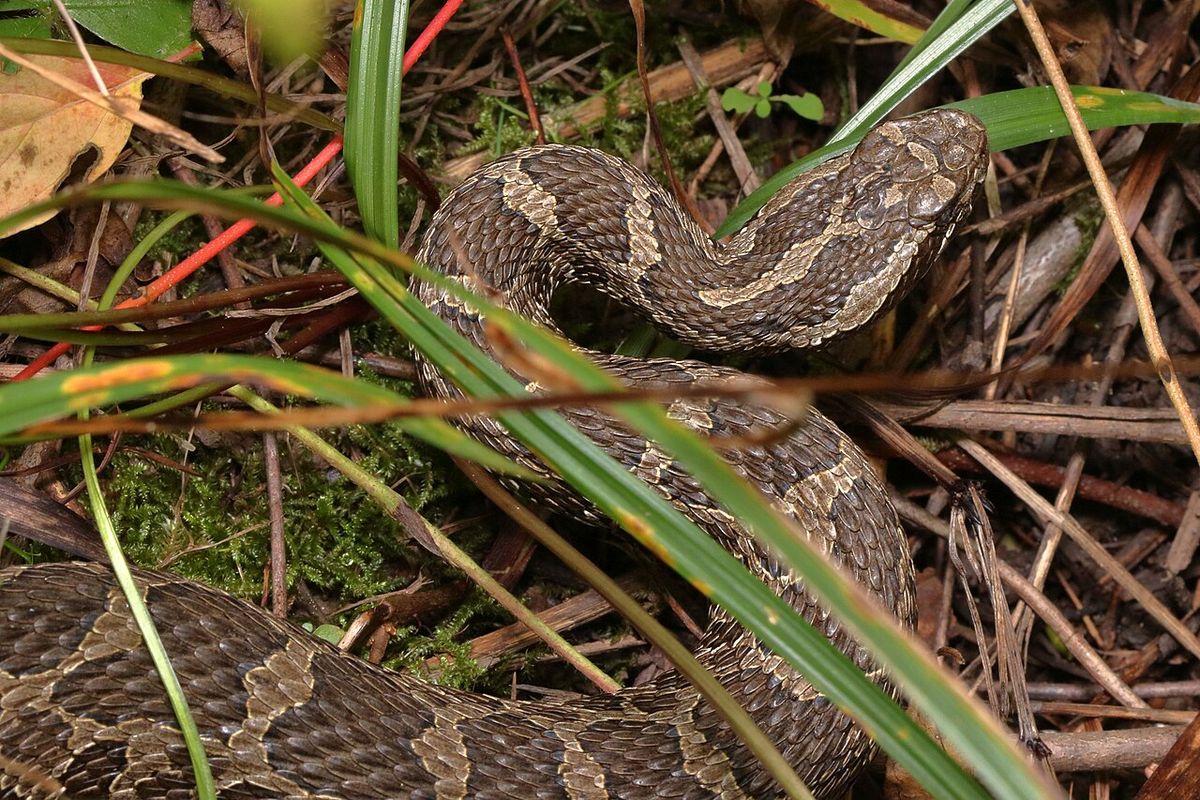
The eastern massasauga is a relatively small, thick-bodied rattlesnake. Most adults range from 55 to 75 centimetres in length, though they can occasionally reach up to one metre. Its colouration is typically grey, tan, or brown, featuring a distinctive pattern of large, dark brown, saddle-shaped blotches down the centre of its back. These alternate with three rows of smaller blotches along each side. The belly is black or dark brown with scattered light markings. The snake's head is distinctly triangular and features vertical pupils, a characteristic not shared by Ontario's non-venomous snakes. Like all pit vipers, it possesses heat-sensing pits located between its nostrils and eyes. The most recognizable feature is its rattle, composed of interlocking keratin segments added each time the snake sheds its skin. The dorsal scales are keeled, giving the snake a rough texture, and the anal scale is single.
Juvenile massasaugas have a similar pattern but are generally paler than adults. Melanism, or a solid black colouration, is also known to occur in some individuals, and there are cases where the dorsal blotches join with those on the sides. The species can be confused with several non-venomous snakes in Ontario, such as the eastern foxsnake, eastern milksnake, and northern watersnake. Key distinguishing features of the massasauga include its rattle, vertical pupils, and the saddle-shaped blotches. The foxsnake and milksnake may vibrate their tails in dry vegetation when threatened, mimicking the sound of a rattle, but they lack the actual structure and have round pupils. The milksnake has smooth scales, and the foxsnake's scales are only weakly keeled compared to the massasauga's strongly keeled scales. The rattle itself can break off, so its absence does not definitively indicate the snake is not a massasauga, making the pupil shape and blotch pattern critical secondary identifiers.
Taxonomy and Etymology
The eastern massasauga's scientific name, Sistrurus catenatus, has descriptive origins. The generic name Sistrurus is derived from the Greek 'seistron' or Latin 'sistrum,' meaning a type of rattle or musical instrument, combined with 'oura,' the Greek word for tail. The specific epithet catenatus comes from the Latin 'catena' for chain, combined with the suffix 'atus' meaning provided with, likely alluding to the chain-like pattern of blotches along the snake's back. For over a century, it was considered one of three subspecies within Sistrurus catenatus, but taxonomic revisions based on research published in 2011 recognized Sistrurus catenatus catenatus and Sistrurus catenatus tergeminus as full species. The eastern massasauga (Sistrurus catenatus) is now considered a separate species from the western massasauga (Sistrurus tergeminus). The eastern massasauga is currently considered monotypic, meaning it has no recognized subspecies of its own.
The standardized English name, eastern massasauga, and the common name 'massasauga' itself come from the Ojibwe language, where it means 'great river-mouth.' This name was likely given to describe the grasslands surrounding the river deltas in Ojibwe territory, which aligns with the snake's affinity for wetland habitats. The species has accumulated numerous colloquial names across its range, reflecting its varied habitats and appearances. These include massasauga rattler, black massasauga, swamp rattler, prairie rattlesnake, little grey rattlesnake, muck rattler, and triple-spotted rattlesnake. In Michigan, it has been called the Michigan point rattler, and historically it was also known as Kirtland's rattlesnake. Other names noted in various regions include black rattler, black snapper, gray rattlesnake, dwarf prairie rattlesnake, and ground rattlesnake.
Distribution and Habitat
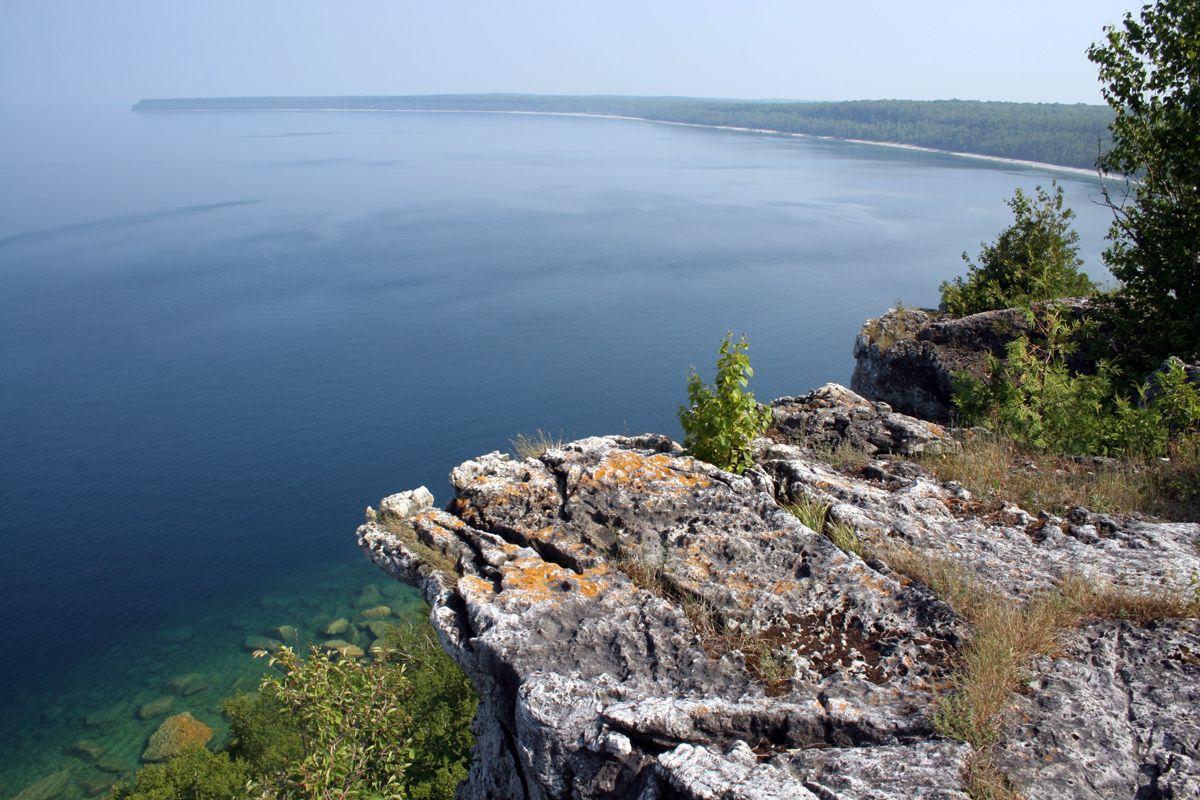
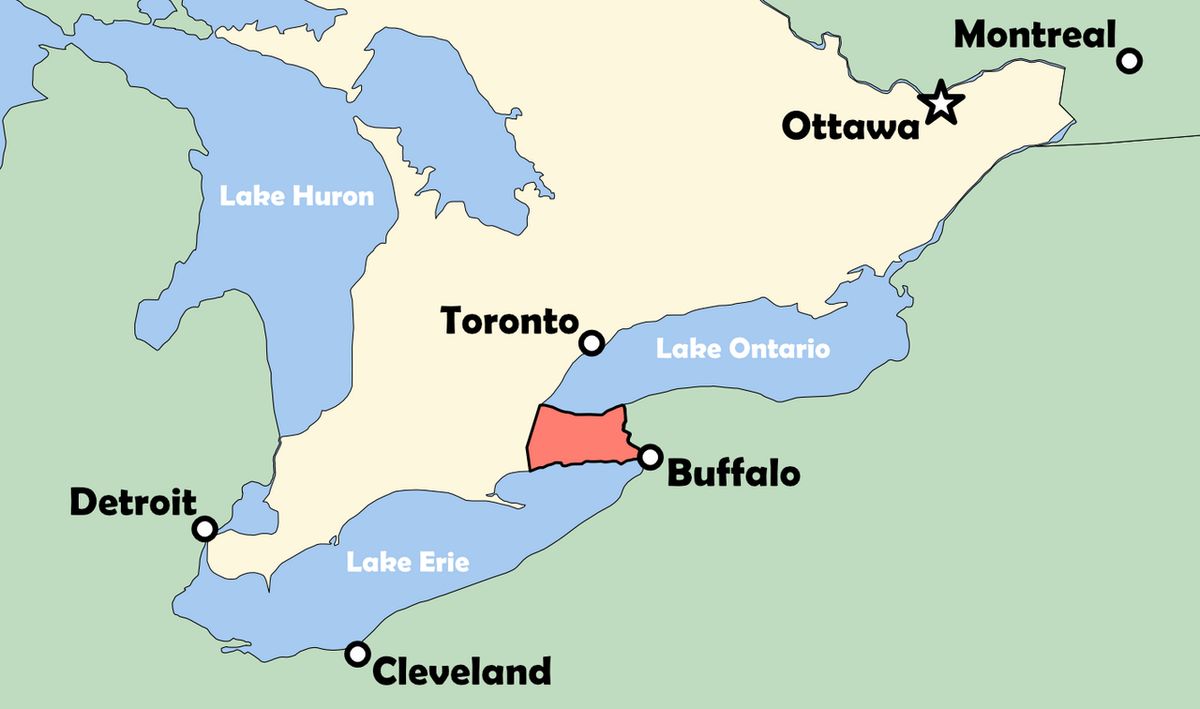
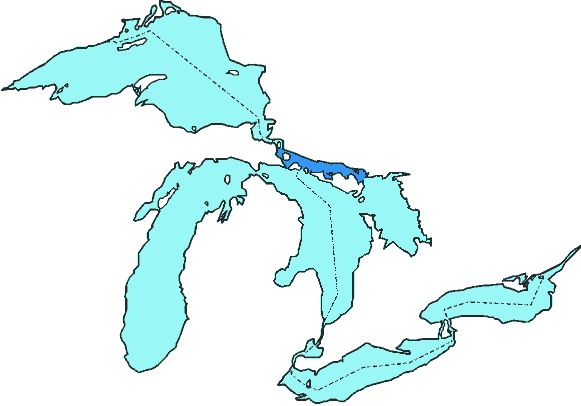
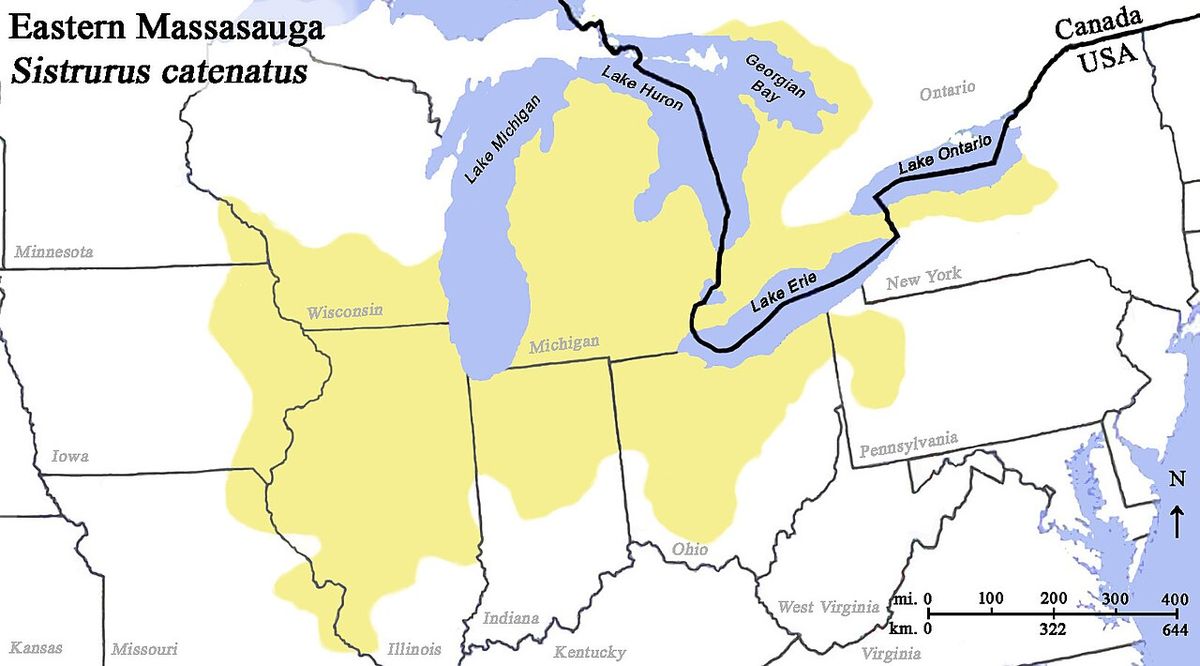
The eastern massasauga's range is centred on the Great Lakes region. In Canada, its distribution is now restricted to several small, isolated areas in southern Ontario. Populations are found near the eastern shore of Georgian Bay, on the northern Bruce Peninsula, at Wainfleet Bog on the Niagara Peninsula, and in the Ojibway Prairie complex near Windsor and LaSalle. Historically, the snake was likely more widespread across southwestern Ontario, from the vicinity of the North Channel of Lake Huron eastward across Georgian Bay, throughout the Ontario Peninsula to the Niagara Peninsula and areas north of Lake Erie. In the United States, it occurs in disjunct populations from western New York and Pennsylvania westward through lower Michigan, northern Ohio and Indiana, much of Illinois, southern Wisconsin, eastern Iowa, and marginal areas of eastern Missouri and Minnesota.
This snake is a habitat generalist but is most often found in the vicinity of wetlands such as marshes, bogs, fens, shrubby peatlands, wet meadows, and floodplains. Its Ojibwe name, 'massasauga,' means 'great river-mouth,' reflecting this connection to aquatic ecosystems. However, it also utilizes a variety of other habitats including rocky outcrops, grasslands, prairies, coniferous forests, forest clearings, shorelines, and old fields. A critical requirement is access to open-canopy areas for basking to regulate body temperature. The species relies on specific microhabitats for shelter and thermoregulation, such as crayfish or mammal burrows, rock piles, log piles, and low vegetation. In spring and fall, individuals often remain close to their hibernation sites, or hibernacula. For hibernation, they require sites that allow them to get below the frost line, often using animal burrows, rock crevices, or root hollows in forested areas near wetlands. Snakes may migrate over a kilometre between their summer foraging grounds and their hibernation sites, to which they often return annually. Gravid females may move to drier upland habitats during the summer months.
Population Decline and Historical Range
The eastern massasauga has experienced a severe range contraction and population decline since the 20th century. It has been extirpated from large areas where it was once common, now persisting mostly in smaller, isolated, and disjunct populations. This decline is starkly illustrated by its status in various American states. In Illinois, the species was formerly common over the northern two-thirds of the state but by the late 20th century was known from only six or eight relict populations in five or six scattered counties. In Pennsylvania, 19 populations were historically known from six northwestern counties, but by 1977 only six populations in three counties remained, and a 2003 to 2005 survey showed only four locations in two counties with confirmed populations. The species is considered extirpated in Missouri and is listed as endangered in Illinois, Indiana, Iowa, Minnesota, New York, Ohio, Pennsylvania, and Wisconsin.
In Canada, the story is similar. The massasauga has been extirpated from much of its previous range in southwestern Ontario and is now restricted to the few remaining pockets. The Carolinian population in the Windsor-LaSalle area is critically endangered, with snakes found only in two very small subpopulations at Wainfleet Bog and Ojibway Prairie. The primary drivers of this collapse have been consistent across its range: the draining of wetlands for agriculture, urban and highway construction, habitat fragmentation, and direct persecution by humans. In Pennsylvania, natural forest succession has also become a major factor, as growing forests shade out the open-canopy habitats the snakes require for basking. Road mortality is a particularly severe and ongoing threat, especially in protected areas where other human pressures are reduced but snakes must cross roads to reach different habitat components. This threat is compounded by the snake's slow movement and the increasing network of roads through its remaining habitat.
Biology and Life History
The eastern massasauga is a pit viper and an ovoviviparous species, meaning females give birth to live young. In Canada, females typically have a biennial reproductive cycle, breeding only once every two years, though a few females in Wisconsin have been noted to reproduce annually. Mating primarily occurs from mid-July to late August. After a gestation period of nearly a year, females give birth to a litter of live young, typically in August or September. Litter size is variable, with studies in Illinois reporting litters of 5 to 14 young and Wisconsin studies reporting ranges of 6 to 19. In Canada, the average is about nine young, but the range can be from 2 to 21. Newborn snakes, called neonates, measure between 16 and 24 centimetres in snout-to-vent length at birth. The mother and neonates remain together for a short period, usually a few days until the young undergo their first skin shedding. Sexual maturity is usually reached between three to six years of age, with females requiring a minimum length of approximately 32.5 centimetres, often attained in their third or fourth year. The maximum lifespan in the wild is estimated to be 14 to 17 years.
The species is a sit-and-wait predator, relying on camouflage and patience to ambush prey. Its heat-sensing pits are highly effective for detecting warm-blooded animals, especially at night. The primary diet of adults consists of small mammals such as voles, white-footed mice, jumping mice, shrews, and chipmunks. Juveniles usually prey on reptiles. In eastern populations they more often eat other snakes, while in western populations lizards are more common. Frogs can constitute an important part of the diet in some northern and eastern populations, with one 1928 study noting they made up the main portion of the diet in Michigan. However, overall, frogs are not considered a primary food source for the species. The venom is cytotoxic, designed to destroy tissue and disrupt blood flow and clotting, which quickly subdues prey. After envenomation, the snake can retreat and wait for the prey to die before consuming it whole. This strategy protects the snake from injury by sharp-toothed rodents. The diet can also include birds, bird eggs, centipedes, and insects, but mammals and reptiles form the bulk of its food intake.
Conservation Status and Legal Protections
The eastern massasauga faces severe threats across its range and is legally protected at multiple levels. In May 2025, the Committee on the Status of Endangered Wildlife in Canada (COSEWIC) assessed the species as a single designatable unit and classified it as Threatened. It is listed as threatened under Ontario's Endangered Species Act, 2007, and the federal Species at Risk Act. The Carolinian population in southern Ontario is considered Endangered. The snake is also protected as a Specially Protected Reptile under Ontario's Fish and Wildlife Conservation Act. In the United States, it is listed as a federally threatened species under the Endangered Species Act as of 2016 and is a candidate for the endangered species list. By individual state agencies, it is listed as endangered in Illinois, Indiana, Iowa, Minnesota, Missouri (where it is considered extirpated), New York, Ohio, Pennsylvania, and Wisconsin. Michigan, which holds significant populations, lists it only as a species of 'special concern.'
Major threats have led to a dramatic decline and fragmentation of its populations. The primary causes are habitat loss and degradation due to wetland drainage, agricultural conversion, urban development, and natural forest succession which reduces crucial open-canopy areas. Road mortality is a significant and ongoing threat, particularly for this slow-moving snake during seasonal migrations. Deliberate persecution and killing by humans, driven by fear, also contribute to population declines despite the negligible risk the snakes pose. The species is further threatened by emerging diseases such as snake fungal disease, which affects the skin of rattlesnakes. These cumulative pressures have confined the massasauga to small, isolated populations that are vulnerable to local extinction, a pattern seen from Ontario to Pennsylvania where it is classified as 'critically imperiled' to 'imperiled.' The species was listed as of least concern on the IUCN Red List in 2007, but that assessment noted it needed updating and the population trend was unknown.
The Massasauga as an Umbrella Species
Conservationists recognize the eastern massasauga as an important umbrella species. This concept involves focusing protection efforts on a single species whose habitat requirements are broad enough that safeguarding it also protects a wide community of other species. The massasauga is an ideal candidate for this role for two key reasons. First, it is in dire need of protection, with its Canadian populations critically reduced, triggering the need for immediate recovery actions. Second, it requires a highly diverse array of habitats and microhabitats to complete its life cycle, meaning conservation actions must address a wide ecological spectrum. The higher the diversity of microhabitat requirements a species has, the greater the 'umbrella effect' it provides.
The snake uses both upland and wetland habitats, open and closed canopy areas, and above-ground and below-ground environments. For instance, it needs open prairies, rock barrens, or meadows for basking and foraging, forest-wetland complexes for hibernation, and specific microhabitats like brush piles, rock piles, or crayfish burrows for shelter. Protecting these interconnected habitats benefits numerous other species at risk. In the Ojibway Prairie area, conservation for the massasauga helps protect species like the eastern chipmunk, which provides both a food source and hibernation burrows, and rare plants such as dense blazing star and colicroot. Tallgrass prairies, which the massasauga uses, are among the rarest ecosystems in Canada, with only about 1 percent remaining in Ontario. By casting a wide 'umbrella' of habitat protection, efforts to recover the eastern massasauga contribute to the health of entire ecosystems, making it a strategic focal point for conservation programs like the Ojibway Prairie Reptile Recovery program which works to protect several reptile species in the Windsor-LaSalle region.
Venom and Human Safety
The eastern massasauga possesses a cytotoxic venom that destroys tissue and contains specialized digestive enzymes that disrupt blood flow and prevent clotting. This venom is highly effective for subduing the snake's small mammal prey but poses a low risk to humans. The species is notably shy, reclusive, and avoids humans when it can. When threatened, its first defences are to remain motionless and rely on its camouflage, rattle as a warning, or retreat under nearby cover. A bite is typically a last resort. Researchers note that even experienced observers searching for the snake find only a very small percentage of those present in an area, and most hikers would walk right by one unaware.
Human encounters resulting in bites are rare and almost always occur when a snake is deliberately handled or accidentally stepped on. In Ontario, only two fatalities from massasauga bites have ever been recorded, both incidents occurring over 40 years ago and in cases where proper medical treatment was not received. The risk to the public is therefore negligible. Safety precautions are straightforward: when hiking in known rattlesnake areas, wear sturdy shoes and long pants, stay on trails, avoid reaching into areas of low visibility like rock piles or tall grass, and never attempt to handle, harass, or kill a snake. If encountered, it is best to give the animal a wide berth and allow it to move away. This combination of respect and simple preventative measures ensures safe coexistence with this threatened component of Ontario's natural heritage.
Similar Species and Misidentification
Several non-venomous snakes in Ontario are commonly mistaken for the eastern massasauga, leading to unnecessary fear and sometimes persecution. Learning to distinguish them is key to coexistence and conservation. The eastern massasauga is the only snake in Ontario with a true rattle, vertical pupils, and heat-sensing pits. Other species may mimic some of these traits defensively but lack the full combination. The eastern foxsnake is a large snake, often with a yellowish background and dark blotches, and it may vibrate its tail in dry leaves when threatened, producing a buzzing sound that mimics a rattle. It has round pupils and only weakly keeled scales. The eastern milksnake features smooth scales and a pattern of light-edged, reddish-brown blotches on a grey or tan background, often with a Y- or V-shaped mark on the head, and it also lacks a rattle and has round pupils. The northern watersnake is heavily built and almost always found near water, with a pattern of dark crossbands on the neck that break into alternating blotches further down the body, and it has round pupils. The eastern hog-nosed snake is known for its dramatically upturned snout and theatrical defensive displays, which include flattening its neck like a cobra, hissing, and even playing dead, and it lacks a rattle and has round pupils. None of these species possess the combination of a segmented rattle, vertical pupils, and heat-sensing pits that define the eastern massasauga. Observing these features from a safe distance allows for accurate identification and helps protect all of Ontario's native reptiles, reducing the chance of the massasauga being killed out of mistaken identity.
Questions about Eastern massasauga
Is the eastern massasauga rattlesnake dangerous to humans?
The eastern massasauga is venomous, but it poses very little danger to humans. It is a shy, reclusive snake that avoids confrontation. Bites are extremely rare and almost always occur when the snake is deliberately handled or accidentally stepped on. In Ontario's recorded history, only two people have died from a massasauga bite, both incidents occurring over four decades ago and involving a lack of proper medical treatment. The snake's first line of defence is to remain still, rattle a warning, or retreat.
What does the eastern massasauga eat?
The eastern massasauga is a carnivorous predator. Adults primarily feed on small mammals such as voles, white-footed mice, jumping mice, shrews, and chipmunks. Juveniles tend to eat more reptiles. In eastern populations they often eat other snakes, while in western populations lizards are more common. While frogs can be part of the diet, particularly in some northern populations like Michigan, they are not a primary food source overall. The snake uses its heat-sensing pits to detect warm-blooded prey, delivers a venomous bite to subdue it, and then swallows the prey whole.
How can you identify an eastern massasauga?
Key identification features include a thick body, a triangular head with vertical pupils, and a tail ending in a segmented rattle. Its back has a pattern of large, dark, saddle-shaped or butterfly-shaped blotches alternating with three rows of smaller spots on the sides. The belly is black with scattered light markings. Unlike Ontario's non-venomous snakes, it has keeled (ridged) scales and heat-sensing pits between the eyes and nostrils. If the rattle is missing, the combination of vertical pupils and the distinct blotch pattern are reliable indicators.
What is being done to protect the eastern massasauga?
The eastern massasauga is legally protected as a threatened species under both Ontario's Endangered Species Act and the federal Species at Risk Act. Conservation efforts include habitat protection and restoration, population monitoring, public education to reduce persecution, and initiatives like wildlife crossings to mitigate road mortality. Specific recovery programs, such as the Ojibway Prairie Reptile Recovery program, work to protect critical habitats and the suite of species that live within them, using the massasauga as an umbrella species to guide conservation action. Its status was most recently reaffirmed as Threatened by COSEWIC in May 2025.
Where can you find eastern massasaugas in Canada?
In Canada, the eastern massasauga is found only in southern Ontario. Its current range is limited to a few isolated areas near the eastern shore of Georgian Bay, the Bruce Peninsula, the North Shore of Lake Huron, Wainfleet Bog, and the Ojibway Prairie complex. Historically, it ranged more widely across southern Ontario, from the North Channel to areas north of Lake Erie, including the Niagara Peninsula. The species has been extirpated from much of its former range due to habitat loss, persecution, and other threats, making it rare in Canada. It is now restricted to these smaller, disjunct populations within its historical geographic distribution.
Why is the eastern massasauga considered an umbrella species?
The eastern massasauga is considered an umbrella species because protecting its habitat confers protection to a wide variety of other plants and animals sharing the same ecological community. This designation is first due to the snake being in dire need of protection itself, particularly in Canada where its Carolinian population is endangered. Second, the massasauga requires a diversity of interconnected habitats and microhabitats to complete its life cycle, including wetlands, prairies, forests, and features like rock piles for thermoregulation. Therefore, conservation actions aimed at securing these varied habitats for the snake inherently create an umbrella of protection for many other species at risk that rely on the same ecosystems, such as certain prairie plants and animals.
Sources and further reading
- Eastern massasauga (Wikipedia)
- » Eastern Massasauga (ontarionature.org)
- The massasauga rattlesnake: nature's umbrella (wildlifepreservation.ca)
- Eastern Massasauga Rattlesnake (thecanadianencyclopedia.ca)
Checked by the Your Space Hamilton desk. Last updated 2026-10-30.