Eastern bluebird
The eastern bluebird (Sialia sialis) is a small, migratory thrush native to North America, celebrated for the male's vivid blue plumage and rusty-red breast. Its range extends from southern Canada across the eastern United States and down to Central America, with a distinct, isolated subspecies residing in Bermuda. In Canada, this species is a cherished sight in open farmlands, orchards, and suburban areas, symbolizing the arrival of spring. Conservation efforts, including widespread nest box programs, have been crucial in reversing population declines caused by habitat loss and introduced species, making the bluebird a success story in avian stewardship.
Taxonomy and Subspecies
The eastern bluebird was formally described by Swedish naturalist Carl Linnaeus in 1758 under the name Motacilla sialis, with the type location recorded as South Carolina. Linnaeus based his short Latin description on the earlier more detailed accounts by English naturalists Mark Catesby and George Edwards. In 1827, English naturalist William Swainson placed the species in the newly created genus Sialia, designating the eastern bluebird as its type species. Seven subspecies are currently recognized across its broad range, reflecting geographical variations in colouration and size. The nominate subspecies, S. s. sialis, is found in south and southeast Canada, the east and central United States, and northeast Mexico. Other subspecies inhabit regions from the southwestern United States down through Mexico and Central America to Nicaragua, including S. s. fulva, S. s. guatemalae, S. s. meridionalis, and S. s. caribaea. The insular subspecies S. s. bermudensis, found only in Bermuda, exhibits a brighter blue coloration compared to mainland birds, while S. s. nidificans is located in east central Mexico.
Physical Description
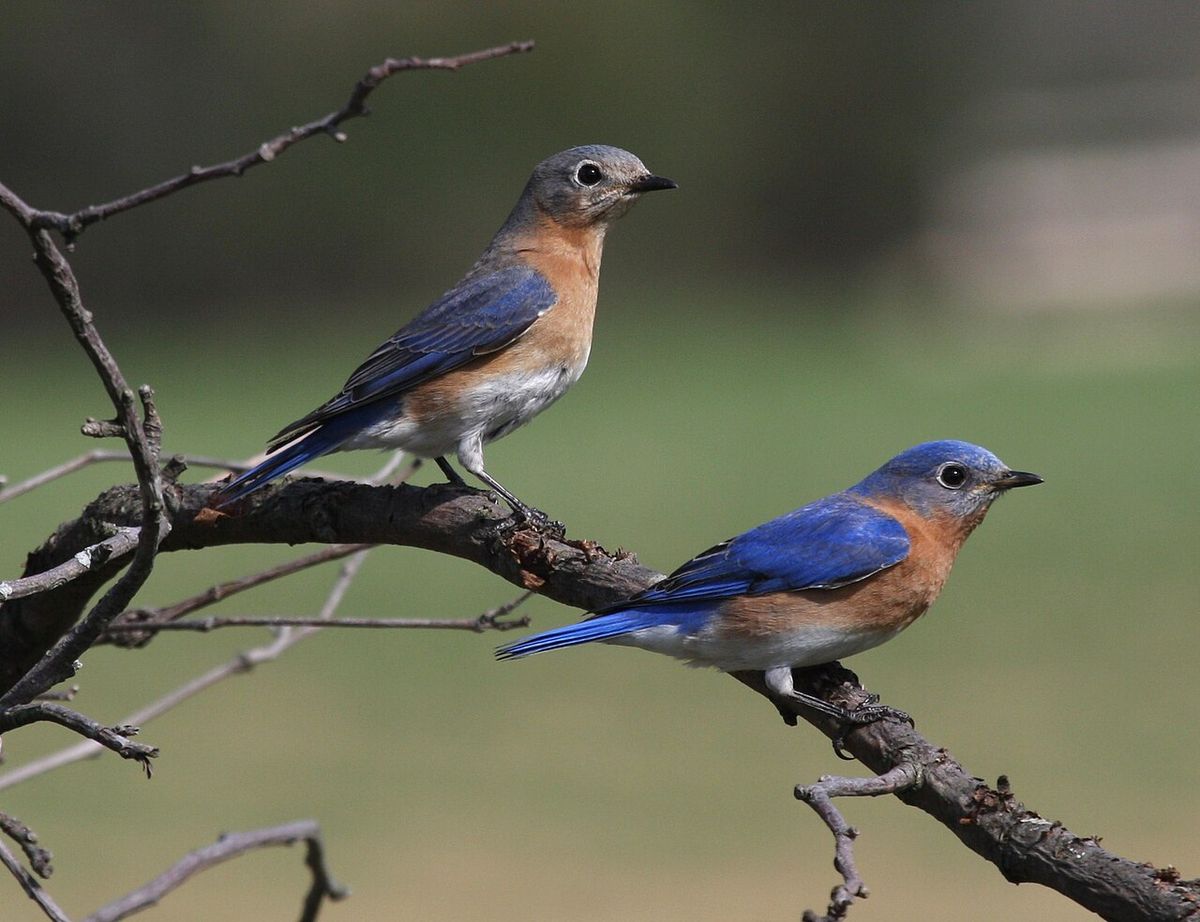
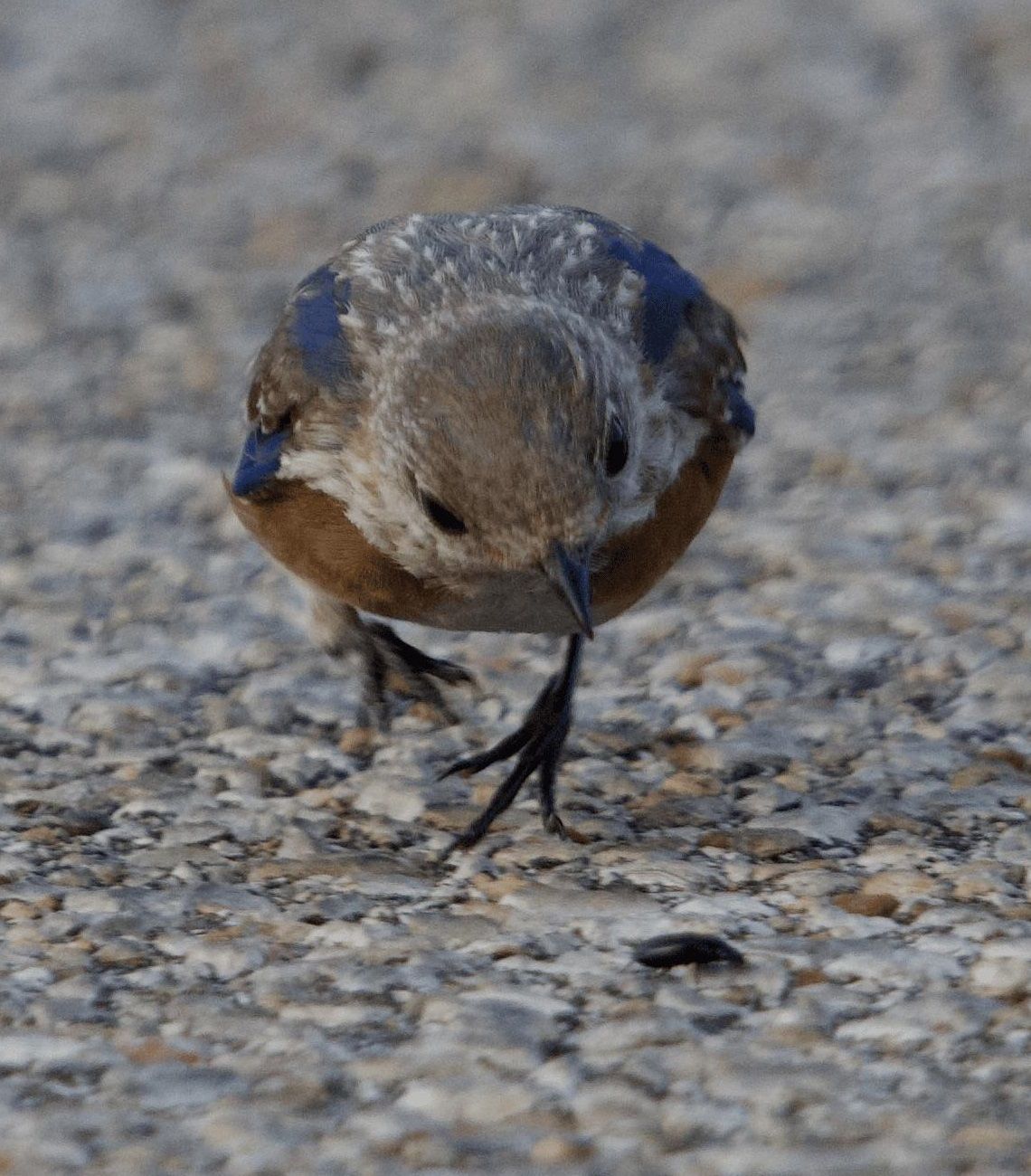
Eastern bluebirds are compact birds, measuring between 16 and 21 centimetres in length with a wingspan of 25 to 32 centimetres. They typically weigh between 27 and 34 grams, making them relatively light. The species exhibits pronounced sexual dimorphism, with males displaying the bright blue plumage on their head, back, and wings, contrasted by a warm brownish-red breast. Females are more subdued in colour, featuring grey on the head and back with some blue on their wings and tail. The female's breast is usually a lighter, more orange shade of brown compared to the male's deeper colour. Juvenile birds are grayish in colour overall with speckled breasts, and the blue colour becomes much more prominent as they mature while the speckles on their breasts disappear. The male's vocalizations include soft warbles of 'jeew' or 'chir-wi', and a melodious song transcribed as 'chiti WEEW wewidoo'.
Distribution, Habitat, and Population Trends
The eastern bluebird's breeding range spans east of the Rocky Mountains, from southern Canada to the Gulf states of the US. Its year-round and wintering range extends south through southeastern Arizona down to Nicaragua, covering a vast portion of eastern North America. An isolated, non-migratory population of the distinct S. s. bermudensis subspecies exists on the island of Bermuda. This population's origin was debated, but a 2013 study using molecular evidence concluded it likely descended from a very small founder population from a single colonization event during the 1600s, which could have been natural or aided by early settlers. The species thrives in open country with scattered trees and sparse ground cover, a habitat historically provided by open, frequently burned pine savannas, beaver ponds, and forest openings. Today, they are most common along pastures, agricultural fields, suburban parks, backyards, and golf courses. Population data from 1966 to 2015 shows the species experienced an annual population increase greater than 1.5% across most of its breeding and year-round ranges. This recovery is attributed to concerted conservation efforts, though exceptions to the positive trend include southern Florida and the Ohio River valley. The westward expansion of the bluebird's range into the Great Plains over the past century was facilitated by fire suppression and tree planting, which increased tree cover in previously open areas.
Behaviour and Ecology
Eastern bluebirds are social outside of the breeding season and will sometimes gather in flocks of over a hundred individuals. They become territorial during spring and summer, defending nesting sites and may continue to defend a feeding area throughout the winter. Their diet consists of about two-thirds insects and other invertebrates, with the remainder made up of wild fruits or berries. They show a strong preference for grasshoppers, crickets, katydids, and beetles, but will also eat earthworms, spiders, millipedes, centipedes, sowbugs, and snails. Bluebirds typically hunt by perching on a high point like a branch or fence post, and swooping down to catch insects on or near the ground. The availability of a winter food source will often determine whether or not a bird will migrate. If bluebirds do remain in a region for the winter, they group and seek cover in heavy thickets, orchards, or other areas where adequate food and cover resources are available. Birds that live farther north and in the western part of the range tend to lay more eggs than eastern and southern birds.
Breeding and Life Cycle
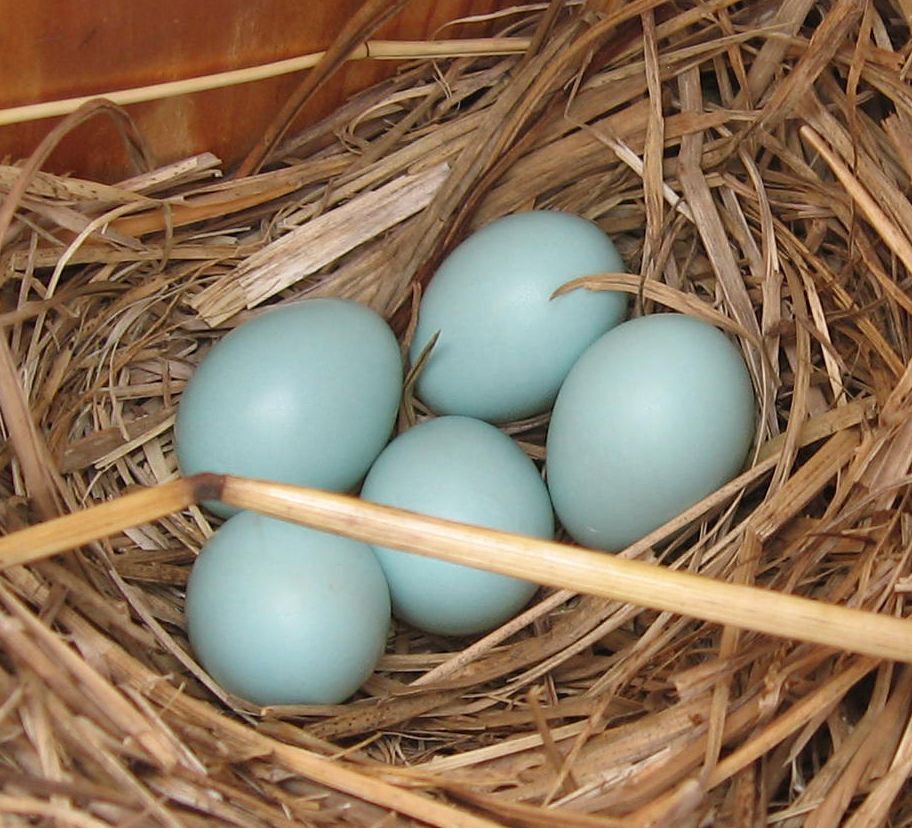
Eastern bluebirds breed in the spring and summer, with a mature female typically raising two broods per season. They are cavity nesters, utilizing abandoned woodpecker holes or other natural cavities that provide adequate protection, usually several feet above ground. The female primarily constructs the nest, a small cup-like structure made of grass, feathers, stems, and hairs, a process that takes around 10 days to complete. The female lays a clutch of three to seven light blue or, rarely, white eggs, which she incubates for 13 to 16 days. Upon hatching, the altricial young are brooded by the female for up to seven days and cannot care for themselves. Both parents cooperate to feed the nestlings a diet consisting almost entirely of insects. The young fledge, or leave the nest, 15 to 20 days after hatching. Some fledglings may stay around the nest to help raise a subsequent brood. Bluebirds can begin breeding the summer after they hatch, and while they can live 6 to 10 years, most die within their first year of life due to various threats. The longest recorded lifespan for a bluebird is 10 years and five months.
Mating for the eastern bluebird occurs in the spring and summer. A mature female typically raises two broods each season, constructing a small, cup-like nest in a tree cavity like an abandoned woodpecker hole. She lays three to seven light-blue eggs and incubates them for 13 to 16 days. The young fledge the nest 15 to 20 days after hatching, and both parents cooperate to feed them a diet consisting almost entirely of insects.
- Nest construction: Primarily by female, takes around 10 days.
- Egg laying: Clutch of 3-7 light blue (rarely white) eggs.
- Incubation: 13-16 days, performed by female.
- Brooding: Female broods hatchlings for up to 7 days.
- Fledging: Young leave nest 15-20 days after hatching.
- Multiple broods: A mature female often raises two broods per season.
Natural predators pose significant threats at all life stages. Eggs and nestlings are vulnerable to eastern chipmunks, flying squirrels, American black bears, fire ants, and raccoons. Bluebirds of all ages are threatened by rat snakes, Eastern racers, American kestrels, and domestic cats. Non-nesting adults face predation by all native species of falcons, owls, and most varieties of hawks, particularly those in the genus Accipiter. When a predator approaches, the male makes a song-like warning cry. If a male is absent, a threatened female will begin to sing, hoping to attract a protective male back to the territory. Both sexes also flick their wings and warble as alarm signals when predators are nearby. Starvation and freezing are also dangers to young birds.
Conservation History and Efforts
Eastern bluebird populations flourished in the 1700s and 1800s, a period thought to be connected with settler activity that created new habitat and nesting sites in rotting wooden fence posts and apple orchards. Populations are believed to have been most abundant around 1900 before suffering a major decline throughout the early to mid-20th century. The main drivers were changes in land use, including clearing land for agriculture and human settlements, intensive logging, and the destruction of dead trees which provided essential nesting cavities. The insecticide DDT also contributed by contaminating insects in the bluebird's diet, leading to eggs with weakened shells that could break during incubation. Some organisations have attributed the decline to competition with introduced house sparrows and European starlings, but their abundance for decades before the bluebird's recovery suggests other factors were more critical. A definite population drop was shown to have occurred between 1938 and the late 1970s.
Organized conservation efforts for the eastern bluebird began as early as 1934 when Thomas Musselman created the first bluebird trail by setting up rows of bluebird houses along roads. Also in the 1930s, William Duncan created a bluebird house design and educated others about these birds. In 1976, Lawrence Zeleny's book and a National Geographic article helped publicize their plight, and he founded the North American Bluebird Society in 1978. These efforts have been fundamental to the species' recovery from major population declines in the mid-20th century.
- 1934: Thomas Musselman created the first bluebird trail by setting up rows of bluebird houses along roads.
- 1930s: William Duncan created a bluebird house design and educated others about these birds.
- 1964: The National Association for Protection and Propagation of the Purple Martin and Bluebirds of America was founded.
- 1976: Lawrence Zeleny's book, 'The Bluebird: How You Can Help Its Fight For Survival', and a National Geographic article he wrote helped publicize the bird's plight.
- 1978: Lawrence Zeleny founded the North American Bluebird Society, which continues conservation work.
The widespread installation and maintenance of nest boxes along trails has been the most effective action in the species' remarkable recovery. The Bermuda subspecies faces a distinct and severe set of challenges. Early settlers described flocks of over 50 birds, but today only about 500 individuals are thought to remain. The near-extinction of native Bermuda cedar forest in the 1940s and 1950s wiped out the majority of natural nesting habitat, leaving the population almost completely dependent on artificial nest boxes for breeding. Introduced starlings and house sparrows evict bluebirds from nests, and introduced great kiskadees feed on juvenile birds. They are also threatened by feral cats and pesticides, making this isolated population highly endangered.
Cultural Significance
The eastern bluebird holds a cherished place in North American culture, long associated with happiness, joy, and the arrival of spring. Early American colonists sometimes called it the 'blue robin' due to its resemblance to the European robin. In traditional Haudenosaunee (Iroquois) cosmology, the call of the bluebird is believed to ward off the icy power of Sawiskera, also called Flint, the spirit of the winter, causing him to flee in fear and the ice to recede. The bird has been featured in the works of many writers, including Henry David Thoreau and John Burroughs, who wrote an essay titled 'The Bluebird'. Poet Robert Frost wrote 'The Last Word of a Bluebird (as told to a child)', and the species is referenced in popular songs like 'Over the Rainbow' from The Wizard of Oz and 'Zip-A-Dee-Doo-Dah' from Disney's Song of the South. Lawrence Zeleny stated that bluebirds represent joy to Americans. Its image is prominently featured on the obverse of the Bermudian two-dollar bill. The eastern bluebird is also the official state bird of both Missouri and New York, cementing its status as a recognizable and beloved symbol.
Population Recovery Data and Threats
The eastern bluebird's population trajectory over the last century provides a clear case study in conservation biology. From a peak around 1900, numbers fell dramatically due to the cumulative effects of habitat alteration and pesticides. The period from 1966 to 2015, however, documents a strong and sustained recovery for the species across the majority of its range. This positive trend is directly linked to the proliferation of nest box trails and public education campaigns that began in the mid-20th century. The table below summarizes key comparative data on population trends and reproductive output across the range.
| Region/Subject | Key Trend or Fact | Time Period or Note |
|---|---|---|
| Overall Breeding Range | >1.5% annual population increase | 1966 to 2015 |
| Southern Florida & Ohio Valley | Exception to overall increase | 1966 to 2015 |
| Peak Abundance | Believed most abundant | Around 1900 |
| Major Decline Period | Definite drop occurred | 1938, late 1970s |
| Bermuda Population Estimate | Approximately 500 individuals | Current |
| Clutch Size (Northern/Western) | Tend to lay more eggs | Compared to eastern/southern birds |
Despite the overall recovery, specific threats persist and vary by location. On the mainland, ongoing competition with non-native birds for nest sites requires active management of nest boxes to ensure they are accessible to bluebirds. Predation from natural and introduced animals remains a constant pressure. In Bermuda, the situation is far more precarious, with the subspecies facing an extreme bottleneck, habitat dependency on artificial boxes, and a suite of introduced predators and competitors. The alteration of the island's ecosystem through historical forest clearing initially facilitated the bluebird's colonization by creating open feeding habitat, but the subsequent loss of native cedar and introduction of new species has now pushed it to the brink. The Nature Society and other groups have continued conservation work following the earlier efforts of specific associations.
Questions about Eastern bluebird
What do eastern bluebirds eat?
The eastern bluebird's diet is approximately two-thirds insects and other invertebrates, with the remaining third consisting of wild fruits or berries. They particularly favour grasshoppers, crickets, katydids, and beetles, and will also eat earthworms, spiders, millipedes, centipedes, sowbugs, and snails. They hunt by perching on a high point such as a branch or fence post and swooping down to catch insects on or near the ground. In winter, the availability of a berry food source will often determine whether or not a bird will migrate.
How can I attract eastern bluebirds to my yard?
To attract eastern bluebirds, provide the open, grassy habitat with little understory they prefer, along with a source of water. The most effective method is to install a properly designed nest box on a post about five feet high, facing an open area, mimicking the cavities they naturally seek. Offering mealworms can provide supplemental food. It is also beneficial to plant native trees and shrubs that produce winter berries and to minimize pesticide use to ensure a healthy insect population for them to feed on, as insects make up the majority of their diet.
Why did eastern bluebird populations decline?
Eastern bluebird populations declined sharply from the early to mid-20th century due to several interconnected factors. Widespread changes in land use, including intensive logging, agricultural expansion, and the clearing of dead trees, destroyed their natural habitat and removed nesting cavities. The insecticide DDT contaminated their food supply, causing eggshell thinning and reproductive failure. While competition from introduced house sparrows and starlings for nesting sites was a problem, their abundance for decades before the recovery suggests habitat loss and pesticides were the primary drivers of the definite drop between 1938 and the late 1970s.
How long do eastern bluebirds live?
Eastern bluebirds have a potential lifespan of 6 to 10 years in the wild, with the longest recorded individual living 10 years and five months. However, mortality is high, with most bluebirds dying within their first year of life due to starvation, freezing, and predation. Threats come from a variety of predators including rat snakes, birds of prey like American kestrels and Accipiter hawks, raccoons, and domestic cats. Successful conservation efforts, such as providing safe nest boxes that protect from competitors and some predators, have helped increase survival rates.
What is the difference between male and female eastern bluebirds?
Male and female eastern bluebirds exhibit distinct differences in plumage. Males have a bright blue head, back, and wings with a brownish red breast. Females are lighter with gray on the head and back and some blue on their wings and tail. The female's breast is usually lighter in colour than in males, and is more orange. Juvenile birds of both sexes are grayish with speckled breasts and do not develop their full adult colouration until they mature, when the blue becomes more prominent and the breast speckles disappear.
Where can you find eastern bluebirds in Canada?
In Canada, eastern bluebirds are found in the south and southeast, corresponding to the range of the S. s. sialis subspecies. They live east of the Rockies, with their distribution extending from southern Canada to the Gulf states. Their preferred habitats in Canada include open country around trees, such as farmlands, pastures, and suburban parks. Populations in Canada are part of the species' broader North American range, which has expanded westward in the Great Plains due to increased tree cover from fire suppression and planting. Birds in northern parts of the range, like Canada, tend to lay more eggs than those in eastern and southern areas.
Sources and further reading
- Eastern bluebird (Wikipedia)
- Eastern Bluebirds: The Little Blue Bomber (naturecanada.ca)
- Sialia sialis (eastern bluebird) | INFORMATION (animaldiversity.org)
- Eastern Bluebird (kids.nationalgeographic.com)
Checked by the Your Space Hamilton desk. Last updated 2026-11-02.