Common watersnake
The common watersnake (Nerodia sipedon) is a large, nonvenomous colubrid snake native to eastern and central North America, including significant populations in southern Ontario and Quebec. Frequently mistaken for the venomous cottonmouth, this adaptable reptile is a common sight along the shorelines of lakes, rivers, and wetlands across its range. In Canada, its presence is a reminder of the country's rich riparian ecosystems, though certain populations, like the Lake Erie watersnake subspecies, have faced conservation challenges. The species is notable for its live-bearing reproduction, varied diet, and its role as both predator and prey within aquatic habitats.
Physical Description and Identification
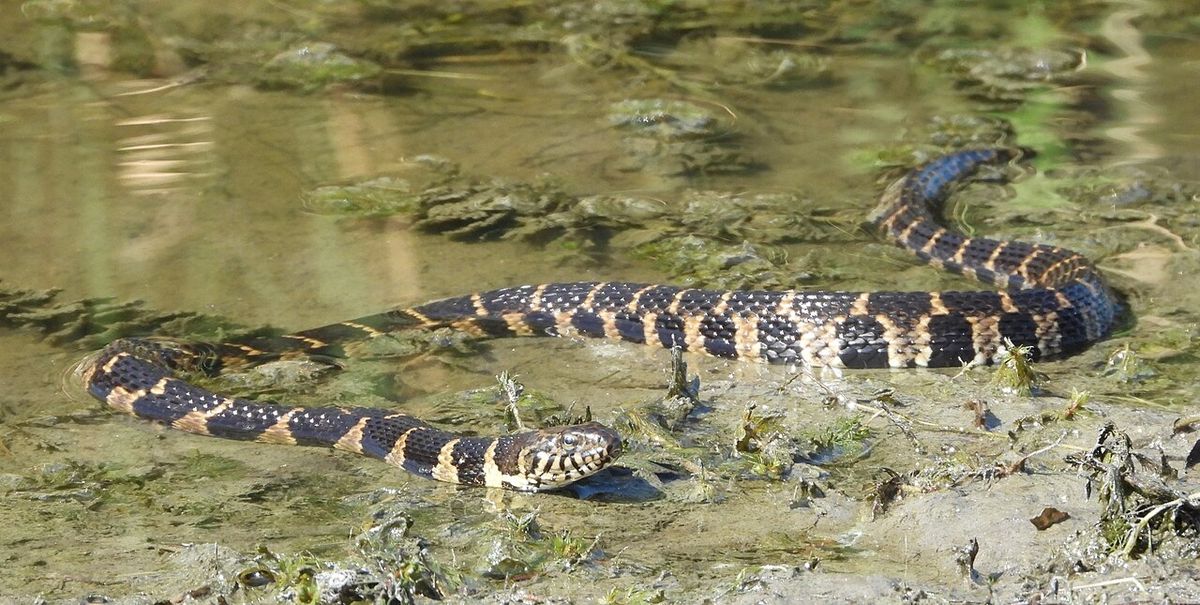
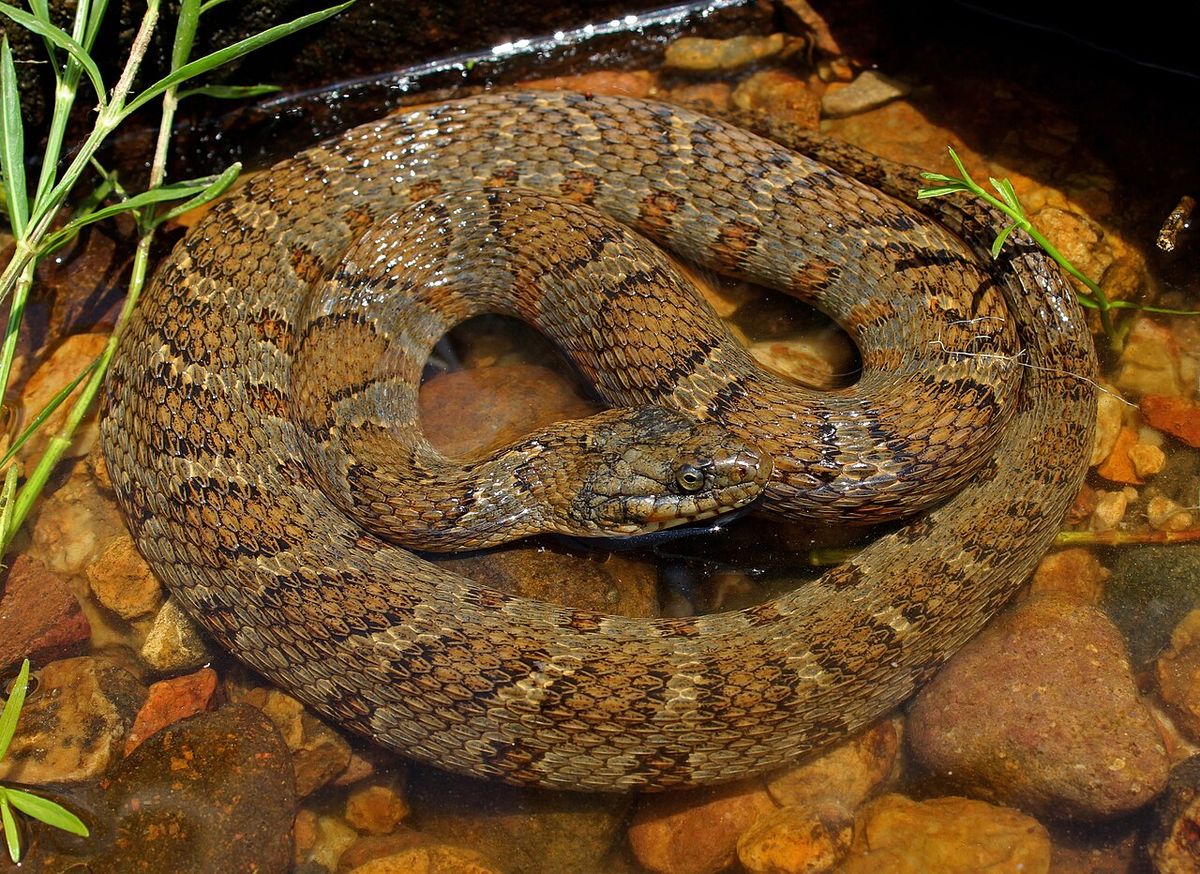
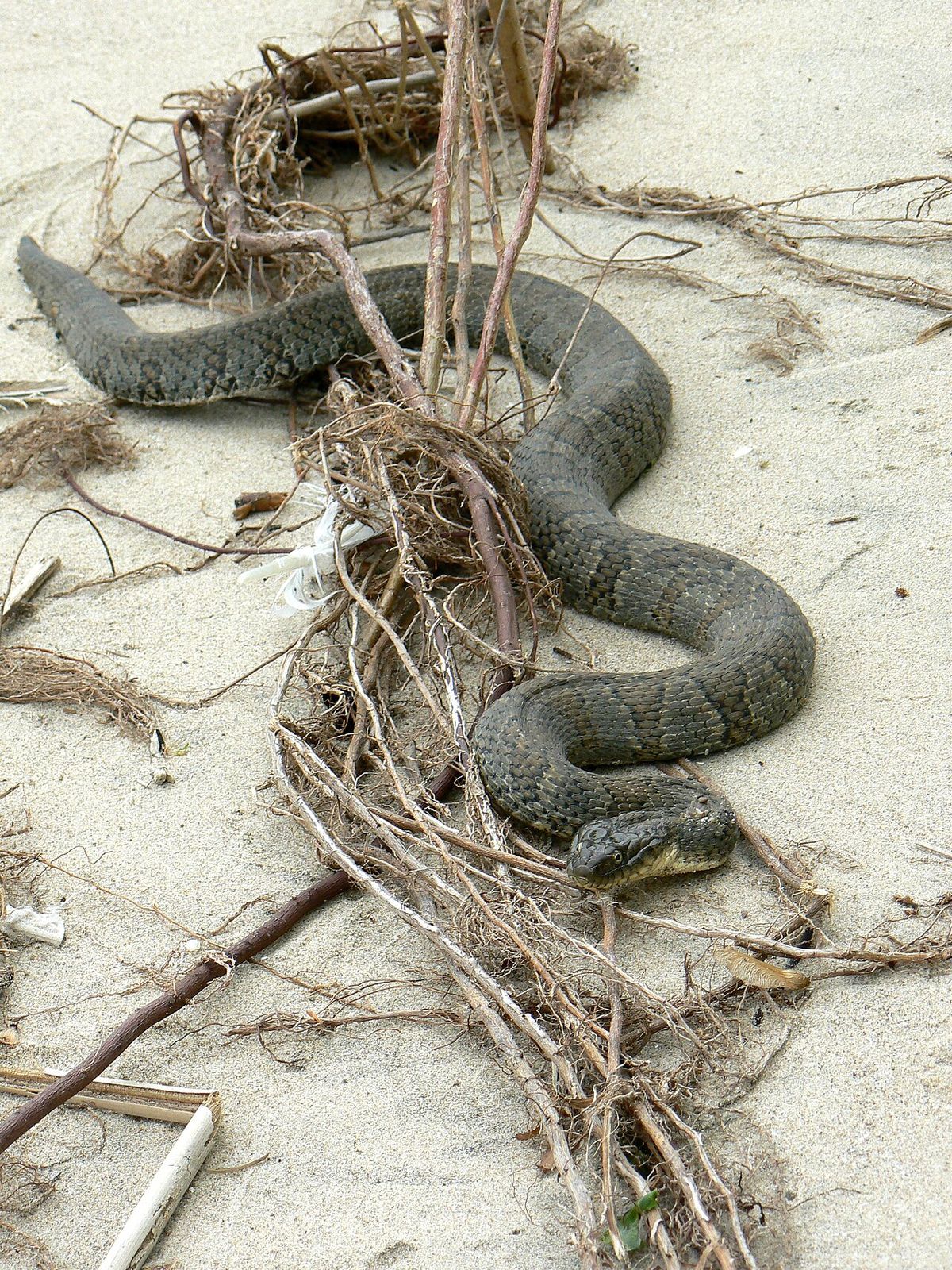
The common watersnake exhibits considerable variation in colour and pattern, which can lead to confusion with venomous species. Adults can be brown, gray, reddish, or brownish-black, featuring dark crossbands on the neck and dark blotches along the body. As these snakes age, their colour often darkens and the pattern can become obscure, with some individuals appearing almost completely black. The belly colouration is also variable, ranging from white and yellow to gray, typically adorned with reddish or black crescent markings. The species is sexually dimorphic, with females being larger on average than males. Studies show average total lengths of 81.4 cm for females and 69.6 cm for males, with maximum lengths reaching approximately 135 cm.
Distinguishing the harmless common watersnake from the venomous cottonmouth is crucial for public safety and the snake's conservation. Key identification features include a longer, more slender body and a flattened head that is the same width as the neck. The watersnake has round pupils and lacks the heat-sensing pits found between the eyes and nostrils of pit vipers. In contrast, the cottonmouth possesses a heavier body, a distinct wedge-shaped head that is wider than the neck due to prominent venom glands, cat-like pupils, and heat-sensing pits. The common watersnake's saliva contains a mild anticoagulant that can cause a bite to bleed more but poses little medical risk to humans.
From known studies of this species in the wild, adult females can weigh between 159 and 408 grams typically. The smaller male can range from 80.8 to 151 grams. The largest females can weigh up to 560 grams while the largest males can scale 370 grams. Females are known to be larger in both length and mass when compared to males. The average total length of females was 81.4 cm, while that of males was 69.6 cm. The common watersnake can grow up to 135 cm in total length.
Geographic Range and Habitat
The common watersnake's native range spans eastern and central North America, from Texas and Florida northward to southern Ontario and southern Quebec. The northern watersnake subspecies (N. s. sipedon) occurs naturally as far west as Colorado, east of the Rocky Mountains, and is commonly associated with major river systems like the South Platte and Arkansas Rivers. This species is highly aquatic and is found in a variety of freshwater habitats including streams, lakes, ponds, and wetlands. Juveniles often inhabit smaller, lower-order streams adjacent to the larger waterways used by adults, a strategy believed to help them avoid predators like large fish, birds, and turtles present in open water.
Within these habitats, watersnakes are frequently observed basking on rocks, stumps, or brush near the water's edge. They are quick to dive into the water at the slightest disturbance, a behaviour that makes them a familiar sight to anyone frequenting Canadian shorelines. For shelter and hunting, they tend to select areas such as dead cattail clumps or low-hanging branches further out from the bank. An introduced population was discovered in California in 2007, where the species is considered invasive and poses a potential threat to native species like the threatened giant garter snake. Consequently, since 2008, it has been illegal to own or import common watersnakes in California without a permit, a regulation aimed at preventing further ecological disruption.
Diet and Hunting Behaviour
The common watersnake is an opportunistic and effective predator with a broad diet that reflects its aquatic lifestyle. It is active both day and night, employing sight and smell to hunt. During daylight hours, it forages among plants at the water's edge for prey including small fish, tadpoles, frogs, worms, leeches, and crayfish. Its diet also extends to large insects, salamanders, other snakes, turtles, and occasionally small birds and mammals. At night, hunting often concentrates on minnows and other small fish that are resting in shallow water. The species' adaptability is exemplified by the Lake Erie watersnake subspecies, which now relies heavily on the invasive round goby, constituting up to 90% of its diet and aiding its population recovery.
The common watersnake's prey list is extensive and includes many aquatic and semi-aquatic organisms. During the day, it hunts among plants at the water's edge, looking for small fish, tadpoles, frogs, worms, leeches, crayfish, large insects, mollusks, annelids, salamanders, other snakes, turtles, small birds, and mammals. At night, it concentrates on minnows and other small fish resting in shallow water. It hunts using smell and sight. The Lake Erie watersnake subspecies now benefits from the introduction of the round goby, an invasive species, which constitutes up to 90 percent of its diet.
- Small fish and minnows
- Tadpoles and adult frogs
- Earthworms and leeches
- Crayfish
- Large insects
- Salamanders
- Other snakes
- Turtles, small birds, and mammals
This varied diet allows the snake to exploit different food sources depending on availability, season, and its own life stage. The shift in diet for the Lake Erie population to the round goby shows how the species can capitalise on new, abundant food sources. The Lake Erie watersnake subspecies was once endangered, but now benefits from the introduction of the round goby. The introduction of this invasive species became a new food source for the Lake Erie watersnake. By 2009, the population recovered to 11,980 snakes, safely exceeding the recovery plan goal.
Reproduction and Life Cycle
The common watersnake has a distinctive reproductive biology. Mating occurs from April through June, and the species is ovoviviparous, meaning females give birth to live young rather than laying eggs. After a gestation period, a female gives birth to an average of eight fully developed young between August and October, though litters can number as high as 30. Each newborn measures 19 to 23 cm in length and receives no parental care after birth. Females are known to mate with multiple males, leading to sperm competition, with research suggesting reproductive success for males is linked more to sperm quality than to body size. Males typically reach sexual maturity at around 21 months of age.
Females invest significant energy in reproduction, undergoing vitellogenesis to create extra yolk protein for their developing young, which requires substantial fat reserves. A rare phenomenon of facultative parthenogenesis, where females reproduce without mating, has been observed only in captivity. Female movement during the mating period is directly related to male success in locating mates, and this effect is intensified when females have recently shed their skin. The reproductive timeline for the common watersnake includes several key stages:
- Mating season: April to June.
- Gestation: Occurs internally throughout the summer.
- Birth period: August to October.
- Litter size: Average of 8, with a maximum recorded of 30.
- Male sexual maturity: Approximately 21 months (second year).
The common watersnake is ovoviviparous, which means it does not lay eggs but gives birth to free-living young. A female may have as many as 30 young at a time, but the average is eight. Each young is 19 to 23 cm long when born between August and October. Mothers do not care for their young. The common watersnake mates from April through June. Multiple mating by females is common, leading to a focus in sperm competition.
Predators, Defence, and Unique Adaptations
The common watersnake faces predation from a wide array of animals and is often killed by humans due to misidentification. Natural predators include various birds, raccoons, opossums, foxes, snapping turtles, and other snakes. When threatened, the common watersnake defends itself vigorously. If cornered or captured, it will typically not hesitate to bite repeatedly. Its defensive repertoire also includes the release of foul-smelling musk and excrement. While nonvenomous, its bite can be painful due to its sharp teeth and the mild hemotoxic anticoagulant in its saliva, which increases bleeding.
An extreme and unique defensive behaviour is caudal autotomy, where the snake can twist off its own tail if it is grabbed. The detached tail continues to writhe for up to 30 minutes, potentially distracting a predator, but unlike in many lizard species, the tail does not regenerate. This sacrifice is a last-resort tactic to escape with its life. The species is also an effective thermoregulator, managing its body temperature by basking in the sun or retreating to cooler water or shade as needed, a trait noted in scientific literature.
Conservation Status and the Lake Erie Watersnake
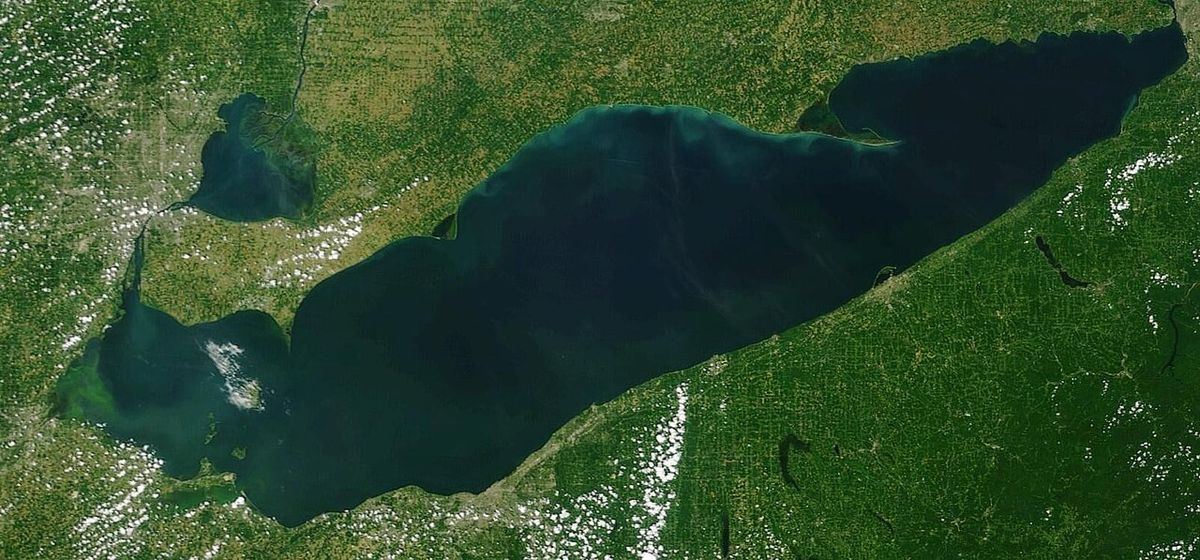
While the common watersnake species is considered of Least Concern across most of its range, the Lake Erie watersnake subspecies (N. s. insularum) has a notable conservation history. This population, found mainly on islands in western Lake Erie offshore from Ohio and Ontario, was listed as threatened under the U.S. Endangered Species Act in 1999. Its decline was attributed to human persecution, habitat loss, and degradation, with the adult population plummeting to only 1,500 snakes. Recovery efforts included the designation of 120 hectares of inland habitat and 18 kilometres of shoreline as protected breeding grounds, which were critical for the subspecies' survival.
A major factor in its recovery was the arrival of an invasive prey species. The Eurasian round goby, which entered Lake Erie in the mid-1990s, became a plentiful and accessible food source. By 2009, the subspecies population had rebounded to 11,980 adults, safely exceeding the recovery plan goal of 5,555. Consequently, on August 16, 2011, the U.S. Fish and Wildlife Service removed the Lake Erie watersnake from the Federal List of Endangered and Threatened Wildlife. It became just the 23rd species or subspecies to be delisted due to recovery, with monitoring required for five years following the delisting. The recovery of this subspecies demonstrates how ecological changes, even from invasive species, can sometimes interact with conservation law to produce positive outcomes for specific populations.
Subspecies, Common Names, and Taxonomic History
Within the species Nerodia sipedon, four subspecies are recognized as valid. These subspecies exhibit regional variations across the extensive geographic range of the common watersnake. The nominate subspecies, Nerodia sipedon sipedon, is the widespread northern watersnake. The other recognized subspecies are Nerodia sipedon pleuralis (the midland watersnake), Nerodia sipedon insularum (the Lake Erie watersnake), and Nerodia sipedon williamengelsi. The trinomial nomenclature indicates that some of these subspecies were originally described in a genus other than Nerodia, reflecting historical taxonomic revisions. The common watersnake is known by a multitude of regional and descriptive names, which highlights its wide recognition and the frequency of encounters with people across its range.
Common names for Nerodia sipedon include banded water snake, black water adder, black water snake, brown water snake, common water snake, and common northern water snake. Other names are eastern water snake, North American water snake, northern banded water snake, and northern water snake. Further names include spotted water snake, streaked snake, water pilot, and water snake. This long list of vernacular names reflects the snake's prevalence across many different regions.
- Banded water snake
- Black water adder and black water snake
- Brown water snake
- Common water snake and common northern water snake
- Eastern water snake
- North American water snake
- Northern banded water snake and northern water snake
- Spotted water snake, streaked snake, water pilot, and simply water snake
The many common names reflect the snake's prevalence across many different regions and habitats. The variety of names also points to the variety of patterns observers have noted on its body. The common watersnake can be brown, gray, reddish, or brownish-black. It has dark crossbands on the neck and dark blotches on the rest of the body. As it ages, the color darkens, and the pattern becomes obscure, with some individuals becoming almost completely black.
Comparison with Related and Introduced Species
The common watersnake's ecological niche in eastern North America is filled by garter snakes in the western United States, which lack native true water snakes. This fact makes the introduction of Nerodia sipedon to western states like California a significant ecological concern. The introduced population discovered in California in 2007 is believed to have originated from released pets. This non-native snake may compete with the native giant garter snake (Thamnophis gigas), which is a threatened species, and could also threaten vulnerable local fish and amphibian populations through excessive predation. The related species Nerodia fasciata, the banded water snake, had been introduced to California even earlier, with records dating back to at least 1992, showing a pattern of problematic reptile releases.
The common watersnake is frequently mistaken for the venomous cottonmouth. The common watersnake is nonvenomous and harmless to humans, but superficially resembles the venomous cottonmouth. The two can be easily distinguished. The watersnake has a longer, more slender body and a flattened head the same width as the neck, round pupils, and no heat-sensing pits. The cottonmouth has a fatter body, a wedge-shaped head with prominent venom glands that are wider than the neck, cat-like pupils, and heat-sensing pits.
| Trait | Common Watersnake (Nerodia sipedon) | Cottonmouth (Agkistrodon piscivorus) | Banded Water Snake (Nerodia fasciata) |
|---|---|---|---|
| Venom | Nonvenomous | Venomous | Nonvenomous |
| Head Shape | Flattened, same width as neck | Wedge-shaped, wider than neck | Similar to N. sipedon |
| Pupils | Round | Vertical, cat-like | Round |
| Heat-sensing Pits | Absent | Present | Absent |
| Primary Defence | Bite, musk, caudal autotomy | Venomous bite, threat display | Bite, musk |
| Introduced in California | Population found in 2007 | Not introduced | Introduced since at least 1992 |
This comparison clarifies the identification features that separate the harmless watersnake from a dangerous pit viper. Understanding these differences is essential for both public safety and effective wildlife management. The common watersnake is often killed by humans out of fear. Attempting to kill snakes greatly increases the chance of being bitten. In California, common watersnakes are considered invasive species likely to compete with the native giant garter snake. In 2008 it was made illegal in California to own or import common watersnakes without a permit.
Questions about Common watersnake
Is the common watersnake venomous and dangerous to humans?
No, the common watersnake is nonvenomous and harmless to humans. It is often mistaken for the venomous cottonmouth, leading to unnecessary fear and persecution. While it will bite in self-defence if cornered, and its saliva contains a mild anticoagulant that can make the bite bleed more, the bite poses little medical risk. Attempting to kill or handle the snake greatly increases the chance of being bitten.
Where can you find common watersnakes in Canada?
In Canada, the common watersnake is native to southern Ontario and southern Quebec. It inhabits the shorelines and aquatic environments of lakes, rivers, streams, ponds, and wetlands within this range. A notable population is the Lake Erie watersnake subspecies found on islands in western Lake Erie. They are frequently seen basking on rocks, logs, or vegetation near the water.
What does the common watersnake eat?
The common watersnake has a varied, fish-heavy diet. It preys on small fish, tadpoles, frogs, worms, leeches, crayfish, and large insects. Its diet can also include salamanders, other snakes, turtles, and occasionally small birds or mammals. The Lake Erie subspecies now relies heavily on the invasive round goby, which makes up to 90% of its diet. It hunts using both sight and smell, during the day and at night.
How can you tell a common watersnake from a venomous cottonmouth?
Several key features distinguish them. The common watersnake has a longer, more slender body and a flattened head that is the same width as its neck. It has round pupils and lacks heat-sensing pits. The cottonmouth has a heavier body, a distinct wedge-shaped head that is wider than the neck due to venom glands, vertical cat-like pupils, and heat-sensing pits between its eyes and nostrils. Observing these details from a safe distance is the best way to identify them.
How does the common watersnake reproduce?
The common watersnake is ovoviviparous, meaning it gives birth to live young instead of laying eggs. Mating occurs from April to June. The female carries the developing eggs inside her body and gives birth to an average of eight fully formed young between August and October, though litters can be as large as 30. The newborn snakes are independent immediately, measuring 19 to 23 cm in length. Females often mate with multiple males.
What is the conservation status of the Lake Erie watersnake?
The Lake Erie watersnake subspecies was removed from the U.S. Federal List of Endangered and Threatened Wildlife on August 16, 2011, marking a full recovery. It was first listed as threatened in 1999 after its population declined to only 1,500 adults due to human eradication and habitat loss. Endangered Species Act protections included designating specific inland habitat and shoreline breeding grounds. The population's recovery was greatly aided by the introduction of the invasive Eurasian round goby into Lake Erie in the mid 1990s, which became a primary food source. By 2009, the population had rebounded to 11,980 snakes, safely exceeding the recovery plan's goal of 5,555 adults. This subspecies is only the 23rd species or subspecies to be delisted due to recovery in the United States. Monitoring was planned for five years following its removal from the list.
Sources and further reading
- Common watersnake (Wikipedia)
- Common Watersnake (thecanadianencyclopedia.ca)
- Fish and Wildlife: Common Watersnake (in.gov)
- Common Watersnake (ohiodnr.gov)
Checked by the Your Space Hamilton desk. Last updated 2026-11-01.