Common grackle
The common grackle (Quiscalus quiscula) is a medium-sized, iridescent blackbird native to North America. A familiar sight across much of Canada east of the Rocky Mountains, this highly adaptable bird thrives in open habitats, from farmlands and wetlands to suburban parks and city centres. Known for its resourceful, opportunistic nature and raucous vocalizations, the common grackle has expanded its range alongside human development, though its populations have declined significantly in recent decades. Its striking appearance, complex social behaviours, and ecological role make it a notable, if sometimes contentious, part of Canada's avian landscape.
Taxonomy and Description
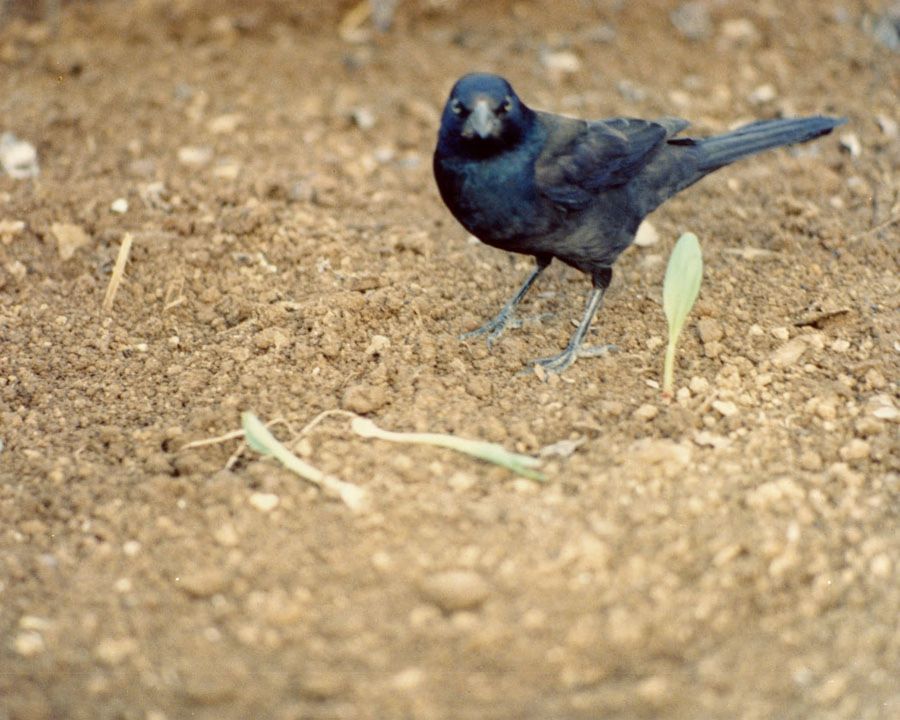
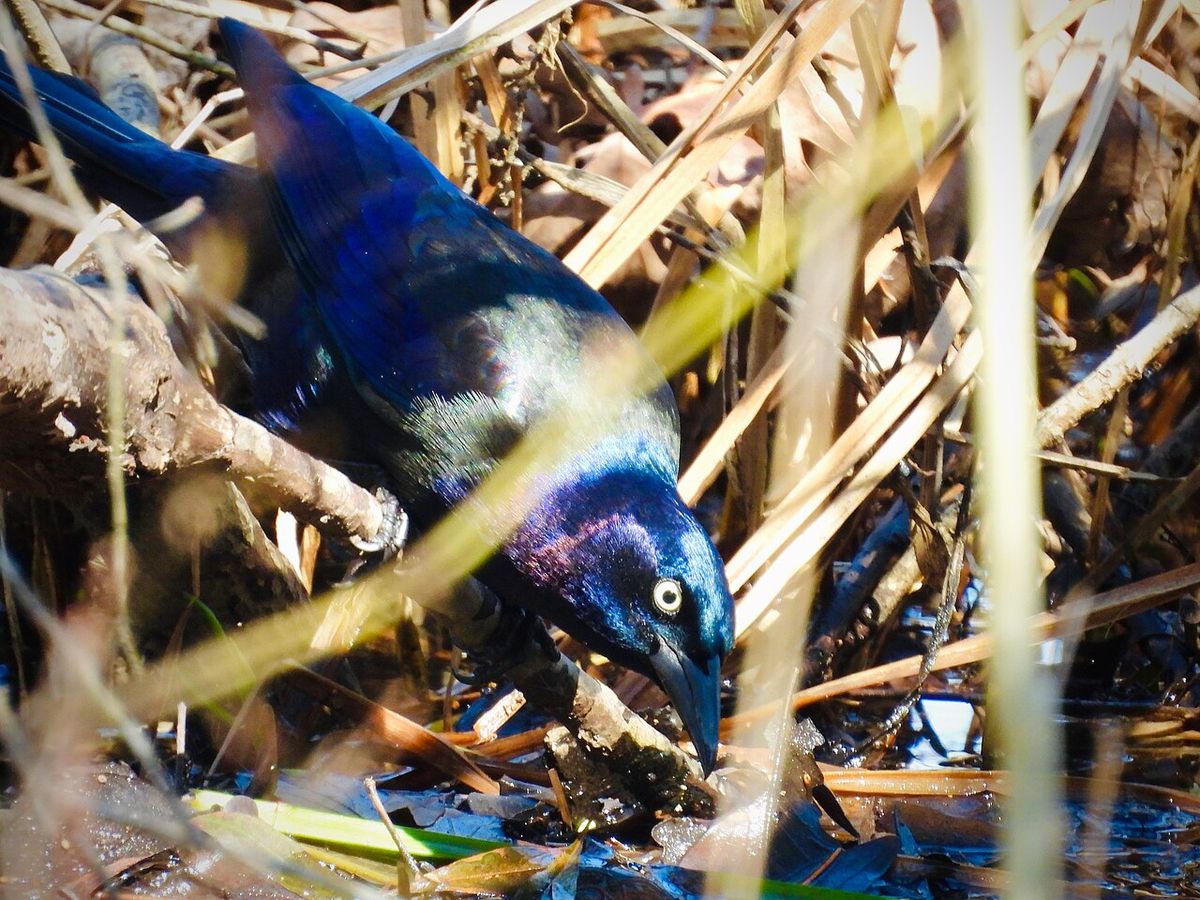
The common grackle was first formally described by Carl Linnaeus in 1758 as Gracula quiscula. It was later reclassified into the genus Quiscalus by French ornithologist Louis Pierre Vieillot in 1816. Three subspecies are officially recognized, which correspond to regional variations in plumage colouration. The nominate subspecies, the Florida grackle (Q. q. quiscula), is found in the southeastern United States. The purple grackle (Q. q. stonei) resides east of the Allegheny Mountains, while the bronzed grackle (Q. q. versicolor) is the widespread subspecies found across New England, the West, and throughout most of Canada. Adult common grackles are medium-sized blackbirds with a distinctive elongated body and a long, keel-shaped tail, giving them a 'stretched' appearance compared to other blackbirds. They possess a long, sharp black bill and pale yellow eyes. Their plumage is not simply black but exhibits a glossy, iridescent sheen that shifts in colour with the light. Generally, the head, neck, and breast display hues of glossy purplish-blue or bluish-green, while the body plumage often has a bronze or purple sheen depending on the subspecies. Males are larger, more iridescent, and have a more pronounced tail keel than females. Juveniles are brown with dark brown eyes and lack the adult's iridescence.
Distribution and Habitat
The common grackle's breeding range encompasses nearly all of eastern North America east of the Rocky Mountains, extending far into southern Canada during the summer months. It is a permanent resident in much of the southern part of its range, while northern populations migrate in flocks to the southeastern United States for the winter. The species is highly adaptable and occupies a wide variety of open and semi-open habitats. It is commonly found in areas with scattered trees, particularly conifers, and is frequently associated with human-altered landscapes. Prime habitats include farmlands, orchards, swamps, suburban developments, city parks, and cemeteries. The clearing of forests for agriculture historically facilitated a significant westward expansion of the grackle's range. The bird nests in dense trees or shrubs, often near water, and readily uses man-made structures such as birdhouses, barn rafters, or eaves. It frequently nests in colonies, which can sometimes grow to be quite large, and the nest itself is a well-concealed cup constructed from grasses, stems, and mud, often lined with fine materials.
Diet and Foraging Behaviour
The common grackle is a resourceful and omnivorous feeder, consuming a remarkably wide array of food items. Its diet includes insects, minnows, frogs, eggs, berries, seeds, grain, and even small birds and rodents. Grackles forage on the ground, in shallow water, or in low shrubs, and they are notorious for their boldness around humans, often scavenging scraps from picnic areas or bird feeders. They will readily steal food from other birds, snatching items directly from another bird's beak. A unique anatomical adaptation aids their diet. They possess a hard, sharp ridge, or keel, on the inside of their upper bill. This keel functions like a saw, allowing the bird to score and crack open hard nuts, acorns, and dried kernels. This tool, combined with powerful jaw muscles, gives grackles access to food sources many other birds cannot exploit. Their foraging intelligence is further demonstrated by behaviours such as soaking dried food in water to soften it. Grackles are also known to practice 'anting', a behaviour where they rub insects, typically ants, on their feathers. It is believed the formic acid secreted by the ants helps deter parasites, though grackles have been observed using other substances like marigolds or citrus fruits for the same purpose.
Breeding and Life Cycle
Common grackles are generally monogamous for a breeding season, though polygyny does occur occasionally. Pair formation begins in early spring within flocks, involving aerial chases and mutual displays between a female and several competing males. Once a pair bond is established, the pair leaves the flock. The female selects the nest site, which is typically in a coniferous tree but can be in more unusual locations like woodpecker holes, cattail clumps, or on man-made structures. She constructs the nest alone, building a large, bulky cup from woody stems, grasses, and mud, sometimes incorporating human debris like fishing line or tape. The female lays a clutch of one to seven eggs, though five or six is typical. The eggs are highly variable in colour, ranging from light blue to dark brown, often with scrawled markings. She incubates the eggs for 12 to 14 days. During this period, the male often remains closely associated with the female to guard against rival males, but approximately half of all males desert the nest after incubation begins. Parental care, including brooding and feeding the altricial chicks, is performed mainly by the female, though some males assist. The more aggressive nestlings often monopolize the food supply. The young leave the nest about 12 to 15 days after hatching but remain nearby and are fed by the adults for several more weeks. Common grackles are usually single-brooded, but can raise two broods per season in some areas. Their nests are rarely successfully parasitized by brown-headed cowbirds, as grackles are adept at rejecting foreign eggs.
Social Structure and Vocalizations
Common grackles are highly social birds outside of the breeding season, forming massive communal roosts that can include other blackbird species and European starlings, sometimes numbering in the hundreds of thousands or even a million individuals. During breeding, they often nest in loose colonies. Their vocal repertoire is extensive and notably harsh to human ears. Both males and females sing, though females do so less frequently. Their primary song is a loud, screeching 'readle-eak' often compared to a rusty gate hinge. Mates may sing back and forth to each other, and flocks create a cacophony of whistles, creaks, and clatters. Grackles are also capable of mimicking other sounds, including those of other birds, though not with the precision of a mockingbird. Their calls serve various communicative purposes, from maintaining contact in flocks to issuing alarms. The collective noun for a group of grackles is a 'plague', a term that reflects both their large numbers and their sometimes unwelcome presence in agricultural areas. Their social nature is also evident in their acceptance of other species like brown-headed cowbirds within their foraging flocks, though they fiercely defend their own nesting colonies.
Common grackles are highly social birds that often gather in large flocks, including mixed-species roosts that can number up to a million birds. Their vocalizations are particularly harsh, ranging from a year-round 'chewink' call to a faster, complex breeding season song. Both male and female grackles sing, and mated pairs may sing back and forth to each other. Courtship involves chases with several males pursuing a female, accompanied by vocalizations and displays with fluffed feathers. The species often breeds in colonies with many closely-built nests.
- Formation of massive, mixed-species roosts outside of breeding season.
- Nesting in colonies, with nests often built in close proximity.
- Both sexes produce a harsh, high-pitched 'readle-eak' song.
- Vocalizations include a variety of whistles, creaks, and clattering sounds.
- Ability to mimic sounds from their environment, including other bird calls.
- Use of vocal and physical displays for courtship and territory defence.
Conservation Status and Relationship with Humans
The common grackle has a complex relationship with human society. Its range and numbers initially expanded significantly due to forest clearing for agriculture, as the bird thrives in open, human-modified landscapes. It is commonly seen in suburban and urban areas, benefiting from its opportunistic feeding habits. However, this very adaptability has led to conflict. Grackles are often considered agricultural pests due to their large flocks and fondness for grain crops like corn, and they can be notoriously difficult to deter. Despite this localized nuisance, the overall population trajectory is a cause for conservation concern. A 2011 study by the National Audubon Society, using data from the Christmas Bird Count, indicated that common grackle populations had declined by 61 percent from historic highs of over 190 million birds to an estimated 73 million. As a result, the International Union for Conservation of Nature (IUCN) classifies the species as Near Threatened. The reasons for this decline are not fully understood but are likely linked to broader environmental pressures affecting many bird species. In Canada and the United States, the common grackle is protected under the Migratory Bird Treaty Act, making it illegal to keep them as pets or to harm them without a permit.
Unique Adaptations and Behaviours
Beyond their general resourcefulness, common grackles exhibit several specific and fascinating adaptations. Their bill keel, used for cracking hard seeds, is a specialized tool not found in all blackbirds. Their practice of 'anting' for feather maintenance demonstrates problem-solving and hygiene. Grackles are also studied for a potential, though poorly understood, sensitivity to the Earth's magnetic field, which may play a role in navigation. Their boldness is legendary, with reports of them stealing food directly from picnic tables, earning them the nickname 'taco raptors' in some regions like Texas. They have been observed engaging in clever behaviours such as following lawn mowers to catch disturbed insects and stealing worms from American robins. This combination of physical adaptation and behavioural intelligence has been key to their survival and expansion in a changing world. They are also known for their fastidious nest hygiene, with adults carefully removing their chicks' fecal sacs from the nest, often disposing of them in water sources. Adult grackles have occasionally been observed acting as 'helpers' at the nests of other grackles, assisting with feeding the young.
Common grackles are omnivorous and highly resourceful, eating a wide variety of items including insects, grain, small birds, and even food scraps from humans. They have a unique adaptation in their bill, a sharp keel on the horny palate, which they use in a sawing motion to crack open hard nuts and acorns. The species is known to practice 'anting,' rubbing insects on its feathers, possibly to apply secretions like formic acid. Common grackles are also attuned to the Earth's magnetic field to a scientifically significant degree, though the exact mechanism is poorly understood.
- Use of a specialized keel in the bill to saw open hard nuts and acorns.
- Practice of 'anting' with insects or other substances for parasite control.
- Potential attunement to the Earth's magnetic field for navigation.
- Remarkable boldness in scavenging food from humans and other birds.
- Observation of 'helper' behaviour, where adults occasionally assist at nests that are not their own.
- Fastidious nest hygiene, with adults removing fecal sacs from the nest.
Questions about Common grackle
What do common grackles eat?
Common grackles are omnivorous and highly opportunistic eaters. Their diet includes insects, minnows, frogs, eggs, berries, seeds, and grain. They will also eat small birds and rodents. They are known to forage on the ground at bird feeders, steal food from other birds, and scavenge scraps in human environments. A special ridge in their bill helps them crack hard foods like acorns.
How can you identify a common grackle?
Common grackles are medium-sized blackbirds with a long tail and a long, sharp black bill. They have pale yellow eyes. Their black plumage has a glossy, iridescent sheen that can appear purple, blue, green, or bronze in sunlight, especially on the head and neck. They are taller and longer-tailed than a typical blackbird, and their tail often appears keel-shaped in flight.
Are common grackles found in Canada?
Yes, common grackles are found in Canada. The species is an abundant and widespread resident in open wooded areas across Canada east of British Columbia. Its breeding range extends far into the country during the summer season. The distribution of the common grackle is largely tied to annual mean temperature, and its range has expanded significantly since the last glacial period. Northern populations of these birds migrate in flocks to the Southeastern United States for the winter, while others remain as permanent residents in parts of their range.
Why are common grackles considered pests?
Common grackles are considered pests primarily because their large numbers and fondness for grain pose a serious threat to agricultural crops. They are omnivorous and will readily eat seeds and grain, making them a problem for farmers. Their resourceful and opportunistic nature allows them to thrive in human altered landscapes. Controlling them is notoriously difficult and often requires the use of hawks or other large birds of prey. Their tendency to form large, noisy communal roosts in urban areas can create conflicts with people.
What is the conservation status of the common grackle?
The common grackle is classified as Near Threatened by the International Union for Conservation of Nature. This status was assigned following a 2011 study by the National Audubon Society that analyzed Christmas Bird Count data. The study indicated the population had declined by sixty one percent from historic highs of over 190 million birds to an estimated 73 million. Despite this decline and the current Near Threatened status, the common grackle population is still considered strong and the species remains widespread across its range.
Is it legal to keep a common grackle as a pet?
No, it is not legal to keep a common grackle as a pet in the United States. The common grackle is protected under the Migratory Bird Treaty Act. This federal law makes it illegal to possess, transport, or sell native migratory birds, their feathers, eggs, or nests without a specific permit. The species is listed as illegal to keep as a pet by authoritative sources, reflecting its protected status as a wild migratory bird.
Sources and further reading
- Common grackle (Wikipedia)
- Quiscalus quiscula (common grackle) | INFORMATION (animaldiversity.org)
- 10 Fun Facts About the Common Grackle (audubon.org)
- Common Grackle Animal Facts, Quiscalus quiscula (a-z-animals.com)
Checked by the Your Space Hamilton desk. Last updated 2026-10-26.