Cedar waxwing
The cedar waxwing (Bombycilla cedrorum) is a medium-sized, silky-plumaged songbird native to North and Central America. It is a familiar sight across much of Canada during its breeding season, known for its sleek crest, black mask, and the distinctive red, wax-like droplets on its wing feathers. These highly social, nomadic birds travel in flocks and are specialized frugivores, playing a significant role in seed dispersal for many native berry-producing plants. While common and of least conservation concern, cedar waxwings are a charismatic part of Canada's avian fauna, frequently observed in suburban parks, orchards, and woodland edges where fruit is abundant.
Taxonomy and naming
The cedar waxwing is one of three species in the waxwing family, Bombycillidae, all placed in the genus Bombycilla. French ornithologist Louis Pierre Vieillot established this genus in 1808, coining the name from the Latin bombyx, meaning silk, and a misinterpretation of cilla as tail, intending it to mean 'silktail'. The species name, cedrorum, is Latin for 'of the cedars', a reference to the bird's fondness for the small cones of the eastern redcedar, which is actually a juniper. This dietary preference is the source of the bird's common English name. Other historical colloquial names for the species include Canada robin, cedar bird, cherry bird, and recellet.
Physical description
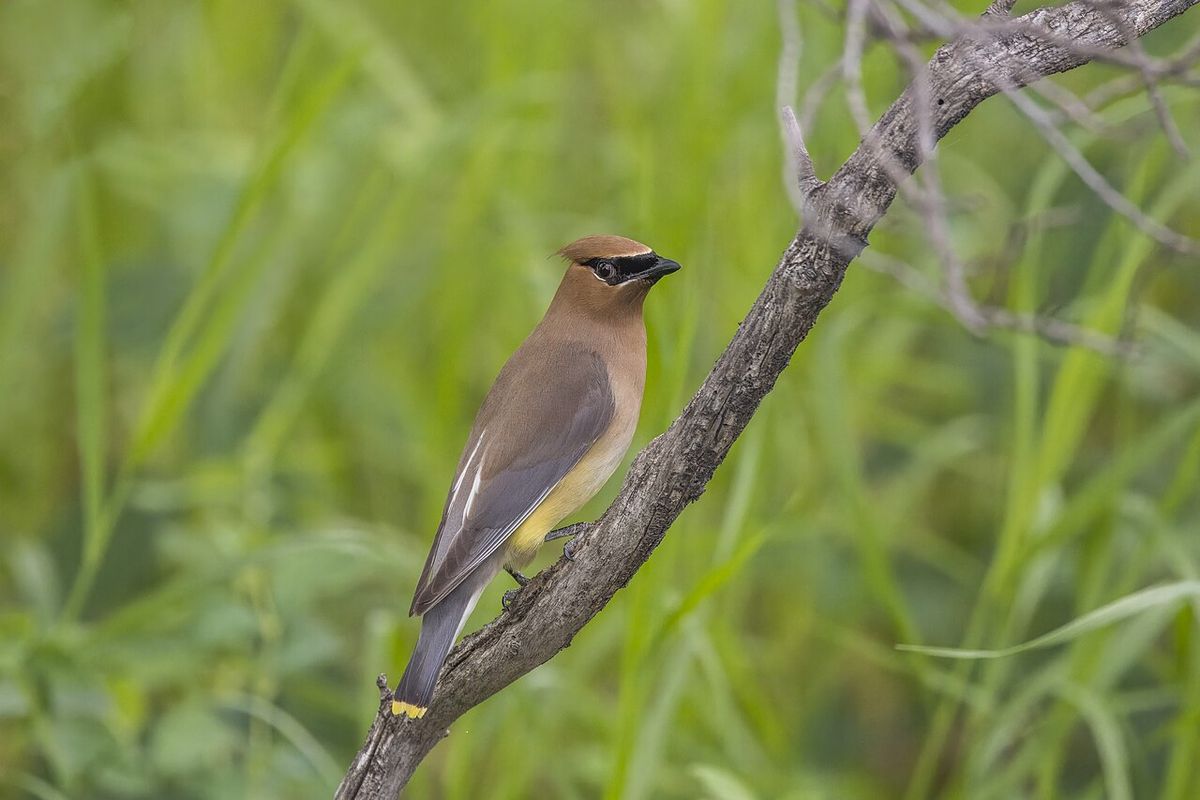
Cedar waxwings are sleek, medium-sized passerines with a body length of 15 to 18 centimetres and a weight of roughly 30 grams. Their plumage is a soft, silky blend of brown, grey, and pale lemon-yellow, accented by a subdued crest that often lies flat. The most striking facial feature is a sharp black mask, outlined thinly in white. The bird's namesake characteristic is the small, red, wax-like droplet found on the tips of its secondary wing feathers, formed by pigmented feather tips surrounded by a transparent cuticle. The tail is short and square-tipped, typically yellow or orange. A darker orange tail tip can result from feeding on the berries of introduced Eurasian honeysuckles during feather growth. Males and females are identical in appearance. Immature birds lack the black mask and have streaked plumage on the throat and flanks. In flight, which is strong and direct at speeds up to 40 kilometres per hour, their broad, pointed wings and flocking behaviour can resemble that of European starlings.
Vocalizations and flight
Cedar waxwings are quite vocal, especially when in flight, and their calls are not melodic songs but rather high-pitched, thin whistles and buzzy trills. The most common calls are very high-pitched, often transcribed as 'see' or 'sree', and last about half a second, and these frequent, piercing notes help maintain contact within flocks as they move between feeding sites. The vocalizations lack the complex musicality of many other songbirds but are a distinctive and familiar sound in areas where waxwing flocks are foraging. Their flight is strong and direct, and they can fly at speeds of 40 kilometres per hour at altitudes up to 610 metres. The movement of a flock in flight, with their broad, pointed wings, is often compared to that of a flock of pale European starlings, and they are known to fly over water to catch insects.
Distribution, habitat, and movements
Cedar waxwings breed in open wooded areas across southern Canada and the northern United States, and their preferred habitat is the edge of forests or wooded areas, particularly locations that provide easy access to berry sources and water. They are commonly found in suburban and urban environments such as parks, golf courses, cemeteries, and gardens that feature fruiting trees and shrubs, as well as a nearby water source like a fountain or birdbath. They are also frequent visitors to farms and orchards, and this species is highly nomadic and irruptive outside the breeding season. While much of the population migrates south to winter across the southern United States, Central America, and rarely as far as northern South America, their winter movements are erratic and tied to berry supplies. They will move in huge numbers if local food sources are low, and flocks, sometimes numbering in the hundreds, are a common sight year-round. Rare vagrants have been recorded in western Europe, including seven reported sightings in the United Kingdom, and individual Bohemian waxwings occasionally join large winter flocks of cedar waxwings.
Specific habitats and locations where cedar waxwings are regularly observed include trees at the edge of wooded areas or forests. They are frequently seen in fruiting trees. In urban or suburban environments, they often favour parkland, golf courses, cemeteries, or other landscaping with well-spaced trees. They are also found near farms, orchards, and gardens, particularly those with fruiting trees or shrubs.
- Edges of wooded areas or forests with berry sources.
- Urban and suburban parkland with well-spaced trees.
- Golf courses and cemeteries with landscaping that includes fruiting bushes.
- Areas near farms, orchards, and gardens with fruiting trees or shrubs.
- Locations with a consistent shallow water source, such as a creek, fountain, or birdbath.
Their attraction to running water means they are often seen bathing and drinking in shallow creeks. This behaviour can draw flocks to suitable spots in both wild and developed areas. Waxwings are attracted to the sound of running water. In urban settings, they may use a nearby water source such as a fountain or birdbath.
Diet and foraging behaviour
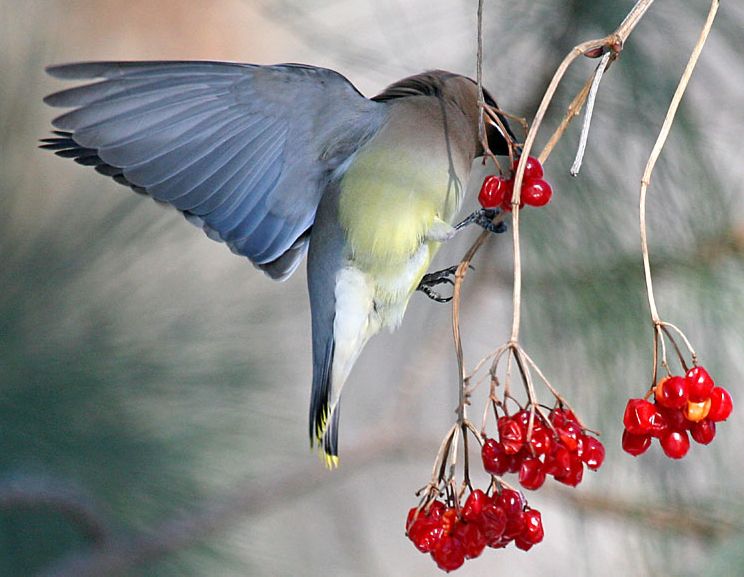
Cedar waxwings are highly specialized frugivores, meaning fruit forms the main part of their diet year-round, and they consume a wide variety of berries and sugary fruits, including those of dogwood, serviceberry, juniper, hawthorn, winterberry, and mountain ash. Their consumption of eastern redcedar cones is the origin of their common name, and insects become a more important dietary component during the breeding season to provide necessary protein for growing young. They are known to fly over water to catch insects in mid-air, and a remarkable social foraging behaviour involves birds lining up along a twig and passing berries beak-to-beak down the line so each member of a flock gets a share when only one bird can reach the food source at a time. This species can sometimes be considered an agricultural pest, as large flocks may cause significant damage to commercial fruit crops like cherries, and on rare occasions, waxwings may eat overripe, fermenting fruit, which can intoxicate the bird.
Key fruit and plant species that form their diet include cedar cones, fruit, and holly berries. Their diet also includes dogwood, serviceberry, juniper, hawthorn, and winterberry. Their fondness for the small cones of the eastern redcedar gave these birds their common name. They eat berries whole and sometimes eat fruit that is overripe and has begun to ferment.
- Eastern redcedar (juniper) cones.
- Dogwood berries.
- Serviceberry fruit.
- Hawthorn berries.
- Winterberry fruit.
- Mountain ash berries.
- Introduced Eurasian honeysuckle berries (affects tail feather colour).
- Madrone berries (a potential source of red wingtip pigment).
Digestive physiology and ecology
The cedar waxwing exhibits an almost unique physiological adaptation among passerines for a diet dominated by sugary fruit, and unlike other fruit-eating birds that use fruit opportunistically, waxwings can subsist on fruit alone due to highly efficient digestion of simple sugars. However, fruit is energy-rich but protein-poor, and to meet their protein requirement of about 1.7 percent, waxwings supplement their diet, especially in spring, by consuming protein-rich flower pollen and insects. A study of 212 individuals found average stomach contents of 84 percent fruit, 12 percent invertebrates, and 4 percent flowers, and their digestive system processes food quickly, which results in a relatively low nutrient extraction efficiency of about 36.5 percent, as evidenced by undigested fruit skins in their droppings. This necessitates consuming large quantities of fruit, and a key adaptation is the rapid separation and defecation of seeds before the fruit pulp is fully digested, which minimizes gut processing limitations. This efficient seed processing, along with the presence of viable seeds in their feces, points to the waxwing's important ecological role as a seed disperser for many native plants.
Experimental feeding studies revealed specific digestive responses. Cedar waxwings lost body mass when experimentally fed one fruit type alone, such as Viburnum opulus. They gained body mass when fed pollen-rich catkins, like those from Populus deltoides. This illustrates the importance of multiple food sources to acquire the precise nutrients needed.
- Birds lost body mass when fed only Viburnum opulus fruit.
- Birds gained body mass when fed pollen-rich Populus deltoides catkins.
- Seed defecation rates increased in correlation with increased fruit consumption.
- Ingestion and activity increased when seeds were regurgitated, not when seeds passed through the gut.
- A period of 'loafing' or inactivity followed meals where seeds were digested, limiting further foraging.
The presence of viable seeds in feces confirms their role in seed dispersal. Their digestive strategy allows them to maintain a primarily fruit-based diet despite the challenges of processing seeds. The low use efficiency of fruits digested by cedar waxwings indicates the necessity of consuming large quantities of fruits. Their efficient rates of seed processing allow seeds to be separated from and defecated before the pulp of the fruit.
Breeding and life cycle
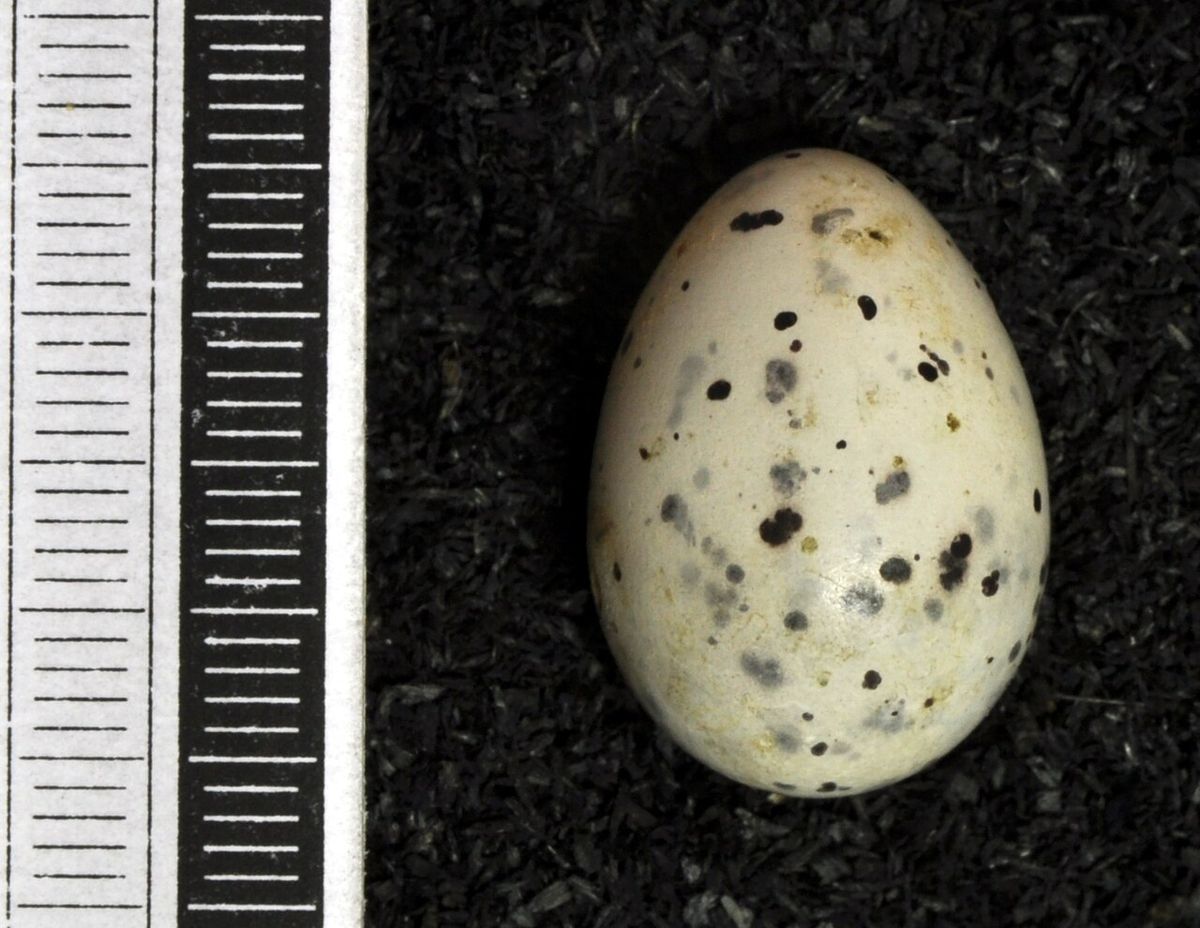
The cedar waxwing breeding season begins around the end of spring and runs through to late summer, and courtship involves the male performing a 'hopping dance' for the female, who will hop back if she is interested. Pairs engage in a ritual of passing small objects like flower petals or insects back and forth and may gently rub their beaks together, and these birds are not territorial. Both sexes participate in building the nest, a loose, open cup constructed from grass and twigs and lined with softer materials, and the female does the majority of the construction, making up to 2,500 trips over five or six days, and may sometimes steal nest material from other species' nests. Nests are typically placed on a horizontal tree branch averaging 2 to 6 metres above ground, though at times considerably higher, and the outer diameter of the nest is approximately 12 to 16 centimetres. The female lays a clutch of five or six oval, smooth, bluish-grey eggs with dark brown or greyish-brown spots, and she incubates the eggs alone for 11 to 13 days. Both parents then feed the nestlings, which fledge about 14 to 18 days after hatching, and typically, one or two broods are raised during the mating season.
Key facts and figures related to cedar waxwing reproduction include a mating season from the end of spring through late summer. The nest is a loose, open cup built with grass and twigs, averaging 2 to 6 metres above ground. Usually, five or six eggs are laid, and the female incubates them for 11 to 13 days. Young leave the nest about 14 to 18 days after hatching, and typically one or two broods are raised.
- Courtship involves passing objects like flower petals or insects.
- The female makes up to 2,500 trips to build the nest over 5-6 days.
- Nest outer diameter is 12-16 cm (4.7-6.3 in).
- Eggs are bluish-grey with irregular dark brown spots or greyish-brown splotches.
- Incubation is performed solely by the female for 11-13 days.
- Young are fed by both parents and fledge 14-18 days after hatching.
- Typically 1-2 broods are raised per mating season.
Social behaviour and population status
Cedar waxwings are exceptionally social birds, seen in flocks year round, and they are nonterritorial birds that will often groom each other. Their movements are dictated by the availability of fruit, making them nomadic, and this sociality extends to their foraging, as seen in their cooperative berry-passing behaviour. Their role as seed dispersers is significant for ecosystem health, and while populations are stable and even increasing in some areas due to reforestation and the planting of ornamental fruit trees, they face anthropogenic threats. Collisions with windows and vehicles while foraging along roadsides are common causes of mortality for this species, and the species is evaluated as Least Concern by the IUCN. Populations are increasing in their range partly because fields are being allowed to grow into forests and shrublands, and fruiting trees such as mountain ash are being planted as landscaping, which provides them with abundant food sources.
Comparative table: Cedar waxwing vs. Bohemian waxwing
While the cedar waxwing is common across Canada, it is often compared to its close relative, the Bohemian waxwing, which breeds farther north and west. The two species share the characteristic red wingtips but differ in several key aspects of size, colouration, and range. The Bohemian waxwing is larger than the cedar waxwing. The Bohemian waxwing's cinnamon under tail coverts and white wing patches are reliable field marks for identification, which is important for birdwatchers, especially in winter when both species may be present in mixed flocks.
| Feature | Cedar Waxwing | Bohemian Waxwing |
|---|---|---|
| Size | Smaller (15-18 cm) | Larger |
| Overall Colour | Browner and more subdued | Greyer with richer colours |
| Under Tail Coverts | White | Distinctive cinnamon colour |
| Wing Markings | Red wax droplets only | Red wax droplets and white wing patches |
| Primary Breeding Range | Southern Canada, northern U.S. | Northern boreal forests (farther north/west) |
| Winter Range | Southern U.S., Central America, N. South America | More irregular, often in northern U.S. and Canada |
| Flocks in Winter | Often huge flocks of cedar waxwings | Individual Bohemians may join cedar flocks |
Questions about Cedar waxwing
What do cedar waxwings eat?
Cedar waxwings are specialized frugivores, meaning their diet consists primarily of berries and sugary fruit year-round. They eat a wide variety, including dogwood, serviceberry, juniper, hawthorn, and winterberry. During the breeding season, insects become a crucial protein source for feeding their young. They are named for their consumption of eastern redcedar cones. They sometimes eat overripe, fermenting fruit, which can intoxicate them.
Where can I see cedar waxwings in Canada?
Cedar waxwings breed across southern Canada in open wooded areas, forest edges, and suburban landscapes. To spot them, look in parks, golf courses, cemeteries, or gardens that have berry-producing trees or shrubs like mountain ash, juniper, or crabapple, especially if there is a nearby water source. They are highly social and are usually seen in flocks, often perched high in fruiting trees. They are present in the breeding season and can be seen during migration or in winter if berry supplies are sufficient.
Why do cedar waxwings have red tips on their wings?
The red, wax-like droplets on the tips of their secondary wing feathers are a defining characteristic. The red colour is caused by pigmented feather tips encased in a transparent, waxy cuticle. The colour may be derived from carotenoid pigments found in berries they consume, such as those of the madrone. Both cedar and Bohemian waxwings share this feature, which is the source of the 'waxwing' name, as the droplets resemble old-fashioned sealing wax.
Are cedar waxwings endangered?
No, cedar waxwings are not endangered. The International Union for Conservation of Nature (IUCN) lists them as Least Concern. Their populations are generally stable and have increased in some regions. This is partly due to beneficial land-use changes, such as the growth of shrublands and the planting of ornamental fruit trees in urban areas, which provide them with abundant food sources.
How do cedar waxwings behave in flocks?
Cedar waxwings are extremely social and non-territorial, living in flocks year-round. They often engage in allopreening, grooming each other. A famous cooperative foraging behaviour involves birds lining up on a branch and passing berries beak-to-beak so every bird in line gets a share when food is limited. Their flocks can number in the hundreds, especially outside the breeding season, and they move nomadically in search of fruit.
How long do cedar waxwings live?
The lifespan of a cedar waxwing in the wild is typically several years. The oldest recorded individual, based on bird banding data, was eight years and two months old. Common causes of mortality include collisions with windows and vehicles, as they often forage near roadsides and in suburban areas. Their social, flocking nature does not provide protection from these anthropogenic threats.
Sources and further reading
- Cedar waxwing (Wikipedia)
- Cedar Waxwing Animal Totem and Spirit (expressionsoftheuniverse.com)
- Cedar waxwing (nationalzoo.si.edu)
- Bombycilla cedrorum (cedar waxwing) | INFORMATION (animaldiversity.org)
- Cedar waxwing | Space for life, Jardin botanique (m.espacepourlavie.ca)
Checked by the Your Space Hamilton desk. Last updated 2026-11-02.