California quail
The California quail (Callipepla californica) is a small, ground-dwelling bird native to western North America and the official state bird of California. Known for its distinctive forward-curling topknot and sociable nature, this species inhabits shrublands, open woodlands, and suburban edges. For Canadians, the California quail is a notable introduced species in British Columbia and represents a charismatic example of western North American avifauna. Its adaptability and complex social behaviours make it a subject of ongoing ecological and behavioural research.
Description and Identification
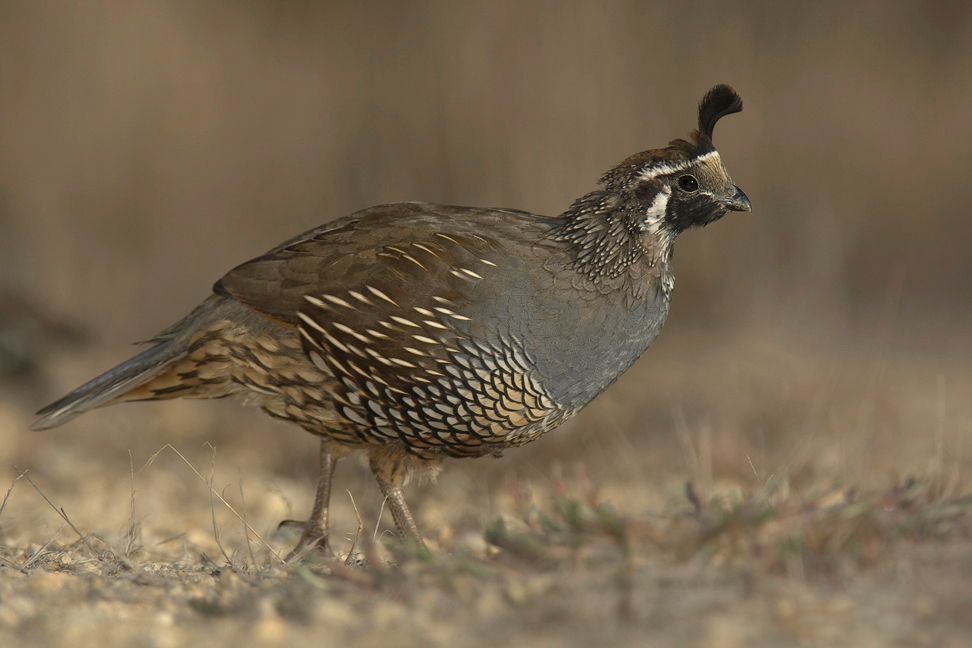
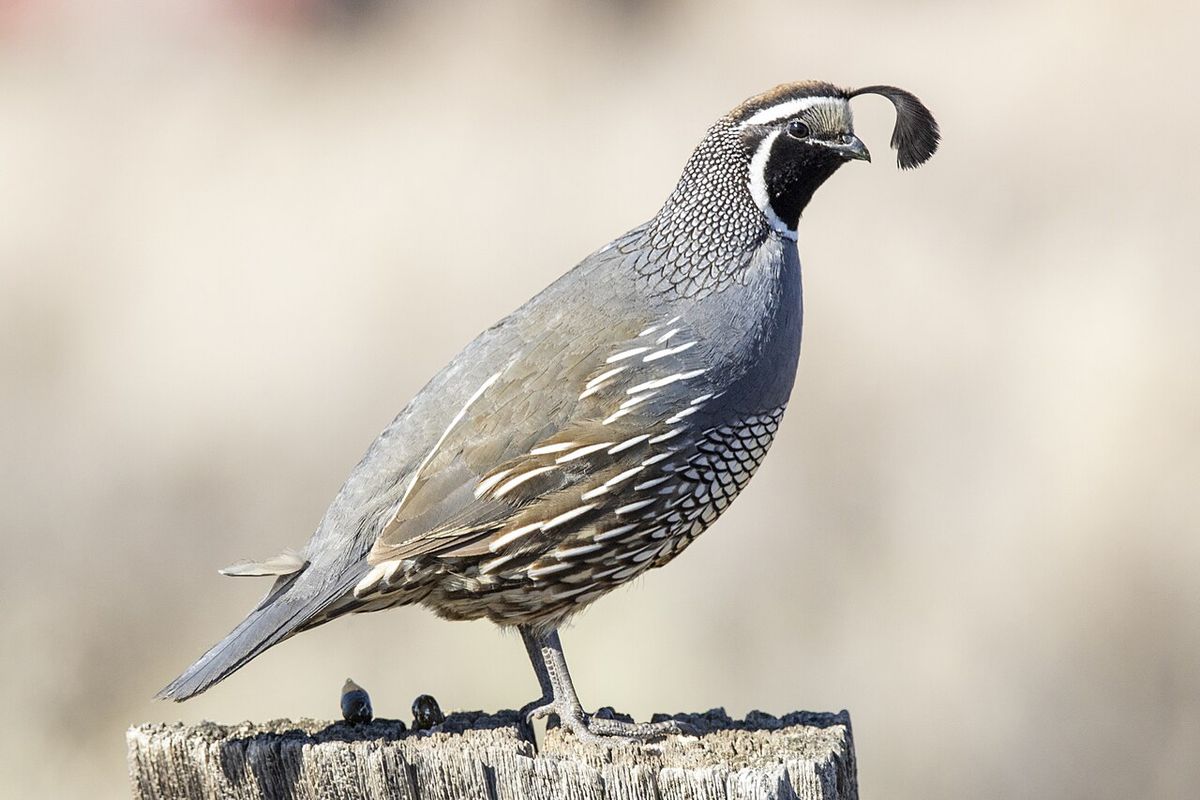
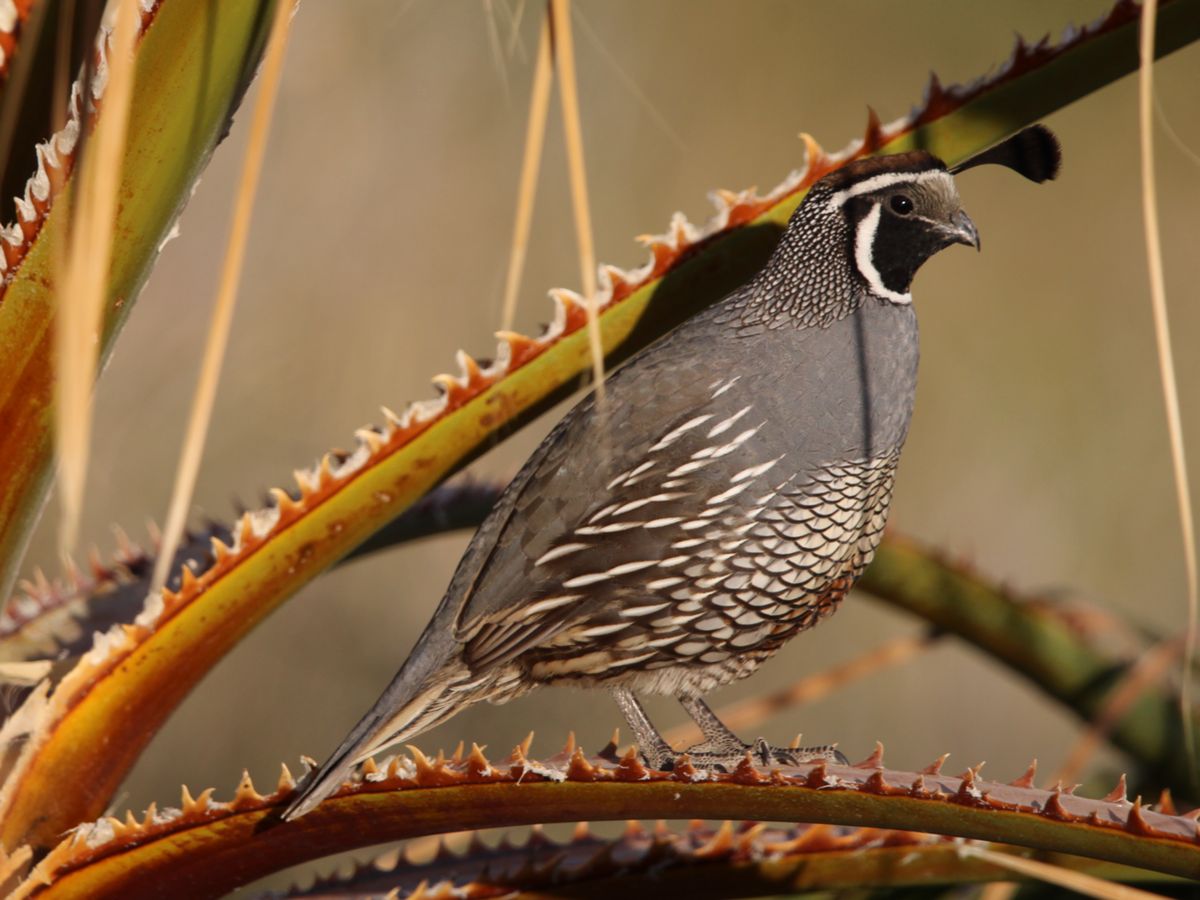
The California quail is a plump, medium-sized bird with a characteristic silhouette defined by a forward-drooping crest or topknot, which is longer and more pronounced in males. Adult males display a striking pattern of blue-gray feathers on the breast and back, a black face sharply outlined with white stripes, and underparts marked with a distinctive chestnut-coloured, scaled appearance. Females are more subdued in coloration, presenting a overall plain brown plumage that provides camouflage for nesting. They lack the bold facial markings of the male and have a shorter crest. In terms of size, the species typically measures between 24 and 27 centimetres in length with a wingspan of 32 to 37 centimetres, and individuals weigh from 140 to 230 grams. The bird's rounded body and ground-hugging posture contribute to its soccer ball-like appearance when observed in its natural habitat. The species can be distinguished from its close relative, the Gambel's quail, by its scaly underbelly and shorter crest, and from the mountain quail by its curved rather than straight plume.
Taxonomy and Subspecies
The California quail belongs to the New World quail family, Odontophoridae, and its closest living relative is Gambel's quail, from which it diverged approximately one to two million years ago during the Late Pliocene or Early Pleistocene. Gambel's quail has a more southerly distribution, a longer crest at about 6.4 centimetres, a brighter head, and lacks the scaled underparts characteristic of the California quail. The two species are known to hybridize in regions where their ranges overlap, and they share a common ancestry that split as the landscapes of western North America changed. Seven distinct subspecies of California quail are recognized across its range, each adapted to specific regional habitats and primarily distinguished by subtle variations in plumage and geographic isolation. The genetic difference between the island population on Santa Catalina and mainland birds is minimal, suggesting a human-mediated introduction by Native Americans around 12,000 years ago, which is a key point of study in understanding the species' dispersal and genetic resilience.
- C. c. californica: Found from northern Oregon and western Nevada to southern California and the Coronado Islands.
- C. c. achrustera (San Lucas California quail): Inhabits southern Baja California.
- C. c. brunnescens: Ranges from extreme northern coastal California to southern Santa Cruz County.
- C. c. canfieldae (Owen Valley quail): Restricted to the Owens Valley of east-central California.
- C. c. catalinensis (Santa Catalina quail): Endemic to Santa Catalina Island off southern California.
- C. c. orecta (Warner Valley quail): Found in the Warner Valley in Oregon to extreme northern California.
- C. c. plumbea (San Quintin California quail): Ranges from San Diego County to southern Baja California.
Habitat and Distribution
The California quail is native to the western coastal regions of North America, with a historic range extending from southern Oregon through California and into the Baja California peninsula. It avoids high-elevation mountainous regions due to cold temperatures, snow, and limited food availability, preferring lower-elevation habitats with a mix of cover and open space that provide security and foraging opportunities. Its ideal environments include broken chaparral, coastal sage scrub, open oak woodlands, grasslands, and the edges of agricultural or suburban areas where it can find seeds and insects. The species has been successfully introduced to numerous regions outside its native range, establishing populations in British Columbia, Hawaii, Chile, Uruguay, Brazil, Argentina, Peru, South Africa, New Zealand, and on Norfolk Island and King Island in Australia. These introductions demonstrate the bird's notable adaptability to novel habitats, from the slopes of Kilauea in Hawaii to the Monte Desert of Argentina, and in its introduced range in British Columbia, it occupies similar edge habitats, showing how its ecological preferences translate across geographies.
Behaviour and Social Structure
California quails are highly gregarious birds, living for much of the year in social groups called coveys, which typically consist of 10 to 12 individuals but can amalgamate into much larger flocks of over 1,000 birds in the fall and winter. Coveys provide collective vigilance against predators such as hawks, owls, coyotes, foxes, and snakes, and the birds rely on vocalizations like contact "pips" to stay connected in dense brush while foraging or moving through their home range. A signature daily behaviour is the communal dust bath, where groups select areas of soft soil, burrow shallow indentations one to two inches deep, and wriggle vigorously to coat their feathers in dust, which helps maintain plumage health and control parasites. These circular baths are often 7 to 15 centimetres in diameter and are typically made in sunny locations preferred by the birds. The birds are primarily terrestrial, preferring to escape danger by running at speeds up to 12 miles per hour, resorting to short, rapid bursts of flight only when startled, a behaviour known as "flushing" that is common among ground-dwelling game birds. Their vocal repertoire is complex, featuring a social "chi-ca-go" call, contact "pips," warning "pips," and an agonistic "squill" used by males during the breeding season, sometimes in antiphonal response to a mate's calls, which may function as a form of communication or mate guarding. Research into their social dynamics reveals that the non-breeding covey structure influences subsequent breeding associations, though the precise relationships are still being studied, and the dissolution of coveys in spring leads to a variety of mating strategies, including social monogamy, sequential polygamy, and simultaneous polyandry, reflecting a dynamic and flexible social system that makes the California quail a significant subject for studies in avian social evolution.
Diet and Foraging Ecology
As ground foragers, California quails spend most of their time scratching at soil and leaf litter in search of food, and they can often be observed feeding along roadsides or in open clearings where seeds are abundant. Their diet is primarily vegetarian for adults, consisting of a wide variety of seeds and leaves, supplemented by berries such as those from the Toyon bush, which is a common food source in their native habitat and provides essential nutrients. Insects and other arthropods form a crucial protein source for growing chicks, aiding in their rapid development and accounting for a larger portion of the diet in the first few weeks of life before they transition to a more seed-based diet. This foraging activity plays a significant ecological role, as the quail act as seed dispersers, helping to propagate vegetation across their habitat and contributing to plant diversity and the regeneration of annual plants like legumes. Their insect consumption also contributes to natural pest control, balancing populations of insects and arachnids that could otherwise harm local plant life and agricultural crops near their habitats. The species is considered an indicator of ecosystem health, as its presence reflects the availability of patchy habitat with ample cover and food resources, and its decline in areas like San Francisco signals broader environmental changes from urbanization.
Breeding and Lifecycle
The breeding season commences in spring as coveys dissolve and birds form pair bonds or other mating associations, with patterns of genetic parentage often not aligning with social pairings due to the species' flexible mating system. The nest is a simple, shallow scrape on the ground, lined with grasses and hidden beneath a shrub or other protective cover within shrubby areas and open woodlands that provide concealment from predators. A typical clutch contains 12 to 16 creamy white eggs, each measuring about 3.2 centimetres long and 2.5 centimetres wide, which the female incubates for approximately three weeks while the male may stand guard nearby. Mating strategies are diverse, ranging from social monogamy to sequential polygamy and even simultaneous polyandry, with males associated with broods not always being the genetic fathers, a fact revealed through modern genetic analysis. In productive years, females will lay more than one clutch, leaving the first brood with an associated male to raise while moving on to nest with a different male, a strategy that maximizes reproductive output when conditions are favourable and food is plentiful. After hatching, the precocial chicks can run and feed within hours, and families often merge to form large communal broods with multiple adults and many offspring, which enhances the survival chances of the young through shared vigilance and care. Research indicates that breeding productivity and the nature of family associations are influenced by ecological factors such as rainfall, habitat disturbance, and possibly the concentration of phytoestrogens in food plants, which can affect hormone levels and behaviour. The average lifespan is three to five years, with the oldest recorded wild individual reaching six years and eleven months, though many individuals do not survive their first year due to high predation pressure and the challenges of finding food in variable climates.
Conservation, Management, and Human Interaction
The California quail is not currently considered a threatened species across its range, but local populations face significant pressures from habitat loss due to urbanization and the historical conversion of land for intensive agriculture, which fragments the patchy habitats they require. Historical declines occurred in the 1800s due to unregulated hunting and trapping for the market, and the species remains susceptible to extinction in isolated urban habitat fragments, as evidenced by its near disappearance from San Francisco where only one bird remained in 2017. In that city, the last male quail was nicknamed Ishi by local birders after the last known member of the Yahi tribe, highlighting the vulnerability of isolated populations and their cultural resonance with local communities. Active management efforts include regulated hunting seasons, which are detailed in annual regulations to ensure sustainable harvest, and relocation programs, such as the Utah Division of Wildlife Resources' practice of trapping hundreds of California quail each winter for translocation to support populations elsewhere in the state. The species' designation as the California state bird in 1931 has cemented its place in the region's cultural identity and helps maintain public interest in its conservation and management across its range. Ongoing research continues to explore the impacts of ecological factors like rainfall, habitat disturbance, and dietary compounds on the bird's breeding behaviour and population dynamics, ensuring management strategies are informed by contemporary science and long-term data sets.
| Season / Area (2026 to 2027) | Dates |
|---|---|
| Q1 (Mountain Quail Only) | September 12 - October 16 |
| Q1 (All Quail) | October 17 - January 31 |
| Zone Q2 (All Quail) | September 26 - January 31 |
Questions about California quail
What does a California quail look like?
The California quail is a plump, round bird with a distinctive forward-drooping black crest on its head. Males have a striking blue-gray breast, a black face outlined in white, and scaled, chestnut-coloured underparts. Females are more camouflaged, with plain brown plumage and a shorter crest, lacking the male's bold facial markings. Both sexes typically measure 24 to 27 centimetres in length and have a wingspan of 32 to 37 centimetres.
What do California quail eat?
California quail are primarily ground foragers with a diet consisting mainly of seeds and leaves. They also eat berries, such as Toyon berries, and insects like beetles and grasshoppers. The insect portion of the diet is particularly important for growing chicks, providing the necessary protein for their development. Their foraging helps with seed dispersal and offers natural insect control in their ecosystems.
Where can you find California quail in Canada?
In Canada, California quail can be found as an introduced population in British Columbia. They are not native to the country but were successfully introduced to this region. Their original native range is western North America, primarily in the southwestern United States. They have also been introduced to other parts of the world, including Hawaii, New Zealand, Chile, and Argentina. The species adapts well to various habitats, which allowed it to establish in British Columbia.
How long do California quail live?
The average lifespan of a California quail is between three and five years. The oldest recorded individual in the wild lived to be six years and eleven months. Their life expectancy is influenced by environmental factors and predation. As ground dwelling birds, they face risks from predators such as hawks, coyotes, and foxes. Their social behaviour in coveys may help improve vigilance and survival chances.
Are California quail endangered?
No, the California quail is not currently considered threatened or endangered in any part of its overall range. However, local populations are susceptible to decline due to urbanization and habitat fragmentation. Historical declines have occurred from unregulated hunting and intensive agriculture. For example, by 2017 only one known quail remained in San Francisco. Conservation efforts, such as trapping and relocation in Utah, are sometimes undertaken to support populations.
Why is the California quail the state bird?
The California quail was officially designated the state bird of California in 1931. It is a recognizable symbol of the state's natural heritage, known for its distinctive curving crest and social behaviour. The bird is strongly associated with California's chaparral and coastal scrub ecosystems. Its selection reflects its well-known status and prevalence in the region's landscapes, though its population has fluctuated significantly within the state over time.
Sources and further reading
- California quail (Wikipedia)
- 2026 Species Spotlight: Californian Quail (ochabitats.org)
- California Quail Callipepla californica (birdsoftheworld.org)
- California Quail (sierraclub.bc.ca)
Checked by the Your Space Hamilton desk. Last updated 2026-10-26.