Bullsnake
The bullsnake (Pituophis catenifer sayi) is a large, nonvenomous colubrid snake and a subspecies of the gopher snake. It is one of the largest snakes native to North America, with some individuals reaching lengths of over eight feet. In Canada, its range extends into the southern portions of Saskatchewan and Alberta, where it inhabits prairie grasslands. The bullsnake is notable for its impressive defensive display, which includes a loud hiss and a rattlesnake-like posture, a bluff that often leads to its mistaken identity and persecution.
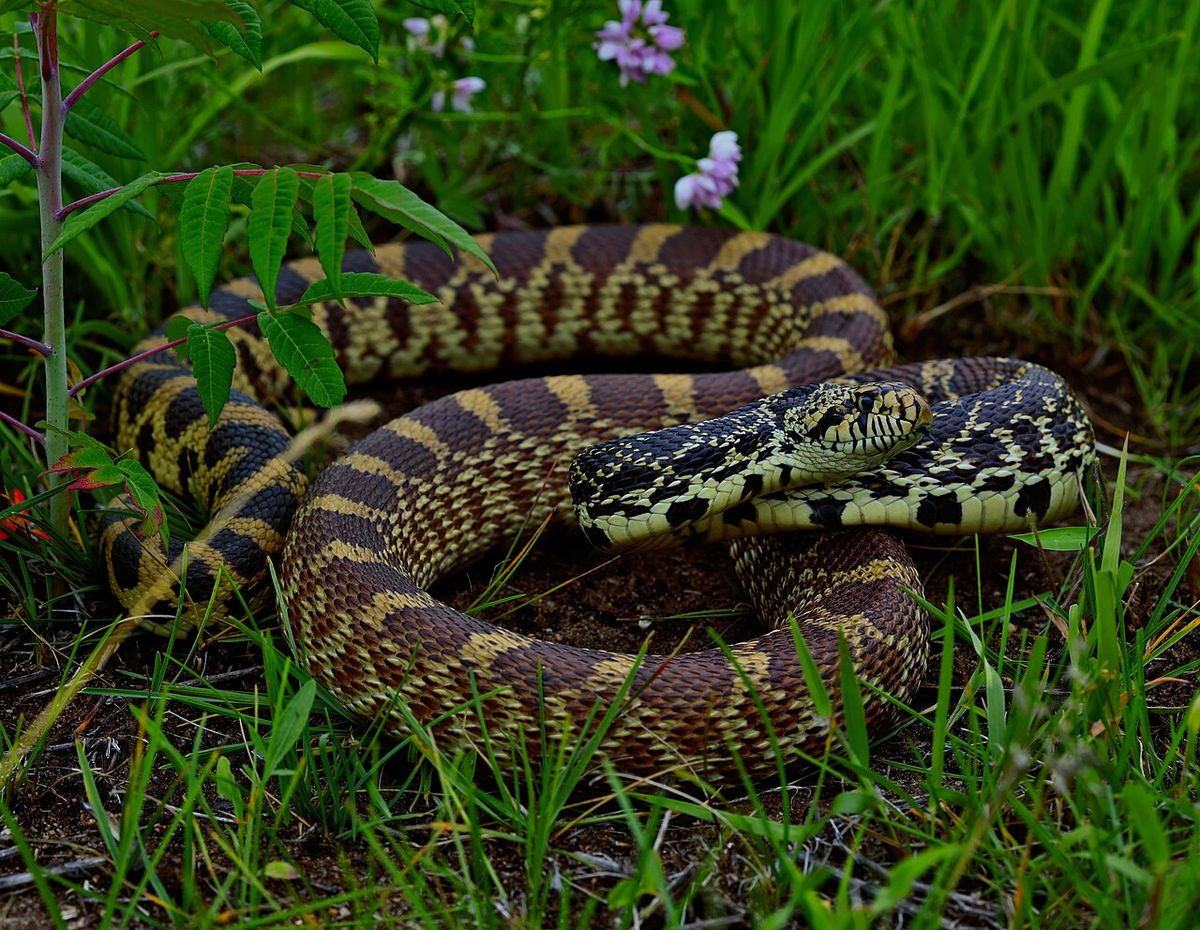
Description and Identification
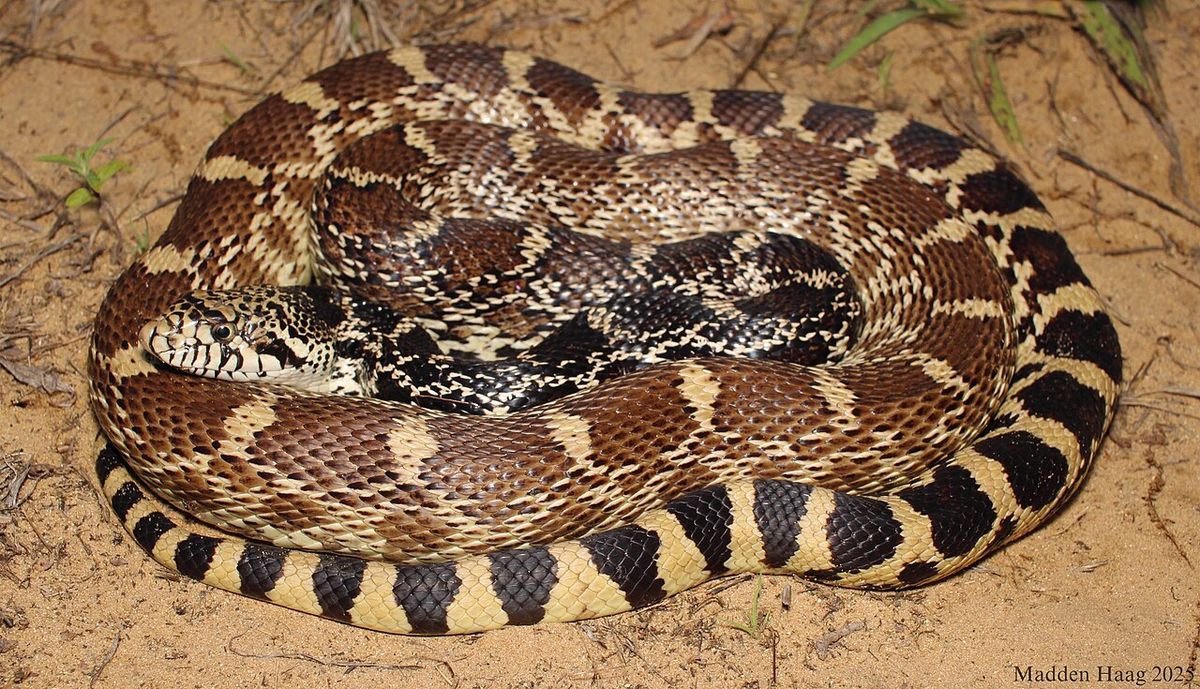
The bullsnake is a large, heavy-bodied constrictor, ranking among the biggest snake species found in Canada and the United States. While not as long as indigo snakes nor as heavy as large rattlesnakes, bullsnakes can be substantial for a colubrid, with known heavy specimens weighing between 3.6 and 4.5 kilograms. The base colouration is usually yellow, overlaid with a series of large brown, black, white, or sometimes reddish blotches along the back. The pattern consists of large dorsal blotches, three sets of spots on the sides, and distinct black bands on the tail, though colour variations including albino and white forms exist. A scale count is required to distinguish juvenile bullsnakes from other juvenile gopher snakes. Bullsnakes have between 33 and 66 dark dorsal blotches on the body, usually 41 or more, and between 9 and 19 on the tail, with the pattern often being bolder on the neck and tail and lighter midbody.
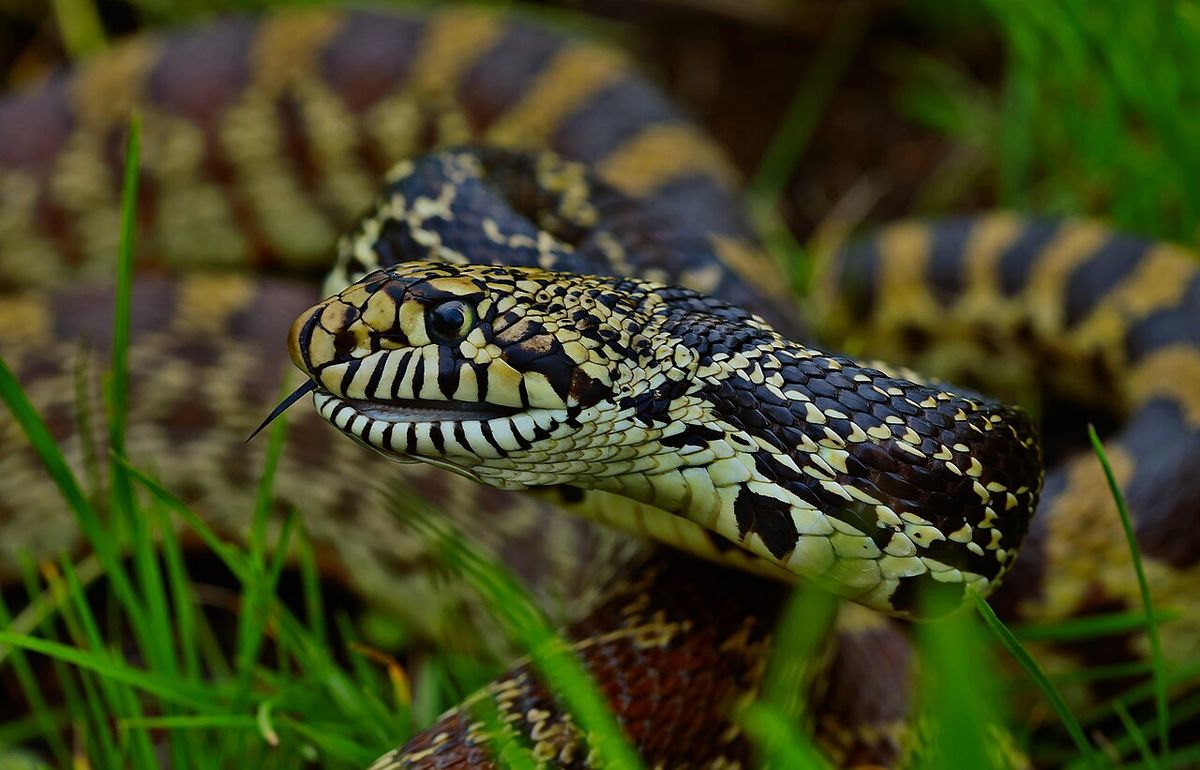
A key identifying feature is the large, narrow rostral scale at the tip of the snout, which is higher than it is wide and protrudes above adjacent scales, giving the head a somewhat pointed appearance when viewed from above. This distinguishes it from other gopher snake subspecies. The dorsal scale rows at midbody number between 27 and 37, most commonly 29, 31, or 33. The combination of its pointed snout, semi-keeled scalation, and dorsal pattern can cause it to superficially resemble the western diamondback rattlesnake, a similarity the bullsnake exploits in its defensive behaviour.
Distribution and Habitat
The bullsnake has an extensive geographic range across the interior of North America. Its distribution stretches from northern Mexico, through the Great Plains and parts of the American Midwest, and into the Canadian prairies. In the United States, it is found in a wide array of states across the central region. In Canada, the bullsnake's range includes the southern regions of Saskatchewan and Alberta, representing the northern limit of its territory. This snake thrives in open, dry ecosystems and is strongly associated with prairie grasslands, agricultural fields, and sandy woodlands.
Bullsnakes prefer prairies, grasslands, and woodlands that provide open and dry ecosystems. They are often found in well-drained, sandy soils. These snakes can occupy both natural and human-made environments. Their preference for open spaces and sandy soils relates to their need for basking and burrowing.
- Mexican States: Nuevo León, Tamaulipas, San Luis Potosí, Veracruz, Hidalgo.
- US States: Colorado, Illinois, Indiana, Iowa, Kansas, Minnesota, Missouri, Montana, Nebraska, New Mexico, North Dakota, Oklahoma, South Dakota, Texas, Wisconsin, Wyoming.
- Canadian Provinces: Southern Saskatchewan, southern Alberta.
- Preferred Ecosystems: Prairies, grasslands, sandy woodlands, agricultural fields.
Diet and Hunting
As powerful constrictors, bullsnakes are formidable predators of small vertebrates. Their primary diet consists of small mammals, which they subdue by coiling around and suffocating. Common prey items include various species of mice, voles, rats, pocket gophers, ground squirrels, young rabbits, and even moles. They are also proficient climbers, a skill they use to raid the nests of ground-nesting birds and birdhouses to consume nestlings, eggs, or brooding adults. One documented snake consumed five small birds within a 15-minute period. Their diet is supplemented with lizards, smaller snakes, bats, and large insects. Juvenile bullsnakes begin life feeding on smaller prey such as baby mice, small lizards, and frogs.
A persistent myth suggests bullsnakes are significant predators of rattlesnakes, often cited as a reason for people to protect them. However, scientific examination, including a study of 1000 bullsnake stomach contents, found rattlesnake remains in only two individuals, indicating such predation is a very rare occurrence. The bullsnake's climbing proficiency is a key hunting adaptation, allowing it to access a food source many other terrestrial snakes cannot. Their diet includes ground-nesting birds, birds' eggs, smaller snakes including Crotalus species, lizards including Uta species, and insects.
- Mammalian Prey: Mice (Peromyscus, Reithrodontomys), voles, rats (Dipodomys), pocket gophers, ground squirrels (Spermophilus), young rabbits, moles, bats.
- Avian Prey: Ground-nesting birds, birds' eggs, nestlings.
- Other Prey: Lizards (Uta spp.), smaller snakes (including Crotalus spp.), insects.
- Juvenile Diet: Small lizards, frogs, baby mice.
- Feeding Record: One snake ate five small birds in 15 minutes.
- Rattlesnake Consumption: Found in only 2 of 1000 examined stomachs.
Behaviour and Defence
Bullsnakes exhibit a range of defensive behaviours that are often misinterpreted as aggression. When confronted by a potential threat, such as a human, their first response is typically to remain motionless. If the threat persists, they will attempt to flee, though they are not particularly fast movers. When escape is not possible, they escalate to an impressive defensive display designed to intimidate. The snake will rear up, flatten its head into a triangular shape, and coil its body into an S-curve posture reminiscent of a rattlesnake about to strike. Simultaneously, it produces a loud, deep hiss by forcibly exhaling air through a glottal structure. The resulting sound is often compared to the bellow of a bull, which is the origin of its common name.
A critical part of this bluff is tail vibration. The bullsnake will rapidly vibrate its tail against dry leaves or grass, producing a buzzing sound that convincingly mimics a rattlesnake's rattle. The sound is produced by the epiglottis, a piece of cartilage, flapping back and forth as air is exhaled from the right lung. Unlike rattlesnakes, which usually keep their tails up to sound the most efficient rattle, bullsnakes tend to keep their tails in contact with the ground, where they can be vibrated against leaves. This elaborate mimicry, combined with a colour pattern that can superficially resemble a western diamondback rattlesnake, leads to frequent cases of mistaken identity, often with fatal consequences for the harmless bullsnake. All these actions are a bluff. The snake is not venomous and rarely bites in defence.
Thermoregulation and Dormancy
As ectothermic reptiles, bullsnakes must actively regulate their body temperature through behavioural means, a process known as thermoregulation. They shuttle between warm and cool microhabitats to maintain an optimal internal temperature. Studies in Canadian grasslands show they frequently bask in sunny areas, such as at the entrance of their burrows, to absorb heat. They show a preference for burrows in open grasslands rather than shaded woodlands because the open environment provides easier access to sunlight for warming. Thermal gradients across the landscape guide their daily movements as they seek out specific temperatures. Bullsnakes actually prefer burrows in open grassland areas as opposed to shaded woodland areas, because living in an open space makes thermoregulation easier.
To survive the cold winters, especially in the northern parts of their range like Canada, bullsnakes enter a state of dormancy called brumation. From approximately October to April, they retreat into hibernacula, which are burrows dug below the frost line. They often brumate communally, sometimes forming large, multi-species colonies with other snakes such as rattlesnakes and garter snakes to share body heat. Bullsnakes also employ physiological adaptations for temperature control, such as regulating blood flow to different parts of the body to conserve or expel heat as needed. They decrease blood flow to the head when too warm to expel heat from their tails and increase flow to the head in colder temperatures to conserve heat.
Reproduction and Life Cycle
Bullsnakes exhibit sexual dimorphism in their rate of maturation. Males typically reach sexual maturity at a younger age, between one and two years old, while females take longer, maturing between three and five years of age. Both sexes are generally about 90 to 96 centimetres in total length when they become reproductively active. Breeding occurs in the spring, usually in March or April, with mating often taking place near the hibernation sites in northern regions. The female subsequently lays a clutch of eggs in late spring or early summer, between April and June.
She deposits the eggs in a protected location such as sandy soil, a rotting log, or an abandoned mammal burrow, and provides no parental care thereafter. The eggs are elliptical, have a leathery, rough, and slightly sticky texture, and can be up to 70 millimetres long. A typical clutch contains about 12 eggs, but the size is variable. The eggs incubate for approximately two to three months, with most hatching occurring in August or September. Baby bullsnakes are between 20 and 55 centimetres at hatching and are initially a grayish colour until after their first shed. Hatchings have been recorded from as early as June 30 to as late as November 7.
- Male Maturity: 1-2 years, at 90-96 cm total length.
- Female Maturity: 3-5 years, at 90-96 cm total length.
- Breeding Season: March or April.
- Egg-Laying Season: April, May, or June.
- Clutch Size Range: 5 to 22 eggs (typically around 12).
- Hatching Season: Typically August or September (records from June 30 to November 7).
- Hatchling Size: 20-55 cm (7.9-21.7 in) at hatching.
Etymology and Naming
The bullsnake's scientific and common names have distinct origins. The subspecific name, sayi, is in honour of American naturalist Thomas Say, a prominent figure in early American zoology. The common name 'bullsnake' or 'bull snake' derives directly from the animal's defensive behaviour. When threatened, the snake produces a deep, rumbling hiss that many observers have likened to the bellowing sound made by a bull. This auditory display is a central component of its bluff against predators. In Mexico, the snake is known by a different name rooted in indigenous language. It is called 'cincuate', a term originating from the Náhuatl words sentli (corn) and coatl (snake). This name reflects a different cultural perception and connection to the local environment, distinct from the defensive-behaviour-based naming in English.
Conservation and Human Interactions
The bullsnake's relationship with humans is complex, largely shaped by its defensive behaviour and physical resemblance to venomous rattlesnakes. This mimicry, while an effective survival strategy against natural predators, frequently leads to bullsnakes being unnecessarily killed by people who mistake them for a danger. Public education is crucial to dispel this misconception and highlight the bullsnake's role as a beneficial predator. By controlling populations of rodents like mice, voles, and gophers, bullsnakes provide a valuable ecological service to agricultural areas and help limit the spread of diseases associated with small mammals.
In Canada, where its range is limited to the southern prairies, the bullsnake faces threats from habitat loss due to agricultural expansion and urban development. The fragmentation of grassland ecosystems can isolate populations and reduce genetic diversity. Conservation efforts focus on preserving large tracts of native prairie, maintaining wildlife corridors, and promoting coexistence by informing landowners and the public about the snake's harmless nature and ecological importance. Its ability to thrive in some human-modified habitats, like pastures, offers hope for its persistence if direct persecution can be reduced. The idea that bullsnakes occasionally eat rattlesnakes is sometimes given as a reason for humans not to harm bullsnakes when encountering them in the wild.
Questions about Bullsnake
Are bullsnakes venomous?
No, bullsnakes are completely nonvenomous. They are constrictors, meaning they subdue their prey by coiling around it. Their intimidating defensive display, which includes hissing, head-flattening, and tail vibration, is a bluff designed to scare away potential threats. They are generally reluctant to bite humans, and their bite, while potentially painful due to their size, is not medically significant.
Where are bullsnakes found in Canada?
The bullsnake occurs in southern Saskatchewan and Alberta, Canada. This is part of its range throughout the Great Plains and parts of the Midwestern United States. Its range extends south into Mexico. These Canadian areas represent the northern part of its geographic distribution.
Why is it called a bullsnake?
They are known as bull snakes or bullsnakes because of the deep hissing or rumbling sound they make when nervous. This sound can be reminiscent of a bellowing bull. Their defensive display also includes rearing up like a rattlesnake and rattling their tail in leaves. This is a bluff as the snake is not venomous.
Do bullsnakes eat rattlesnakes?
The idea that bullsnakes occasionally eat rattlesnakes is sometimes given as a reason for humans not to harm them. However, a study of 1000 bullsnakes found only two had rattlesnake in their stomach contents. This means it is a very rare occurrence. Bullsnakes primarily eat small mammals, birds, eggs, and other prey.
How can you tell a bullsnake from a rattlesnake?
Several key features distinguish a bullsnake from a rattlesnake. Bullsnakes have a narrow, pointed rostral scale on the nose, a rounded pupil (rattlesnakes have vertical, cat-like pupils), and no rattles on the tail, they vibrate their tail against leaves to create sound. Their head, while flattened in defence, is not as broadly triangular as a rattlesnake's when viewed from above. Most importantly, bullsnakes lack the heat-sensing facial pits found on pit vipers like rattlesnakes.
What should I do if I encounter a bullsnake?
If you encounter a bullsnake, the best course of action is to observe it from a safe distance and allow it to move away on its own. Remember that it is a harmless, nonvenomous animal that is likely more frightened of you. Do not attempt to kill it, as this is both unnecessary and illegal in many jurisdictions where it is a protected species. Appreciate its role in controlling rodent populations and simply give it space.
Sources and further reading
- Bullsnake (Wikipedia)
- Bullsnake (canadianherpetology.ca)
- Bullsnake (reptichip.com)
- Common Bullsnake (cosleyzoo.org)
- The Bullsnake Can Be a Gentle Giant | Our Lives in Nature (livesinnature.com)
Checked by the Your Space Hamilton desk. Last updated 2026-11-01.