Baltimore oriole
The Baltimore oriole (Icterus galbula) is a small migratory songbird common in eastern North America. It is a summer resident across southern Canada, breeding from the Prairies through southern Ontario and Quebec to New Brunswick. The species is noted for the male's orange and black plumage, its carefully woven hanging nests, and a series of clear whistled notes. While not exclusive to Canada, its seasonal presence in woodlands and suburbs makes it a recognizable part of the country's avian fauna and a frequent visitor to backyard feeders.
Taxonomy and Naming
The Baltimore oriole was formally described by Swedish naturalist Carl Linnaeus in 1758 in the tenth edition of his Systema Naturae, where he gave it the binomial name Coracias galbula. Linnaeus based his description on the 'Baltimore-Bird' detailed and illustrated earlier by English naturalist Mark Catesby in his work The Natural History of Carolina, Florida and the Bahama Islands, published between 1729 and 1732. The species is now classified within the genus Icterus, a group of New World orioles introduced by French ornithologist Mathurin Jacques Brisson in 1760. The Baltimore oriole is considered monotypic, meaning no subspecies are currently recognised. The common name originates from the resemblance of the male's orange and black plumage to the heraldic colours in the coat-of-arms of 17th-century Lord Baltimore. The genus name Icterus comes from the Ancient Greek word for a yellow bird, while the specific name galbula is Latin for a small yellow bird. The word 'oriole' itself derives from the Latin aureolus, meaning 'golden,' and was applied to this New World family due to its physical similarity to the unrelated Old World orioles of the family Oriolidae.
Physical Description
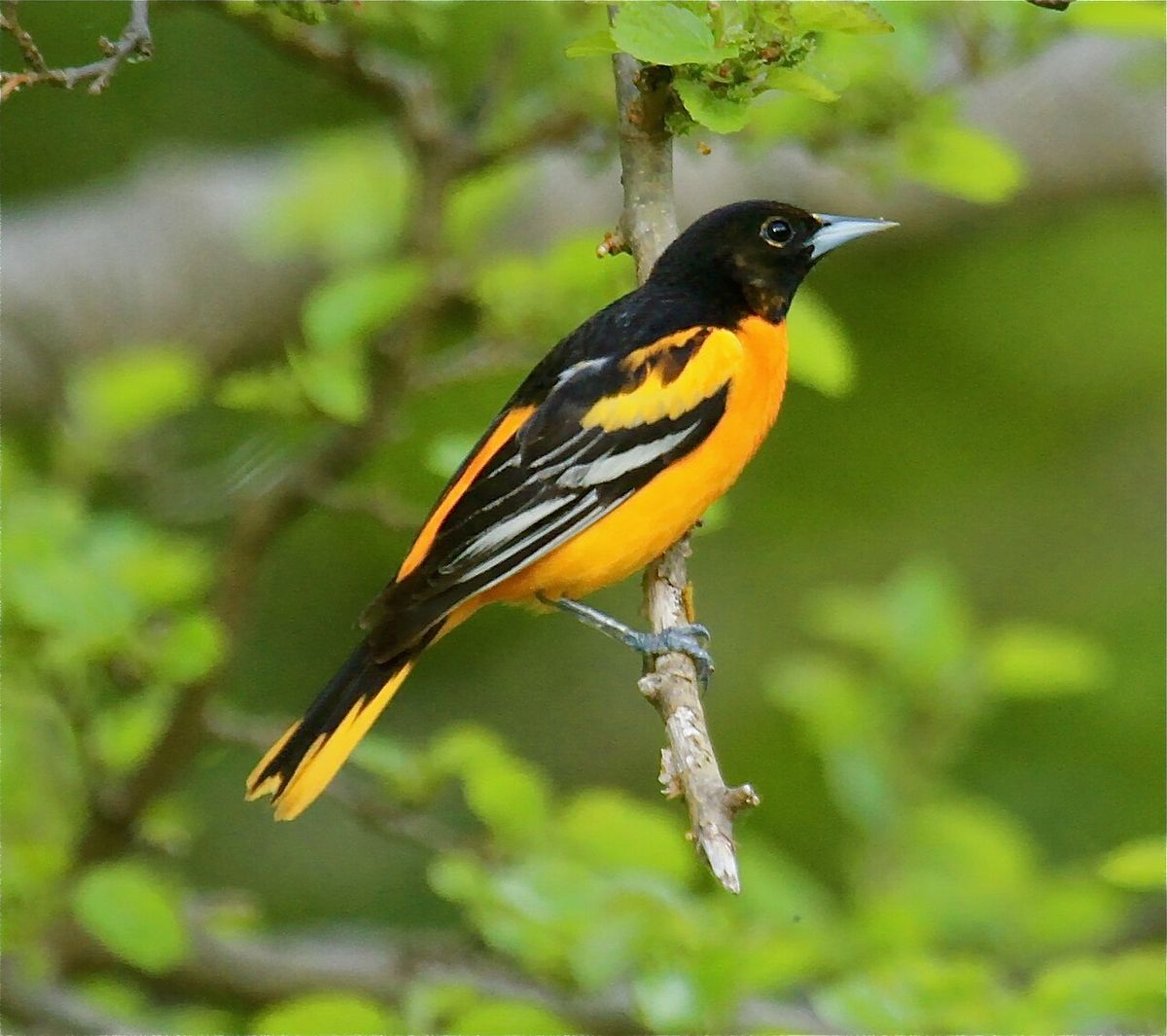
The Baltimore oriole is a medium-sized passerine with a sturdy body, a longish tail, fairly long legs, and a thick, pointed bill characteristic of the icterid family. It measures between 17 and 22 centimetres in length with a wingspan ranging from 23 to 32 centimetres. The average body weight is approximately 33.8 grams, though individuals can weigh anywhere from 22.3 to 42 grams. Adults of both sexes always display distinctive white bars on their wings, which is a key identification feature. The adult male is a striking bird with orange underparts, shoulder patches, and rump, while the rest of its plumage is solid black. The intensity of the orange can vary from a deep flaming hue to a more yellowish orange, with some birds appearing very deep orange and others more yellowish. The adult female is more subdued, with yellow-brown upper parts, darker wings, and dull orange yellow on the breast and belly. Juvenile orioles resemble the female, and males do not attain their full adult plumage until the fall of their second year. The male oriole is slightly larger than the female, although this size dimorphism is minimal by the standards of the icterid family.
Distribution, Habitat and Population Trends
During the summer breeding season, the Baltimore oriole inhabits the Nearctic region, with a range that extends across much of eastern North America. In Canada, its breeding grounds include the Canadian Prairies, eastern Montana, southern Ontario, southern Quebec, and New Brunswick. Its range continues south through the eastern United States to central Mississippi and Alabama and northern Georgia. The species migrates to winter in the Neotropics, primarily in Central America and northern South America, though some birds may winter as far north as Mexico or the southern U.S. coast. Some areas of the southern United States may retain orioles all winter if they have feeders that appeal to them. Baltimore orioles are adaptable birds not generally found in deep forests. They prefer high perches in large, leafy deciduous trees and are commonly found in open woodlands, forest edges, partially wooded wetlands, and stands of trees along rivers. They have successfully adapted to secondary habitats such as orchards, farmland, urban parks, and suburban landscapes that retain woodlots. In Mexico, they winter in flowering canopy trees, often over shade coffee plantations. From 1966 to 2015, the Baltimore oriole experienced an annual population decrease of greater than 1.5 percent throughout the northern and eastern parts of its breeding range. One significant factor in this decline was the loss of favoured nesting trees, particularly American elms, due to Dutch elm disease which destroyed a meaningful amount of their favourite nesting locations. The range of this bird overlaps with that of the similar Bullock's oriole in the Midwest, and the Baltimore oriole is considered a rare vagrant to Western Europe.
Vocalizations and Communication
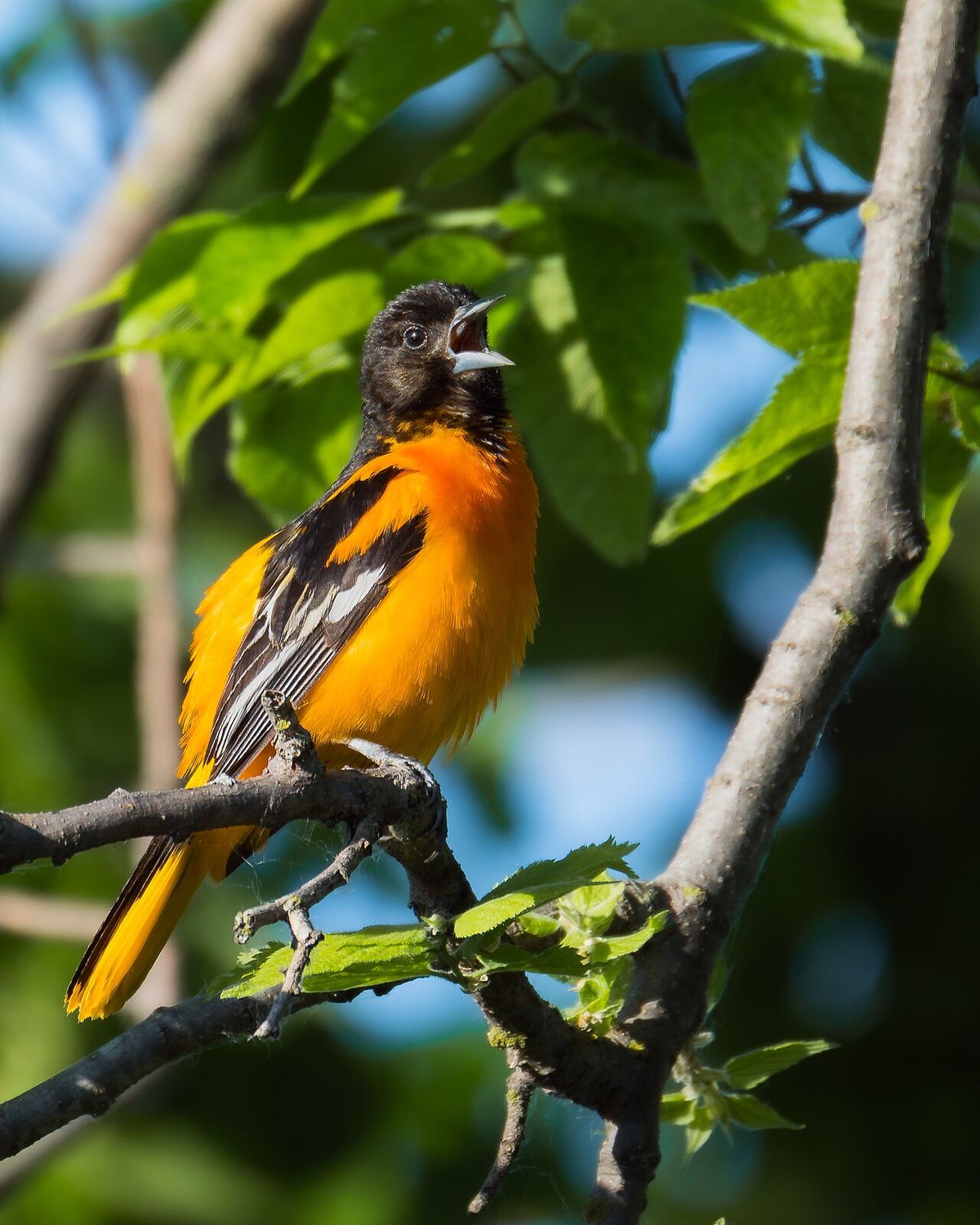
The song of the Baltimore oriole is a series of clear, sweet, whistled notes often described as sounding like 'tyew, pyeer, peededoo, and teer.' The male's song is a clear whistle with a flowing tone that includes a brief sequence of notes that are paired and repeated two to seven times, lasting one to two seconds, used to proclaim and defend territory. During breeding season, mature males may also produce a 'flutter-drum' sound by making noise with their wings in flight while displaying to each other. Females also sing, primarily to communicate, and they give a distinctive fierce screech when protecting their nest. Both sexes use a variety of calls for different situations, including an unusual nasal 'veeer' sound, a low chatter call, and high-pitched calls like 'tyew-li and kleek.' Both male and female orioles make specific warning calls that sound like inharmonious chatter during combative confrontations. If there are other species of orioles in the area that hear the chatter, they will respond to alert calls and try to help defend the territory, indicating a level of interspecific communication and cooperative defence behaviour.
Diet and Foraging Behaviour
Baltimore orioles are agile foragers that comb high branches in trees and shrubs, also making short flights to catch insects. They acrobatically clamber, hover, and hang among foliage as they search for food. Their diet is omnivorous, consisting mainly of insects, berries, and nectar, and they are often seen sipping at hummingbird feeders. A favoured prey item is the forest tent caterpillar moth, which orioles typically consume in its larval stage. The larvae caterpillar is beaten against a branch until their protective hairs are skinned off before being eaten, and this predation plays an important ecological role by helping to regulate populations of a pest that can damage forest trees. Orioles also consume beetles, grasshoppers, wasps, bugs, and spiders. When eating fruit, they show a strong preference for ripe, dark-coloured varieties, seeking out the darkest mulberries, the reddest cherries, and the deepest-purple grapes while ignoring green grapes and yellow cherries even if they are ripe. They sometimes use a technique called 'gaping,' stabbing their closed bill into soft fruit and then opening it to lap up the juice with their tongue. During spring and fall migration periods, nectar, fruit, and other sugary foods are readily converted into fat, which supplies energy for their long journeys. Many people now attract Baltimore orioles to their backyards with oriole feeders, which contain essentially the same food as hummingbird feeders but are designed for orioles, are orange instead of red, and have larger perches. Baltimore orioles are also fond of halved oranges, grape jelly, and in their winter quarters, the red arils of gumbo-limbo (Bursera simaruba). If they discover a well-kept feeder, orioles will lead their young there, demonstrating learned behaviour and site fidelity.
Breeding and Life Cycle
Baltimore orioles are generally solitary outside of the breeding season and are considered monogamous, though evidence suggests extra-pair copulation is relatively common. In spring, males establish a territory and then display to females by singing and chattering while hopping from perch to perch in front of them. Males also give a bow display, bowing with wings lowered and tail fanned. Depending on their receptiveness, the females may ignore these displays or sing and give calls or a wing-quiver display in response, which involves leaning forward, often with the tail partly fanned, and fluttering or quivering slightly lowered wings. The nest is built solely by the female and is a tightly woven, bundle-like pouch located on the end of a branch, consisting of any fine plant or animal materials available. Trees such as elm, cottonwood, maple, willow, or apple are regularly selected, with the nest usually located around 7 to 9 metres above the ground. The female lays a clutch of three to seven pale gray to bluish-white eggs, measuring about 2.3 cm by 1.6 cm on average, with four being the norm. She incubates the eggs for 12 to 14 days. After hatching, both parents feed the nestlings by regurgitation, and the female broods them for about two weeks before they fledge and become largely independent shortly thereafter. The species is single-brooded, meaning if the eggs, young, or nest are destroyed, the oriole is unable to lay a replacement clutch.
Predation is a common cause of mortality for eggs, nestlings, fledglings, and adults. Common predators at Baltimore oriole nests can include common grackles, American crows, blue jays, black-billed magpies, tree squirrels, and domestic cats, which most commonly capture newly fledged orioles or adults engaged in brooding. Rapacious birds commonly prey on both young and fully-grown orioles, the most prolific being the eastern screech owl and Cooper's and sharp-shinned hawks. Somewhat larger rapacious birds also sometimes opportunistically prey on the oriole, including peregrine falcons, great horned owls, and barn owls, while merlins may do so while orioles are migrating. The oldest recorded wild Baltimore oriole lived 11 years and 7 months, while captive individuals have lived up to 14 years, showing a significant difference in potential lifespan between wild and controlled environments.
Relationship with Humans and Cultural Significance
The Baltimore oriole holds cultural significance as the state bird of Maryland and as the namesake and mascot for the Baltimore Orioles Major League Baseball team. For bird enthusiasts, particularly in Canada during the summer months, the species is a welcome visitor that can be attracted to backyards with specific offerings. The historical impact of Dutch elm disease, which destroyed many American elm trees, demonstrated how human-altered landscapes and introduced pathogens can directly affect a species' preferred nesting habitat and population trends. Conservation efforts that consider habitat preservation, including the planting of native trees and the provision of safe feeding stations, can support local oriole populations. The species' adaptability to orchards, farmland, and suburban areas shows its ability to coexist with human development when suitable resources like woodlots are maintained. Research by scientists including James Rising, a professor of zoology at the University of Toronto, was instrumental in clarifying the species' taxonomic status by showing that Baltimore and Bullock's orioles did not interbreed significantly, leading to their re-separation as distinct species in 1995.
Taxonomic History and Similar Species
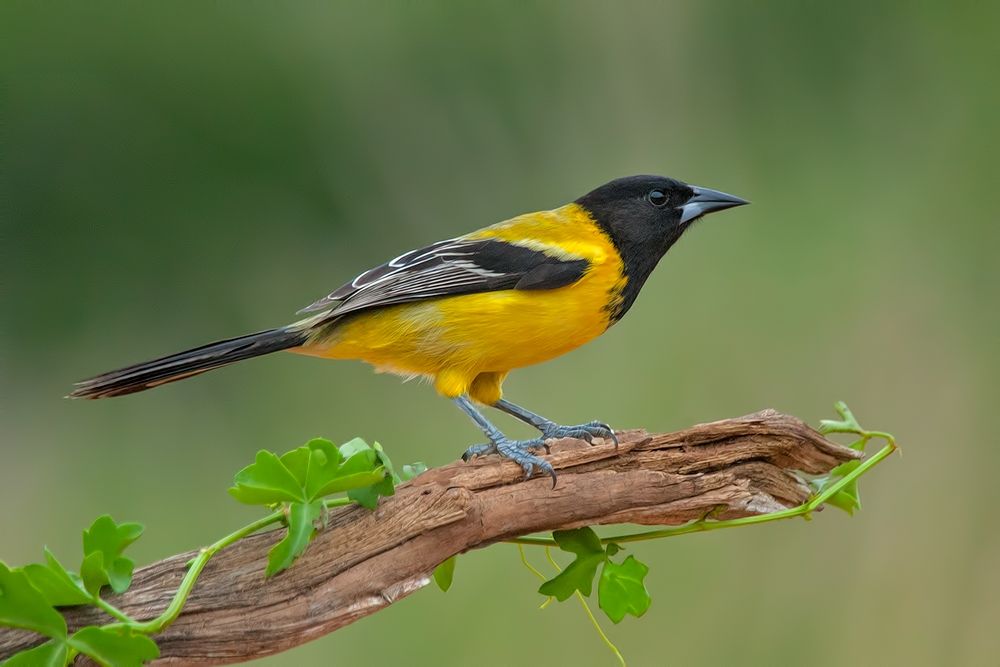
For over two decades, from 1973 to 1995, the Baltimore oriole was classified as conspecific with the Bullock's oriole (Icterus bullockii) under the combined name 'northern oriole.' This classification was based on observations of interbreeding and fertile hybrids in the Midwest where their ranges overlap. However, research led by scientists including James Rising, a professor of zoology at the University of Toronto, demonstrated that significant interbreeding did not occur, leading to the two being recognized as separate species once again. The Baltimore oriole's range overlaps with other oriole species, requiring careful identification, especially in the central plains where hybrids may occasionally occur. Key similar New World oriole species include the smaller, chestnut-coloured orchard oriole, the southwestern Scott's oriole, and Audubon's oriole found in Texas and Mexico. Like all New World orioles, this species is named after an unrelated, physically similar family found in the Old World, the Oriolidae. The species is also a rare vagrant to Western Europe, though such sightings are exceptional and not part of its normal migratory pattern.
Questions about Baltimore oriole
Where can you see Baltimore orioles in Canada?
During the summer breeding season, Baltimore orioles are found across southern Canada. Their range includes the Canadian Prairies, eastern Montana, southern Ontario, southern Quebec, and New Brunswick. They inhabit open woodlands, forest edges, riparian areas, and increasingly suburban parks and backyards with mature trees. They typically arrive in Canada in late April or May and depart for their wintering grounds in Central and South America by September, though migration timing can vary yearly based on weather and food availability along their route.
What do Baltimore orioles eat and how can I attract them to my yard?
Baltimore orioles have an omnivorous diet consisting of insects, berries, and nectar. To attract them, you can offer specific foods in your yard. Specialized oriole feeders filled with a sugar-water solution are effective, as are offerings of grape jelly, halved oranges, and mealworms. They show a strong preference for dark, ripe fruit like mulberries, cherries, and purple grapes while ignoring green or yellow fruit. Providing a water source and planting native fruit-bearing trees and shrubs such as serviceberries or wild grapes can also make your yard more attractive to foraging orioles throughout the season.
How can you tell a male Baltimore oriole from a female?
The adult male Baltimore oriole is unmistakable with its orange underparts, shoulder patch, and rump contrasted against solid black plumage on the head, back, wings, and tail. The adult female is much more subdued, with yellow-brown upper parts, darker wings, and dull orange yellow on the breast and belly. Both sexes have white bars on their wings, a key feature at any age. Juvenile birds closely resemble the female, and young males do not acquire their full adult plumage until their second fall, making first-year males challenging to distinguish from females without close observation.
What does a Baltimore oriole's nest look like and where is it built?
The Baltimore oriole's nest is a carefully woven, pouch-like structure that hangs from the end of a tree branch. It is built exclusively by the female from fine plant and animal materials like grass, plant fibres, hair, and sometimes string. The nest is typically located high up, between 7 and 9 metres above the ground, in deciduous trees such as elms, cottonwoods, maples, willows, or apple trees. Its suspended, bag-like design helps protect the eggs and young from many ground-based predators, though it is still vulnerable to birds, squirrels, and climbing snakes that can access the canopy.
What is the difference between a Baltimore oriole and a Bullock's oriole?
The Baltimore oriole and Bullock's oriole are two separate species that were once combined as the 'northern oriole' from 1973 to 1995. The male Baltimore oriole has a solid black head and back with orange underparts, while the male Bullock's oriole has an orange face with a black line through the eye and a large white wing patch. Females are harder to distinguish but generally, female Baltimores are more orange-toned below. Their breeding ranges overlap in the Great Plains, but research by James Rising and others showed they do not interbreed significantly, leading to their reclassification as distinct species based on behavioural and genetic evidence.
Are Baltimore oriole populations declining and why?
Yes, Baltimore oriole populations are declining. From 1966 to 2015, the species experienced a greater than 1.5 percent annual population decrease throughout the northern and eastern parts of its breeding range. One major cause for this decline was Dutch elm disease, which destroyed a significant amount of their favourite nesting locations, specifically elm trees. These birds often nest high up in large, leafy deciduous trees, with elms being a regularly selected species. The loss of these trees has directly impacted their breeding habitat availability. This population trend highlights the vulnerability of the species to environmental changes affecting its preferred nesting sites.
Sources and further reading
- Baltimore oriole (Wikipedia)
- Baltimore Oriole (nwf.org)
- Baltimore Oriole (nationalgeographic.com)
- Baltimore oriole (nationalzoo.si.edu)
Checked by the Your Space Hamilton desk. Last updated 2026-11-02.