Treasure Island
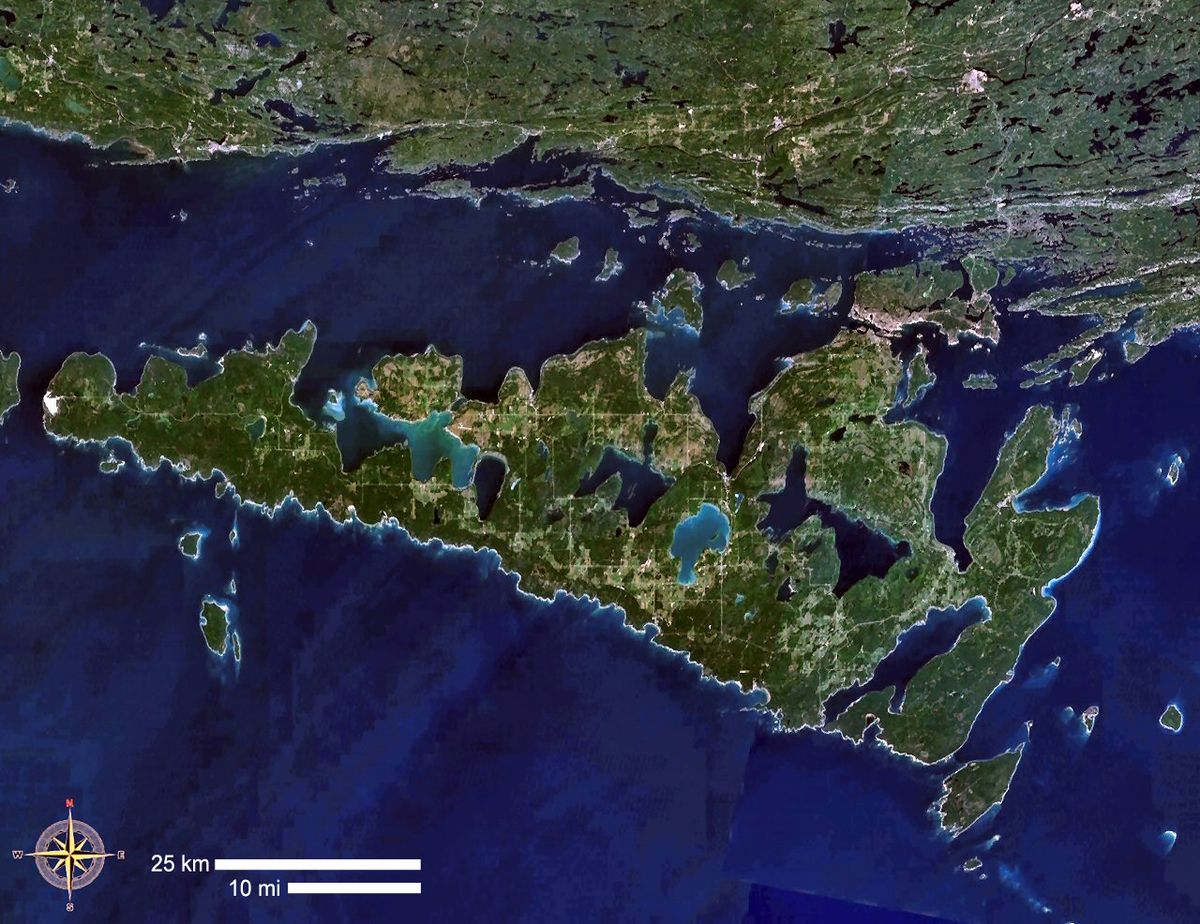
Treasure Island, also known by its original name Mindemoya, is a small island located within Lake Mindemoya on Manitoulin Island in Lake Huron, Ontario. It is notable for being the world's largest natural island in a lake on an island in a lake, a unique geographical feature. The island, which is approximately 0.445 square kilometres in area, has no permanent residents but features seasonal cottages and a history as a tourist resort. Its distinctive shape is central to local Anishinaabe legend, giving the island and the surrounding lake their names.
Geography and Notable Status
Treasure Island is situated in Lake Mindemoya, which is itself located on Manitoulin Island in Lake Huron. The island measures approximately 1.4 kilometres in length and is about 400 metres wide, encompassing an area of 0.445 square kilometres or roughly 110 acres. Its base elevation is about 200 metres above sea level, with its highest point rising to approximately 225 metres. This modest size belies its significant geographical distinction. Treasure Island holds the record as the world's largest natural island in a lake on an island in a lake. This recursive geographical phenomenon makes it a point of interest for cartographers and geography enthusiasts. The island's terrain is characterized by a long, flat hill at one end that drops steeply to a lower area at the other, a formation that inspired its original name and associated legends. The island's dimensions and isolated location within two nested bodies of water contribute to its unique ecological and geological identity within the Great Lakes basin.
History of Ownership and Use
The documented ownership history of Treasure Island begins in 1883 when it was purchased for $60 by William McPherson, who served as a deputy chief of police in Toronto. For forty-five years, the island remained under his ownership before being sold in 1928 to Joe and Jean Hodgson. The Hodgsons were instrumental in developing the island's commercial potential by establishing the Treasure Island Resort, a tourist camp that catered to visitors seeking a rustic getaway. The resort operated for four decades until Joe Hodgson's death in 1968. Following his passing, Jean Hodgson attempted to maintain the business but was ultimately unsuccessful. The property changed hands several times and fell into a state of disrepair. In 1980, the island was purchased by the Moeller family from Spencerville, Ohio, who transformed it into a private corporate and family retreat, which remains its primary use today. The island has no permanent residents, but the presence of cottages indicates its continued seasonal use, preserving a thread of its resort-era character within its current private ownership.
The Legend of Mindemoya
Long before it was called Treasure Island, the landform was known as Mindemoya, a name derived from local Anishinaabe tradition. The island's unique silhouette, with a high, rounded hill at one end and a lower area at the other, is said to resemble a kneeling figure. One prominent legend explains this shape through a story of a great chieftain or demi-god from Sault Ste. Marie. According to the tale, frustrated by his wife's constant quarrelling, he kicked her, sending her flying through the air. She landed on her hands and knees in what is now Lake Mindemoya, with her back and rump remaining above the water, permanently forming the island. The word 'Mindemoya' is popularly translated as 'old lady's bottom,' directly referencing this origin story. This name was later applied to the surrounding lake and the nearby village on Manitoulin Island. The more prosaic name 'Treasure Island' was adopted in the early 20th century by a tourist operator seeking to market the resort, though the original name remains in use and is deeply woven into local culture. The legend is one of several about the island's origin, reflecting the rich oral history of the region and the Anishinaabe people's connection to the landscape.
Treasure Island Development Project in San Francisco
It is important to distinguish the natural Ontario island from the unrelated, human-made Treasure Island in San Francisco Bay, California, which is the subject of a major urban redevelopment. The San Francisco Treasure Island is a former naval base built in 1939 for the Golden Gate International Exposition. A massive development project is transforming the island, led by the Treasure Island Development Authority (TIDA). Upon completion, the Treasure Island/Yerba Buena Island Development Project will create up to 8,000 new housing units, including market-rate and affordable homes intended for approximately 18,000 residents. The plan includes extensive new commercial spaces, shops, and restaurants designed to establish a complete new neighborhood for San Francisco. This project represents the largest new neighborhood development undertaken in the city in decades, aiming to create a community for a wide range of household types and income levels. The development also includes plans for new public transportation infrastructure and public art installations, fundamentally reshaping the 1930s-era island into a modern, mixed-use community. The Treasure Island Development Authority (TIDA) is the City agency responsible for the development and ownership of the parks and infrastructure as part of this long-term project.
Parks and Public Spaces on San Francisco's Treasure Island
A central component of the San Francisco redevelopment is the creation of nearly 290 acres of new parks and open space across Treasure Island and neighbouring Yerba Buena Island, with 80 acres designated for Yerba Buena Island specifically. Management of these parks will transition to the San Francisco Recreation and Park Department starting July 1, 2026. The crown jewel of this new green space is Cityside Park, a six-acre, $12 million Bayfront park that opened on the western shore of Treasure Island. Cityside Park offers sweeping, 180-degree views of the San Francisco skyline and is designed as the primary gateway for visitors arriving by ferry. San Francisco Mayor Daniel Lurie hailed the park as capturing the spirit of the city and a key part of driving its recovery by improving public spaces. The park features grassy areas, walking paths, and serves as a venue for numerous public events and gatherings, becoming an immediate focal point for the emerging community. Residents and visitors have praised the park for its scenery, noting it is good for children and walking dogs, and believe it will help bring people together and make the island more active. The park's opening was celebrated as a milestone in the island's transformation from a former military base into a thriving residential and recreational area.
Recreation and Events on San Francisco's Treasure Island
Recreational and community activities are a growing feature of life on San Francisco's Treasure Island, even as construction continues. A regular roster of public events helps animate the new parks and historic venues. The popular 'Off the Grid' food truck market returns seasonally, for example on Saturdays from September 12 through October 17, offering a variety of international cuisines alongside live music at Cityside Park. Weekly events include outdoor yoga sessions on Sunday mornings through the end of May, led by skilled Bay Area instructors in Cityside Park, and live musical performances at venues like Mersea Restaurant and Bar and the Gold Bar Distillery. The Gold Bar Distillery, set in a historic 1930s Art Deco building, hosts jazz nights, sunset cocktail events, and larger dance parties featuring headline DJs like SIDEPIECE. These activities leverage the island's unique setting, combining Bay views with community programming. The nonprofit One Treasure Island also fosters community by organizing a variety of events for residents and employees, with details available in a community calendar and newsletter.
- Off the Grid: Seasonal Saturday food truck markets at Cityside Park from 11 AM to 4 PM, featuring Asian, Latin, European, and classic American food.
- Cityside Park Yoga: Outdoor vinyasa flow classes held Sunday mornings, open to all levels with advance registration.
- Mersea Restaurant and Bar: Free live music every Friday, Saturday, and Sunday by acts like The Backyard Trio, Jaz Force, and Richie and the Green Lights.
- Gold Bar Distillery: Jazz nights with bands like Sueños, whiskey flights, and DJ events like Sunday sunset sets with Marc Stokes.
- Community Gatherings: Regular events and opportunities organized by nonprofit One Treasure Island to foster an equitable community.
- Treasure Island Museum: A resource for learning about the island's exposition and military history through exhibits like 'Treasured Stories'.
- Active Recreation: Opportunities to rent kayaks, play bocce ball, and enjoy biking along the island's pathways with panoramic bay views.
Access to Treasure Island in San Francisco is provided by the 25 Muni bus line, ferry service, and by car or bicycle from the East Bay. The ferry from downtown San Francisco is an eight-minute ride from the Ferry Building. The ongoing Treasure Island and Yerba Buena Island Development Project is creating up to 8,000 new homes. This development will also provide over 290 acres of new parks and open space. The project aims to foster an equitable, inclusive, and thriving community for all residents and visitors.
Community Response and Future Vision
The transformation of San Francisco's Treasure Island has been met with positive responses from early residents and visitors who appreciate the new community amenities. Longtime resident Melanie Williams, who moved to the island in 1996 when there was 'nothing here but dirt,' views the development of Cityside Park and the new neighborhood as a 'miracle' and a positive step forward for community cohesion. Newer residents like Breasia Rucker believe the park and events will bring more people together and make the island more active. The developer, Chris Meany, emphasizes the project's goal to create a neighborhood for a wide range of household types and incomes, which is central to the island's future identity. The vision extends beyond housing and parks to include a full suite of urban amenities, with the Treasure Island Development Authority overseeing the creation of public transportation links and cultural assets. The planned 8,000 homes and 290 acres of parks represent a comprehensive effort to build a sustainable, connected community from the ground up on this unique Bay Area island, marking its latest reinvention from a world's fair site to a military base to a forward-looking urban neighbourhood. Residents like Mary Taufaao highlight the practical benefits of the new park for family activities and enjoying the exceptional scenery of the San Francisco Bay.
Questions about Treasure Island
Where is Treasure Island located in Canada?
Treasure Island, also known as Mindemoya, is located in Lake Mindemoya on Manitoulin Island in Lake Huron, Ontario. It is a natural landform, not to be confused with the human-made island of the same name in San Francisco Bay. The Canadian Treasure Island is notable for its unique recursive geographical status as the world's largest island in a lake on an island in a lake. Its specific coordinates place it within the traditional territory of the Anishinaabe people.
Why is Treasure Island considered geographically unique?
Treasure Island holds the distinction of being the world's largest natural island in a lake on an island in a lake. This means it is an island (Treasure Island) within a lake (Lake Mindemoya), which is on a larger island (Manitoulin Island), which is itself situated within a lake (Lake Huron). This nested configuration is a rare geographical phenomenon that makes the island a point of cartographic interest. Its area of 0.445 square kilometres solidifies its record-holding status among similar recursive landforms globally.
What is the legend behind the name Mindemoya?
According to local Anishinaabe legend, the island was originally named Mindemoya, which is said to mean 'old lady's bottom.' The story tells of a great chieftain from Sault Ste. Marie who, frustrated with his wife, kicked her, sending her flying to land in the lake. Her kneeling form, with her back and rump above the water, is said to have become the island. This name was later given to the lake and the nearby village. The legend directly explains the island's distinctive shape of a high hill at one end and a lower area at the other.
What is being built on Treasure Island in San Francisco?
San Francisco's Treasure Island is undergoing a massive redevelopment project that will create a new neighborhood with up to 8,000 homes for about 18,000 residents. The project includes 290 acres of new parks and open space, commercial areas, shops, and restaurants, as well as public transportation and public art. A key feature is the new six-acre Cityside Park, which opened on the island's western shore with panoramic views of the San Francisco skyline. This development is the largest new neighborhood project in San Francisco in decades.
Who will manage the parks on San Francisco's Treasure Island?
The San Francisco Recreation and Park Department will begin operations and management of the Treasure Island and Yerba Buena Island Parks on July 1, 2026. Until that date, the Treasure Island Development Authority (TIDA) is responsible for development and ownership of these parks. TIDA remains in charge of parks that have not yet been renovated as part of the development project. After July 1, 2026, the Recreation and Park Department will take over management duties.
Can you visit Treasure Island in Ontario?
General public access to Treasure Island in Ontario is not available as it is a privately owned corporate and family retreat. The island has no permanent residents, though it does contain some seasonal cottages. Historically, it was accessible when it operated as the Treasure Island Resort from 1928 until the owner's death in 1968. After the resort closed, the property was sold and became run down before being purchased for private use in 1980. Visitors to Manitoulin Island can view the island from the shores of Lake Mindemoya, but cannot typically set foot on it.
Sources and further reading
- Treasure Island (Wikipedia)
- Treasure Island and Yerba Buena Island Parks (sfrecpark.org)
- Events on Treasure Island San Francisco | Food, Music & ... (tisf.com)
- San Francisco's newest public park opens on Treasure Island (abc7news.com)
Checked by the Your Space Hamilton desk. Last updated 2026-10-26.