University of Toronto St. George
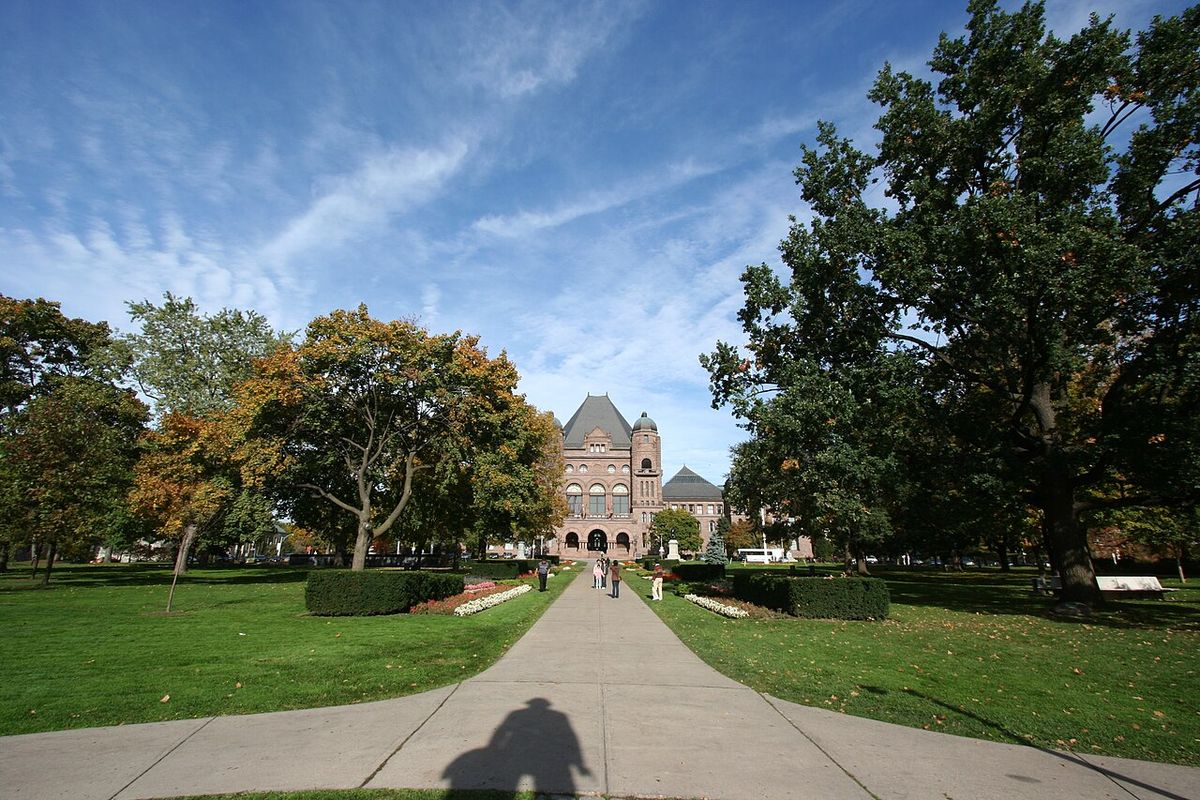
The University of Toronto St. George campus, often called U of T St. George or UTSG, is the historic downtown Toronto location and principal campus of the University of Toronto. As the oldest and largest of the university's three campuses, it serves as the central administrative hub and is distinguished by its collegiate system of 11 constituent and federated colleges. The 73.6-hectare campus, centred around Queen's Park, is a major centre for research, education, and culture in Canada, housing the majority of the university's professional faculties and graduate programs. Its blend of historic Romanesque and Gothic Revival architecture with modernist structures forms a defining part of the city's character.
History and Indigenous context
The land comprising the St. George campus has a long history predating European settlement, rooted in Indigenous habitation and diplomacy. The area was traversed by Taddle Creek, a waterway buried in the 19th century that flowed near the present-day Philosopher's Walk and Hart House. This creek served as a gathering place for Indigenous groups including the Huron-Wendat, the Seneca, and the Mississaugas of the Credit First Nation. The surrounding land was covered by a peace agreement between the Anishinaabe and Haudensaunee Confederacy under a Dish With One Spoon treaty. Formal ownership was transferred from the Mississaugas to the British Crown under Treaty 13, part of the Toronto Purchase finalized in 1805, a transaction that remained disputed until a settlement between the Mississaugas and the Government of Canada in 2010.
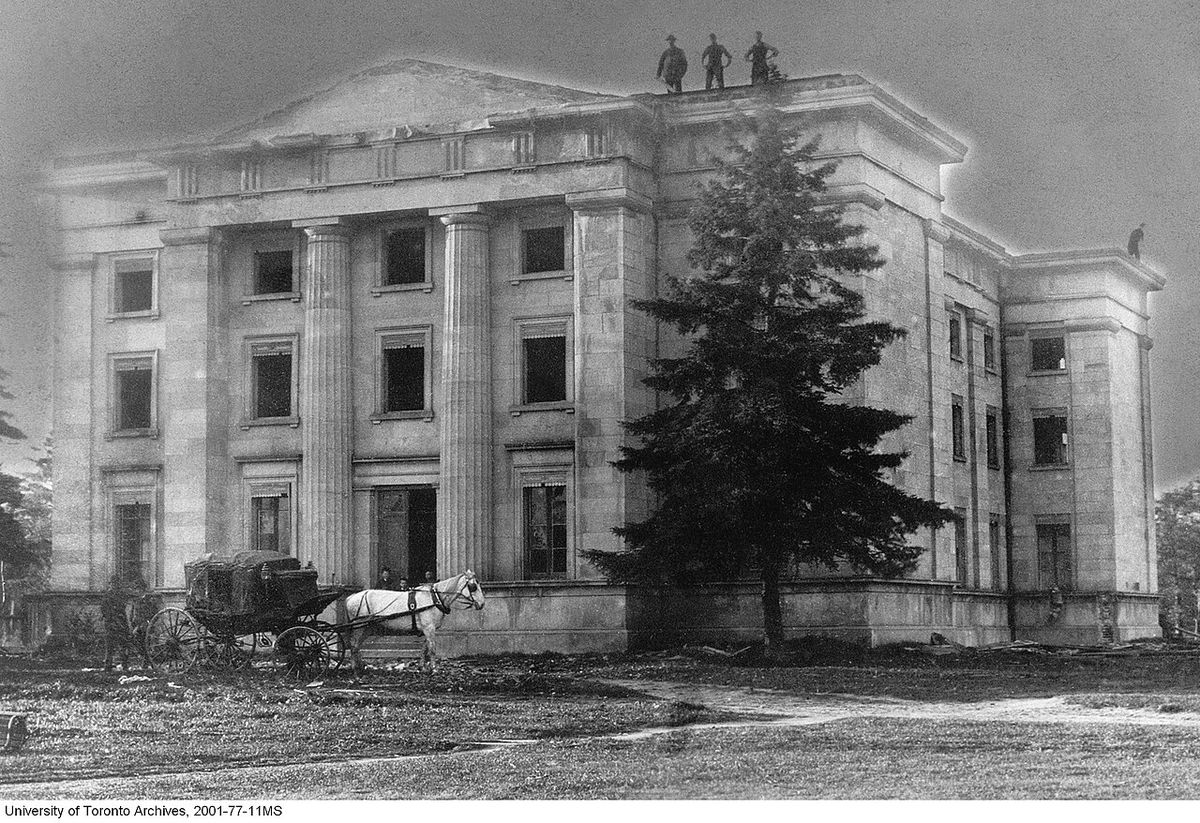
The modern campus originated with the 1827 charter for King's College, with 128 acres of forested land purchased in the town of York the following year for £3,750. The property was assembled from 50-acre parcels purchased from Chief Justice William Dummer Powell, D'Arcy Boulton, and the Elmsley family. The first building began construction on the present site of Queen's Park, and the campus was formally established during a ceremony on April 23, 1842, when the foundation stone for the building was laid by governor general Sir Charles Bagot. On April 3, 1849, Robert Baldwin successfully proposed a bill to the provincial parliament to turn King's College into a secular institution with no official religious affiliation. Upon secularization in 1850, King's College became the University of Toronto. The founding of University College, the university's first constituent college, marked the beginning of the St. George campus as it stands today. The college's main building opened on October 4, 1859. The campus expanded westward over the decades, leading to the adoption of the name St. George campus to distinguish it from the newer Scarborough and Erindale campuses. A major recent transformation, the Landmark Project, was completed in 2024, converting the circular road of King's College Circle into a pedestrian-friendly space with new landscaping and benches, and creating Canada's largest geoexchange system and an underground parking garage beneath the area.
Campus layout and architectural heritage
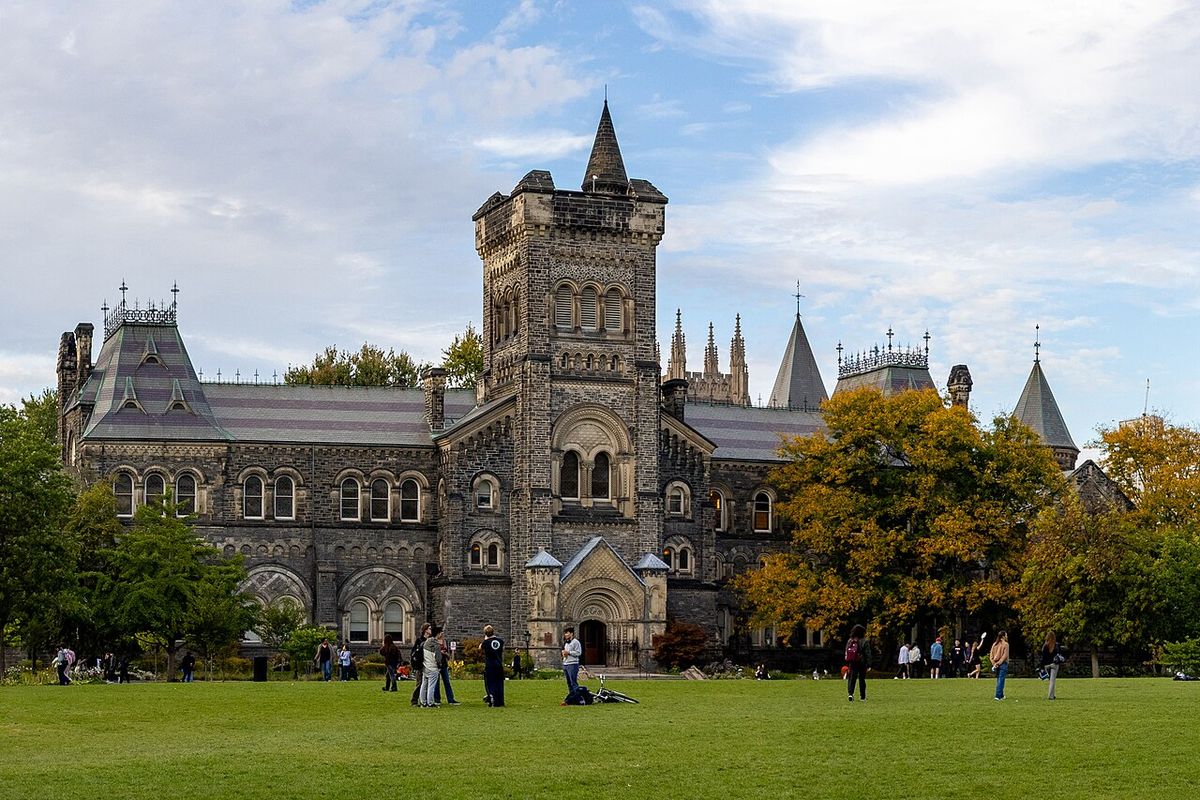
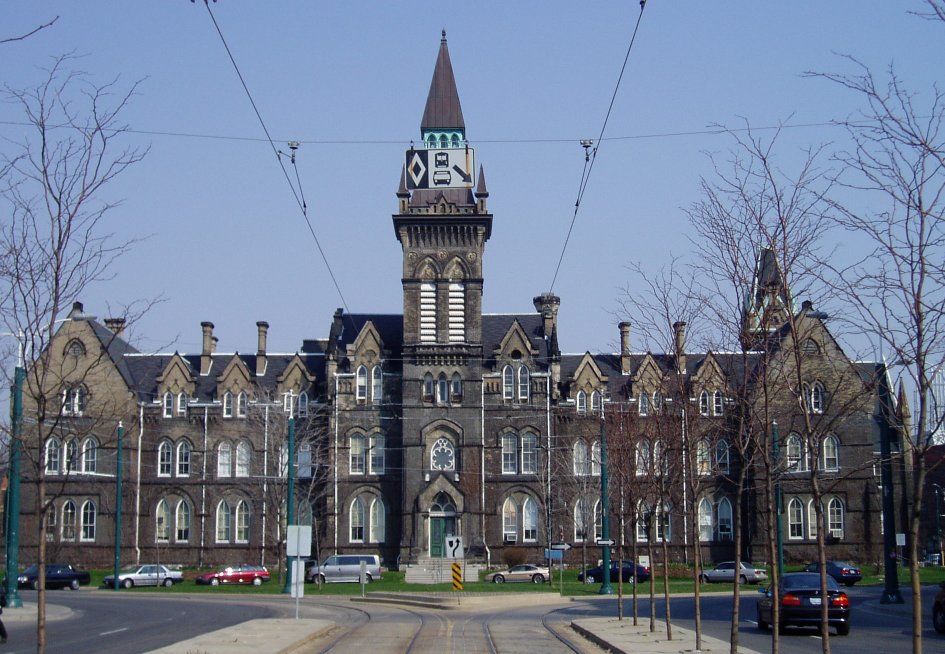
The St. George campus is roughly bounded by Bloor Street West to the north, College Street to the south, Spadina Avenue to the west, and Bay Street and Queen's Park to the east. Its architecture presents a chronological narrative of styles, with the eastern and central portions dominated by historic Romanesque and Gothic Revival buildings constructed primarily between 1858 and 1929. The traditional heart is Front Campus, a large open square and green space outlined by the pedestrian street King's College Circle. This area is surrounded by landmark structures including the main building of University College, a National Historic Site of Canada built in 1857 with an eclectic blend of Richardsonian Romanesque and Norman architectural elements designed by architect Frederick William Cumberland. Convocation Hall, built in 1907, is recognizable for its domed roof and Ionic-pillared rotunda and hosts the annual convocation ceremonies. The sandstone buildings of Knox College epitomize the North American collegiate Gothic design with characteristic cloisters.
A lawn at the northeast is anchored by Hart House, a Gothic-revival student centre complex completed in 1919 and named after Hart Massey. Among its many common rooms, the building's Great Hall is noted for large stained-glass windows and a long quotation from John Milton's Areopagitica inscribed around the walls. The adjacent Soldiers' Tower stands 143 feet tall as the most prominent structure in the vicinity, its stone arches etched with the names of university members lost in the two World Wars. The tower houses a 51-bell carillon played on Remembrance Day and convocation. North of University College, the main building of Trinity College displays Jacobethan Tudor architecture, while its chapel was built in the Perpendicular Gothic style of Giles Gilbert Scott by Italian stonemasons using ancient methods. Philosopher's Walk is a scenic footpath that follows the buried Taddle Creek, linking with Trinity College, Varsity Arena and the Henry N.R. Jackman Faculty of Law. Victoria College is on the eastern side of Queen's Park, centred on a Romanesque main building made of contrasting red sandstone and grey limestone.
The section of the campus west of St. George Street consists mainly of modernist and internationalist structures developed after the Second World War. The most significant example of Brutalist architecture is the massive Robarts Library complex, built in 1972 and opened in 1973, which features raised podia, extensive use of triangular geometric designs and a towering 14-storey concrete structure that cantilevers above a field of open space. Sidney Smith Hall is the home to the Faculty of Arts and Science, as well as a few departments within the faculty. The Leslie L. Dan Pharmacy Building, completed in 2006, exhibits the high-tech architectural style of glass and steel by British architect Norman Foster. The campus is organized into several distinct areas.
- Central Area: Bounded by St. George Street, Hoskin Avenue, Queen's Park Crescent West, and College Street. It contains Hart House, Soldiers' Tower, the Back Campus Fields synthetic turf fields, and the main buildings of the Temerty Faculty of Medicine and the Faculty of Applied Science and Engineering.
- Western Portion: Includes everything west of St. George Street, housing the Faculty of Arts and Science, Rotman School of Management, the John H. Daniels Faculty of Architecture, Landscape, and Design, Robarts Library, and New College.
- Northern Portion: Houses colleges such as Trinity College, Woodsworth College, and Innis College, as well as the Munk School of Global Affairs and Public Policy, the Ontario Institute for Studies in Education, and the Varsity Centre sports complex.
- Eastern Portion: Extends across Queen's Park and is roughly outlined by Bloor Street, Bay Street, and Wellesley Street. It includes the Jackman Faculty of Law, Victoria College, Emmanuel College, and the Toronto School of Theology.
- Southern Portion: Has seen recent development including the Schwartz Reisman Innovation Campus and runs along University Avenue to Dundas Street, containing buildings like the Dentistry Building and Chestnut Residence.
The collegiate system and academic structure
The St. George campus is unique within the University of Toronto for its Oxford and Cambridge-inspired collegiate system. All 11 of the university's constituent and federated colleges are located here, each with its own character, history, and varying degrees of autonomy over admissions, housing, and student life. This system provides a smaller community within the large university, offering academic advising, residential spaces, and social programming. The colleges include University College, Trinity College, Victoria College, St. Michael's College, Innis College, New College, Woodsworth College, University of St. Michael's College, Knox College, Wycliffe College, and the independent affiliated Massey College for graduate students. The model was designed to resemble those of Oxford and Cambridge, with each college holding autonomy over admissions and other academic and financial affairs while managing housing and social duties of typical residential colleges.
Unlike the two other University of Toronto campuses, Mississauga and Scarborough, St. George does not act as its own academic division. Instead, it is made up of various divisions and colleges, the largest of which is the Faculty of Arts and Science. This faculty, headquartered in Sidney Smith Hall, provides the majority of undergraduate education at the St. George campus. The campus is home to the main offices of the president and governing council, and the majority of professional faculties and graduate programs. It encompasses 73.6 hectares of land primarily within the University neighbourhood, including 17.7 hectares owned by its federated colleges and Massey College.
Athletics, student governance and demographics
Student life is enriched by a wide array of athletic facilities and student organizations. The Varsity Blues intercollegiate teams are based at the Varsity Centre area, which includes Varsity Stadium, the oldest sports stadium in Toronto with a field dating to 1898, and Varsity Arena for ice hockey. The Goldring Centre for High Performance Sport hosts basketball and volleyball. The first documented North American football game was played on the St. George campus at University College on November 9, 1861. In the University of Toronto Tri-Campus League, an intramural sports tournament, the St. George campus is represented by two teams dubbed UTSG Red and UTSG Blue, with players selected through tryouts.
Student governance is represented by several bodies, with full-time undergraduates represented by the University of Toronto Students' Union (UTSU), the largest union at the university. Part-time undergraduates and graduate students are represented by the tri-campus Association of Part-time Undergraduate Students (APUS) and the University of Toronto Graduate Students' Union (UTGSU), respectively. Student representative bodies also exist at the various colleges, academic faculties and departments. The St. George campus has the largest student enrolment of the three University of Toronto campuses, with approximately double the number of students compared to the Mississauga and Scarborough campuses combined. It is the primary centre for graduate education within the university, hosting 94 per cent of all University of Toronto postgraduate students during the 2024 to 2025 academic year.
| Campus | International Student Percentage |
|---|---|
| St. George | 29.0% |
| Mississauga | 25.7% |
| Scarborough | 30.7% |
Transportation and accessibility
Its downtown location makes the St. George campus highly accessible by public transit. Several Toronto subway stations serve the area, with St. George station being the second-busiest in the entire system, averaging 209,994 passenger entries per day in the 2023 to 2024 period. This station, located near the north-central part of campus, has a non-staffed entrance within the Ontario Institute for Studies in Education building. Other nearby stations include Museum and Queen's Park on Line 1 Yonge-University. Spadina station is also close by, and serves as an interchange with Line 2 Bloor-Danforth alongside St. George station. Surface routes include the 510 Spadina streetcar along the western border and the 506 Carlton streetcar along College Street to the south.
Parking on campus is limited and primarily accommodated through underground facilities. The Landmark Garage beneath King's College Circle, completed in 2024 as part of the Landmark Project, includes 48 electric vehicle charging stations. Another parking garage is located at the Rotman School of Management building on St. George Street. For travel between campuses, the UTM Shuttle Bus operates all week between Wetmore Hall and the Instructional Centre at the University of Toronto Mississauga.
Use as a filming location and in popular culture
The St. George campus's distinctive architecture has made it a frequent filming location for movies and television series, often standing in for other university settings. The 1997 film Good Will Hunting used the campus to represent Harvard University and MIT, while Mean Girls filmed scenes in Convocation Hall in 2004. Other notable films shot on campus include The Incredible Hulk at Knox College, RoboCop in the Donnelly Centre and Convocation Hall, and Harold & Kumar Go to White Castle, where it portrayed Princeton University. The 1965 student production Winter Kept Us Warm holds the distinction of being the first feature film shot at the University of Toronto, set on the St. George campus, and is considered English Canada's first queer film and the first English-language Canadian film shown at the Cannes Film Festival.
Television productions have also utilized the campus. The series Gen V, a spin-off of The Boys, filmed at Victoria and Massey colleges, though primary production occurred at the Mississauga campus. The 2025 series Overcompensating also featured Victoria College. Beyond screen productions, the campus was the setting for the 1985 music video for "Head over Heels" by Tears for Fears, filmed in the Emmanuel College Library. The campus has appeared in many other films including Resident Evil: Afterlife, Cocktail, Urban Legend, The Prince and Me, Total Recall, Tommy Boy and The Freshman.
Notable features and institutions within the campus
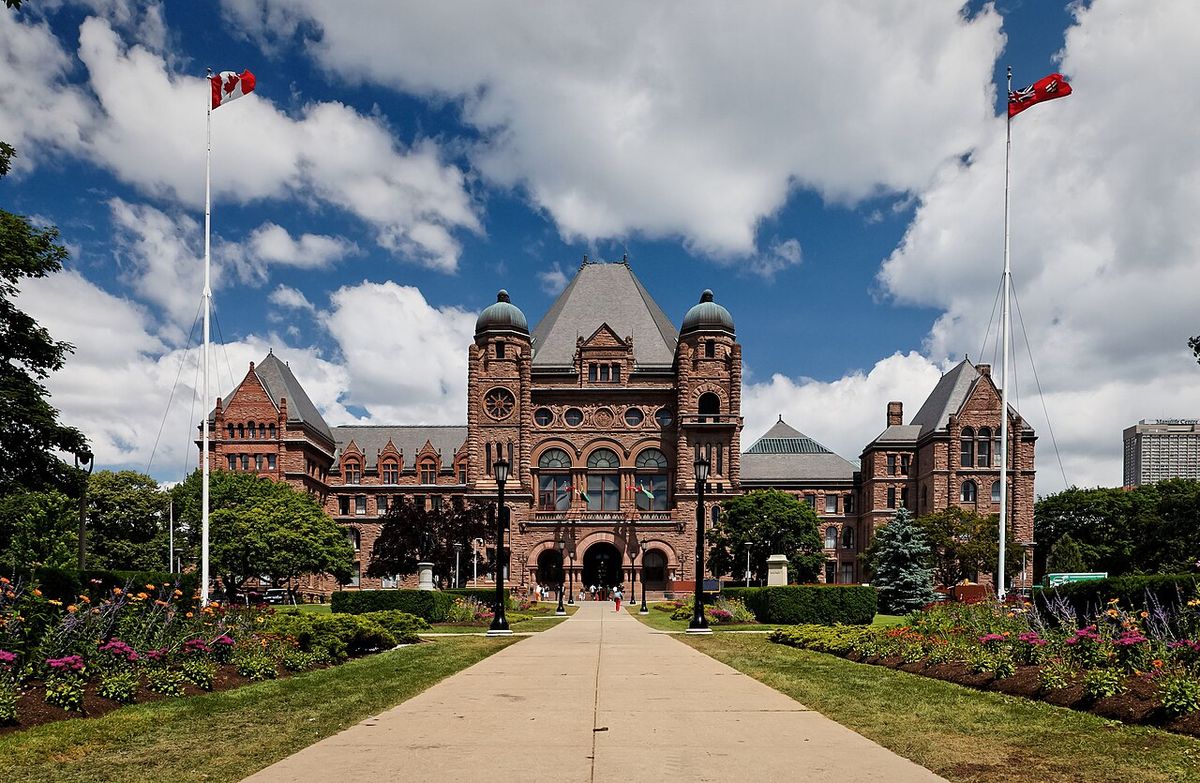
Beyond its academic buildings, the St. George campus contains several notable institutions and features. Queen's Park is a large urban park within the campus grounds, surrounded by Queen's Park Crescent. It is the location of the Ontario Legislative Building, which sits on land acquired by the Government of Ontario in a 999-year peppercorn lease from the University of Toronto in 1859. The Justina M. Barnicke Gallery of the Art Museum at the University of Toronto is situated within Hart House, and hosts the second largest gallery space for visual art and programming in Toronto after the Art Gallery of Ontario. The street from which the campus takes its name, St. George Street, is believed to be named after French Royalist military officer Quetton St. George.
The campus is also defined by its relationship with the surrounding city neighbourhood, simply called the University neighbourhood, into which its 73.6 hectares primarily extend. The Landmark Project, completed in 2024, fundamentally altered the central Front Campus area by removing vehicular traffic from King's College Circle and creating a new pedestrian space. This project also installed the largest geoexchange system in Canada beneath the area, using the earth's stable temperature to heat and cool surrounding buildings. The Back Campus Fields provide two outdoor synthetic turf fields behind University College used for recreational sport, while the southern portion of the central area houses the main buildings of the Temerty Faculty of Medicine and the Faculty of Applied Science and Engineering.
Questions about University of Toronto St. George
How do I get to the St. George campus using public transit?
The St. George campus is exceptionally well-served by Toronto public transit. It is accessible via several subway stations on Line 1 Yonge-University, including St. George, Museum, and Queen's Park stations. St. George station is also an interchange with Line 2 Bloor-Danforth and is the second-busiest station in the system. The 510 Spadina streetcar runs along the western border, and the 506 Carlton streetcar runs along the southern border on College Street. An underground parking garage with electric vehicle charging is available beneath King's College Circle.
What are the most famous buildings on the St. George campus?
The campus features many architecturally significant buildings. University College, built in 1859, is a National Historic Site of Canada with a blend of Romanesque and Norman styles. The Brutalist Robarts Library, opened in 1973, is the largest academic library building in Canada. Other notable structures include the Gothic revival Hart House student centre, Convocation Hall with its domed roof, and the Soldiers' Tower carillon memorial. The modern Leslie L. Dan Pharmacy Building, designed by Norman Foster, represents a high-tech architectural style.
What is the collegiate system at the University of Toronto St. George?
The collegiate system on the St. George campus is modelled after those at Oxford and Cambridge, comprising 11 distinct colleges. Each college has its own character, history, and varying degrees of autonomy, providing students with a smaller community within the larger university. The colleges are responsible for aspects of student life such as residence, academic advising, scholarships, and social activities. This system includes University College, Trinity College, Victoria College, and St. Michael's College, among others.
What sports facilities are available on the St. George campus?
The campus hosts the main athletic facilities for the University of Toronto Varsity Blues. These include Varsity Stadium for football and soccer, which has the oldest sports field in Toronto dating to 1898, and Varsity Arena for ice hockey. The Goldring Centre for High Performance Sport is the primary venue for basketball and volleyball. The Back Campus Fields provide synthetic turf for recreational sports. The campus also fields two intramural teams, UTSG Red and UTSG Blue, in the university's Tri-Campus League.
What is the University of Toronto St. George campus?
The University of Toronto St. George campus is the original and largest campus of the University of Toronto, located in downtown Toronto, Ontario. It houses the university's central administration and is the largest of the three campuses in terms of student enrolment. The campus is set on 73.6 hectares of land surrounding Queen's Park and St. George Street and is the location of the university's college system, comprising 11 distinct constituent and federated colleges. Unlike the Mississauga and Scarborough campuses, St. George does not act as its own academic division but is instead made up of various divisions and colleges, the largest being the Faculty of Arts and Science. It is home to the majority of the university's professional faculties, graduate programs, and Varsity Blues athletic facilities.
What movies have been filmed at the University of Toronto St. George campus?
The University of Toronto St. George campus has been used as a filming location for many movies, often standing in for other universities. Films shot on the campus include Good Will Hunting, where it portrayed Harvard University and MIT, and Mean Girls, which filmed in Convocation Hall. The Incredible Hulk was filmed at Knox College, while Harold & Kumar Go to White Castle used the campus as Princeton University. Other movies filmed there include Resident Evil: Afterlife, Cocktail, Urban Legend, The Prince and Me, Total Recall, Tommy Boy, and The Freshman. The 1965 student production Winter Kept Us Warm was the first feature film to be shot at the University of Toronto and is set on the St. George campus.
Sources and further reading
- University of Toronto St. George (Wikipedia)
- St. George Campus (Downtown Toronto) (utoronto.ca)
- University of Toronto-St.George Campus, Neighbourhood ... (wahi.com)
- Visit St. George Campus Tours (future.utoronto.ca)
Checked by the Your Space Hamilton desk. Last updated 2026-10-20.