TMU station
TMU station is a major subway station on the TTC's Line 1 Yonge-University in downtown Toronto, Ontario. Located at the intersection of Yonge Street and Dundas Street near Sankofa Square, it serves as a primary transit hub for the campus of Toronto Metropolitan University and the surrounding commercial district. The station, originally named Dundas when it opened in 1954, was officially renamed TMU in December 2025 following a landmark partnership between the university and the Toronto Transit Commission. This change reflects the station's integral role in serving the university community and its position at the heart of Canada's largest city.
History and renaming process
The station opened in 1954 as Dundas station, part of the original Yonge subway line stretching from Union to Eglinton. Its original address at 300 Yonge Street remains a common reference point on TTC system maps. Major physical changes occurred in the 1970s with the construction of the Toronto Eaton Centre, which necessitated a pedestrian tunnel under the tracks to connect the station's two separate concourses. A refurbishment in 1982 replaced the original Vitrolite wall tiles with yellow ceramic tiling. The early 2000s saw another significant modification with the creation of a new entrance staircase from the newly constructed Yonge-Dundas Square, now known as Sankofa Square, and the addition of elevators in 2002 made the station accessible. In 2021, Toronto City Council voted to rename civic assets honouring Dundas due to his historical role in delaying the abolition of the transatlantic slave trade. This directive led to a council motion in December 2023 instructing the TTC to rename Dundas station by the fourth quarter of 2024. Toronto Metropolitan University expressed interest in financing the renaming if the station was named in its honour. The TTC Board approved the proposal to rename the station TMU in May 2025, with the university agreeing to fund the transition costs. Temporary new signage began appearing in November 2025, and the official name change took effect on December 7, 2025. The renaming was supported by local Councillor Chris Moise and Mayor Olivia Chow, and recognized by TTC Chair Jamaal Myers and the TTC Board.
Station layout and operational features
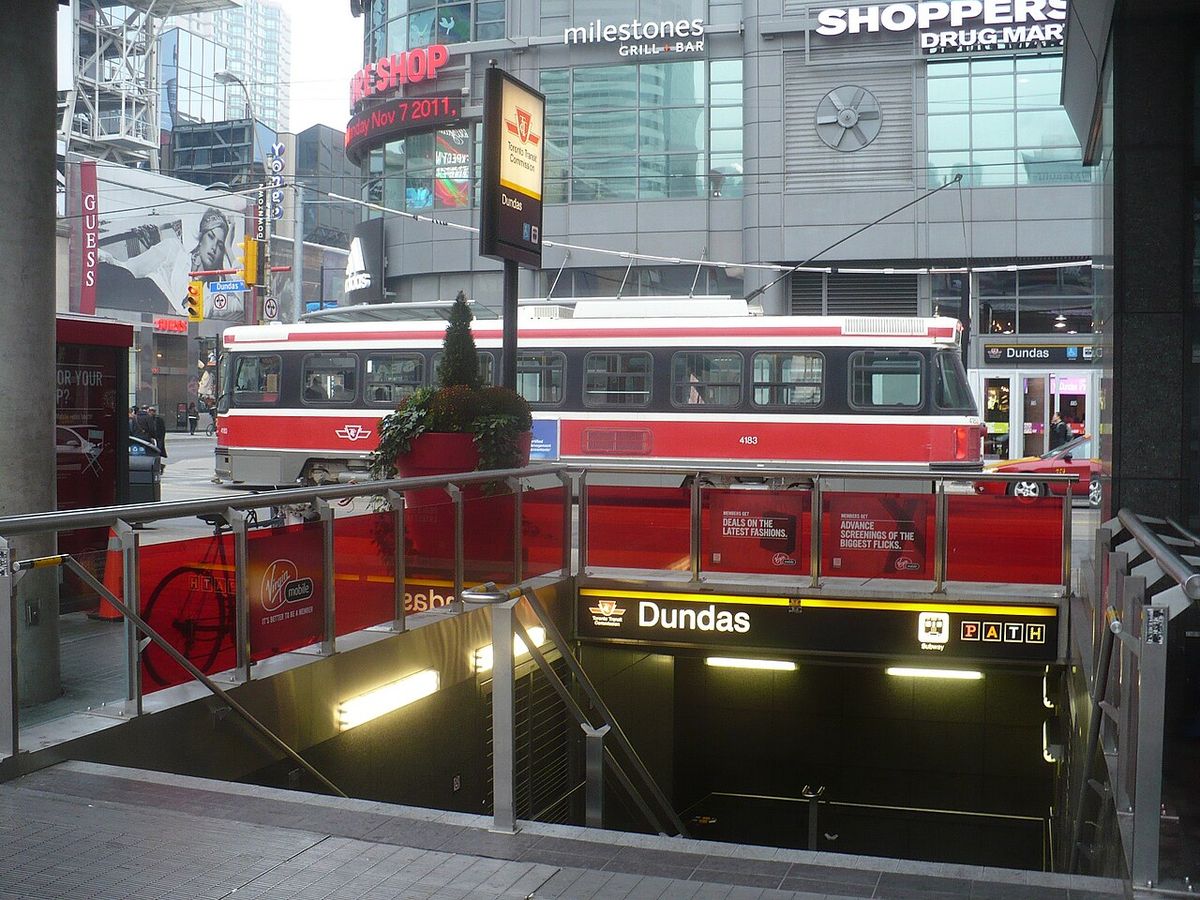
TMU station is built on three levels beneath the intersection of Yonge and Dundas Streets. It features entrances on all four corners of the intersection, with the southeast, southwest, and northeast entrances providing accessible access via elevators managed by the adjacent property owners, not the TTC. These entrances connect to Sankofa Square, the Toronto Eaton Centre, and The Tenor building respectively. The northwest entrance at the Atrium on Bay is a sidewalk staircase only. A unique characteristic of TMU station is its operational design as the only station in Toronto where northbound and southbound platforms are in separate fare-paid areas. This layout resulted from constrained space and difficult geology during the station's original construction. The two sides were connected only by street-level transfers until the 1970s, when the Eaton Centre pedestrian tunnel was built under the tracks outside the paid areas, creating a third level. Passengers who find themselves on the wrong platform must obtain a transfer from a machine on the platform, exit the fare-paid area, and present that transfer to re-enter at the opposite platform. The station is a key node in Toronto's underground pedestrian network, with direct connections to the PATH system, the Toronto Eaton Centre, The Tenor, and the Atrium on Bay. The station's subway infrastructure includes a double crossover located north of the station as the line continues toward College station, and it passes over the unused Lower Queen station before entering Queen station to the south.
Public art and architectural evolution
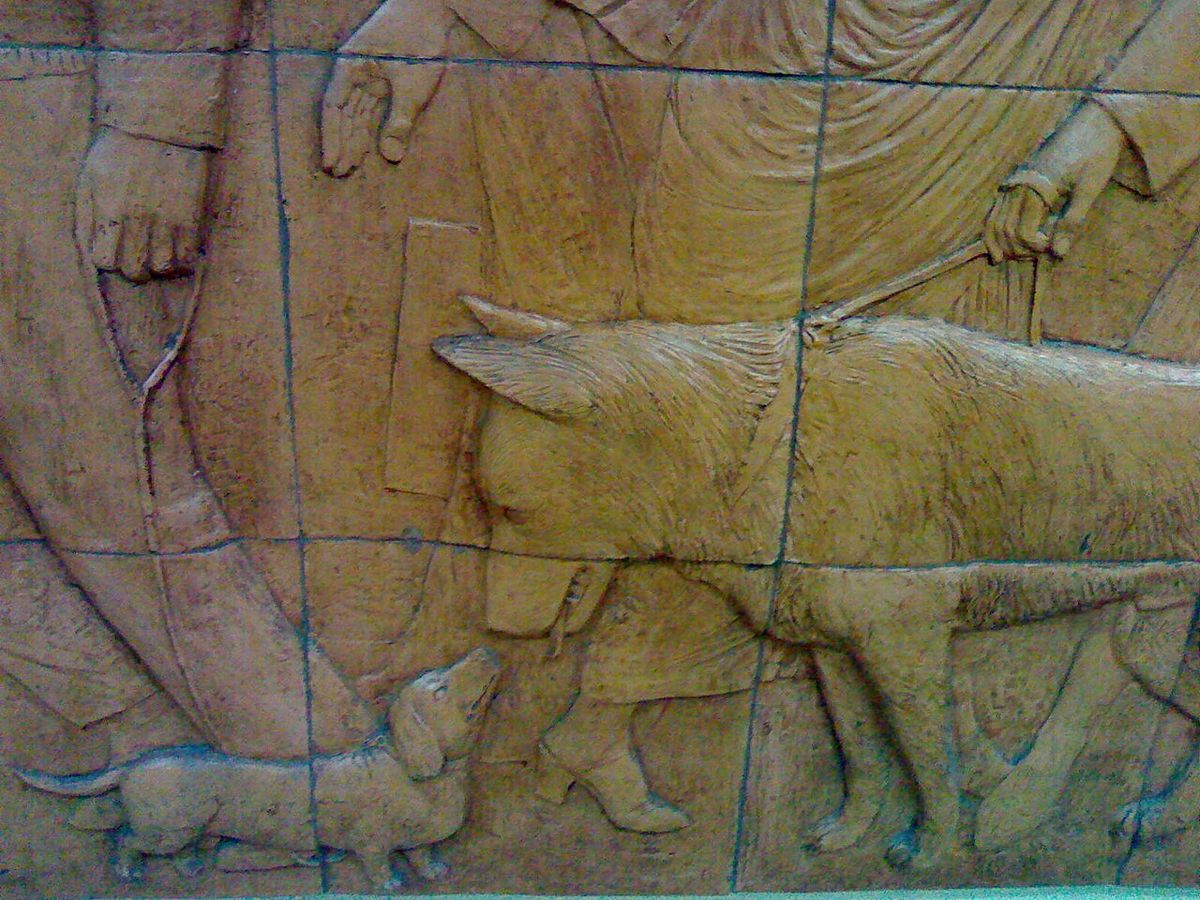
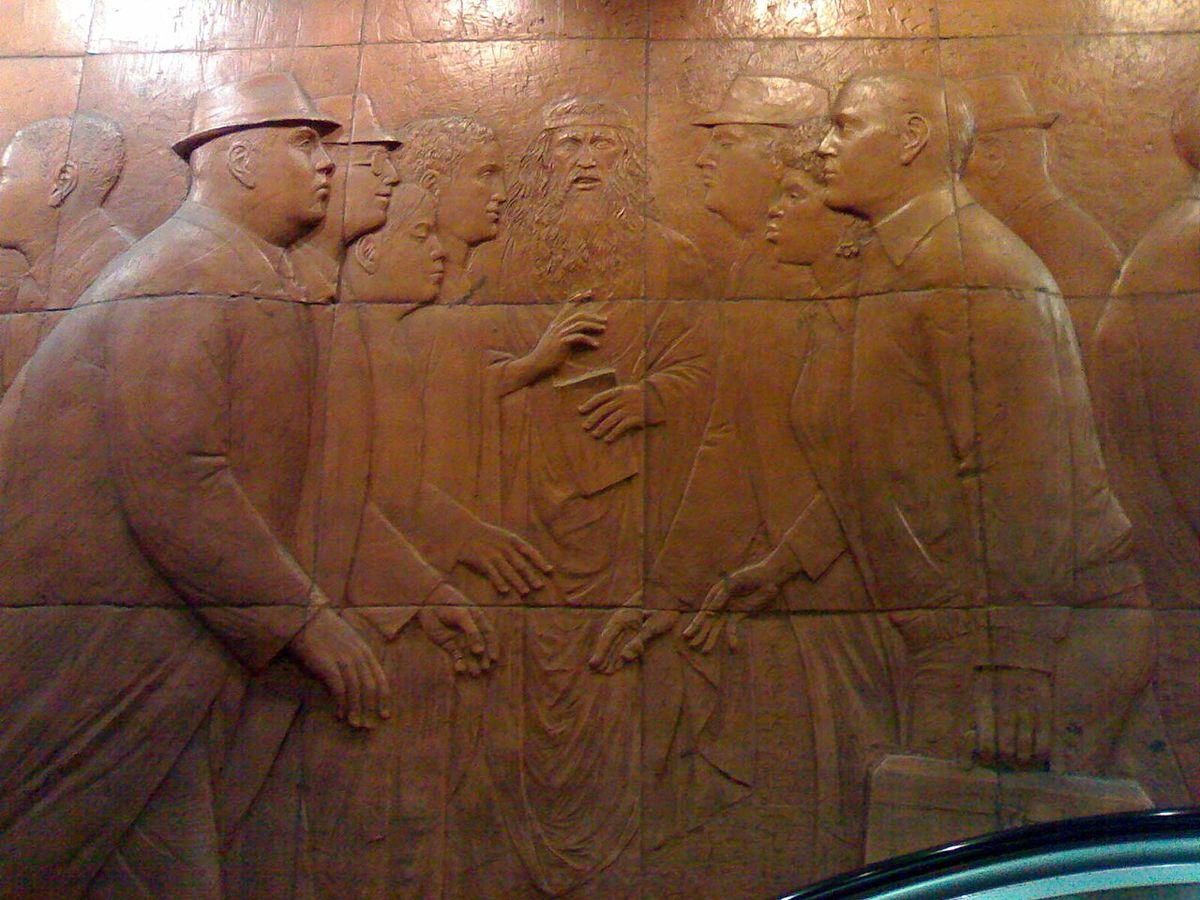
The station's primary artwork is William McElcheran's Cross Section, a large terra cotta mural installed in May 1984. Donated by the Atrium on Bay, the piece is located by the northwest entrance and along the under-platform crosswalk. Cross Section depicts an urban scene composed of shoppers, businesspeople, commuters, and pets, all rendered in two-foot-square fired clay tiles. The artwork adds a distinctive character to the station's circulation spaces. Beyond this installation, the station's architecture has evolved through several refurbishments, with the current aesthetic dominated by the yellow ceramic tiling installed during the 1982 renovations. The station's layout, with its deep platforms and separate concourses, presents a distinct architectural challenge and solution within the TTC network, reflecting the engineering constraints of its downtown location. The integration of new entrances and connections to major buildings like the Eaton Centre and The Tenor over the decades shows how the station's architecture has adapted to serve a changing urban environment above it.
Transit Innovation Yard partnership and goals
The renaming of the station was the most visible component of a broader partnership called the Transit Innovation Yard (TIY), established between Toronto Metropolitan University and the TTC. Approved by the TTC Board in May 2025, this collaboration aims to leverage TMU's research expertise and startup ecosystem to tackle pressing transit challenges. The initiative focuses on developing cutting-edge solutions in areas such as route optimization, real-time service updates, and improved journey planning tools. University researchers and entrepreneurs will use the transit system as a real-world testing ground for innovations intended to improve service for Toronto's approximately 500 million annual TTC riders. The partnership positions Toronto as a potential leader in community-driven transit innovation. TMU's involvement stems from its identity as a commuter school, where more than 80 percent of its 50,000 students, staff, and faculty rely on transit, bringing significant energy to the downtown core daily. The university worked with government partners to help address the costs associated with the station renaming and the launch of the TIY initiative. TMU President Mohamed Lachemi stated the partnership reflects the university's commitment to contributing meaningfully to the city. The TIY is designed to address critical transit challenges including congestion, which costs the Toronto region more than $11 billion each year in lost economic productivity and quality of life. The collaboration provides a framework for scaling innovative solutions that could benefit transit systems in Canada and around the world.
Platform safety pilot project and debate
In 2026, TMU station was selected as the pilot location for a new TTC platform safety initiative under the agency's broader "Advancing Safety" strategy. The project involves the installation of steel platform barriers near the platform edge, designed with gaps where subway train doors open, similar to barriers used on the New York City Subway. These barriers, costing an estimated $2 million per station, are intended as an interim measure to prevent falls or intrusions onto the tracks. The pilot also includes testing an artificial intelligence-based track intrusion detection system. At a June 2026 TTC Board meeting, CEO Mandeep Lali described the barriers as a step toward the eventual goal of installing full platform edge doors, which the agency views as the most effective safety measure. TTC staff estimated that installing platform edge doors at ten stations would cost approximately $50 million per station, or $500 million total. This cost difference sparked debate among board members about whether funding should be directed immediately toward the more comprehensive solution. By the end of August 2026, installation of the pilot barriers at TMU station had begun. The TTC identified up to ten high-volume stations across the network as potential candidates for future installations should the TMU pilot prove successful. The safety measures are a direct response to the need for improved passenger safety in busy underground environments, and their implementation at TMU station places this key hub at the forefront of transit safety innovation in Toronto.
Surrounding area, landmarks, and connections
TMU station sits at the centre of a dense and dynamic area of downtown Toronto. The campus of Toronto Metropolitan University surrounds the station to the west, north, and east, with its buildings integrated into the urban fabric. Key nearby landmarks include Sankofa Square, the northern entrance to the Toronto Eaton Centre shopping mall, the historic former Toronto Coach Terminal, Toronto City Hall, the Ed Mirvish Theatre, and The Tenor shopping centre. Cultural institutions like the Image Centre and Gallery Arcturus are also within walking distance. The station is a major transfer point for surface transit, connecting to numerous TTC bus and streetcar routes. As a critical interchange, the station handles heavy passenger volumes drawn from the university, major retail destinations, entertainment venues, and office towers. Its integration into the PATH network further extends its reach, allowing pedestrians to travel to other parts of the financial and entertainment districts without surfacing. The station's location makes it a gateway not only to the university but to a major commercial and cultural crossroads in the city, with the area having changed dramatically due to the rapid growth of TMU.
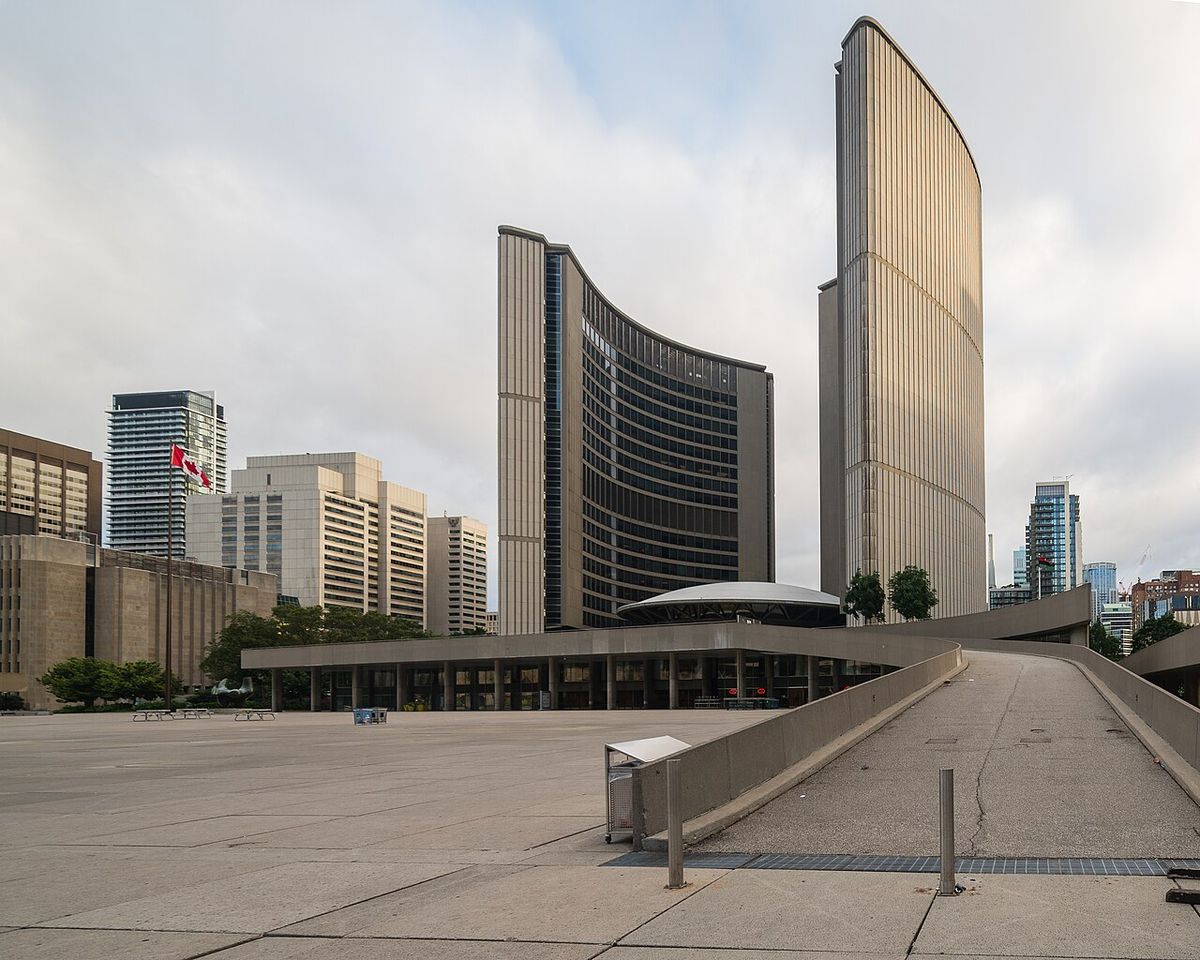
Key landmarks and institutions adjacent to TMU station include Sankofa Square, the north end of the Toronto Eaton Centre, and the former Toronto Coach Terminal. The station is also near Toronto City Hall, the Ed Mirvish Theatre, and The Tenor shopping centre. Buildings on the campus of Toronto Metropolitan University surround the station to the west, north, and east. Nearby public art galleries include the Image Centre and Gallery Arcturus.
- Sankofa Square (formerly Yonge-Dundas Square)
- Toronto Eaton Centre (north entrance)
- Toronto Metropolitan University campus
- The Tenor shopping centre (formerly Toronto Life Square)
- Atrium on Bay office and retail complex
- Ed Mirvish Theatre (formerly the Canon Theatre)
- Toronto City Hall
- Former Toronto Coach Terminal building
- Image Centre art gallery
- Gallery Arcturus
Ridership, community role, and TMU expansion
The station serves as the primary subway access point for the Toronto Metropolitan University community, which comprises nearly 50,000 students, staff, and faculty. With over 80 percent of this population being commuters, the station experiences significant peak period traffic linked to the university's class schedules. This daily influx contributes substantially to the station's status as one of the busiest on the TTC network. The renaming to TMU station was explicitly intended to improve wayfinding for these users and to better reflect the character of the surrounding neighbourhood, which has been dramatically reshaped by the university's growth. The station is fully integrated with the university's urban campus, where academic buildings, student residences, and athletic facilities are interwoven with city streets. This integration highlights the station's role not just as a transit node but as a gateway to an institution that is a major economic, cultural, and social force in downtown Toronto. The partnership behind the renaming aims to deepen this connection by turning transit challenges into opportunities for applied research and innovation that benefits the entire city. The station renaming coincides with a period of significant expansion for Toronto Metropolitan University, which is undertaking its largest building campaign in history. This expansion includes a new 21-storey residence tower that will more than double on-campus housing, a new medical school in Brampton, a permanent home for the Lincoln Alexander School of Law, and a landmark student wellbeing centre. These developments signal the university's growing footprint and ambition, making the renamed TMU station a symbolic and functional anchor for an institution that is becoming increasingly central to the city's identity.
Surface transit connections and accessibility
TMU station functions as a major multimodal transit hub, requiring a transfer between the subway and numerous surface routes operated by the TTC. The station's location at Yonge and Dundas Streets places it at the crossing point of several key surface transit corridors. While the specific bus and streetcar route numbers are detailed in official TTC schedules, the station typically serves routes running along Yonge Street, Dundas Street, and connecting to other major arteries in the downtown core. The station entrances provide direct access to surface stops, and the station's integration with the PATH network offers sheltered connections for pedestrians transferring to other modes. The station also offers connections to the City of Toronto's Bike Share program at several of its entrances, supporting active transportation options. For accessibility, the TTC provides a Lift Line Service, reachable at 416-539-LIFT (5438), which customers can call before travelling to confirm elevator status at the station's various entrance elevators, which are maintained by building management and not the TTC. In the event an elevator is out of service, alternative access plans are posted at each entrance and can be viewed online before travel.
Questions about TMU station
When was Dundas station renamed to TMU station?
The station was officially renamed TMU station on December 7, 2025. The TTC Board approved the renaming proposal in May 2025, and temporary new signage began to appear throughout the station starting in November 2025. The change followed a partnership agreement between the Toronto Transit Commission and Toronto Metropolitan University, with the university funding the costs associated with the transition. The new name was reflected on updated TTC system maps launched in December 2025.
Why was the station renamed?
The renaming occurred for two primary reasons. First, it was part of a broader city initiative to rename civic assets honouring Henry Dundas due to his historical role in delaying the abolition of the transatlantic slave trade. Second, Toronto Metropolitan University proposed a partnership with the TTC, offering to fund the renaming to better reflect the station's primary user base and its location at the heart of the university's downtown campus. The new name aims to improve wayfinding for transit users and acknowledge the university's significant presence in the neighbourhood.
What is the Transit Innovation Yard?
The Transit Innovation Yard is a partnership announced when the TTC agreed to rename Dundas Station to TMU Station. This pilot project will tackle pressing transit challenges including route optimization, real-time service updates, and improved journey planning. TMU researchers and start-ups will develop solutions to help create better transit services for Toronto. The initiative aims to position the city as a leader in community-driven transit innovation.
What safety features are being tested at TMU station?
In 2026, TMU station was selected as the pilot location for new platform safety measures. The project involves installing steel platform barriers with gaps for train doors, similar to those used in New York City, and an AI-based track intrusion detection system. These barriers, costing about $2 million for the pilot, are an interim step toward the TTC's long-term goal of installing full platform edge doors. The success of this pilot could lead to similar installations at other high-volume stations on Line 1, with up to ten stations identified for potential future rollout.
What major buildings and landmarks are connected to TMU station?
The station has direct underground connections to several major buildings via the PATH network and other pedestrian tunnels. These include the Toronto Eaton Centre, The Tenor shopping centre (home to Cineplex Cinemas), and the Atrium on Bay office complex. Key surface landmarks surrounding the station include Sankofa Square, Toronto City Hall, the Ed Mirvish Theatre, the former Toronto Coach Terminal, and the campus of Toronto Metropolitan University. The station is also near public art galleries such as the Image Centre and Gallery Arcturus.
What is unique about the layout of TMU station?
TMU station is the only station in the Toronto subway system where the northbound and southbound platforms are in separate fare paid areas. This unique layout resulted from the constrained space and difficult geology encountered during its original construction. Originally, separate street entrances had to be used for each direction. A connecting pedestrian tunnel was later constructed under the tracks outside the fare paid areas in the 1970s when the Toronto Eaton Centre was built. If a passenger is on the wrong platform, they must obtain a transfer from a machine, exit the station, and re enter on the other side by showing the transfer to the collector.
Sources and further reading
- TMU station (Wikipedia)
- Unveiling TMU Station, News and Events (torontomu.ca)
- TMU Station (ttc.ca)
- TMU's changing skyline, Toronto Met University Magazine (magazine.torontomu.ca)
- Toronto Metropolitan University, Dundas Station to be ... (educationnewscanada.com)
Checked by the Your Space Hamilton desk. Last updated 2026-10-27.