Canada Malting Silos
The Canada Malting Silos are a prominent industrial heritage structure located on Toronto's harbourfront at Bathurst Quay. Constructed in 1928 for the Canada Malting Company, the complex was an innovative and influential example of early modernist industrial architecture, built from concrete to safely store malt. After being abandoned in the 1980s and saved from demolition by a city heritage designation, the silos have become a significant landmark in the city's ongoing waterfront revitalization efforts. As of 2026, the exterior has been refurbished, but the future use of the interior space remains undecided by the City of Toronto.
Architecture and Historical Significance
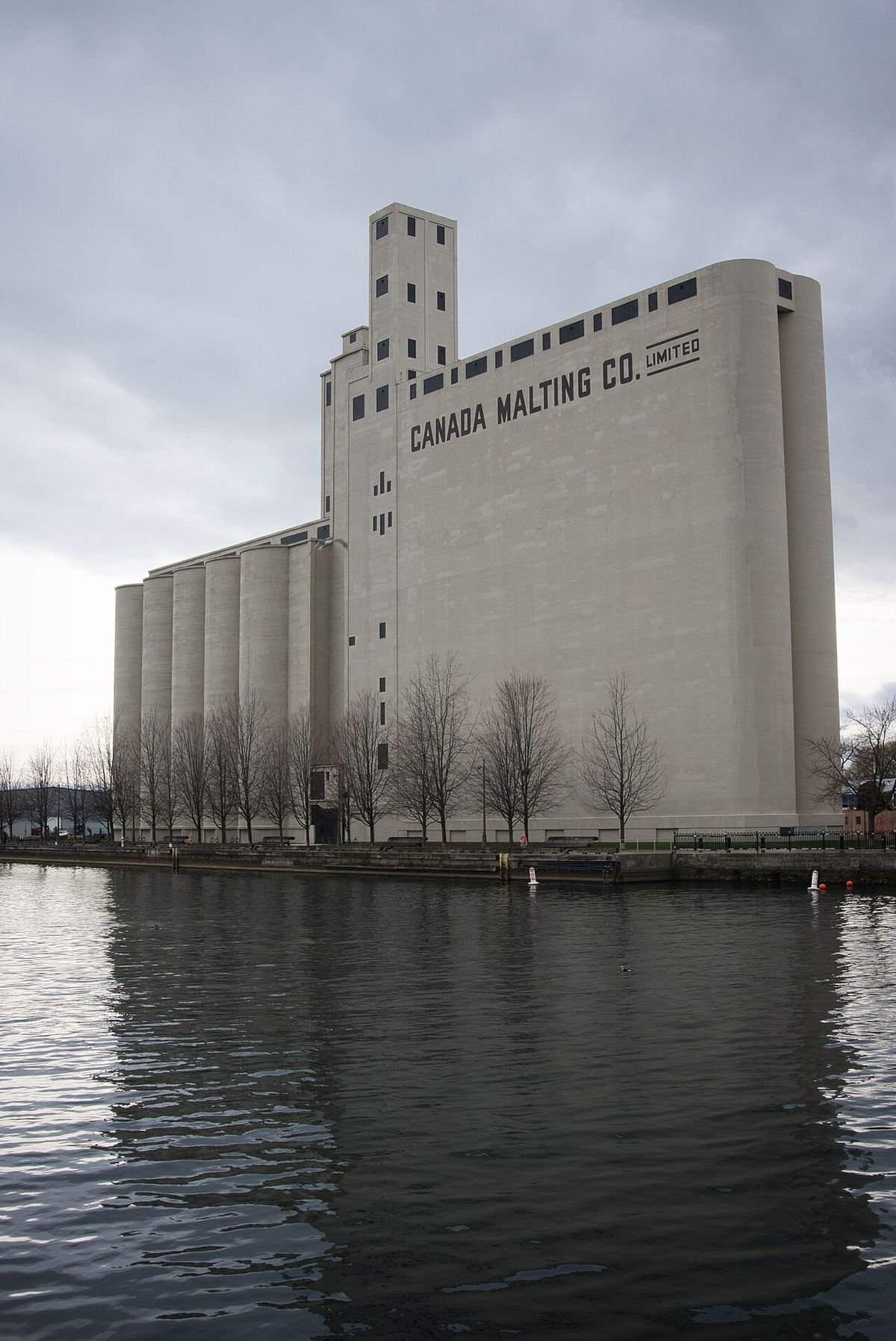
The Canada Malting Silos represent a major shift in the design and construction of grain storage facilities in Canada. Prior to their construction in 1928, such elevators were predominantly built from wood, which posed a significant and constant fire hazard. The decision to construct the malting towers from reinforced concrete was a major innovation for its time, providing superior fire resistance and durability. The design embraced a stark functionalism, with its simple, unadorned geometric forms directly expressing its industrial purpose. This aesthetic approach made the silos an early and influential example of modernist architecture in an industrial context, standing in contrast to the more ornate styles that preceded it.
The original 1928 construction included a glass office building, integrating administrative functions with the industrial process. In 1944, the facility was expanded with the addition of taller storage bins reaching 150 feet in height, as well as a distinctive round office structure. The main complex consists of fifteen concrete silos, each 120 feet high, which dominate the harbourfront skyline. Their sheer scale and monolithic presence have made them an enduring symbol of Toronto's industrial past and a key visual anchor in the harbour.
Operational History and Decline
The Canada Malting Company operated the silos for over five decades, playing a role in the national malt and brewing supply chain. The facility's location at the foot of Bathurst Street on the harbourfront was strategic, allowing for the efficient receipt of grain by ship and its distribution after processing. The concrete construction proved its worth over the years, safely housing the volatile malt product. By the 1980s, changes in industrial practices and the shifting economics of the malting industry led to the facility's obsolescence.
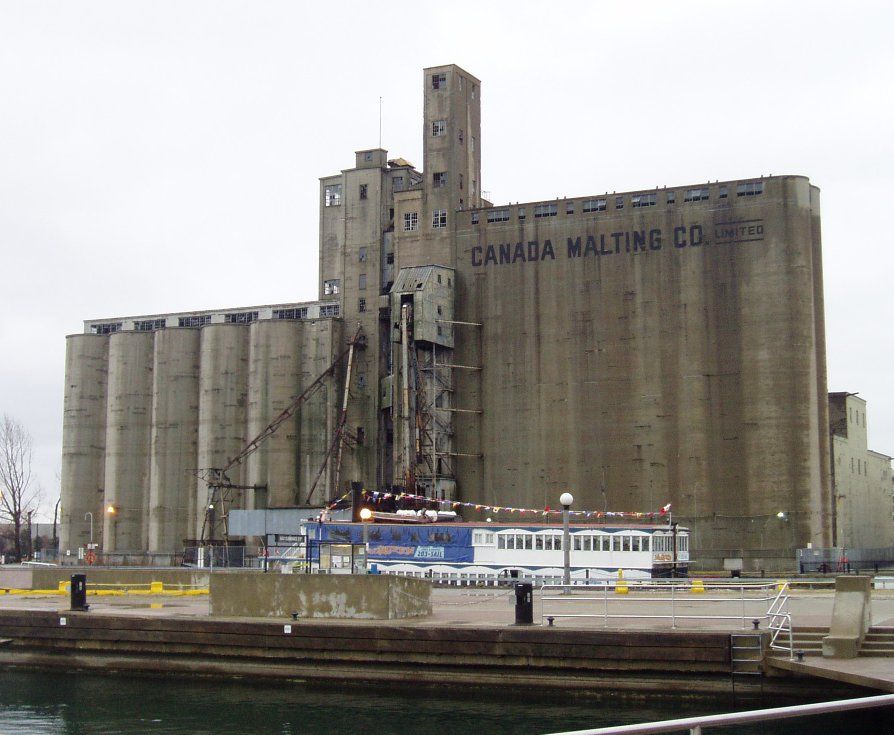
The Canada Malting Silos building was abandoned in the 1980s. It was destined for demolition at that time. The Maple Leaf Mills Silos were demolished in 1983. The city of Toronto designated the Canada Malting Silos a heritage site to prevent its demolition. A long period of debate over the site's preservation and future then began.
Heritage Designation and Preservation
The threatened demolition of the silos sparked preservation efforts that recognized their architectural and historical value. The City of Toronto intervened by designating the Canada Malting Silos as a heritage site, a legal protection that prevented their destruction. This designation affirmed the structure's importance as a rare surviving example of its type and a landmark of industrial design. The fight for preservation highlighted a growing public appreciation for industrial heritage as a vital part of the city's narrative, not merely obsolete infrastructure. Following the designation, the focus shifted from demolition to finding a viable new use for the massive structure. Their vision was to convert the silos into a music museum or a related theme park, aiming to repurpose the structure for cultural and tourist purposes. While this specific proposal did not come to fruition, it demonstrated the creative potential for reinventing the site and kept the silos in the public conversation about waterfront renewal. The city also considered the location for a municipal history museum, reflecting the ongoing search for a suitable public function for the historic property.
Recent Developments and Future
Physical changes to the site began in earnest in September 2010 with the start of demolition for the adjacent germination and kiln buildings. These secondary structures were removed, leaving the primary silo towers and office buildings as the core historic elements on the site. A major exterior refurbishment project was undertaken to stabilize and restore the facade of the remaining structures. This critical preservation work was completed in 2024, ensuring the long-term structural integrity and visual appearance of the heritage silos. As of 2026, the City of Toronto, which holds responsibility for the site's future, has not finalized a decision on the adaptive reuse of the interior spaces.
The refurbished exterior is a preserved monument, but the interior remains empty and awaiting a new purpose. The ongoing challenge is to find a function that is economically sustainable, publicly beneficial, and respectful of the building's unique heritage character, ensuring the silos remain a dynamic part of the city for future generations. The city's previous considerations, from a music museum to a history museum, illustrate the range of possibilities still under discussion for this prominent waterfront location. The final decision will determine how this piece of industrial history is integrated into the modern city.
Context within Toronto's Waterfront
The Canada Malting Silos are one of only two remaining major silo complexes on Toronto's central harbourfront, the other being the Victory Soya Mills Silos. Their survival is notable in a landscape where similar industrial landmarks, like the Maple Leaf Mills Silos, have been lost. The silos are located at Bathurst Quay, also known as Eireann Quay, an area that has undergone significant transformation from industrial port lands to a mixed-use neighbourhood including residential, recreational, and cultural spaces. The preservation of the silos is a key component of the broader Toronto waterfront revitalization, serving as a physical reminder of the area's past amidst new development.
Their imposing form provides a striking contrast to the modern condominiums and parks that now surround them, creating a layered urban fabric. The structure acts as a gateway landmark for those arriving via Bathurst Street and a visual point of orientation on the lakeshore. The ongoing discussion about their future use is part of the larger city-building dialogue about honouring history while creating contemporary public spaces. Their continued presence directly illustrates the transition of Toronto's waterfront from a purely industrial zone to a more diverse urban district, a process in which the silos play a defining role.
Related Industrial Heritage Sites
The story of the Canada Malting Silos is connected to other significant grain and malting facilities across Canada. These sites represent the national scale of this industry and the shared architectural challenges of storage and processing. The existence of these related sites provides a comparative framework for understanding the architectural and historical significance of the Canada Malting Silos in Toronto. Their preservation allows for a tangible connection to an important chapter in Canadian industrial and urban development, highlighting different approaches to heritage conservation.
- Canada Malting Silos, Montreal: A namesake facility in another major Canadian city, highlighting the national reach of the Canada Malting Company.
- Victory Soya Mills Silos: Another surviving silo complex on Toronto's harbourfront, representing a parallel history of industrial adaptation and preservation.
- Maple Leaf Mills Silos: A prominent Toronto silo complex that was demolished in 1983, demonstrating the fate from which the Canada Malting Silos were saved.
The Canada Malting Silos were preserved as a heritage site. The Victory Soya Mills Silos are another silo that is still standing. The Maple Leaf Mills Silos were demolished in 1983. There is also a Canada Malting Silos site in Montreal. The Toronto silos are part of this broader national industrial context.
Questions about Canada Malting Silos
When were the Canada Malting Silos built?
The silos were built in 1928. A round office was added in 1944. Additional storage bins were also built in 1944. A glass office was built in the original construction in 1928.
Why are the Canada Malting Silos considered architecturally significant?
The silos are significant as an early example of modernist industrial architecture in Canada. Their use of reinforced concrete was an innovation over traditional wooden elevators, greatly reducing fire risk. The design is noted for its stark functionalism, where the form directly follows the industrial purpose without decorative elements, influencing later modernist architectural thought. Their scale and simple geometric shapes make them a notable work of industrial design.
What is the current status of the Canada Malting Silos?
As of 2026, the exterior of the Canada Malting Silos has been fully refurbished, with that work completed in 2024. The germination and kiln buildings were demolished starting in 2010. The core silo towers and office buildings remain standing as a city-designated heritage site. The City of Toronto has not yet decided on a final use for the interior spaces, so the building is preserved on the outside but empty inside.
How tall are the Canada Malting Silos?
The complex features two main sets of structures with different heights. The original fifteen main silos, built in 1928, are 120 feet (37 metres) high. The additional storage bins that were added during the 1944 expansion are taller, reaching 150 feet (46 metres) in height. This combination gives the complex a tiered and imposing profile on the waterfront.
Where are the Canada Malting Silos located?
The Canada Malting Silos are located at the foot of Bathurst Street at Bathurst Quay in Toronto's harbourfront, Ontario, Canada. Bathurst Quay is also known as Eireann Quay. This site is one of only two remaining silos on Toronto's harbourfront. The silos were built in 1928 specifically for the Canada Malting Company to store malt. Their location at the harbourfront was strategic for industrial operations.
What plans have been proposed for the silos?
Plans have included conversion into a music museum or theme park, proposed by a group called Metronome Canada Incorporated led by President John Harris. The City of Toronto has also considered the site as a potential location for a municipal history museum. As of 2007, the city was still evaluating this museum idea. Exterior refurbishment was completed in 2024, but as of 2026, the city has not yet decided on a final use for the interior space.
Sources and further reading
- Canada Malting Silos (Wikipedia)
- Canada Malting Silo, Toronto (eraarch.ca)
- Canada Malting Co. (memento.heritagemontreal.org)
- A Peek Inside The Canada Malting Silos & Bathurst Quay ... (urbantoronto.ca)
- ACO Toronto, Canada Malting Building (acotoronto.ca)
Checked by the Your Space Hamilton desk. Last updated 2026-11-01.