Mission, British Columbia
Mission is a city in the Lower Mainland of British Columbia, Canada, situated on the north bank of the Fraser River approximately 65 kilometres southeast of Vancouver. Originally incorporated as a district municipality in 1892, it grew to include the former Town of Mission City in 1969 and was officially reclassified as a city in March 2021. Historically a centre for forestry, hydroelectricity, and berry farming, Mission is known for its municipal tree farm and its role as a gateway to recreational areas in the Fraser Valley. The city is part of the Abbotsford-Mission census metropolitan area and is connected to Vancouver by commuter rail via the West Coast Express.
Geography and Natural Features
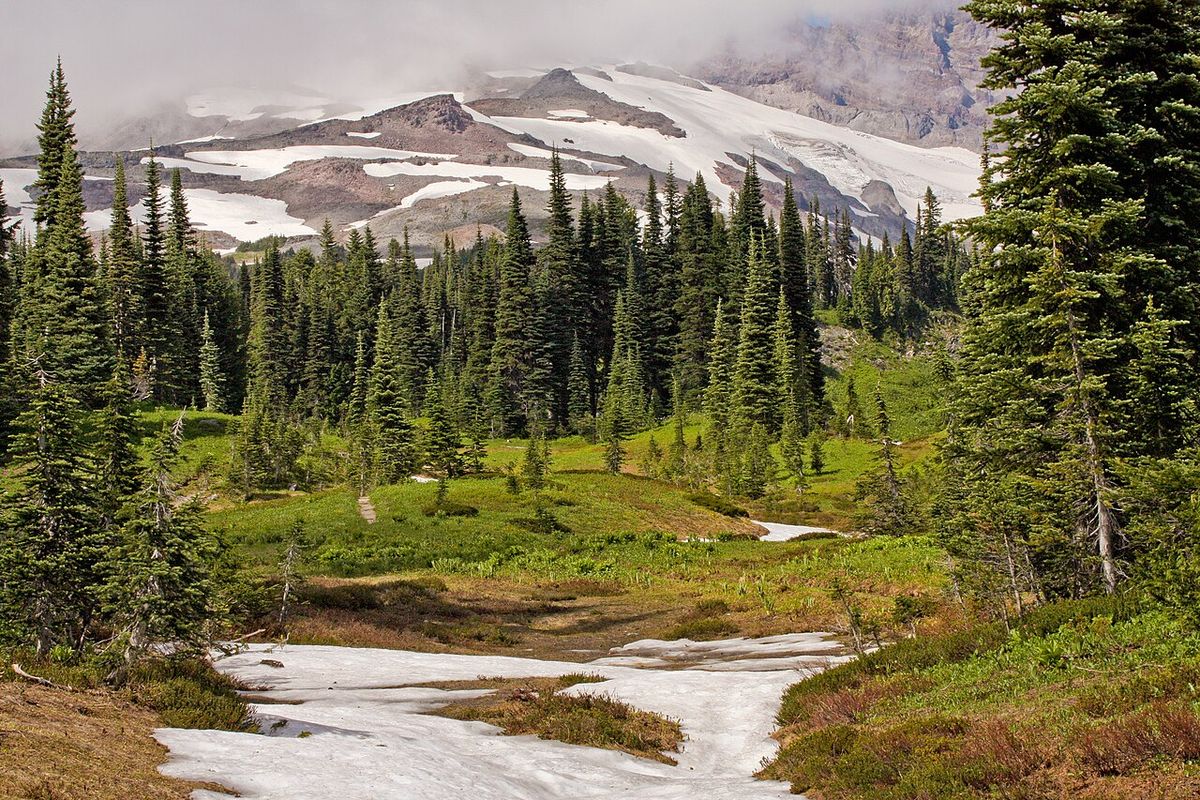
Mission's geography is distinct within the Fraser Valley, characterized mostly by forested upland with only small floodplains along the Fraser River. The municipality stretches northwards into mountainous terrain, with over 40 percent of its land area consisting of the Mission Municipal Forest, also known as Mission Tree Farm Licence #36. This municipal tree farm, which celebrated its 50th anniversary in 2008, covers much of the northern part of the district and is managed by the city's Forestry Department. The farm comprises areas west of the Stave River up to the northern boundary near Mount Robie Reid, including a small portion at the head of Alouette Lake. The western boundary is largely defined by the Stave River, which flows into the Fraser at Ruskin and is home to the Stave Lake and Hayward Lake hydroelectric reservoirs created by the Stave Falls and Ruskin dams.
History and Development
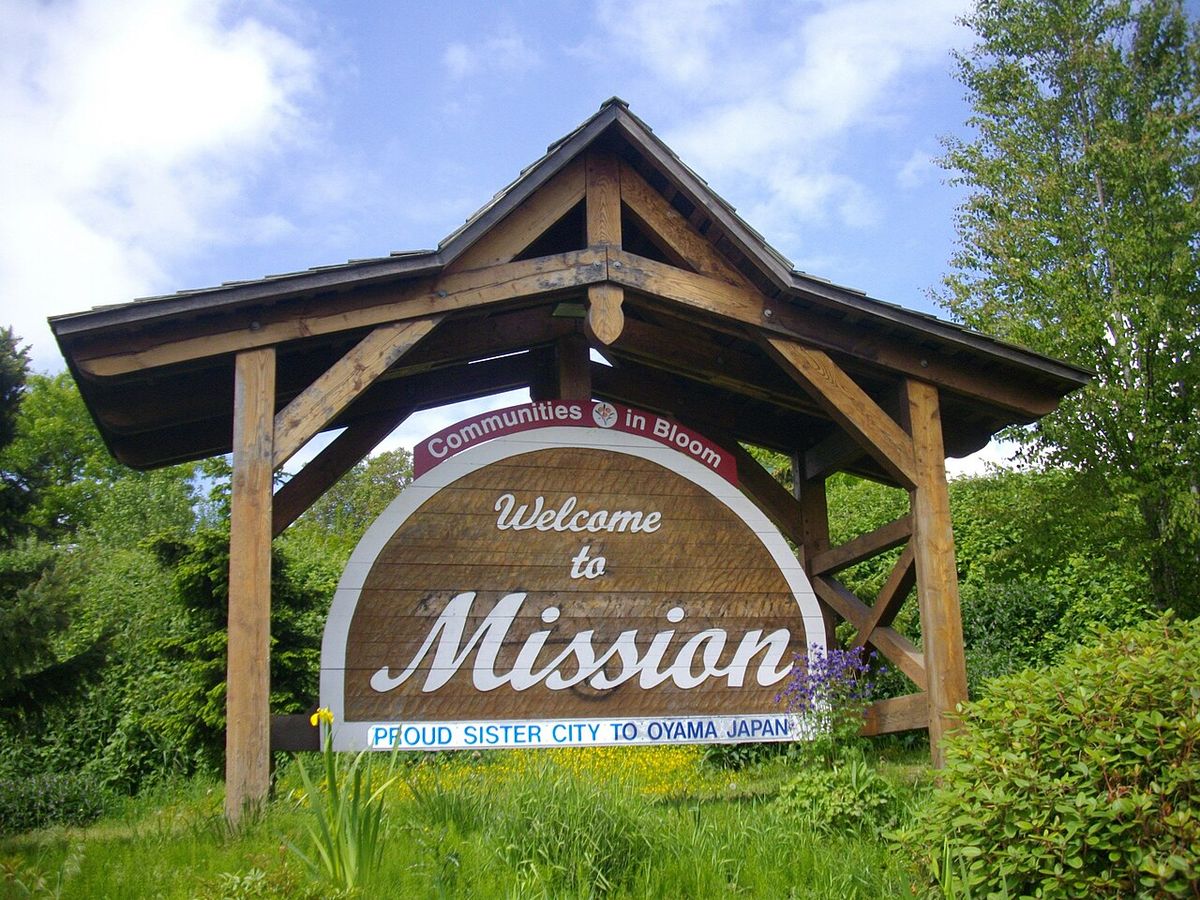
The city takes its name from St. Mary's Mission, established by the Oblate order in 1861 on what is now the Peckquaylis Indian Reserve. The Town of Mission City originated from a land promotion, with its core properties auctioned off in the "Great Land Sale" on May 19, 1891, by James Horne, with buyers brought in via the CPR mainline. Early architecture was deliberately reminiscent of southern Ontario towns to attract settlers, and the Mission Regional Chamber of Commerce was founded on June 19, 1893, by Harry Brown French, becoming the first Board of Trade in British Columbia. The community's strategic importance was cemented by the 1891 Mission Railway Bridge, a swing-span structure that was the only Fraser River crossing in the lower valley until the New Westminster Bridge opened in 1904, and it served both rail and alternating one-way vehicular traffic until 1973. A devastating flood in 1894 prompted the relocation of the commercial core north of the railway tracks to what became First Avenue, originally named Washington Avenue, which served as a principal retail centre for the Fraser Valley for decades, while the abandoned old downtown became a Chinatown that lasted until the 1920s.
The Stave Falls hydroelectric project, built by the British Columbia Electric Railway to power Vancouver's street railway, was the largest in the province until the Bridge River Power Project opened in 1961, and it was served by a light-gauge railway up the river canyon. Mission also became a global centre for red cedar shake and shingle production, hosting a cluster of mills on its waterfront, with the mill at Whonnock being a major producer. Other major industries included the Eddy Match Co. between Mission and Hatzic, once the world's largest matchstick plant until it closed in the 1960s, and the Empress Foods Co. cannery, a survivor of the local berry industry. The berry sector inspired the annual Strawberry Festival starting in 1946, though the festival later shifted focus after wartime relocation of Japanese-Canadian farmers and the devastating 1948 Fraser River flood impacted the industry. The community amalgamated the District of Mission with the Town of Mission City following a plebiscite in 1969, after the town had evolved from a village incorporated in 1922.
- 1861: St. Mary's Mission is established by the Oblate order.
- 1891: "Great Land Sale" auctions town lots and the Mission Railway Bridge opens.
- 1892: District of Mission is incorporated.
- 1893: Mission Regional Chamber of Commerce is founded.
- 1894: Great flood leads to relocation of downtown core and creation of a Chinatown.
- 1922: Village of Mission (later Mission City) is partitioned from the District.
- 1931: Ruskin Dam is completed on the Stave River.
- 1946: First Strawberry Festival is held.
- 1969: Town of Mission City amalgamates with the District of Mission.
- 1973: New Mission Bridge for vehicles opens, replacing the rail bridge for road traffic.
- 2021: District of Mission is reclassified as a city.
Post-World War II developments reshaped the community significantly. The construction of Highway 1 on the south side of the Fraser River in the early 1960s drew retail business to new shopping malls in Abbotsford, leading Mission to lose its anchor Eaton's department store and much of its Main Street trade. This process accelerated with the opening of the new Mission Bridge in the mid-1970s. The opening of the West Coast Express commuter rail line in the 1990s helped reverse this trend by connecting Mission to Vancouver and encouraging exurban population growth. Other significant developments included the establishment of two federal penitentiary facilities, one minimum and one medium security, in the Ferndale area in 1972, and the opening of The Junction Shopping Centre, Mission's largest, near the southern tip in the 1990s. Mission Raceway Park, a professional dragstrip, was moved outside the dyking system to reduce noise in recent decades, and a large tract of land in central Mission's Ferndale area was developed for penal use.
Government and Municipal Services
The City of Mission operates under a Council-Manager system of local government. The municipal council elected on October 15, 2022, is led by Mayor Jag Gill, who was elected by acclamation in September 2026, succeeding Paul Horn. A previous mayor, Pam Alexis, resigned in November 2020 after being elected to the Legislative Assembly of British Columbia for the Abbotsford-Mission riding. The municipality itself is the second-largest employer in Mission, following School District #75. A unique aspect of municipal operations is the direct management of Mission Tree Farm Licence #36, which provides a unique revenue source and has served as a provincial model for silvicultural management. The city's governance extends over a land area of 225.78 square kilometres, encompassing diverse urban, rural, and forested communities that were consolidated over more than a century, including distinct historic settlements like Silverdale, founded by Italian immigrants, and Silverhill, originally settled by a Finnish Utopian sect.
Economy and Major Employers
Mission's economy has historically been rooted in resource extraction and processing. Forestry and wood-related industries, especially red cedar shake and shingle production, have long dominated the manufacturing sector, with the city's several mills noted for being the world's largest suppliers. The city holds the only municipal tree farm license in British Columbia, a model later adopted in part by Revelstoke. Agriculture, though now limited to a narrow belt along the Fraser River, was once centred on berries, with dairy farming currently being the chief agricultural enterprise alongside poultry, hogs, beef, and vegetables. Approximately five percent of the city's land is part of the Agricultural Land Reserve, with about 96 commercial and hobby farms in the greater area. The largest employer is School District #75, followed by the municipal government itself. Transportation improvements have enabled manufacturing to expand beyond traditional sawmilling and food processing. The economy is also supported by retail, services, and institutions like Westminster Abbey, a Benedictine monastery and seminary established near Mission in 1954 which runs its own farm and teaches high school and college men.
| Sector | Key Details and Historical Notes |
|---|---|
| Forestry | Dominant manufacturing sector. World capital for red cedar shakes/shingles. Operates Municipal Tree Farm Licence #36. |
| Agriculture | Historically the "berry industry" heart. Now focused on dairy; ~5% of land in ALR. Major farms in unincorporated eastern areas. |
| Hydroelectricity | Stave Falls project was BC's largest until 1961. Built by BC Electric Railway. Ruskin Dam completed 1931. |
| Other Historic Industry | Eddy Match Co. (world's largest match plant). Empress Foods cannery. Japanese-Canadian berry farming pre-WWII. |
| Major Employers | 1. School District #75. 2. Municipal government. 3. Federal correctional facilities (established 1972). |
Demographics and Community Composition
According to the 2021 census, Mission had a population of 41,519 living in 14,098 of its 14,701 total private dwellings, a 7.7 percent increase from its 2016 population of 38,554. With a land area of 226.98 square kilometres, it had a population density of 182.9 persons per square kilometre. The community is part of the Abbotsford-Mission census metropolitan area, which had a population of 195,726 in 2021. Mission has a complex ethnic composition rooted in its settlement history. The largest group is European Canadian, comprising about 74 percent of the population, with significant communities of German, Dutch, Scandinavian, Italian, Hungarian, Polish, and anglicized French-Canadian ancestries, alongside the typical English-Scottish mix. The largest visible minority group is South Asian, primarily Indo-Canadian, making up 10.7 percent of the population, with a community active since the early 1900s that included sports teams like the "Mission Sikhs" volleyball team.
A sizeable First Nations community forms 8.6 percent of the population, with the Peckquaylis Indian Reserve serving as a centre for services and governments of the Sto:lo communities, specifically the Leq' a: mel First Nation (formerly Lakahahmen) on Nicomen Island and Deroche. The city has historically had a young population, with a median age of 36.4 recorded in the 2001 census. Before World War II, there was a large Japanese-Canadian population involved in berry farming, logging, milling, and the fishery, which was displaced during wartime internment. The distinct rural communities within the municipality, such as Steelhead, a weekend retreat for Vancouver's press community, and Ferndale and Cedar Valley, contributed to this diverse social fabric.
Transportation and Access
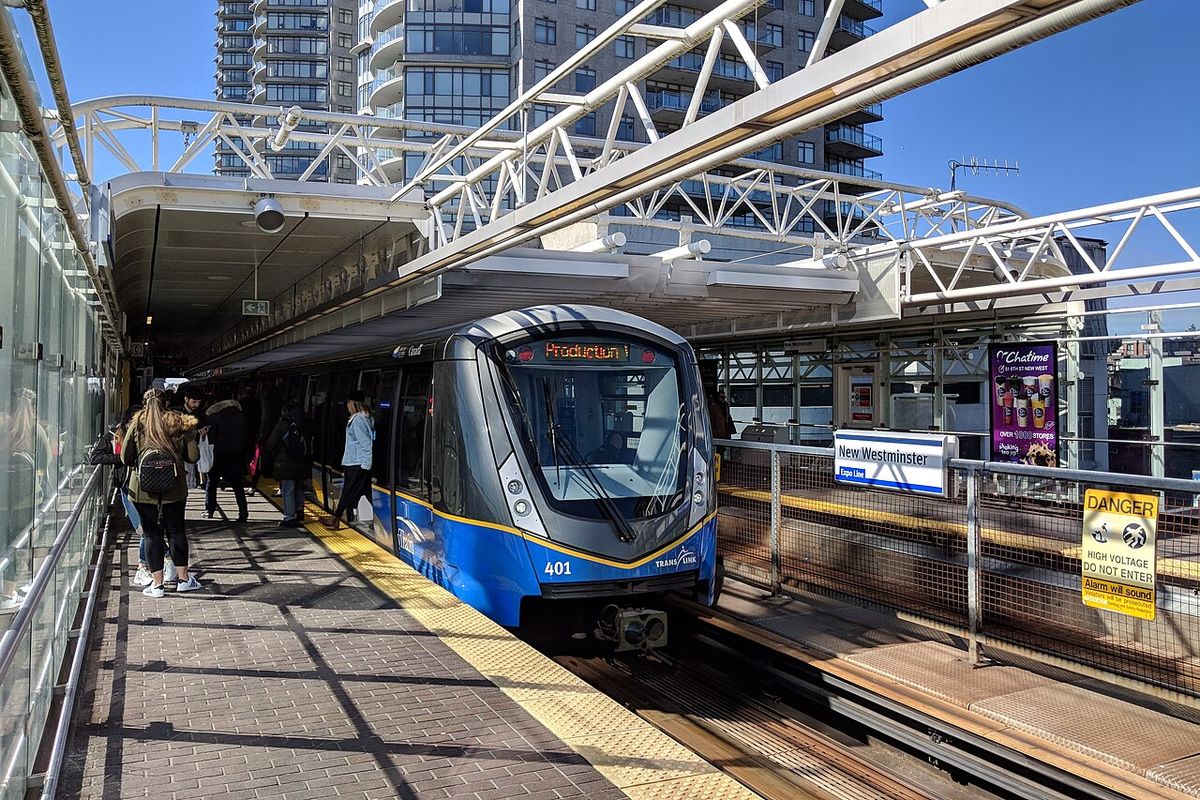
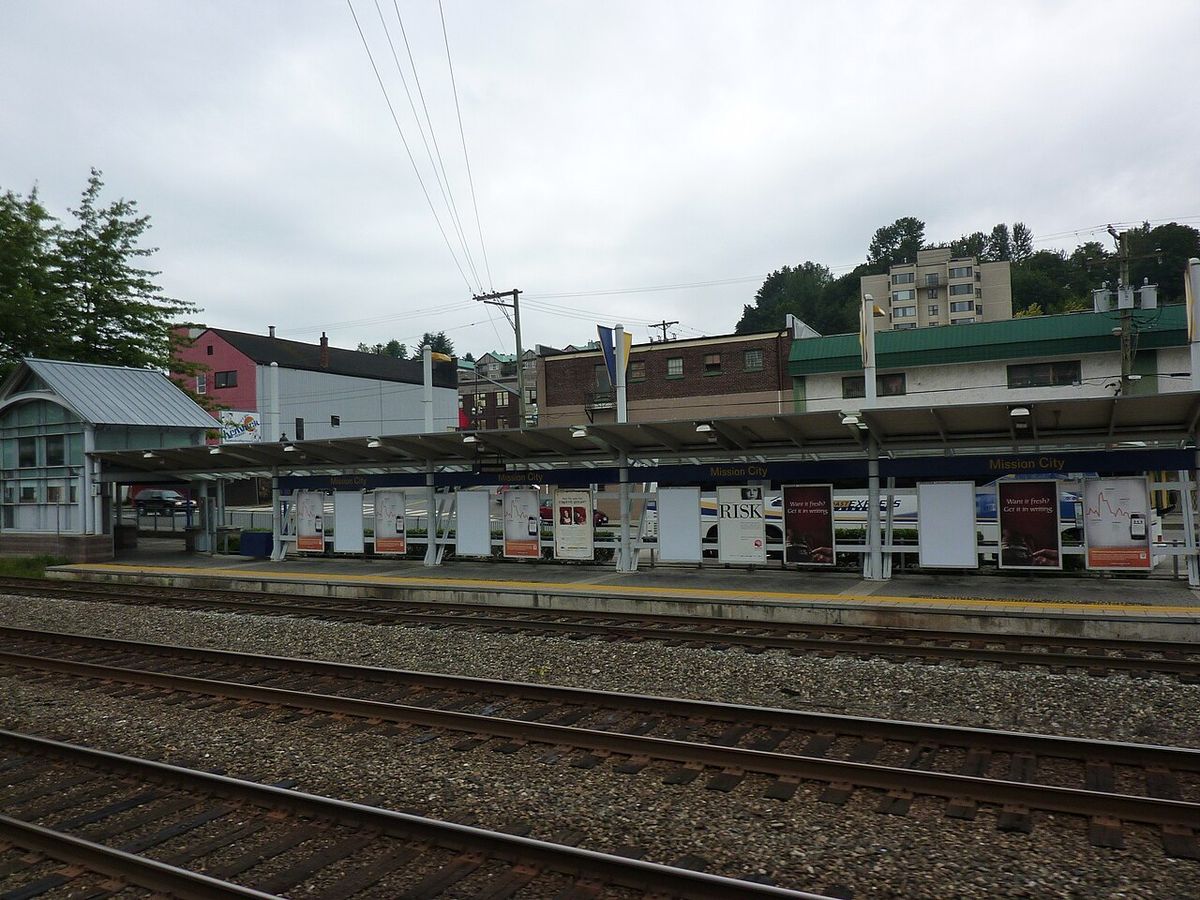
Mission is served by several key transportation corridors that connect it to the region. Road access is provided by the Abbotsford-Mission Highway (Highway 11) and the Lougheed Highway (Highway 7). The city is notably connected to Vancouver via the West Coast Express commuter rail, which operates five trains in each direction on weekdays between Mission City Station and Waterfront Station in downtown Vancouver. Local bus service is provided by the Central Fraser Valley Transit System, with connections to Abbotsford, and by TransLink's Route 701 to Coquitlam Central Station. Mission Harbour railway station is a flag stop for Via Rail's The Canadian, providing eastbound service three days a week, with westbound service routed through Abbotsford due to directional running on CN and CPR lines. The Fraser River itself is an important transportation and recreational corridor, with Mission's docks on Harbour Avenue serving as a launch point for boating, fishing, and tours, capitalizing on the famous salmon runs and population of green sturgeon.
The historic Mission Railway Bridge opened in 1891. It was the only crossing of the Fraser River in the Fraser Valley below the Alexandra Bridge at the time. All rail traffic between Vancouver and the United States was necessarily routed through Mission until the New Westminster Bridge was built in 1904. The rail bridge at Mission doubled duty as a one way alternating vehicular bridge until 1973. During the construction of the Ruskin Dam the Dewdney Trunk Road used the Stave Falls dam to cross the Stave River. The transportation network has been fundamental to the city's development from the early railways that spurred its founding.
Culture, Recreation, and Notable Sites
Mission's cultural identity is shaped by its history and natural setting. The annual Strawberry Festival, begun in 1946 on suggestion of the Board of Trade, was a major summer event, though the strawberry theme was later abandoned after industry challenges. The town later acquired the rights to the Western Canada championships of the Soap Box Derby, held annually in a specially built facility until 1973 and revived in the new millennium. From 1967 through the 1970s, the July 1 Dominion Day holiday featured both the Derby and a large Loggers Sports event, one of the largest in British Columbia and important on the North American Loggers Sports Association circuit. Mission Raceway Park is a long-established professional dragstrip. Recreational trails, such as those circling Hayward Lake on the old railway grade and trestles from the Stave Falls Power Co. line, offer outdoor activities.
Significant landmarks include the historic Mission Railway Bridge and water gauge, the Stave Falls Powerhouse, and Westminster Abbey and Seminary of Christ the King, established by Benedictine monks in 1954. The city's commercial areas include the historic First Avenue strip and The Junction Shopping Centre, opened in the 1990s. The surrounding lakes, rivers, and municipal forest provide extensive opportunities for hiking, water sports, and exploration, including water recreation on Stave Lake. Other notable sites include the former drive-in theatre near Ruskin, now a large trailer park, and the federal correctional facilities in Ferndale, which have associated wilderness work camps in the Stave River basin that have participated in clearing flooded forests from Stave Lake. The building that once housed the Empress Foods cannery was later converted, in a local scandal, into one of the province's largest marijuana grow-operations.
Questions about Mission, British Columbia
Where is Mission, British Columbia located?
Mission is a city in the Lower Mainland of the province of British Columbia, Canada. It is situated on the north bank of the Fraser River, 65 km southeast of Vancouver. It is bordered by the city of Abbotsford to the south and the city of Maple Ridge to the west. To the east are the unincorporated areas of Hatzic and Dewdney.
What is Mission known for?
Mission is historically known as a centre for forestry, particularly as a world leader in red cedar shake and shingle production. It was once called the "Home of the Big Red Strawberry" for its berry industry. The city is also notable for operating its own municipal tree farm, one of only two in British Columbia. Mission Raceway Park, a professional dragstrip, and the West Coast Express commuter rail line are other well-known features.
What is the population of Mission?
According to the 2021 Census of Population, Mission had a population of 41,519. This represented a change of 7.7 percent from its 2016 population of 38,554. With a land area of 226.98 square kilometres, this gave the city a population density of 182.9 people per square kilometre. At the census metropolitan area level, the Abbotsford Mission CMA, which includes Mission, had a population of 195,726 in 2021. The community is noted for having a relatively young population, with a median age of 36.4 according to the 2001 census.
How do you get to Vancouver from Mission?
Mission is accessible from Vancouver via commuter rail on the West Coast Express, which runs five trains in each direction a day on weekdays between Vancouver and Mission City Station. By road, primary transportation infrastructure includes the Lougheed Highway 7. Mission is also served by the Central Fraser Valley Transit System for bus connections, including TransLink route 701 to Coquitlam Central Station. Historically, Mission was a crucial rail junction, and all rail traffic between Vancouver and the United States was routed through Mission until 1904 due to its railway bridge being the only Fraser River crossing in the lower valley.
Who is the mayor of Mission?
Jag Gill serves as the mayor of Mission, having been elected by acclamation in September 2026. He succeeded the previous mayor, Paul Horn. The current municipal council was elected on October 15, 2022. The City of Mission operates under a Council Manager system of local government. A previous mayor, Pam Alexis, resigned in November 2020 after winning a seat in the Legislative Assembly of British Columbia for the Abbotsford Mission provincial riding.
What is the Mission Tree Farm?
The Mission Tree Farm is a municipal forest known as Mission Tree Farm Licence number 36, managed by the City of Mission's Forestry Department. Over 40 percent of Mission's land area is tree farm, making it one of only two communities in British Columbia with municipal tree farms. It celebrated its 50th anniversary in 2008. The tree farm comprises much of the northern part of the district, including areas west of the Stave River up to the northern boundary near Mount Robie Reid. It has served as a model for silvicultural management in the province and provides a unique income source for the municipality.
Sources and further reading
- Mission, British Columbia (Wikipedia)
- City of Mission | (lmlga.ca)
- Mission BC (missionchamber.bc.ca)
- About Mission | City of Mission (mission.ca)
- Mission | Fraser Country | Vancouver, Coast and Mountains (travel-british-columbia.com)
Checked by the Your Space Hamilton desk. Last updated 2026-11-01.