Coquitlam
Coquitlam is a suburban city in the Lower Mainland of British Columbia, Canada, and the largest municipality within the Tri-Cities region of Metro Vancouver. With an ethnically diverse population estimated at 178,477 in 2026, it is the sixth-largest city in the province. Coquitlam is governed by a mayor and city council, with elections held every four years, most recently on October 17, 2026. The city's history stretches back thousands of years to Coast Salish settlement, evolving through European exploration, industrial lumber milling, and significant Francophone settlement to become a major residential and commercial hub.
History and Development
The territory of Coquitlam has been continuously occupied for at least 9,000 years by Coast Salish peoples, with the name Kwikwetlem derived from a Coast Salish term meaning "red fish up the river. European exploration began with Simon Fraser in 1808, with more permanent settlement following in the 1860s. The municipality's early development was tied to transportation, notably the construction of North Road in the mid-19th century to connect New Westminster to Port Moody. A major economic catalyst arrived in 1889 with the opening of the state-of-the-art Fraser Mills lumber mill on the Fraser River's north bank, leading to the official incorporation of the Corporation of the District of Coquitlam in 1891.
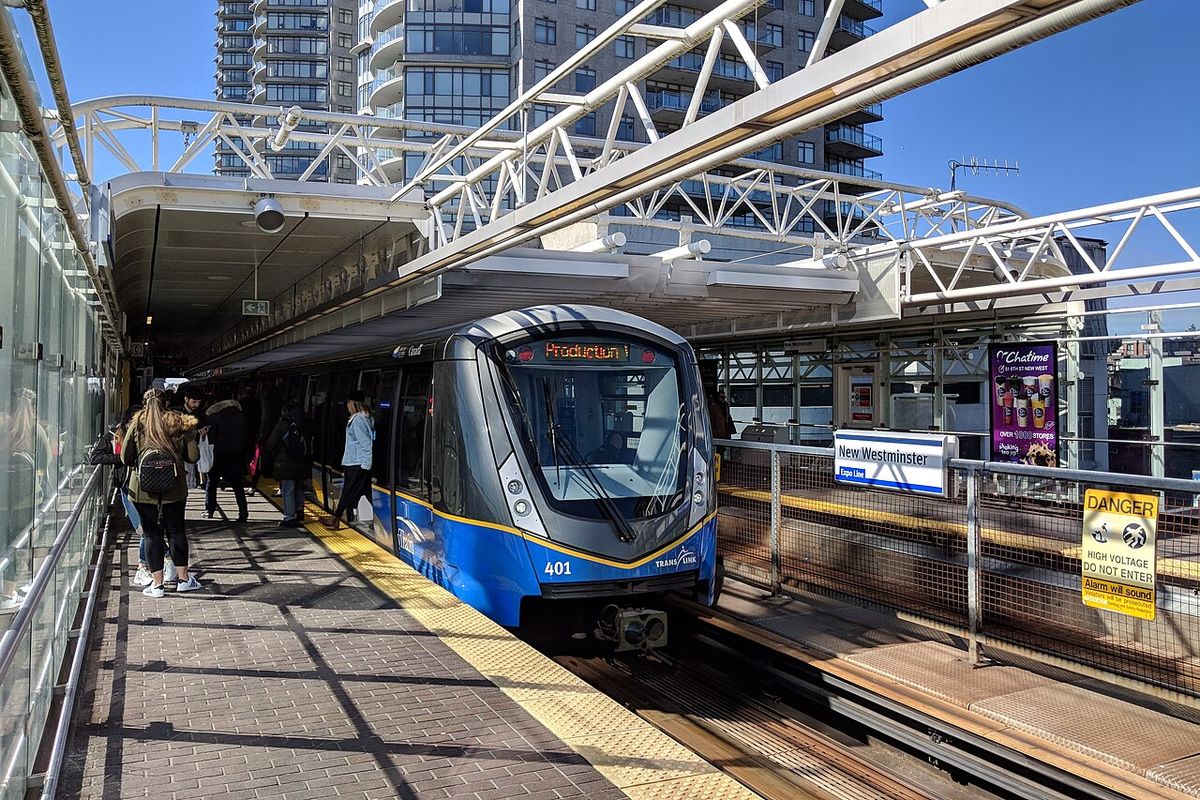
Following the Second World War, Coquitlam experienced substantial population growth alongside the rest of the Lower Mainland. The opening of Lougheed Highway in 1953 improved accessibility and spurred residential development. A significant administrative change occurred in 1971 with the amalgamation of Coquitlam and Fraser Mills, which expanded the city's industrial base. The historic Fraser Mills site closed in 2001 and is now the subject of redevelopment plans for a waterfront community. The city's growth has been consistently guided by planning initiatives, including the 1975 concept for a Town Centre and later expansions into areas like Westwood Plateau and Burke Mountain, accelerated by the opening of the SkyTrain's Evergreen Extension in December 2016.
Geography and Climate
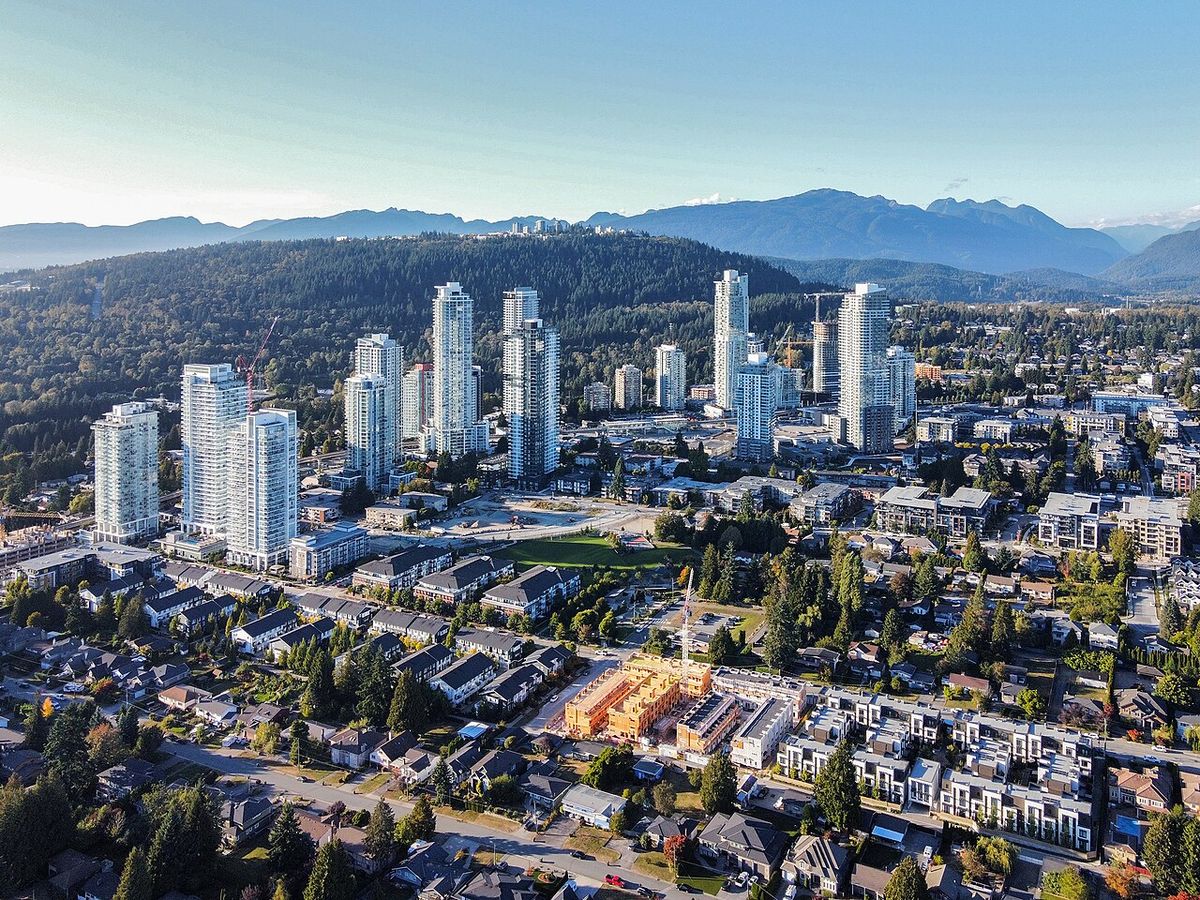
Coquitlam is located approximately 10 to 15 kilometres east of Vancouver, where the Coquitlam River meets the Fraser River. The city extends northeast along the Pitt River toward Coquitlam and Pitt lakes. It shares borders with Burnaby and Port Moody to the west, New Westminster to the southwest, and Port Coquitlam to the southeast. The northern boundary is defined by Burke Mountain, Eagle Ridge, and the 1,583-metre-tall Coquitlam Mountain. Encompassing 152.5 square kilometres, Coquitlam's land area is about six times larger than that of its immediate neighbours, Port Moody and Port Coquitlam. The city's shape is often described as a tilted hourglass, with two larger land parcels connected by a smaller central section.
Coquitlam has an oceanic climate characterized by mild temperatures, warm dry summers, and cool wet winters. Its proximity to mountain slopes results in especially heavy precipitation through orographic lift, with an annual average of 1,969 millimetres. November is typically the wettest month with 316 millimetres, while July is the driest with 60.7 millimetres. The city receives an average of 64.4 centimetres of snow annually. Average temperatures are mild by Canadian standards, with a mean annual temperature of 10.7 degrees Celsius. The average high in August is 23.5 degrees Celsius, while the average low in January is 1.4 degrees Celsius. On June 28, 2021, Coquitlam set an all-time high temperature record of 41 degrees Celsius.
Neighbourhoods and Urban Form
Coquitlam's neighbourhoods reflect its historical growth and topographical diversity. Southwest Coquitlam contains the original city core, including the historic Fraser Mills industrial sector and Maillardville, which transitions into the residential plateau of Austin Heights. This older area features larger lots that are increasingly being redeveloped. The Poirier Street area was the city's original recreational hub, housing facilities like the Coquitlam Sports Centre. Austin Heights is also home to Como Lake, a popular urban fishing and recreation spot, and Mundy Park, one of the largest urban parks in Metro Vancouver. The Riverview Hospital lands, renamed səmiq̓wəʔelə (The Place of the Great Blue Heron) in May 2021, are the subject of a long-term master plan being developed by the kʷikʷəƛ̓əm Nation and BC Housing.
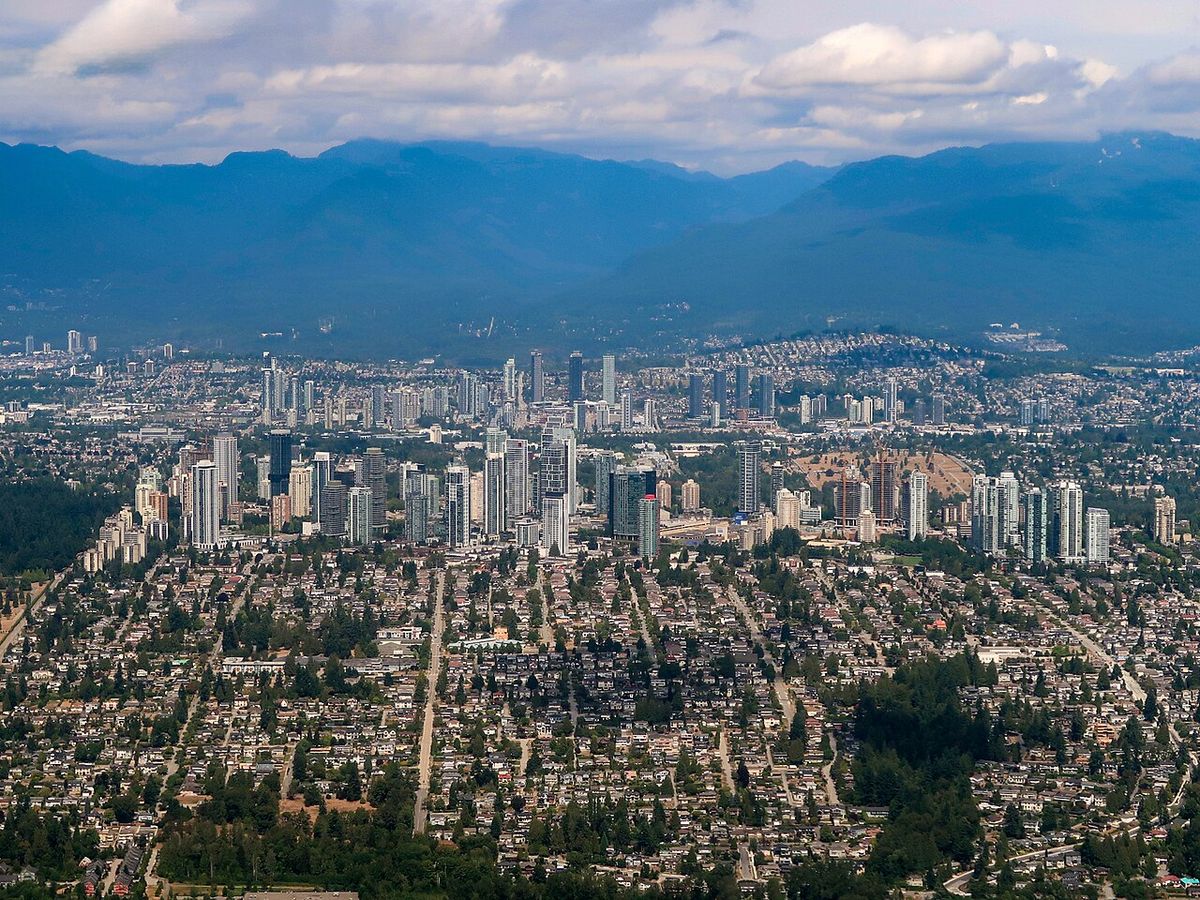
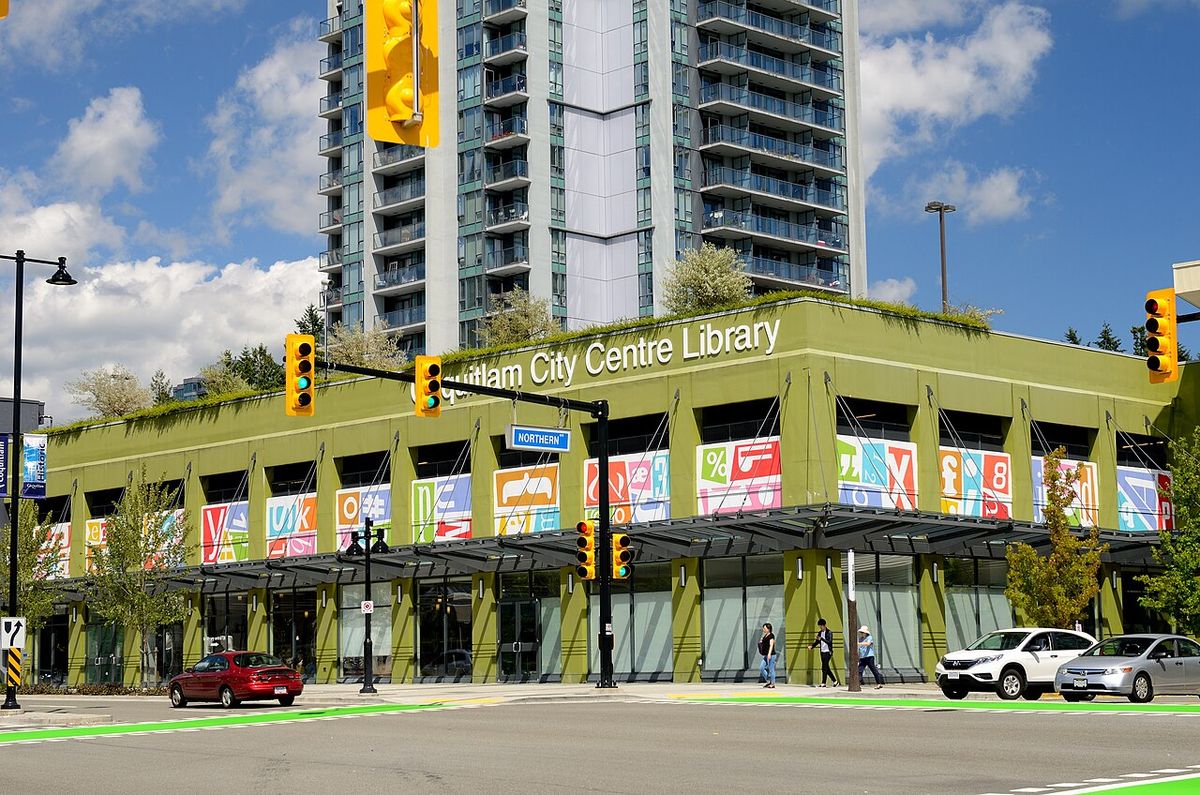
Coquitlam Town Centre is designated as a Regional Town Centre under Metro Vancouver's strategic plan, intended to concentrate high-density housing, offices, and cultural facilities. It is served by rapid transit and houses key public buildings like City Hall, the main library branch, an RCMP station, Douglas College's David Lam Campus, and the Evergreen Cultural Centre. Major residential developments have shaped other areas. With the Plateau completed, primary urban development has shifted to Burke Mountain in the city's northeast, which is now divided into several neighbourhood plans. The opening of the SkyTrain extension has also spurred growth in the Burquitlam area.
- Southwest Core: Maillardville, Fraser Mills, Austin Heights.
- Central Area: Coquitlam Town Centre, City Hall precinct.
- Westwood Plateau: Upscale residential community with golf courses.
- Burke Mountain: Northeast area with active new development.
- Burquitlam: Area experiencing growth due to SkyTrain access.
- Riverview Heights: Subdivision on former Riverview Hospital lands.
Demographics and Society
According to the 2021 census, Coquitlam had a population of 148,625, with a 2026 estimate of 178,477. The population density in 2021 was 1,216.7 people per square kilometre. The 2016 census provided detailed family data, showing that 47% of households were married couples with children, 30% were married couples without children, and 22% were one-person households. The median age was 41.1 years, slightly younger than the provincial median. Coquitlam has a notably high proportion of foreign-born residents at 44%, compared to 28% for British Columbia overall. The 2015 median family income was $65,020, above the provincial average, and 58.2% of adults held a post-secondary certificate, diploma, or degree. A distinct characteristic is that only 23.4% of employed residents work within Coquitlam itself, though 22.2% use active or public transportation to commute.
The city's ethnic and linguistic diversity is pronounced. The 2021 census found that English was the mother tongue for 47.5% of the population. Mandarin was the next most common at 9.7%, followed by Korean at 6.8%. The Maillardville area retains a pocket of French speakers, reflecting its historical roots. In terms of religious affiliation, the 2021 census reported a majority of residents (50.1%) as having no religious affiliation. Christianity was the largest reported religion at 37.4%, followed by Islam (6.3%), Buddhism (2.1%), Hinduism (1.3%), Sikhism (1.3%), Judaism (0.3%), and Indigenous Spirituality (less than 0.1%).
| Religious Group | Persons (2021) | Percentage |
|---|---|---|
| No Religion | 73,945 | 50.1% |
| Christianity | 55,150 | 37.4% |
| Islam | 9,315 | 6.3% |
| Buddhism | 3,110 | 2.1% |
| Hinduism | 1,955 | 1.3% |
| Sikhism | 1,855 | 1.3% |
Economy and Major Employers
Coquitlam functions primarily as a bedroom community, with a majority of its workforce commuting to jobs in Vancouver, Burnaby, and other Metro Vancouver suburbs. The city's main industrial area is located in the southern Maillardville and Fraser Mills sector near the Fraser River. Within the city, the largest employers include the City of Coquitlam itself, with approximately 850 employees, Art in Motion with about 750 employees, and the Hard Rock Casino with around 600 employees. Other significant corporate employers with operations in Coquitlam are Coca-Cola, Sony, and the Marine Propulsion division of Rolls-Royce. Retail is a major employment sector, providing 8,765 jobs from 610 businesses in 2007, which represented 27% of all jobs in the city at that time.
Retail activity is concentrated in several nodes. Coquitlam Centre in the Town Centre area is a major shopping destination, while big-box retailers like IKEA and The Home Depot are located in the Pacific Reach district. Additional retail outlets are centred around the Austin Heights and North Road sectors. The business community is supported by the Tri-Cities Chamber of Commerce, which, as of 2026, represents over 1,300 organizations from Coquitlam, Port Coquitlam, Port Moody, Anmore, and Belcarra. The Chamber fosters economic development, provides business connections, and advocates on public policy issues at various government levels.
Arts, Culture and Recreation
Coquitlam offers a wide array of cultural and recreational amenities, both within the city and through its proximity to Greater Vancouver. The city was designated a Cultural Capital of Canada in 2009. A key performing arts venue is the Molson Canadian Theatre, a 1,074-seat multi-purpose space that opened as part of a casino expansion in 2006. The Evergreen Cultural Centre in the Town Centre features a 264-seat black box theatre, rehearsal hall, art studios, and a gallery, serving as home to groups like the Pacific Symphonic Wind Ensemble and the Coquitlam Youth Orchestra. For cinema, the SilverCity Coquitlam complex operates 20 screens with 4,475 seats. Place des Arts, founded in 1972 in Maillardville, is a non-profit teaching arts centre offering programs in visual arts, music, drama, and dance, and hosts regular concerts and exhibitions.
The city hosts numerous annual festivals that celebrate its diverse community. These include the Festival du Bois celebrating Francophone heritage in March, the Water's Edge Festival, the Como Lake Fishing Derby in May, the BC Highland Games in June, a Canada Day celebration at Town Centre Park, the BC Dumpling Festival in mid-August, and the Blue Mountain Music Festival in mid-July. Colour Fest, a community celebration, is also held at Town Centre Park. Coquitlam maintains an extensive park system with over 80 municipal parks and natural areas totalling more than 890 hectares. Major parks include the centrally located Mundy Park, Town Centre Park, Como Lake Park, Glen Park, and the inter-municipal Colony Farm. The city also operates and maintains numerous sports fields, diamonds, and facilities like Percy Perry Stadium and the Poirier Sport & Leisure Complex.
- Festival du Bois: Celebrates Francophone culture (first full weekend in March).
- BC Highland Games: Scottish cultural event (last Saturday in June).
- Canada Day Celebration: Held at Town Centre Park.
- BC Dumpling Festival: Celebrates diverse food culture (mid-August).
- Colour Fest: Community celebration at Town Centre Park.
- Place des Arts: Teaching arts centre in Maillardville, founded 1972.
- Evergreen Cultural Centre: Town Centre venue for performing and visual arts.
- Mundy Park: One of the largest urban parks in Metro Vancouver.
Sports and Community Facilities
Coquitlam supports a strong sports community with facilities and organizations catering to a wide range of activities. In baseball, the Coquitlam Reds of the B.C. Premier Baseball League play at Mundy Park, with alumnus Larry Walker being a notable former Major League MVP. Coquitlam Little League, part of Little League International since 1955, finished third at the 1984 Little League World Series and hosted the Junior League Canadian Championships in 2008. Basketball is served by the Tri-City Youth Basketball Association, formed in 1999, which operates as part of the Steve Nash Youth Basketball program for over 1,400 players in grades 2 through 9. The Windies Cricket Club fields three adult teams in local leagues.
The city government is responsible for maintaining extensive sports infrastructure, including 40 grass, sand, or soil sports fields, five FieldTurf fields, 35 ball diamonds, and facilities for bowling, croquet, bocce, and cricket. Key city-operated facilities include Percy Perry Stadium and the Poirier Sport & Leisure Complex. Privately, Planet Ice provides four ice rinks, supplementing other rinks found throughout the Tri-Cities. Community centres like Place Maillardville offer programs focused on French language, culture, and physical activities for all ages. Heritage Square provides historic sites, gardens, a bike path, an amphitheatre, and is home to the Mackin Heritage Home & Toy Museum.
Governance and Elections
Coquitlam is governed under a mayor-council system. The city council consists of a mayor and eight councillors, alongside elected school trustees for School District 43. General local elections in British Columbia are held every four years on the third Saturday of October. The most recent election was held on October 17, 2026, where eligible voters elected one mayor, eight councillors, and four school trustees. The current mayor, as of the 2026 election, is Richard Stewart. Voter turnout in the previous 2022 local election was relatively low, with only 20% of eligible voters in Coquitlam casting a ballot. The city's electoral process is conducted in accordance with the Local Government Act, the Community Charter, and the School Act.
Provincially, the area encompassing Coquitlam is part of the Port Coquitlam riding for the Legislative Assembly of British Columbia. As of the 2024 provincial election, this riding is represented by NDP MLA Mike Farnworth, who first took office in 2005. The 2026 provincial election was held shortly after the municipal elections. Local governance decisions on development, transportation, infrastructure, and parks have a direct impact on the community, making civic engagement a key component of the city's governance. The Tri-Cities Chamber of Commerce also plays a role in influencing public policy at various government levels on behalf of the local business community.
Questions about Coquitlam
What is the population of Coquitlam?
Coquitlam's population was 148,625 according to the 2021 census. A more recent estimate for 2026 places the population at 178,477, which would make it the sixth-largest city in British Columbia. The city has experienced consistent growth, with a 6.7% increase between the 2016 and 2021 censuses. Its population density in 2021 was 1,216.7 people per square kilometre.
Who is the mayor of Coquitlam?
As of the October 17, 2026 general local election, the mayor of Coquitlam is Richard Stewart. The city is governed by a mayor and an eight-member city council, with elections held every four years. Voters also elect school trustees for School District 43 during these municipal elections. The mayor and council are responsible for local governance, including planning, infrastructure, and community services.
What are the main parks and natural areas in Coquitlam?
Coquitlam has over 80 municipal parks and natural areas totalling more than 890 hectares. The largest is Mundy Park, a significant urban forest located roughly in the city's centre. Other major parks include Town Centre Park, Como Lake Park, and Glen Park. The city borders several regional and provincial parks, including Pinecone Burke Provincial Park, Minnekhada Regional Park, and Pitt Addington Marsh. Colony Farm, a 404-hectare park shared with Port Coquitlam, offers walking trails and wildlife viewing.
How does the climate in Coquitlam compare to nearby Vancouver?
Coquitlam shares an oceanic climate with Vancouver, featuring mild, wet winters and warm, drier summers. However, due to its proximity to mountain slopes, Coquitlam experiences significantly higher precipitation through orographic lift, with an annual average of 1,969 millimetres compared to Vancouver's lower totals. Coquitlam also receives more snow, averaging 64.4 centimetres per year. Temperatures are similar, with a mean annual temperature of 10.7 degrees Celsius, though Coquitlam set a record high of 41 degrees Celsius on June 28, 2021.
What are the major cultural venues and events in Coquitlam?
Major cultural venues include the Evergreen Cultural Centre, which houses a theatre and art gallery, and the Molson Canadian Theatre at the Hard Rock Casino. Place des Arts in Maillardville is a key teaching and performance centre. Annual events include the Festival du Bois (Francophone culture), the BC Highland Games, Canada Day celebrations at Town Centre Park, the BC Dumpling Festival, and the Blue Mountain Music Festival. The city was designated a Cultural Capital of Canada in 2009 for its arts and cultural contributions.
What is Coquitlam known for historically?
Coquitlam is historically known for its Coast Salish heritage, early European exploration, and industrial development centred on Fraser Mills. The Coast Salish people were the first inhabitants, with archaeology confirming continuous occupation for at least 9,000 years. European settlement increased after explorer Simon Fraser came through in 1808. A major boost came in 1889 with the opening of Fraser Mills, a large lumber mill. Post World War II, substantial population growth was fuelled by the opening of Lougheed Highway in 1953 and later by rapid transit development.
Sources and further reading
- Coquitlam (Wikipedia)
- BC election 2026 results: Port Coquitlam (globalnews.ca)
Checked by the Your Space Hamilton desk. Last updated 2026-10-30.