Trumpeter swan
The trumpeter swan (Cygnus buccinator) is the heaviest living bird native to North America and the world's largest extant species of waterfowl. This majestic bird, known for its pure white plumage, deep trumpeting call, and immense size, is a powerful symbol of wilderness conservation success in Canada and the United States. Once driven to the brink of extinction in the early 20th century, decades of dedicated recovery efforts have restored its populations across much of its historic range. Today, the trumpeter swan is a celebrated resident of wetlands from Alaska and Yukon to the interior provinces and the Great Lakes region, embodying one of North America's most remarkable wildlife recovery stories.
Physical Description and Identification
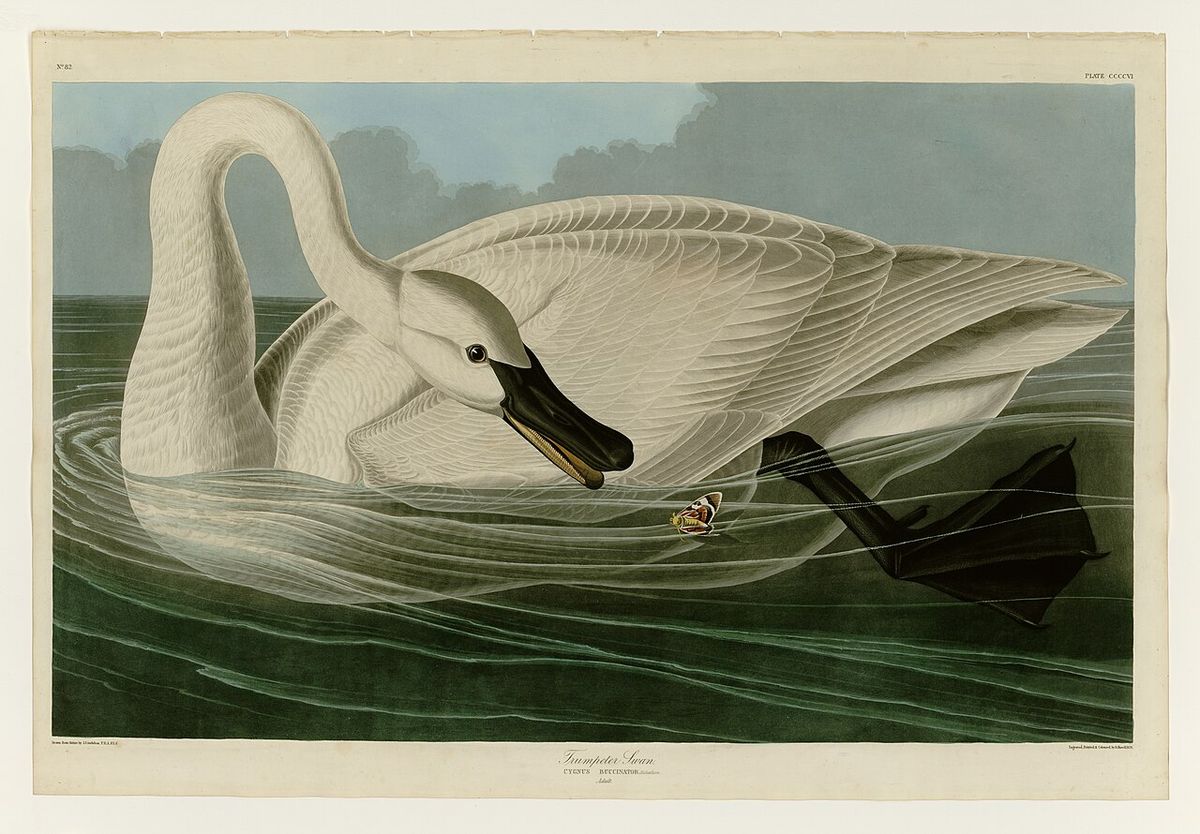
The trumpeter swan is an exceptionally large bird, with adults typically measuring between 138 and 165 centimetres in length. Large males can exceed 180 centimetres, making them the longest native bird in North America. Their weight ranges from 7 to 13.6 kilograms, with males averaging 10.9 to 12.7 kilograms and females averaging 9.4 to 10.3 kilograms. This substantial mass makes the trumpeter swan one of the heaviest flying birds in the world. The species' most striking feature is its immense wingspan, which ranges from 185 to 304.8 centimetres, with the largest recorded male having a wingspan of 3.1 metres. Adult plumage is entirely white, while cygnets have light grey plumage and pinkish legs, gaining their white feathers after about a year.
Trumpeter swans possess a large, wedge-shaped black bill that can measure 10.5 to 12 centimetres, the largest bill of any waterfowl species. The bill may have minimal salmon-pink colouring around the mouth. Their legs are typically a grey-pink colour, though they can sometimes appear yellowish grey. The species holds an upright posture and generally swims with a straight neck, unlike the introduced mute swan which often holds its neck in a curved S-shape. The trumpeter's loud, resonant, horn-like call, from which it derives its name, is a key identifier and can be heard over long distances.
Distinguishing trumpeter swans from the smaller tundra swan can be challenging, especially at a distance. The trumpeter is significantly larger, with a male's neck potentially being twice as long as that of a tundra swan. The trumpeter's bill is larger and more distinctly wedge-shaped. While tundra swans typically have a small yellow spot in front of the eye (the lore), some trumpeter swans can also exhibit yellow lores, often associated with leucistic individuals. Careful observation of size, neck length, and bill shape is usually required for confident identification.
Historic Decline and Dramatic Recovery
The trumpeter swan's population suffered a catastrophic collapse due to over-hunting and habitat loss following European settlement. The birds were heavily hunted for their meat, skins, and especially their large, beautiful white feathers, which were in high demand for fashion items like powder puffs and quill pens. By 1933, fewer than 70 wild individuals were known to exist, primarily in remote areas of Montana and Wyoming, and extinction seemed imminent. The species had been extirpated from eastern Canada, including Ontario, over 200 years prior. A critical discovery occurred when aerial surveys located a previously unknown Pacific population of several thousand trumpeter swans around Alaska's Copper River, providing a vital genetic reservoir for recovery.
Organized recovery efforts began in the mid-20th century, spearheaded by wildlife agencies and conservation groups like the Trumpeter Swan Society. These efforts involved careful reintroductions, habitat protection, and public education. The first cooperative continental survey in 1968 counted 3,722 birds. Through sustained effort, the North American wild population rebounded to over 46,000 birds by 2010. Regular surveys conducted at five-year intervals have tracked this growth. The most recent continental survey was completed in 2015, and management plans, such as the 2026 Interior Population Trumpeter Swan Management Plan update, continue to guide conservation.
State-level recovery programs have been notably successful. In Wisconsin, where the wild breeding population was non-existent in the mid-1980s, the Department of Natural Resources implemented a detailed recovery plan starting in 1986. Biologists collected 385 wild swan eggs from Alaska between 1989 and 1997, hatching them at the Milwaukee County Zoo and using innovative rearing techniques like decoy-rearing and captive-rearing to establish new populations. The goal of 20 breeding pairs by the year 2000 was far exceeded, with 44 pairs recorded that year. By 2009, the species was removed from Wisconsin's endangered and threatened species list, and the 2025 spring waterfowl survey estimated the state's population now exceeds 15,000 individuals. This success led the Great Wisconsin Birdathon to name the trumpeter swan its 2026 'Bird of the Year'.
Range, Habitat, and Migration
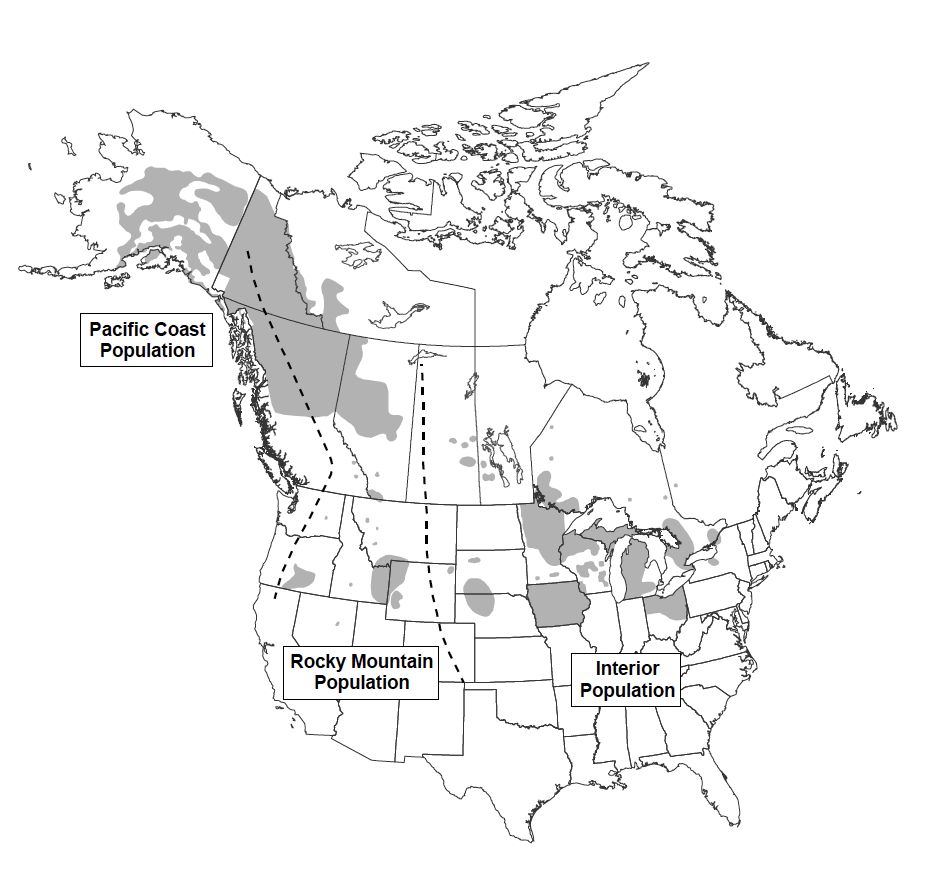
Trumpeter swans inhabit northwestern and central North America. The largest numbers of breeding pairs are found in Alaska, with significant populations also in Canada's western Yukon and northern British Columbia. Their breeding habitat consists of large, shallow ponds, undisturbed lakes, pristine wetlands, wide slow rivers, and marshes. They prefer nesting sites with enough open water for takeoff, reliable food sources, shallow unpolluted water, and minimal human disturbance. In forested regions, they often breed in wetlands surrounded by trees.
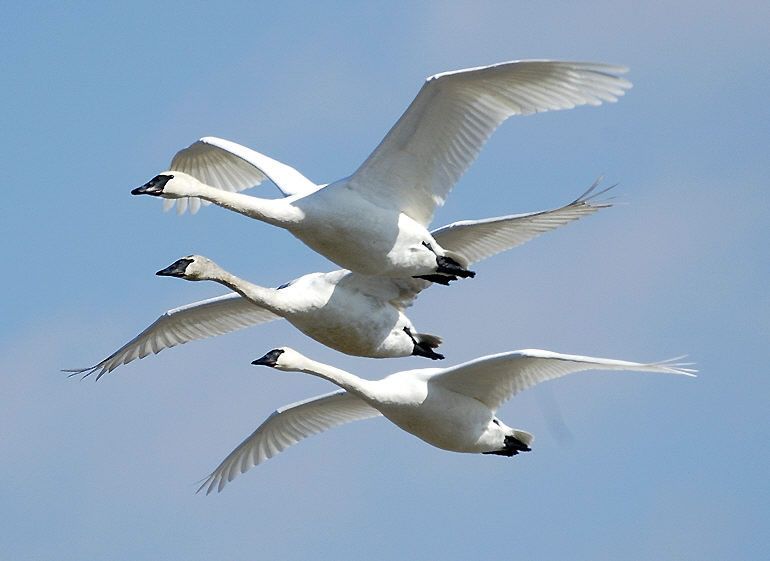
The North American population is divided into three main groups: the Pacific Coast Population (PCP), the Rocky Mountain Population (RMP), and the Interior Population (IP). Natural populations are migratory, while many reintroduced populations in the interior of the continent are non-migratory. Migratory trumpeter swans travel in characteristic V-shaped flocks. They winter in the southern tier of Canada, the eastern part of the northwestern United States, particularly the Red Rock Lakes area of Montana, and the northern Puget Sound region of Washington state. Some migratory individuals have been observed as far south as Pagosa Springs, Colorado.
In Washington state, nearly three-quarters of the trumpeter swans that migrate along the Pacific Flyway winter there, mainly in Whatcom and Skagit counties. More than 1,000 trumpeter and tundra swans overwinter in Whatcom County alone. These birds generally arrive from Alaska and western Canada in late October and begin their northward migration back to breeding grounds in April. Occasional vagrant sightings occur outside the core range, such as a juvenile residing in North Carolina in 2017. The species is considered extirpated from its historic southern range in Texas, California, and Mexico.
Diet and Feeding Behaviour
Trumpeter swans are almost exclusively herbivorous, with a diet focused on aquatic vegetation. They feed while swimming, often submerging their heads and long necks to reach submerged plants. They will eat both the leaves and stems of submerged and emergent vegetation like pondweeds, sedges, and rushes. A key feeding behaviour is digging into muddy substrates underwater with their strong bills to extract roots and tubers. This activity, known as 'tipping up' or 'dabbling', is common in shallow waters.
Their diet shows seasonal variation. In winter, when aquatic foods may be less accessible, they readily adapt to eating grasses and leftover agricultural crops in fields, such as corn and potatoes. This adaptability has been important for wintering populations in areas where native wetlands have been altered. Feeding activity and body weight often peak in the spring as the birds prepare for the demanding breeding season. They will feed both during the day and at night.
Cygnets have a different dietary requirement for growth. Initially, their diet includes insects, small fish, fish eggs, and small crustaceans to provide essential protein. Over the first few months, they gradually shift to the vegetation-based diet of the adults. This protein-rich start is crucial for their rapid development and survival during the vulnerable early stages of life.
Breeding and Life Cycle
Trumpeter swans are known for forming long-term pair bonds, often mating for life. Most pairs form when the birds are between 5 and 7 years old, though some may not pair until nearly 20. While 'divorces' and re-pairing can occur, serial monogamy across breeding seasons is more common. If a mate dies, the surviving swan, particularly males, may not pair again. Courtship involves elaborate displays including synchronized swimming, head bobbing, wing spreading and quivering, and the famous mutual trumpeting duets. These duets help strengthen the pair bond and are also used to defend territory.
Nest construction is a meticulous process taking 11 to 35 days, typically beginning in late April. Pairs build large nests, 1.2 to 3.6 metres in diameter, from submerged vegetation, grasses, and sedges. Nests are almost always placed in or very near water, on islands, muskrat houses, or floating vegetation, which helps protect them from mammalian predators. The male gathers material by facing away from the nest and throwing vegetation over his shoulder, while both sexes arrange it. During this time, the female feeds intensively to prepare for egg-laying.
The female lays a clutch of four to six eggs, though clutches of up to nine have been recorded in reintroduced populations. The eggs are exceptionally large for a flying bird, averaging 113.5 millimetres long and 73 millimetres wide, and weighing about 320 grams. The female performs the majority of the incubation over a period of 32 to 37 days, standing periodically to turn the eggs. Both parents fiercely guard the nest and, later, the cygnets. Young swans, or cygnets, can swim and feed shortly after hatching but remain with their parents for their first year, learning migration routes and wintering areas. Young swans have a survival rate as low as 40% due to various threats, but adult annual survival is high, typically between 80 and 100 percent.
Threats and Conservation Status
Despite the species' overall recovery, trumpeter swans face ongoing threats that require continued management and monitoring. The primary historical threats of over-hunting and habitat loss have been largely mitigated through legal protection and conservation programs. Trumpeter swans are protected under federal and state laws in the United States and under various wildlife acts in Canada. For example, there has been no legal hunting season for trumpeter swans in Washington state since 1918. The species is currently listed as 'Not at Risk' in Canada and has been delisted from state endangered species lists in areas like Wisconsin.
Current significant threats include habitat degradation and loss, particularly the draining and pollution of wetlands. Collisions with power lines are a notable cause of mortality, especially for migrating flocks. Lead poisoning from ingesting spent lead shot or fishing weights left in wetlands continues to be a serious concern, as swans can mistake the pellets for grit or seeds. Occasional illegal or accidental shootings still occur. Natural predation pressure is highest on eggs and cygnets. Common nest predators include common ravens, raccoons, coyotes, and bears. Cygnets are also vulnerable to predators like snapping turtles, large gulls, great horned owls, foxes, and mink. Healthy adults have few natural predators, though golden eagles, bald eagles, and coyotes may rarely attack, especially injured or nesting birds.
Conservation efforts are comprehensive and ongoing. Key actions include:
- Regular population monitoring through aerial surveys and banding programs.
- Habitat protection and restoration of wetlands.
- Public education campaigns to reduce lead contamination and prevent disturbance.
- Working with utility companies to mark power lines in key flight corridors.
- Continued enforcement of hunting regulations that protect all swan species.
- Updating science-based management plans, such as the 2026 Interior Population plan, to adapt to new challenges.
Population Trends and Survey Data
The recovery of the trumpeter swan is quantitatively documented through a series of continental surveys that began in 1968. These surveys, repeated in 1975 and then at five-year intervals, assess abundance and productivity across the three North American populations. The data shows a consistent and dramatic upward trend from a precarious baseline. The most recent full continental survey was conducted in 2015, while state and provincial agencies conduct more frequent regional counts. The table below illustrates the remarkable population growth since surveys began.
| Survey Year | Estimated Continental Population | Key Notes |
|---|---|---|
| 1968 | 3,722 | First cooperative continental survey. |
| 1975 | Data not in notes | Second five-year survey. |
| 2010 | 46,225 | Population exceeds 46,000. |
| 2015 | Data not in notes | Most recent continental survey. |
| 2025 (Wisconsin) | 15,000+ | State population from spring waterfowl survey. |
Regional population successes are equally telling. Wisconsin's population, rebuilt from zero breeding pairs in the 1980s, now forms a significant component of the Interior Population. The 2025 survey confirming over 15,000 individuals in Wisconsin alone highlights the scale of the recovery. In Washington state, wintering populations are a major feature, with thousands of swans relying on the Skagit and Whatcom county farmlands and wetlands. Migration counts in these areas help track the health of the Pacific Coast Population. These ongoing surveys are vital for detecting changes, evaluating the impact of threats like disease or habitat loss, and informing adaptive management strategies to ensure the trumpeter swan's continued prosperity.
Questions about Trumpeter swan
How can you tell a trumpeter swan from a tundra swan?
Distinguishing between these two native swans relies on size, bill shape, and subtle markings. The trumpeter swan is significantly larger, with a longer neck and a larger, wedge-shaped black bill that often appears to merge smoothly with the forehead. The tundra swan is smaller and usually has a more rounded head profile with a distinct concave slope between the bill and forehead. Many tundra swans have a small yellow spot in front of the eye (the lore), though some trumpeters can also show this. The trumpeter's call is a lower-pitched, resonant trumpet or horn sound.
Are trumpeter swans still endangered?
No, trumpeter swans are not currently considered endangered on a continental scale. They are listed as 'Not at Risk' in Canada and have been removed from state endangered species lists in regions like Wisconsin, where they were delisted in 2009. This status reflects one of North America's great conservation success stories, with the population rebounding from fewer than 70 known wild birds in 1933 to over 46,000 by 2010. However, they remain protected by law, and ongoing threats like habitat loss, lead poisoning, and power line collisions require continuous management.
What do trumpeter swans eat?
Trumpeter swans are primarily herbivores, feeding on aquatic vegetation. Their diet includes the leaves and stems of submerged plants like pondweeds, as well as roots and tubers they dig from muddy bottoms. In winter, they adapt their diet to include grasses and agricultural leftovers such as corn and potatoes in fields. Young cygnets initially consume insects, small fish, and crustaceans for essential protein before transitioning to a plant-based diet within a few months. They feed by dabbling and up-ending in shallow water.
Where can I see trumpeter swans in Canada?
In Canada, trumpeter swans can be seen in several regions depending on the season. The largest breeding populations are in Alaska, western Yukon, and northern British Columbia. Migratory populations winter in the southern parts of the Canadian prairies and interior British Columbia. Reintroduced, often non-migratory populations are now established in areas like central and northern Ontario, parts of the Prairie provinces, and interior British Columbia. Specific locations include wetlands near Vanderhoof, British Columbia, where they return each spring, and various managed marshes in southern Ontario.
Why was the trumpeter swan chosen as the 2026 Bird of the Year?
The Great Wisconsin Birdathon named the trumpeter swan its 2026 'Bird of the Year' to honour the species' incredible conservation comeback story and to mark the anniversary of related recovery efforts. The Natural Resources Foundation of Wisconsin's flagship project in 1987 supported the Trumpeter Swan Recovery Program. From a non-existent wild breeding population in the mid-1980s, Wisconsin now hosts over 15,000 trumpeter swans as of 2025. This dramatic recovery, achieved through egg collection, captive rearing, and habitat work, exemplifies successful wildlife restoration, making the swan a fitting symbol for the Birdathon's conservation fundraising goals.
What is the largest trumpeter swan ever recorded?
The largest known male trumpeter swan attained a length of 183 centimetres, a wingspan of 3.1 metres, and a weight of 17.2 kilograms. This measurement makes it the second heaviest wild waterfowl ever found, as a mute swan was once recorded at 22.5 kilograms. Typically, adult trumpeter swans measure 138 to 165 centimetres long and weigh 7 to 13.6 kilograms, with large males sometimes exceeding 180 centimetres. Their impressive wingspan ranges from 185 to 304.8 centimetres. As the heaviest living bird native to North America and the largest extant waterfowl species, the trumpeter swan is one of the heaviest flying animals in the world.
Sources and further reading
- Trumpeter swan (Wikipedia)
- Trumpeter swan | Washington Department of Fish & Wildlife (wdfw.wa.gov)
- Trumpeter swan named 2026 Birdathon 'Bird of the Year' ... (wisconservation.org)
Checked by the Your Space Hamilton desk. Last updated 2026-10-29.