Papilio polyxenes
The Eastern Black Swallowtail ( Papilio polyxenes ) is a widespread and familiar butterfly species native to North America, recognized for its distinctive black wings adorned with yellow, blue, and orange markings. It is commonly found from southern Canada through the United States and into South America, favouring open habitats like meadows, gardens, and parks. The species is notable for its pronounced sexual dimorphism, with females mimicking the toxic Pipevine Swallowtail for protection, and its caterpillars, known as parsleyworms, feed on common garden herbs like parsley, dill, and carrots. Its adaptability to human-altered landscapes and role as a pollinator make it a significant and appreciated part of Canadian lepidopteran fauna.
Description and Identification
The Eastern Black Swallowtail is a medium to large butterfly with a characteristic wingspan ranging from 6.9 to 11.5 centimetres. The upper surfaces of the wings are predominantly black. Both sexes display two rows of yellow spots along the forewings and an orange-red eyespot with a black centre on the inner margin of each hindwing. A key identifying feature is the presence of 'tails' extending from the hindwings, typical of the swallowtail family. The ventral, or underside, of the wings features rows of pale yellow spots on the forewings and bright orange spots separated by areas of powdery blue on the hindwings. This ventral pattern provides protective mimicry for both males and females when their wings are closed.
Sexual dimorphism is pronounced in this species. Males have narrower black wings with larger, brighter yellow spots and only a small, less prominent area of iridescent blue scaling on the hindwings. Females are generally larger with smaller, lighter yellow spots. Their most distinguishing feature is a broad, prominent band of iridescent blue across the hindwings. This female coloration is a form of Batesian mimicry, closely resembling the appearance of the distasteful and toxic Pipevine Swallowtail (Battus philenor), which offers protection from bird predators. Males can occasionally display this female-like pattern, but typically coloured males are more successful in territorial competition.
Life Cycle and Development
The complete life cycle of the Black Swallowtail includes four distinct stages: egg, larva (caterpillar), pupa (chrysalis), and adult butterfly. The duration of each stage is variable, heavily influenced by temperature and host plant species. Females lay single, round, cream-coloured eggs on the foliage or flowers of host plants. The egg stage lasts between 4 to 9 days before hatching. Upon emerging, the larvae begin feeding on the host plant. The larval stage, which lasts 10 to 30 days, consists of five growth phases called instars.
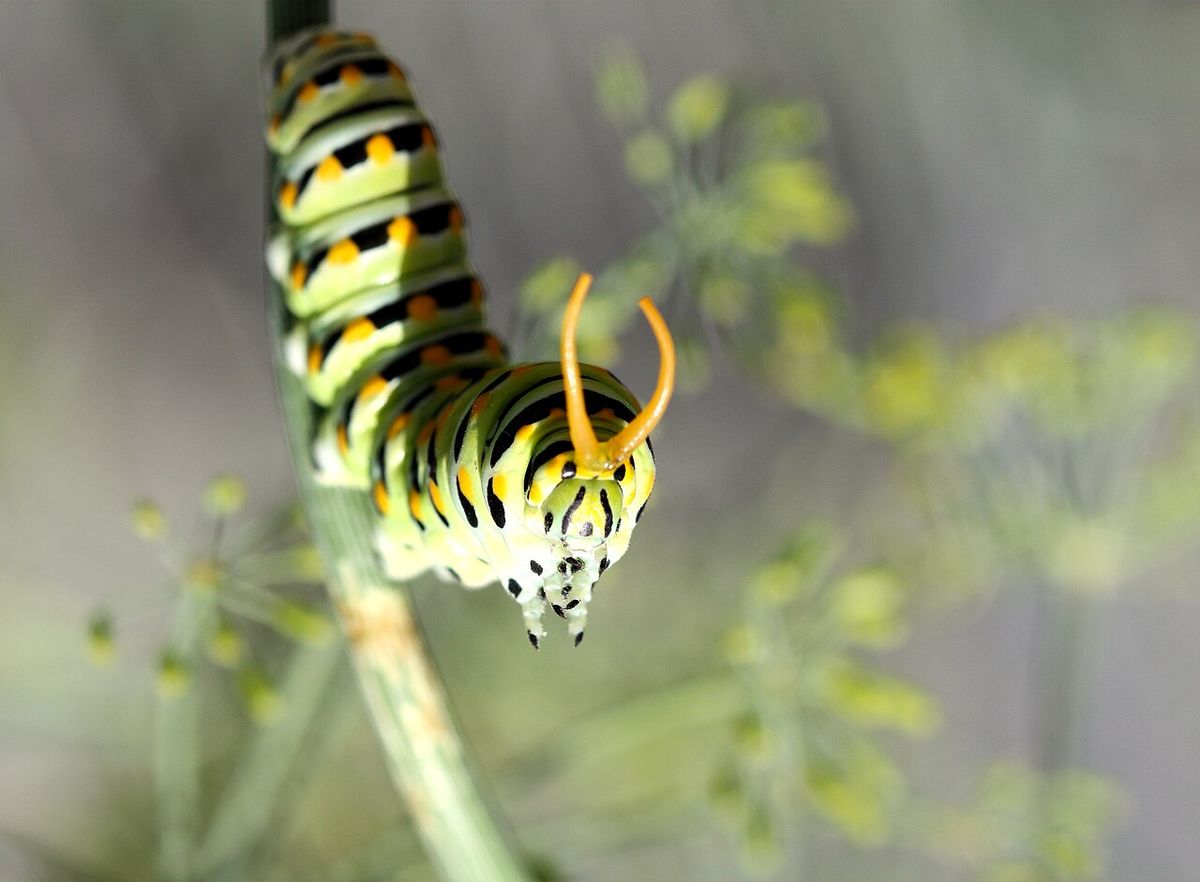
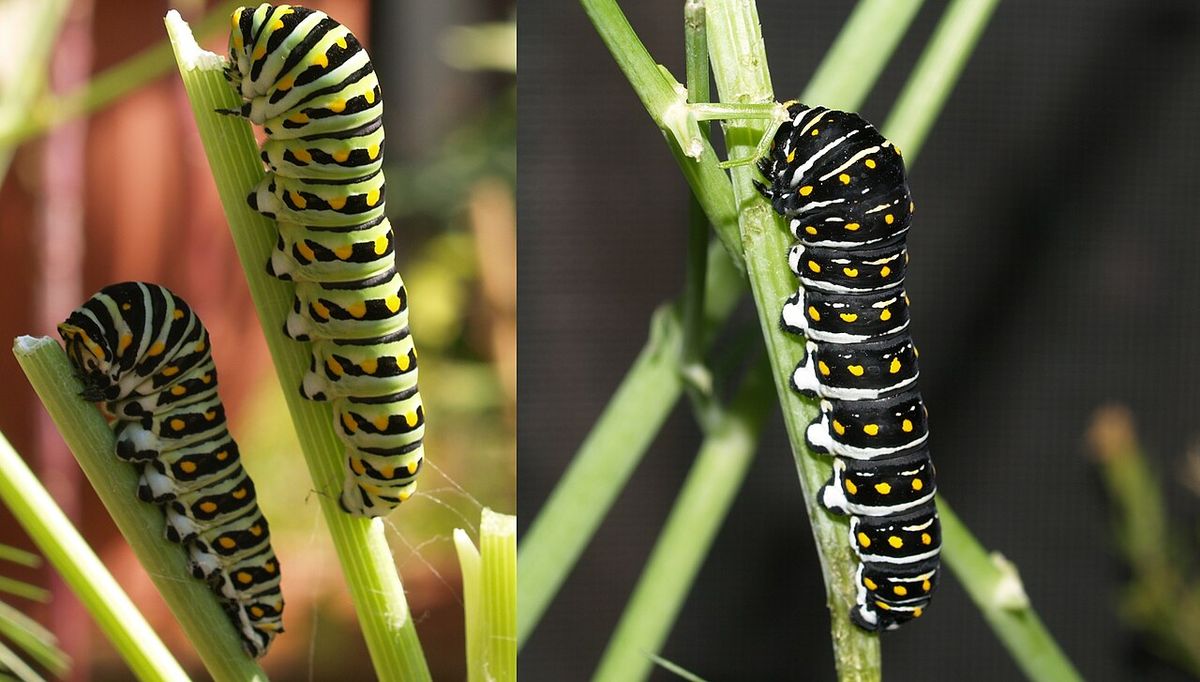
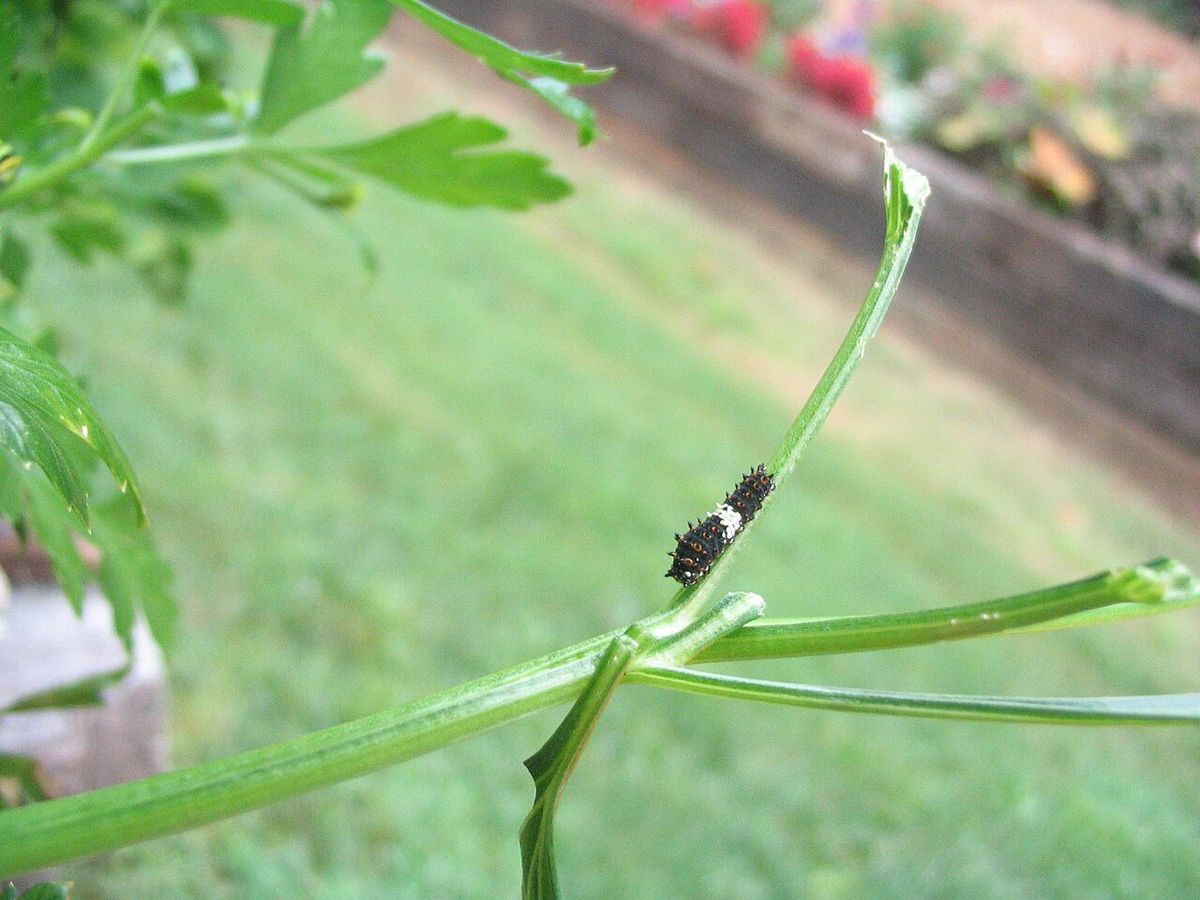
Young caterpillars are mostly black and white with a saddle-like marking. As they mature through successive molts, they become predominantly green with black transverse bands containing yellow or orange spots. The caterpillar, often called a parsleyworm, possesses a unique defensive organ called an osmeterium. This orange, forked gland, resembling a snake's tongue, can be everted when the caterpillar is threatened to release a foul-smelling chemical deterrent. The pupal, or chrysalis, stage follows the final larval molt and lasts approximately 18 days, though pupae that overwinter do so for many months. The colour of the chrysalis is not determined by its surroundings but by a local genetic balance, resulting in green, brown, or even black forms. A distinctive feature is that the chrysalis is 'girdled,' supported by a silken loop around its middle, with its feet attached to a silk pad, which aids the emerging adult in unfolding its large wings.
- Egg: Laid singly on host plants. Stage lasts 4-9 days.
- Larva (Caterpillar): Five instars. Stage lasts 10-30 days. Features defensive osmeterium.
- Pupa (Chrysalis): Overwintering stage. Colour varies (green, brown, black). Stage lasts ~18 days (non-overwintering).
- Adult: Emerges in spring. Has two to three broods per year. Mates and lays eggs to complete the cycle.
Distribution and Habitat
The Black Swallowtail has an extensive range spanning much of the Western Hemisphere. In North America, its distribution is concentrated east of the Rocky Mountains, from southern Canada through the continental United States and into Mexico. Its range extends through Central America and into northern South America, including the West Indies. The species is notably absent or uncommon in western North America beyond the Rockies. This butterfly is a habitat generalist, thriving in a variety of open, sunny environments. It is commonly observed in meadows, fields, roadsides, gardens, parks, and marshes. It also inhabits lowlands and can be found in desert areas where its host plants grow. The species' adaptability to cultivated gardens, where host plants like parsley and dill are common, has made it a frequent and welcome visitor in suburban and rural areas across Canada, particularly in the eastern and central provinces.
Ecology and Diet
The ecological role of Papilio polyxenes is that of a pollinator in its adult stage and a specialized herbivore in its larval stage. Adult butterflies feed on nectar from a wide variety of flowering plants, contributing to pollination as they move from bloom to bloom. The species' survival, however, is intrinsically linked to the availability of specific host plants for its caterpillars. Larvae are obligate feeders on plants within the carrot family, Apiaceae (formerly Umbelliferae), and the rue family, Rutaceae. Female butterflies use visual and chemical cues, particularly host plant odours, to select appropriate landing and egg-laying sites. This preference is innate and is not influenced by the plant species the female fed on as a larva.
The primary host plants are common garden herbs and wild species, which provide both food and chemical defense for the caterpillars. These plants produce defensive chemicals called psoralens, but Black Swallowtail larvae have evolved a resistance to them. The caterpillars sequester these compounds, making themselves distasteful to potential bird predators. This chemical defense carries over to some degree in the adult stage, though adults are more palatable, which is why the mimicry of the toxic Pipevine Swallowtail is a crucial secondary defense. Survival rates for eggs and larvae are influenced by the specific host plant and environmental factors. Research indicates that eggs laid on wild carrot or parsnip have higher survival rates than those on poison hemlock, and survival is generally greater at higher elevations within the species' range.
| Host Plant Family | Example Species | Common Name |
|---|---|---|
| Apiaceae | Petroselinum crispum | Parsley |
| Apiaceae | Anethum graveolens | Dill |
| Apiaceae | Daucus carota | Queen Anne's Lace / Wild Carrot |
| Apiaceae | Foeniculum vulgare | Fennel |
| Apiaceae | Pastinaca sativa | Parsnip |
| Rutaceae | Ruta graveolens | Rue |
| Rutaceae | Zanthoxylum americanum | Northern Prickly Ash |
Behaviour and Mating Systems
Black Swallowtails exhibit complex behaviours related to thermoregulation, territoriality, and mating. As ectotherms, they must behaviourally regulate their body temperature to achieve the approximately 24 degrees Celsius necessary for flight. In cooler conditions, they raise their abdomens above flattened wings and perch closer to the ground to absorb heat. In hotter weather, they lower their abdomens into the shade of their wings, perch higher, and have shorter perch durations with more frequent flights. The species has a protandrous emergence pattern, meaning males emerge from their chrysalides before females each season. This gives early-emerging males a competitive advantage in securing high-quality territories, which are critical for mating success.
The Black Swallowtail employs a lek mating system, a rare strategy among butterflies. Males establish and aggressively defend small, distinct territories, often on hilltops or other topographically prominent sites. These territories contain no resources like nectar or host plants. Their sole function is to serve as display sites for attracting females. Males spend most of their day perching and patrolling these areas, chasing off rival males. Females visit these leks specifically to choose a mate, with the males themselves being the only resource offered. Territories with the most male-male aggression are typically the most visited by females. Courtship involves a brief flight, after which the pair lands and copulates for 30 to 45 minutes. Males can mate up to twice per day, while females often mate more than once to replenish sperm supplies. This system creates intense intrasexual competition among males, which is a stronger evolutionary force maintaining the classic male wing pattern than female mate choice.
Conservation and Relationship with Humans
The Eastern Black Swallowtail is classified as Globally Secure (G5) by NatureServe, indicating it is widespread, abundant, and faces no major conservation threats. Its success is largely due to its dietary flexibility, ability to utilize human-altered habitats like gardens and agricultural edges, and high reproductive output, with females laying between 200 to 440 eggs in their lifetime. The species holds cultural significance as the official state butterfly of both Oklahoma and New Jersey, the latter designating it in 2016. Its popularity is reflected in citizen science. As of 2026, it ranks within the top 150 most observed species on the iNaturalist platform, with over 122,000 recorded observations.
For Canadian gardeners and naturalists, the Black Swallowtail is one of the easiest and most rewarding butterflies to attract and support. Planting its host herbs, such as parsley, dill, fennel, and rue, in sunny garden patches will encourage females to lay eggs. Providing nectar sources for adults, including native wildflowers like milkweed, coneflower, and asters, supports the entire life cycle. Observing the transformation from caterpillar to chrysalis to butterfly offers a direct connection to local biodiversity. While the caterpillars may defoliate some garden herbs, their feeding is rarely detrimental to healthy plants, and the benefit of supporting this native pollinator far outweighs the minor cosmetic damage. Its presence is a clear indicator of a healthy, pesticide-free garden ecosystem.
Similar Species and Mimicry
Several other swallowtail species in North America can be confused with the Eastern Black Swallowtail, requiring careful observation for accurate identification. The Pipevine Swallowtail (Battus philenor) is the model for the female's mimicry. It lacks the yellow spots and has more extensive, solid iridescent blue on the hindwings. The Old World Swallowtail (Papilio machaon) and the closely related Anise Swallowtail (Papilio zelicaon) have more extensive yellow patterning and lack the prominent blue band seen on female P. polyxenes. The Short-tailed Swallowtail (Papilio brevicauda) is a northern species with shorter hindwing tails and a more restricted range in Atlantic Canada. The Spicebush Swallowtail (Papilio troilus) has more prominent blue-green iridescence on the hindwings and lacks the row of yellow spots on the forewings.
Mimicry is a central aspect of the Black Swallowtail's biology. Females engage in Batesian mimicry, where a harmless species evolves to resemble a harmful or distasteful one. By mimicking the toxic Pipevine Swallowtail, female Black Swallowtails gain significant protection from visual predators like birds, who learn to avoid the distinctive colour pattern. This mimicry is particularly advantageous for females because they spend more time exposed with their wings open while laying eggs on host plants. The ventral wing patterns of both sexes also mimic those of the Pipevine Swallowtail, providing protection when the butterflies are at rest with wings closed. This complex mimicry ring is a classic example of evolutionary adaptation and predator-prey dynamics in North American Lepidoptera.
Questions about Papilio polyxenes
What does the Black Swallowtail caterpillar look like and what does it eat?
The Black Swallowtail caterpillar, often called a parsleyworm, changes appearance as it grows. Young larvae are black and white, while mature caterpillars are green with black transverse bands containing yellow or orange spots. A key feature is an orange, forked defensive organ called an osmeterium. It feeds exclusively on plants in the carrot (Apiaceae) and rue (Rutaceae) families. Common host plants include parsley, dill, fennel, carrot tops, Queen Anne's lace, and rue, often making it a familiar sight in herb gardens.
How can I tell a male and female Black Swallowtail apart?
Males and females exhibit clear differences. Males have black wings with two rows of large, bright yellow spots and only a small, less conspicuous patch of iridescent blue on the hindwings. Females are larger with smaller, lighter yellow spots and a prominent, broad band of iridescent blue across the hindwings. This female pattern is a mimicry of the toxic Pipevine Swallowtail. Both sexes have an orange eyespot with a black centre on the inner hindwing margin and 'tails' on the hindwings.
Where in Canada can you find the Eastern Black Swallowtail?
The Eastern Black Swallowtail is found in the southern regions of Canada, primarily in provinces east of the Rocky Mountains. Its range extends across southern Ontario, Quebec, and the Maritime provinces. It inhabits open, sunny areas such as meadows, fields, roadsides, parks, and most commonly, gardens. It is not typically found in the far northern boreal forest or in western Canada beyond the Rocky Mountains, where other swallowtail species are more common.
How can I attract Black Swallowtails to my garden?
To attract Black Swallowtails, plant both larval host plants and adult nectar sources. For caterpillars, plant parsley, dill, fennel, rue, or carrot tops in a sunny location. To nourish the adult butterflies, provide a succession of nectar-rich flowers such as milkweed, butterfly bush, coneflowers, zinnias, and asters. Avoid using pesticides, as they will kill the caterpillars and butterflies. Providing a shallow water source or damp patch can also be beneficial for these pollinators.
What is the lifespan of a Black Swallowtail butterfly?
The total lifespan from egg to adult death varies. Pupae that form in late summer or fall enter diapause and overwinter, emerging the following spring. Adult butterflies are relatively long-lived for temperate butterflies, surviving for several weeks. They produce two to three broods per year in most of their Canadian range.
Why does the female Black Swallowtail look different from the male?
The female's different appearance is an evolutionary adaptation for survival called Batesian mimicry. The female's wing pattern, with its prominent blue band, closely resembles that of the Pipevine Swallowtail, a species that is toxic and distasteful to birds. By mimicking this unpalatable model, the female Black Swallowtail gains protection from predators who have learned to avoid the Pipevine's colour pattern. This is especially important for females, who are more exposed while searching for and laying eggs on host plants. Males do not engage in this high-risk activity to the same degree and thus retain a different pattern.
Sources and further reading
- Papilio polyxenes (Wikipedia)
- Papilio polyxenes | INFORMATION (animaldiversity.org)
- Unveiling the Black Swallowtail (Papilio polyxenes) (davethebugguy.org)
- Black swallowtail | Space for life (espacepourlavie.ca)
Checked by the Your Space Hamilton desk. Last updated 2026-10-30.