Eastern whip-poor-will
The eastern whip-poor-will (Antrostomus vociferus) is a medium-sized nocturnal bird native to North America, renowned for its distinctive, repetitive call that gives the species its onomatopoeic name. In Canada, it breeds in deciduous and mixed forests across central and southeastern regions, serving as an evocative symbol of summer nights in rural and woodland areas. This cryptically coloured nightjar is more often heard than seen, foraging for insects at dusk and dawn. The species is currently in significant decline, with populations dropping by over 60% between 1970 and 2014, leading to its classification as Near Threatened and making its conservation a growing concern for Canadian naturalists.
Physical Description and Identification
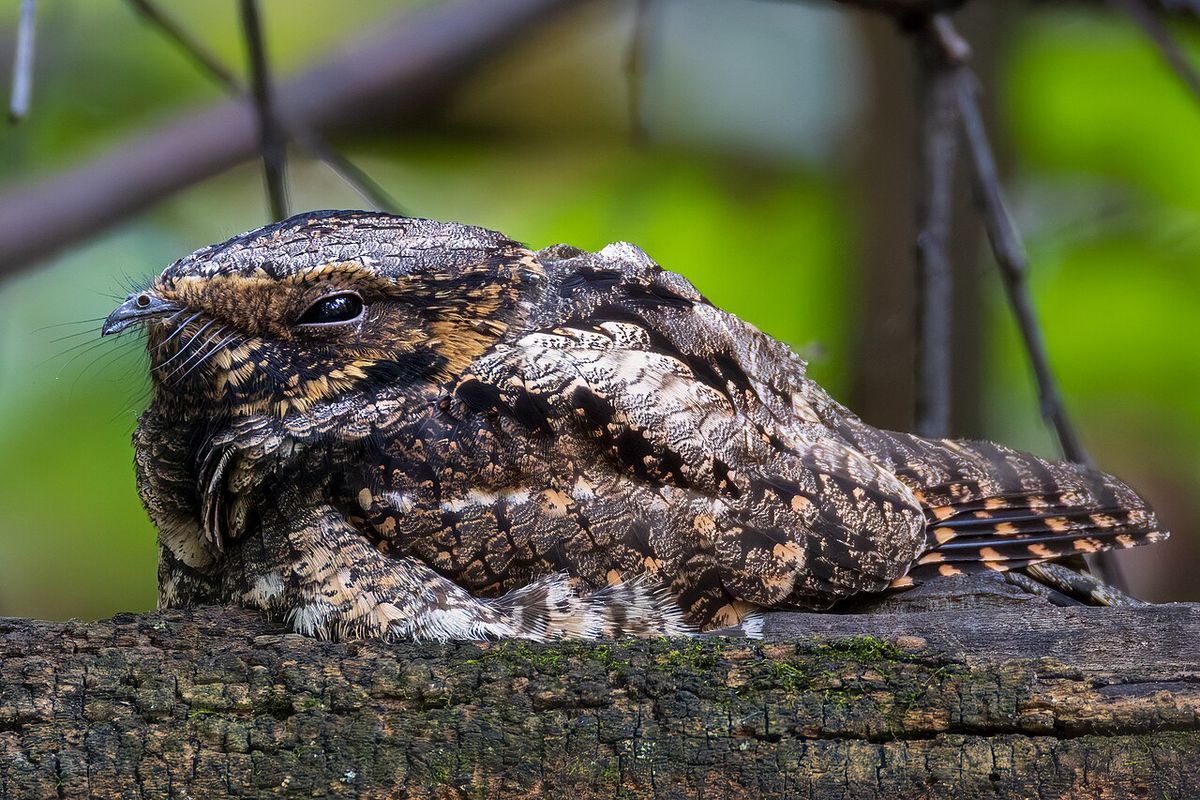
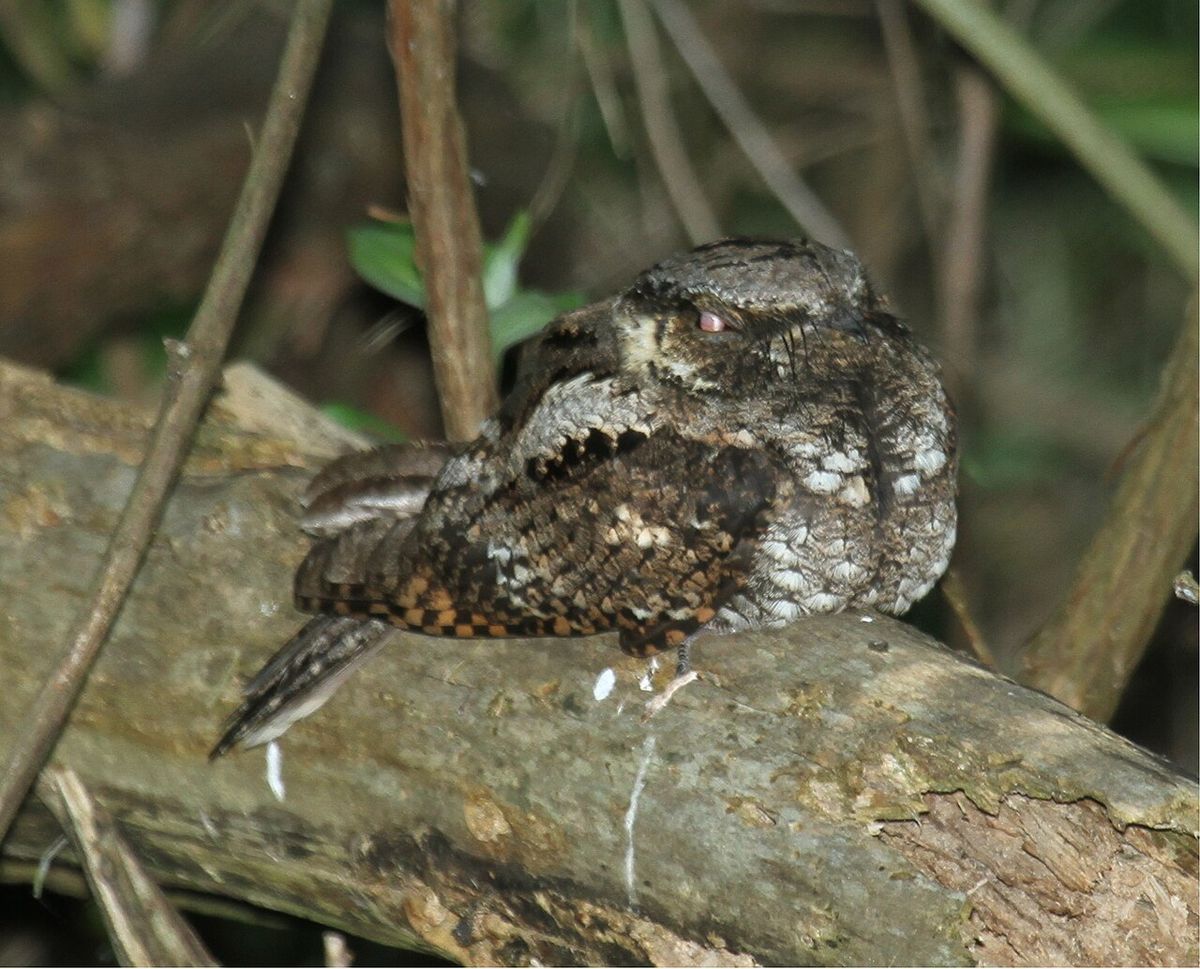
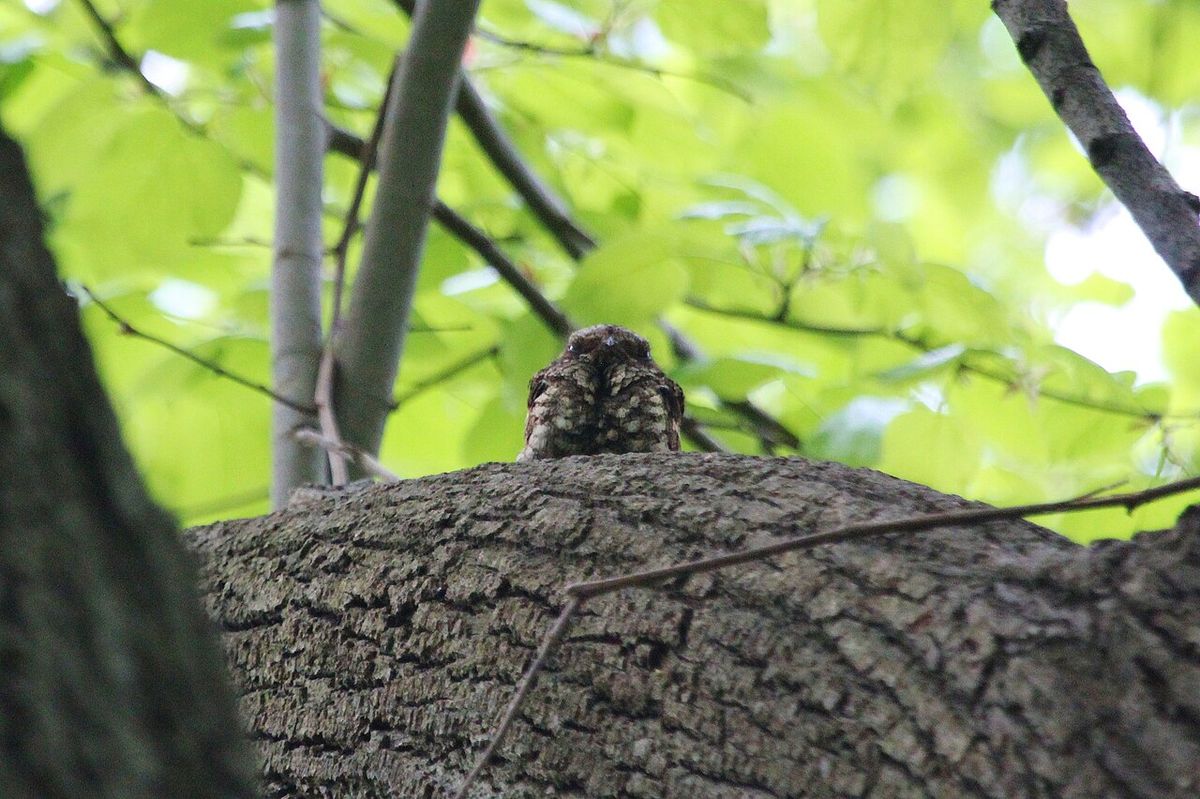
The eastern whip-poor-will is a medium-sized nightjar with a body length of 22 to 27 centimetres and a wingspan ranging from 45 to 50 centimetres. Its weight is relatively light for its size, between 42 and 69 grams, an adaptation for its aerial insect-catching lifestyle. Standard measurements include a wing chord of 14.7 to 16.9 centimetres, a tail length of 10.5 to 12.8 centimetres, a very short bill of 1 to 1.4 centimetres, and a tarsus measuring 1.5 to 1.8 centimetres. The bird's plumage is a masterclass in disruptive camouflage, with mottled upperparts in shades of grey, black, and brown that blend perfectly with forest floor leaf litter. The underparts are similarly patterned in grey and black, and the bird has a conspicuously black throat. Sexual dimorphism is present, with males displaying a white patch below the black throat and white tips on the outer tail feathers, while females have these same areas in a light brown colour. The species is sometimes confused with the closely related chuck-will's-widow (Antrostomus carolinensis), which has a similar but lower-pitched and slower call. This confusion is common where their ranges overlap in the southeastern United States, but the chuck-will's-widow is a very rare vagrant in Canada. The whip-poor-will's cryptic appearance and silent daytime roosting make visual identification difficult, so its persistent nocturnal song is often the primary means of detection.
Habitat, Range and Migration
The eastern whip-poor-will's breeding range extends across central and southeastern Canada, encompassing provinces such as Ontario, Quebec, and the Maritimes, as well as throughout the eastern United States. These birds favour open deciduous or mixed woodlands, particularly areas with a patchwork of forest and clearings, which provide ideal foraging grounds. They are migratory, undertaking long journeys to escape the northern winters. Their wintering grounds are in the southeastern United States, eastern Mexico, and parts of Central America. This migratory cycle is a critical part of their annual life history, connecting Canadian breeding habitats with neotropical ecosystems. The species exhibits a disjunct population in the southwestern United States and Mexico, which has now been classified as a separate species, the Mexican whip-poor-will (Antrostomus arizonae). The two populations were split based on clear differences in their geographic ranges, distinct vocalizations, variations in egg coloration, and DNA sequencing that showed genetic differentiation. This taxonomic split means the eastern whip-poor-will's range is now defined as strictly eastern, with the western population recognized as its own full species. Migration timing sees the birds arriving on Canadian breeding grounds in late spring and departing by early autumn for their southern wintering areas.
Behaviour and Ecology
The eastern whip-poor-will is a strictly nocturnal and crepuscular bird, meaning it is most active at dawn and dusk. Its days are spent roosting motionless on the ground or on a low branch, relying on its exceptional camouflage to avoid detection. As twilight falls, it becomes airborne to hunt, catching insects in flight with its wide, bristle-fringed gape. The species is typically socially monogamous, with pairs forming for the breeding season. An unusual recorded instance involved a male attending the nests of two different females, a behaviour that may occur if one female loses her original mate. Their famous vocalization, a loud, clear, and incessant "whip-poor-will" repeated dozens of times in succession, is primarily a territorial and mating call delivered by the male from a perch. This call is a defining sound of eastern North American woodlands on spring and summer evenings, often continuing through the night. The bird will commonly remain on the nest unless almost stepped upon, demonstrating a strong commitment to incubation and a reliance on its camouflage for safety. These birds forage at night, catching insects in flight, and normally sleep during the day, making them a classic example of a nocturnal avian predator.
The eastern whip-poor-will's life cycle is closely tied to the forest floor. These birds nest directly on the ground, in shaded locations among dead leaves. They usually lay two eggs at a time. The bird will commonly remain on the nest unless almost stepped upon. Eastern whip-poor-wills are typically socially monogamous. However, a male whip-poor-will was once recorded attending the nests of two different females.
- Nests are simple, unlined scrapes on the ground, always in shaded locations among dead leaves.
- Both parents share incubation duties, with the bird famously remaining on the nest unless almost stepped upon.
- Chicks are precocial and leave the nest shortly after hatching, though they are still fed and cared for by the parents.
- This ground-nesting strategy makes the species particularly vulnerable to predation and habitat disturbance during the critical breeding period.
Diet and Foraging
The eastern whip-poor-will is an insectivorous aerial hunter, feeding exclusively on flying insects caught on the wing during its nocturnal forays. Its diet is diverse but heavily reliant on larger nocturnal insects, especially moths, which often form the bulk of its intake. Beetles, mosquitoes, and many other flying insects are also consumed regularly. The bird's foraging technique involves flying out from a low perch to snatch prey, often returning to the same or a nearby perch. Its large eyes are adapted for low-light vision, and its wide mouth is surrounded by specialized bristles that help funnel insects into its grasp. This dietary specialization directly links the bird's survival to the abundance of nocturnal insect populations, making it an indirect indicator of ecosystem health. The documented declines in flying insect populations due to pesticides and intensified agriculture are therefore a direct and significant threat to the whip-poor-will's food supply and overall survival. The bird's entire energetic budget is tied to the availability of moths, beetles, and other insects in the night air above its woodland habitat.
Conservation Status and Threats
The eastern whip-poor-will is experiencing a severe and ongoing population decline across its range, including in Canada. In 2017, the International Union for Conservation of Nature (IUCN) uplisted the species from Least Concern to Near Threatened. This decision was based on extensive citizen science observations, primarily from the North American Breeding Bird Survey, which demonstrated a population decline of over 60 percent between 1970 and 2014. While the bird remains fairly common in some local areas, the overall trend is deeply concerning for the long-term viability of the species. The causes of this decline involve several interconnected threats to its habitat and food supply. Several reasons for the decline are proposed, such as loss of early successional forest habitat related to fire suppression and habitat destruction, predation by feral cats and dogs, and poisoning by insecticides, but the actual causes remain elusive according to research. Pesticides and intensified agriculture have led to declines in the flying insect populations that the eastern whip-poor-will depends on, creating a direct link between agricultural practices and the bird's decline.
Primary threats contributing to the eastern whip-poor-will's decline include several proposed reasons. These reasons are loss of early successional forest habitat related to fire suppression and habitat destruction. Other threats are predation by feral cats and dogs and poisoning by insecticides. Pesticides and intensified agriculture have also led to declines in the flying insect populations that the bird depends on. The actual causes for the decline, however, remain elusive.
- Loss of early successional forest habitat due to fire suppression and changes in forestry practices.
- General habitat destruction and fragmentation from urban and agricultural development.
- Predation pressure from introduced species, particularly feral cats and dogs.
- Indirect poisoning from insecticides, which reduce insect prey populations.
- Declines in flying insect biomass linked to pesticide use and intensified agriculture.
- The bird's ground-nesting behaviour increases vulnerability to trampling and predation.
Conservation organizations like BirdLife International have stated that initiatives like the Conservation Reserve Program will be crucial in conserving the species and reversing its decline. The need for action is urgent given the rate of decline observed over the past five decades. Between 1970 and 2014, populations of the eastern whip-poor-will declined by over 60 percent. In 2017, the eastern whip-poor-will was uplisted from least concern to near threatened on the IUCN Red List. This uplisting was based on citizen science observations demonstrating the population decline.
Cultural Significance
The haunting, repetitive call of the eastern whip-poor-will has cemented its place in North American folklore and art, often symbolizing loneliness, wilderness, and the mysteries of the night. A persistent legend, particularly in New England, holds that the whip-poor-will can sense a departing soul and capture it as it flees, a belief thought to be derived from earlier Native American and general American folk omens linking the bird's song to death. This legend was used as a plot device by H.P. Lovecraft in his story "The Dunwich Horror", an idea based on local legends given to him by Edith Miniter of North Wilbraham, Massachusetts, in 1928. It is also central to James Thurber's chilling short story "Whip-poor-will", in which the constant nighttime singing drives the protagonist to madness and murder. The bird serves as an auditory symbol of rural America in Washington Irving's "The Legend of Sleepy Hollow" and William Faulkner's "Barn Burning", which makes several mentions of the birds calling constantly in the dark trees. Its call has inspired poets for centuries, from Elizabeth Barrett Browning and Emily Dickinson to Robert Frost and Stephen Vincent Benét, who celebrated the bird's connection to mountain life in "The Mountain Whippoorwill".
Notable appearances include the 1927 song "My Blue Heaven" by George A. Whiting and Walter Donaldson. The bird is also featured in the 1934 Frank Capra film It Happened One Night. Hank Williams's 1949 song I'm So Lonesome I Could Cry refers to the whip-poor-will's sound. Elton John and Bernie Taupin's 1975 song "Philadelphia Freedom" features a flute mimicking the bird's call. The Pennsylvania-based indie rock band Dr. Dog also references the bird in their 2012 song "Lonesome".
- The 1927 song "My Blue Heaven" by George A. Whiting and Walter Donaldson, which begins with the line "When Whip-poor-wills call and ev'ning is nigh".
- Clark Gable's famous line in the 1934 Frank Capra film It Happened One Night: "I am the whip-poor-will that cries in the night".
- Hank Williams's 1949 classic "I'm So Lonesome I Could Cry", which opens with "Hear that lonesome whippoorwill, he sounds too blue to fly".
- Elton John and Bernie Taupin's 1975 song "Philadelphia Freedom", which features a flute mimicking the call and includes the lyrics "till the whippoorwill of freedom zapped me right between the eyes."
- The Tragically Hip's song "Gus: The Polar Bear From Central Park" includes the lyric "The whip-poor-will at dusk tells you no one is afraid".
- Bohuslav Martinů’s 1945 Sonata for Flute and Piano, composed in Cape Cod, uses the whip-poor-will's call as a recurring theme in its third movement.
- Jason Molina's band Songs: Ohia included a bonus track titled "Whip Poor Will" on the 2003 album The Magnolia Electric Co.
- The song "Deeper Than the Holler" by Randy Travis states a lover's commitment is "longer than the song of a whippoorwill".
Other cultural references span from Rodgers and Hammerstein's South Pacific to Kurt Vonnegut's novel Slapstick and the Netflix series The Midnight Gospel. This demonstrates the bird's enduring role as a cultural touchstone across different media and generations. In South Pacific, the song "Cockeyed Optimist" mentions the whip-poor-will. In Slapstick, the narrator hears the call of a whip-poor-will. In The Midnight Gospel, a talking bird introduces itself as a "psychopomp or a whippoorwill". The bird's call is consistently used to evoke a specific sense of place and mood. This mood is often tied to rural or natural settings and themes of solitude.
Population Trends and Research
Monitoring the eastern whip-poor-will population is challenging due to its nocturnal habits and cryptic nature, but long-term datasets have provided a clear picture of its decline. The primary tool for tracking this species in Canada and the United States is the North American Breeding Bird Survey (BBS), a large-scale citizen science program. Research into the causes of this decline points strongly to habitat loss, particularly the reduction of the open, young forests and woodlands it requires for nesting and foraging. The table below summarizes key population trend data and conservation milestones for the eastern whip-poor-will.
| Metric | Data |
|---|---|
| Estimated Population Decline (1970 to 2014) | Over 60% |
| IUCN Red List Status (pre-2017) | Least Concern |
| IUCN Red List Status (2017 onward) | Near Threatened |
| Primary Monitoring Program | North American Breeding Bird Survey (BBS) |
| Key Conservation Program | Conservation Reserve Program (CRP) |
| Basis for 2017 IUCN Uplisting | Citizen science observations showing >60% decline |
| Proposed Threat | Loss of early successional habitat from fire suppression |
Ongoing research is investigating the specific habitat features the species requires, the impact of insect population declines, and the effects of light pollution on its foraging behaviour. This scientific work is essential for developing targeted conservation strategies to halt and eventually reverse the whip-poor-will's downward trajectory. The split from the Mexican whip-poor-will also means conservation efforts must now be focused specifically on the eastern population's unique range and threats. Continued annual surveys are critical for tracking whether conservation interventions are having any measurable effect on slowing or stopping the decline.
Taxonomic History and Related Species
The eastern whip-poor-will was historically considered a single species with populations across much of North America. Recent scientific analysis led to a taxonomic revision, splitting the bird into two distinct species. The eastern populations retain the name eastern whip-poor-will (Antrostomus vociferus). The disjunct population found in the southwestern United States and throughout Mexico is now recognized as the Mexican whip-poor-will (Antrostomus arizonae). This split was not based on a single factor but on a combination of evidence that demonstrated significant differentiation between the groups. The decision was supported by clear differences in their geographic ranges, with no overlap in breeding areas. Researchers also documented consistently different vocalizations between the eastern and western birds, with variations in the rhythm, pitch, and pattern of their calls. The eggs of the two populations show different coloration, and DNA sequencing provided genetic evidence confirming they are separate species. This reclassification has important implications for conservation, as the threats and population trends for the eastern whip-poor-will must now be assessed independently from its western counterpart. The split clarifies the biological reality that these two groups have evolved separately and face different ecological pressures across their respective ranges.
Detailed Physical Measurements
The eastern whip-poor-will's physical dimensions are well-documented through ornithological study, providing precise data that distinguishes it from other nightjars. The bird measures 22 to 27 cm (8.7 to 10.6 inches) in total length from bill tip to tail tip. Specific standard measurements used by researchers include a wing chord length of 14.7 to 16.9 cm (5 13/16 to 6 5/8 inches), which is the distance from the wrist to the tip of the longest primary feather. The tail measures 10.5 to 12.8 cm (4 1/8 to 5 1/16 inches), the bill is very short at 1 to 1.4 cm (3/8 to 9/16 inches), and the tarsus (lower leg) is 1.5 to 1.8 cm (9/16 to 11/16 inches). These exact metrics are critical for identification in the hand and for understanding the bird's flight mechanics and ecological niche. The combination of a short bill, wide gape, and long wings is a classic adaptation for birds that catch insects in flight during low-light conditions.
Questions about Eastern whip-poor-will
What does an eastern whip-poor-will sound like?
The eastern whip-poor-will is named for its distinctive call, a loud, clear, and repetitive three-syllable phrase that sounds like "whip-poor-will". Males deliver this call incessantly at dusk, dawn, and throughout the night during the breeding season, often repeating it dozens or even hundreds of times in succession. The call serves as both a territorial declaration and an advertisement for mates. It is a common sound of eastern North American woodlands in spring and summer, though it is often confused with the similar but lower-pitched and slower call of the chuck-will's-widow. The call's onomatopoeic nature is the direct source of the bird's common name, with historical variants including "whip-o-will" and "whip o' will".
Where can you find eastern whip-poor-wills in Canada?
In Canada, eastern whip-poor-wills breed in deciduous and mixed forests across central and southeastern regions. Their breeding range includes parts of Ontario, Quebec, New Brunswick, Nova Scotia, and Prince Edward Island. They favour open woodlands, forest edges, and areas with a mix of trees and clearings, often near sandy or rocky soils. They are migratory and are only present in Canada during the warmer months, typically arriving in late April or May and departing for their wintering grounds in the southeastern United States, Mexico, and Central America by September or October. Their specific habitat requirements mean they are not found in dense, unbroken forest or in fully open agricultural land, but rather in the transitional zones between them.
Why is the eastern whip-poor-will endangered?
The eastern whip-poor-will is not currently classified as endangered in Canada but is listed as Near Threatened globally by the IUCN due to a severe population decline. Its numbers have dropped by over 60 percent since 1970. The primary threats include habitat loss, specifically the decline of the open, young forests it needs for nesting and foraging due to fire suppression and changes in land use. Other major factors are the widespread decline in flying insect populations from pesticide use and intensified agriculture, predation by domestic animals like cats and dogs, and possible indirect poisoning from insecticides. Its ground-nesting behaviour also makes it vulnerable to disturbance from humans and natural predators. Research notes that the actual causes for the steep decline remain elusive, indicating a complex combination of factors that are difficult to disentangle.
What do eastern whip-poor-wills eat?
Eastern whip-poor-wills are exclusively insectivorous, feeding on a variety of flying insects caught during nocturnal flights. Their diet is particularly heavy in moths, but they also consume beetles, mosquitoes, flying ants, and many other night-flying insects. They forage by flying out from a low perch to snatch prey from the air, often returning to the same perch. Their large eyes are adapted for night vision, and their wide mouths are fringed with bristles that help trap insects. This specialized diet makes them highly dependent on healthy populations of nocturnal insects, linking their survival directly to the availability of this prey. The documented declines in insect populations are therefore a direct threat to the species, as a lack of food can lead to failed breeding and reduced survival.
How does the eastern whip-poor-will nest?
The eastern whip-poor-will is a ground-nesting bird that creates no real nest structure. The female selects a shaded location on the forest floor, often among dead leaves or near a log or rock, and simply lays her eggs directly on the ground in a shallow depression. The birds exhibit remarkable nest fidelity and camouflage, often remaining on the nest unless an intruder is almost upon them. This simple nesting strategy leaves the eggs and young highly exposed to predators and weather, contributing to the species' vulnerability.
What is being done to conserve the eastern whip-poor-will?
Conservation efforts for the eastern whip-poor-will focus on habitat protection and management. Key initiatives include programs like the Conservation Reserve Program (CRP), which BirdLife International notes is crucial for the species. The CRP pays landowners to establish long-term vegetative cover on environmentally sensitive land, which can create suitable whip-poor-will habitat. Other efforts involve managing forests to maintain open understories through selective thinning or prescribed burning, protecting large tracts of contiguous woodland, and reducing pesticide use to support insect prey populations. Research and monitoring through citizen science projects like the Breeding Bird Survey continue to track populations and inform conservation strategies. The 2017 uplisting to Near Threatened on the IUCN Red List has also raised the profile of the species, encouraging more focused conservation attention and funding for research into its specific needs.
Sources and further reading
- Eastern whip-poor-will (Wikipedia)
- Eastern Whip-poor-will, Antrostomus vociferus (birdsoftheworld.org)
- Whip-poor-will (naturecanada.ca)
Checked by the Your Space Hamilton desk. Last updated 2026-11-01.