Eastern cottontail
The eastern cottontail (Sylvilagus floridanus) is a medium-sized rabbit and the most widespread and abundant rabbit species in North America. Easily recognized by its distinctive fluffy white tail, it is a familiar sight across southern Canada, inhabiting meadows, agricultural fencerows, and suburban edges. The species has expanded its range northward with land clearance and is now common in regions like southern Ontario, where it was historically absent. As a prolific breeder and key prey species for many predators, the eastern cottontail plays a significant role in Canadian ecosystems while adapting readily to human-altered landscapes.
Taxonomy and Etymology
The eastern cottontail is a member of the family Leporidae within the order Lagomorpha, which distinguishes rabbits and hares from rodents. It was first formally described by the French naturalist Charles Alexandre Lesueur in 1827. The genus name Sylvilagus is derived from the Latin silva, meaning forest or woodland, and the Greek lagos, meaning hare, translating roughly to woodland hare. The species epithet floridanus means of Florida, referencing the region where the species was first scientifically identified. There are at least 17 recognized subspecies of Sylvilagus floridanus, distinguished mainly by geographic distribution and minor morphological differences such as size and coloration. Molecular studies suggest the genus Sylvilagus, a New World group, diverged from Old World rabbits and hares millions of years ago, with the eastern cottontail expanding its range following the last glacial period.
Physical Description and Identification
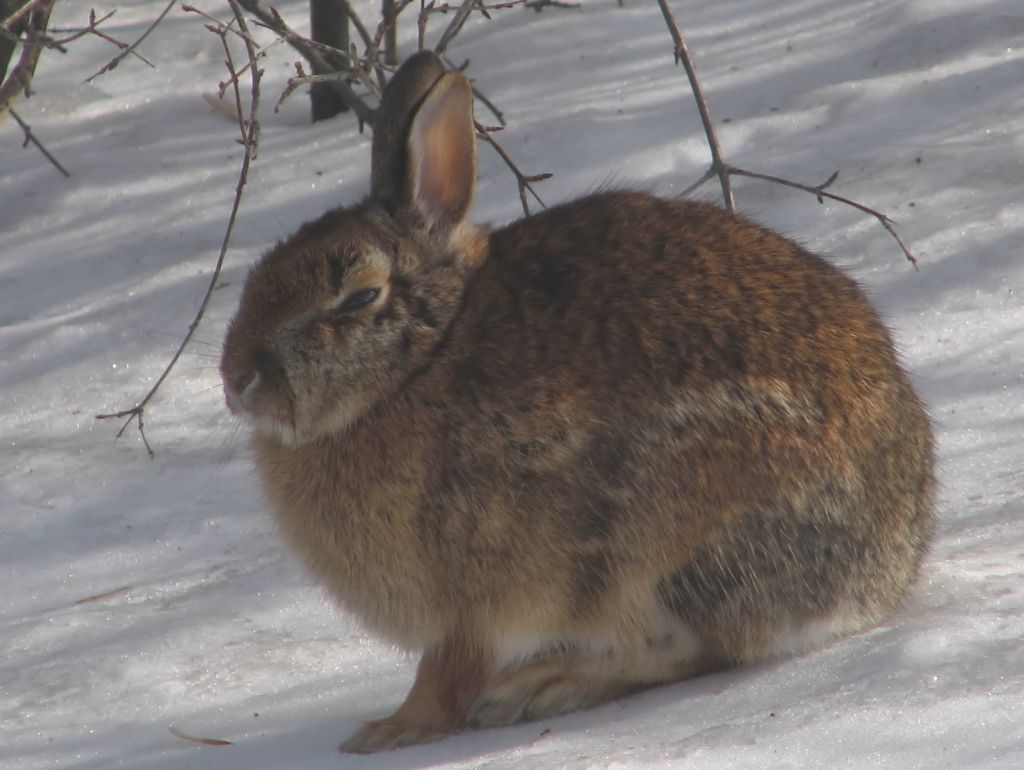
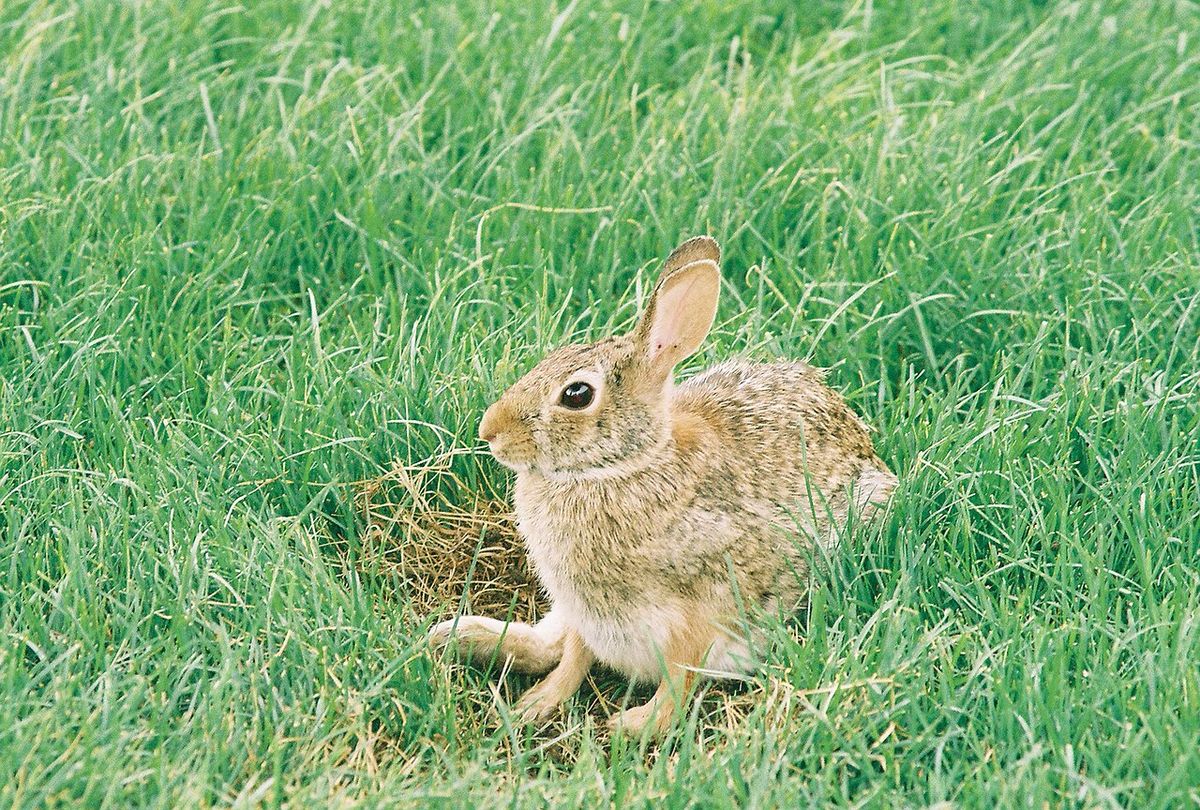
The eastern cottontail is a medium-sized lagomorph with a dense pelage that ranges from reddish-brown to greyish-brown, often with a rusty patch on the nape and black-tipped guard hairs. Its most distinguishing feature is the short, fluffy white tail that resembles a cotton ball, from which its common name is derived. The underside of the body is white, and young kits are born with a distinctive white blaze on the forehead that fades as they mature. Adults measure between 36 and 48 centimetres in total length, including a tail averaging 5.3 centimetres. Weight varies geographically due to Bergmann's rule, with individuals generally larger in northern latitudes. For example, a study of 346 adults from Michigan found an average mass of 3.19 pounds, while specimens from Florida averaged 2.24 pounds. Adults typically weigh between 1.8 and 4.4 pounds, with females tending to be slightly heavier than males. The species can be distinguished from hares like the snowshoe hare by its smaller size, its failure to turn white in winter, shorter ears, and its preference for different habitats.
Range, Expansion, and Habitat
The eastern cottontail's native range extends from southern Canada throughout most of the United States and into Mexico, Central America, and northern South America, including Margarita Island in the Caribbean. Its range has expanded significantly northward over the past two centuries, closely tied to land clearance for agriculture and settlement. Originally absent from New England and much of southern Ontario, it was first reported in southern Ontario around 1860 and was unknown in Ottawa before 1931. The species has since spread throughout the region and has also been intentionally introduced to parts of Oregon, Washington, and British Columbia for hunting. Beyond North America, it was introduced to France and northern Italy in the 1950s and 1960s, and to Cuba, where it underwent rapid territorial expansion.
This rabbit thrives in edge habitats, where open areas meet cover. Optimal habitat includes meadows, old fields, agricultural lands, and suburban gardens interspersed with brush piles, hedgerows, thickets, or forest edges. These elements provide essential escape cover from predators. In the western United States, they occupy diverse habitats such as ponderosa pine, mixed conifer, and pinyon-juniper woodlands, where woody debris and shrubby understories are important. The species generally avoids dense, unbroken forests but can be found in open woodlands, swamps, and marshes. At the Fletcher Wildlife Garden in Ottawa, conditions with brush piles, shrub thickets, and adjacent wooded areas have supported a resident population since around 2000, demonstrating its adaptability to managed green spaces. Populations in the mountainous southwestern United States and western Mexico are now considered a separate species, the strong cottontail (S. holzneri).
Behaviour, Ecology, and Home Range
Eastern cottontails are primarily crepuscular and nocturnal, being most active at dawn, dusk, and through the night, though they may forage during the day in cold, overcast, or foggy conditions. They are solitary and territorial animals that do not hibernate and remain active year-round. Instead of digging their own burrows, they rest in shallow depressions called forms, scratched out in grass or under dense vegetation. They may use abandoned dens of other animals, such as groundhogs or woodchucks, for shelter during severe weather or heavy snow. When threatened, they rely on speed and agility, escaping in a zigzag pattern at speeds up to 29 kilometres per hour. They communicate primarily by stamping their hind feet and can emit grunts, squeals, or a piercing scream when distressed.
Home range size varies with habitat quality, season, and sex. In New England, average home ranges are about 1.4 acres for males and 1.2 acres for females, but they can vary from 0.5 to 40 acres. Male ranges expand during the breeding season, with studies in southwestern Wisconsin showing spring ranges averaging 6.9 acres and peaking at 10 acres in early summer before decreasing in late summer. Daily movements usually cover only 10 to 20 percent of their total range. In southeastern Wisconsin, male home ranges overlapped by up to 50 percent, while female ranges overlapped less than 25 percent, with females aggressively defending the immediate area around their nest. Cover requirements change seasonally, with heavy reliance on woody cover in winter when deciduous vegetation is bare, and use of low patches of saw palmetto in Florida pine flatwoods.
Reproduction and Life Cycle
Eastern cottontails are renowned for their high reproductive rate, which sustains populations despite significant mortality. They reach sexual maturity early, at just two to three months of age. The breeding season varies by latitude, beginning as early as January in the southern United States and around March in northern areas like New England and Pennsylvania, continuing through late summer and sometimes into September. Mating is promiscuous, with males competing aggressively for dominance and access to females. The female constructs a nest in a slanted hole in soft soil, typically in a grassy field or weedy area near brushy cover, lining it with dry grass and fur from her own body.
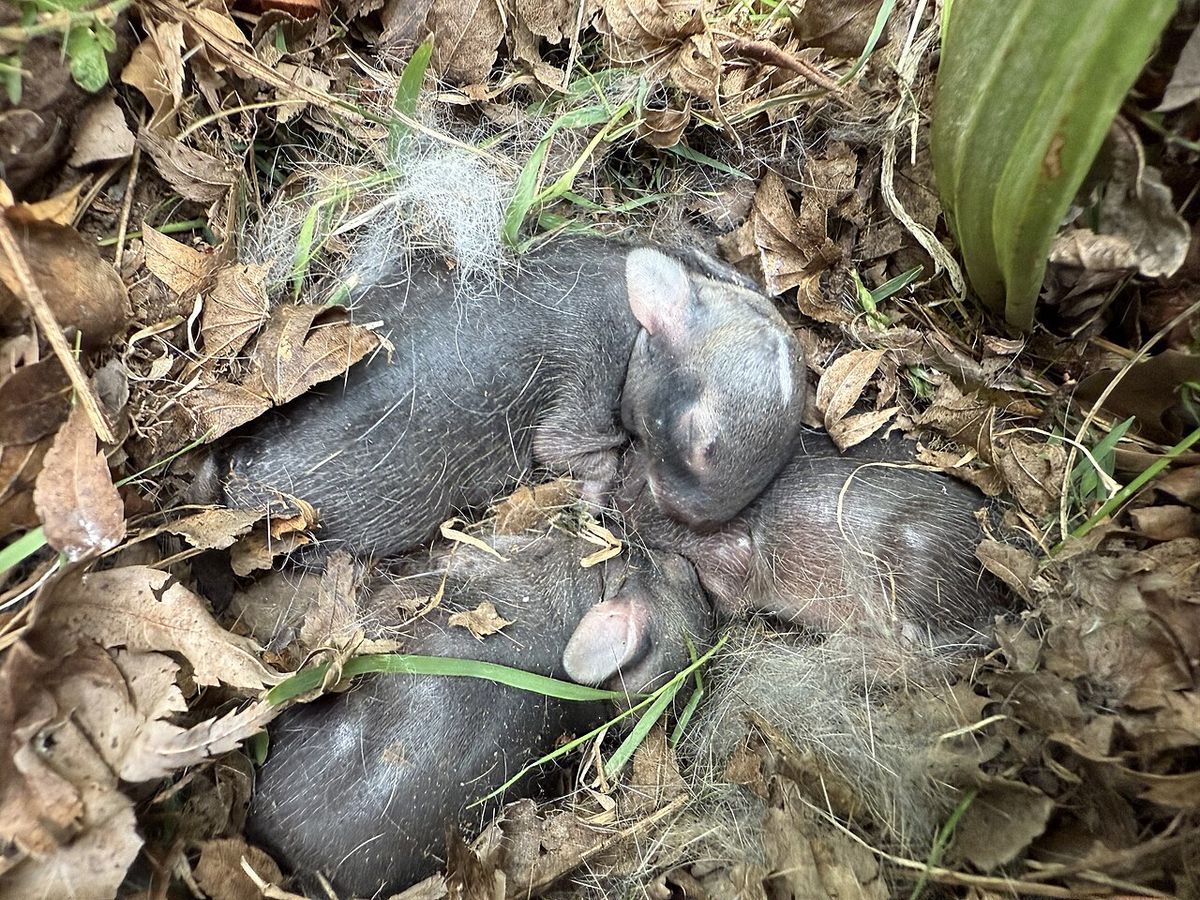
The nest cavity averages about 7 inches long, 5 inches wide, and 5 inches deep. Gestation lasts 25 to 35 days, with an average of 28 days. Litter size ranges from three to eight kits, with an average of five. A female can produce one to seven litters per year, averaging three to four. In southern regions, breeding is nearly continuous, while northern populations have a shorter season but often produce larger litters. Kits are born blind, deaf, nearly hairless, and helpless, weighing about one ounce, with the characteristic white forehead blaze. Their eyes open at four to seven days, they begin leaving the nest at 12 to 16 days, and are weaned by four to five weeks. Dispersal from the natal area begins around seven weeks of age. Only about 15 percent of young survive their first year, but the rapid breeding cycle allows populations to grow quickly.
Diet and Feeding Habits
The eastern cottontail is a herbivorous browser with a highly varied diet, consuming between 70 and 145 different plant species. Their diet shifts seasonally based on availability. During spring and summer, they prefer tender herbaceous vegetation. Studies have documented their consumption of many common plants. In Connecticut, a summer diet analysis included species such as alfalfa, timothy, quackgrass, and various weeds.
In autumn and winter, when green vegetation is scarce or covered by snow, they browse on the twigs, buds, and bark of woody plants. Preferred winter browse includes species like gray birch, red maple, and smooth sumac. They are also coprophagous, re-ingesting soft, nutrient-rich fecal pellets (cecotropes) to extract maximum vitamins and proteins from their food. This adaptation allows them to thrive on coarse vegetation during the harsh winter months and is a key digestive process for lagomorphs.
Predators, Mortality, and Diseases
Eastern cottontails are a vital prey species, often called the protein pill of the animal kingdom due to their importance in the diets of many predators. Annual adult survival is estimated at only about 20 percent, with an average lifespan in the wild of roughly 15 months, though the longest-lived recorded wild individual reached five years. The leading cause of mortality is predation. A Kansas study of radiotracked rabbits found 43 percent of deaths were due to predation. A wide array of predators rely on them, and their contribution to predator diets can be substantial.
- Mammalian predators include coyotes, foxes (red and gray), bobcats, domestic cats and dogs, weasels, raccoons, mink, badgers, and skunks. In Texas, coyotes prey most heavily in early spring and fall.
- Avian predators are numerous, with great horned owls (a primary predator in Pennsylvania), barred owls, red-tailed hawks, and other Buteo hawks being significant threats. In central Missouri, cottontails made up the majority of prey biomass for nesting red-tailed hawks.
- Other predators include snakes, crows, and Virginia opossums, which often prey on nestlings. Red squirrels have also been reported taking young cottontails.
Other significant sources of mortality include collisions with vehicles, with an estimated ten rabbits killed annually per mile of road in Missouri, peaking in spring (March through May) when roadside greens attract them. Disease is another major factor. Tularemia, a bacterial disease transmitted by ticks and fleas, is always fatal to rabbits and accounted for 18 percent of mortality in the Kansas study. Rabbits also host a variety of parasites, including bot fly larvae (commonly called wolves), fleas, ticks, lice, and internal worms like cestodes and nematodes. Despite these pressures, their high reproductive rate maintains stable population levels.
Conservation Status and Human Interaction
The eastern cottontail is classified as Least Concern by the International Union for Conservation of Nature and is considered secure by NatureServe due to its enormous range, abundance, and adaptability. Its population has benefitted from human landscape alteration, such as forest clearing for agriculture, which creates ideal edge habitat. The species is commonly found in suburban areas, parks, and gardens where cover is available. It is a popular game animal across its range and is sometimes considered an agricultural pest when it feeds on crops and garden plants like peas and lettuce. In some areas, it has been introduced outside its native range for sport hunting and as a food source, leading to its establishment in parts of Europe and the Pacific Northwest.
While the species overall faces no major threats, local populations can be affected by habitat loss, severe weather, disease outbreaks, and population cycles that peak and crash every 7 to 10 years. Wildlife rehabilitation centres treat hundreds of eastern cottontails annually for injuries, often from vehicle collisions or pet attacks. For instance, one centre reported admitting over 450 annually, with over 300 already admitted in 2026. Their adaptability to human environments, from the fringes of open spaces to urban greenspaces, and their high reproductive potential ensure the eastern cottontail remains a common and resilient fixture of the North American landscape.
Questions about Eastern cottontail
Where can you find eastern cottontails in Canada?
Eastern cottontails are found primarily in southern Canada, including southern Ontario, southern Quebec, and introduced populations in parts of British Columbia. They thrive in edge habitats like meadows, agricultural fencerows, suburban gardens, and parks where brushy cover is available. The species expanded northward with land clearance and is now common in regions where it was historically absent, such as the Ottawa area, where it was not reported until after 1931. At locations like the Fletcher Wildlife Garden in Ottawa, they have been regularly observed since about 2000, benefiting from managed brush piles and thickets.
What is the difference between an eastern cottontail and a snowshoe hare?
Eastern cottontails are smaller than snowshoe hares and do not turn white in winter, retaining their greyish-brown pelage year-round. Cottontails have shorter ears and a distinctive fluffy white tail, while hares have larger hind feet adapted for snow. Ecologically, cottontails prefer edge habitats near open fields and thickets, whereas snowshoe hares are more associated with dense forests. Cottontails also use shallow forms for resting and may use abandoned burrows, while hares do not typically use nests or burrows. Rabbits are born blind and helpless in nests, while hares are born fully furred and mobile.
How many babies do eastern cottontails have?
Eastern cottontails are extremely prolific breeders. A female can have between one and seven litters per year, with an average of three to four. Each litter typically contains three to eight young, with an average of five kits. Gestation is short, lasting about 28 days on average. A female may give birth to a litter and be bred again within hours. This high reproductive rate is necessary to sustain populations, as annual adult mortality is very high, with only about 20 percent of adults surviving each year and perhaps only 15 percent of young surviving their first year.
What do eastern cottontails eat?
Eastern cottontails are herbivores with a diverse diet that changes with the seasons. In spring and summer, they primarily eat tender grasses, clovers, alfalfa, and weeds like dandelion, plantain, and goldenrod. During winter, they browse on the twigs, buds, and bark of woody plants such as gray birch, red maple, and smooth sumac. They are also coprophagous, meaning they re-ingest special soft fecal pellets called cecotropes to extract additional nutrients, such as B vitamins and protein, from their food. This is an important digestive adaptation for processing coarse plant material.
What are the main predators of the eastern cottontail?
Eastern cottontails are prey for a vast array of predators, making them a crucial link in the food web. Common mammalian predators include coyotes, foxes, bobcats, domestic cats and dogs, weasels, raccoons, mink, and skunks. Significant avian predators are great horned owls, barred owls, red-tailed hawks, and other hawks like the American goshawk. Snakes, crows, and opossums often prey on helpless nestlings. In some regions, cottontails can comprise up to 75 percent of a bobcat's diet or nearly 50 percent of a fox's diet. In southwestern North Dakota, they are a key prey item for bobcats alongside desert cottontails.
Are eastern cottontails endangered?
No, eastern cottontails are not endangered. The species is listed as Least Concern by the International Union for Conservation of Nature and considered secure by NatureServe due to its extremely wide range, large population, and adaptability to human-altered habitats like farms and suburbs. While local populations may fluctuate due to predation, disease, vehicle collisions, or habitat changes, the species as a whole is secure and abundant. Its ability to thrive in edge habitats created by human activity, including suburban parks and gardens, has allowed its range to expand in many areas, both naturally and through introductions.
Sources and further reading
- Eastern cottontail (Wikipedia)
- Eastern Cottontails at the FWG (ofnc.ca)
- Eastern Cottontail (Sylvilagus floridanus) | Virginia DWR (dwr.virginia.gov)
- Eastern Cottontail Rabbit (nationalgeographic.com)
Checked by the Your Space Hamilton desk. Last updated 2026-10-29.