Collapse of the Atlantic northwest cod fishery
The collapse of the Atlantic northwest cod fishery was a catastrophic environmental and socioeconomic event in Canadian history. In 1992, after decades of industrial overfishing, the northern cod population off Newfoundland fell to just one percent of its historic levels, prompting a federal moratorium. The closure, which became indefinite in 1993, ended a commercial fishery that had sustained coastal communities for over 500 years and was once the largest single-species fishery in the world. The collapse resulted in the loss of tens of thousands of jobs, triggered a major cultural shift in Atlantic Canada, and remains a case study in resource mismanagement and ecological fragility. Despite management efforts and some signs of limited recovery, the cod stocks have not returned to their former abundance, with shifting environmental conditions now also influencing their future.
Historical abundance and industrialization
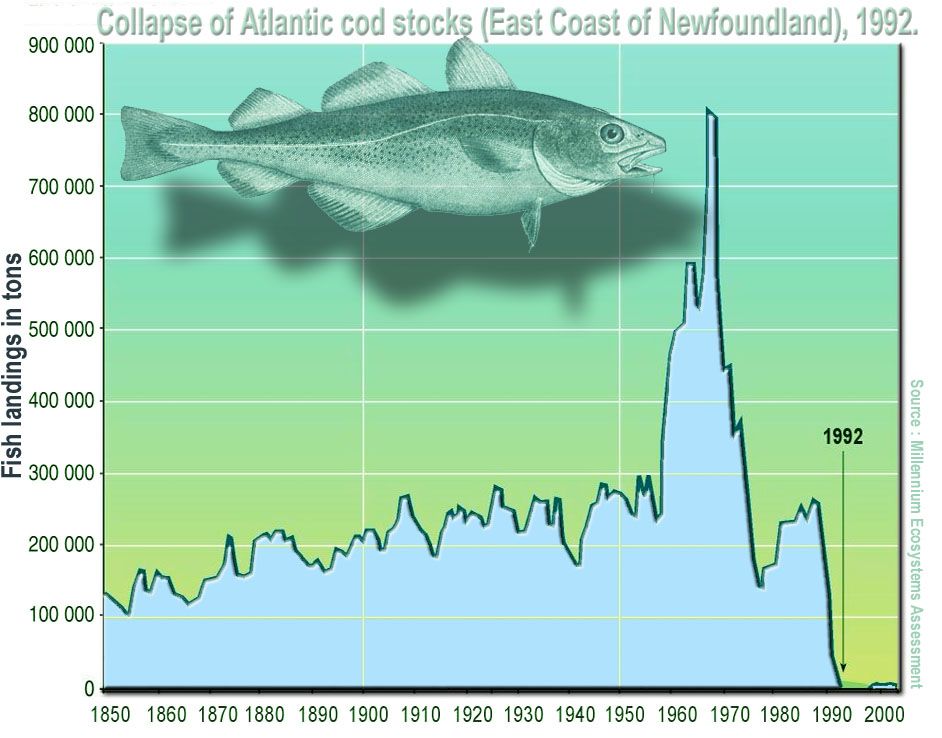
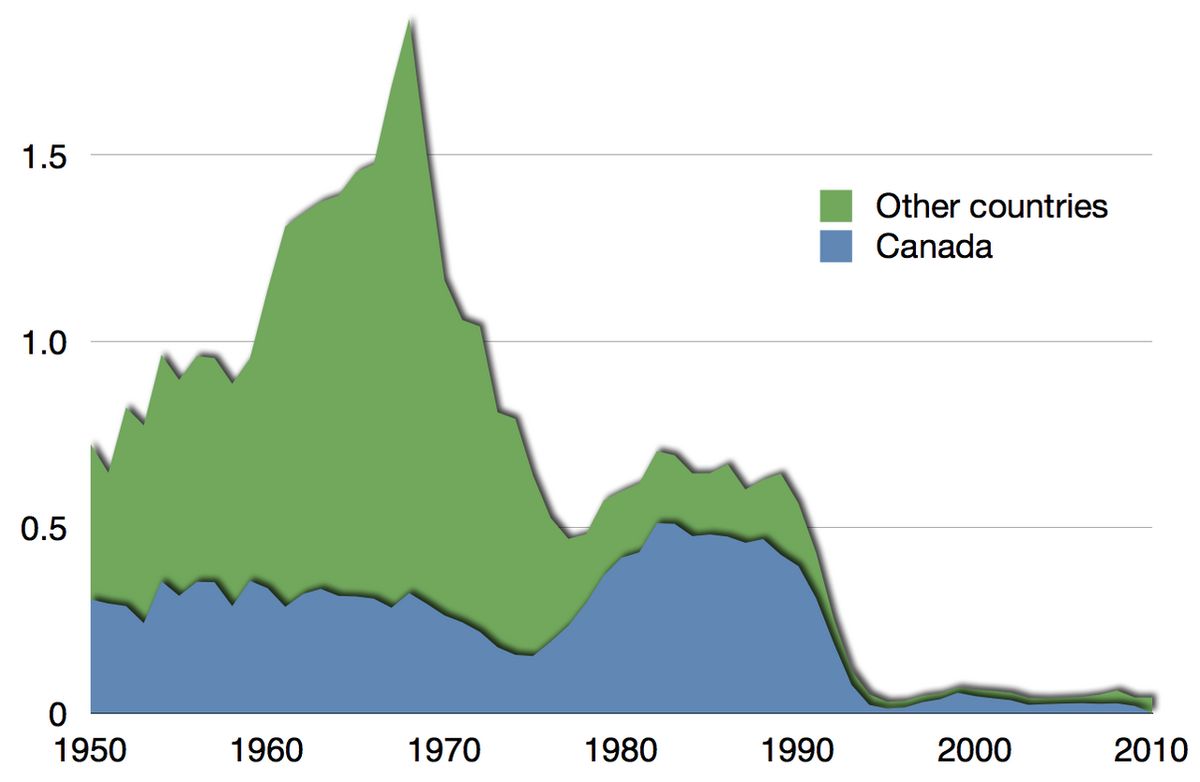
The Atlantic cod fishery off Newfoundland was a central part of the North Atlantic economy for centuries, known for its apparent limitless supply. Since the Middle Ages, European fishers including Vikings, Basques, and later the English, Spanish, and Portuguese harvested cod from the Grand Banks. The fish was valued for its lean, flaky flesh that was ideal for salting and drying, providing a durable protein source that fueled exploration and trade. By the mid 16th century, cod from the northwest Atlantic accounted for an estimated 60 percent of the fish eaten in Europe. The legendary density of the stocks was captured in 1497 by explorer John Cabot, whose crew reported waters so thick with cod they could be caught by lowering baskets. This perception of an endless resource continued into the late 19th century, with the Canadian Ministry of Agriculture declaring in 1885 that it was impossible to exhaust the supply. The fishery began to industrialize in the 19th century with the adoption of longlines, but the most significant changes came after the Second World War. The invention of the freezer allowed for massive international factory trawlers, some over 450 feet long, capable of processing and storing thousands of tons of fish at sea for months. These vessels, equipped with radar, sonar, and electronic navigation, could fish deeper and across wider areas than ever before. Between 1959 and 1968, landings from Newfoundland waters increased from 360,000 tonnes to a peak of 810,000 tonnes, setting the stage for ecological disaster. The progression of fishing technology and catch volumes reveals the scale of the increase in fishing pressure.
- Mid 16th century: 60% of fish eaten in Europe was Atlantic cod from the northwest Atlantic.
- 1873: French novelist Alexandre Dumas wrote a famous analogy about walking across the Atlantic on the backs of cod.
- 1885: Canadian Ministry of Agriculture declared the cod supply impossible to exhaust.
- Early 20th century: Steam trawlers could catch six times more than sailing ships.
- Mid 20th century: Invention of the freezer enabled 450 foot long factory ships holding 4,000 tons of fish.
- 1959: Cod landings in Newfoundland were 360,000 tonnes.
- 1968: Cod landings peaked at 810,000 tonnes.
- 1962 to 1992: The biomass of Atlantic cod dropped by 93%.
Causes of the collapse
The collapse resulted from a combination of technological advancement, scientific misunderstanding, and management failure. The core driver was industrial overfishing enabled by new technology. Powerful factory trawlers could sweep vast areas of the ocean floor with enormous nets, catching cod at a rate far beyond the population's ability to reproduce. This fishing pressure also induced evolutionary changes, shifting the maturation of northern cod towards younger ages and smaller sizes in the decade before the collapse. The trawlers generated massive bycatch, unintentionally capturing enormous quantities of non commercial but ecologically vital species. Significant amounts of capelin, a key prey species for cod, were caught and discarded, further undermining the cod's food source and the stability of the entire ecosystem. Scientific understanding of the ocean ecosystem was poor, and metrics for estimating cod stocks were highly variable due to sampling errors and dynamic environmental factors like ocean temperature. This led to significant uncertainty in predictions, making it difficult for the Department of Fisheries and Oceans to choose an appropriate conservation course. Management decisions were further complicated by social and economic pressures, as the fishery was the primary livelihood and cultural identity for hundreds of coastal communities. Despite warnings from local fishers and revised scientific advice in 1986 calling for the total allowable catch to be halved, quotas remained dangerously high. The government's declaration of a 200 nautical mile Exclusive Economic Zone in 1976 removed foreign fleets but simply allowed Canadian and American trawlers to increase their effort, with the DFO setting quotas that continued to overestimate the available supply.
In 1949, Newfoundland's fishery came under the management of the Department of Fisheries and Oceans, which mismanaged the resource and allowed overfishing. The cod catch peaked at 810,000 tons in 1968. In 1976, Canada declared a 200 nautical mile exclusive economic zone, which reduced fish mortality by excluding foreign trawlers. However, the DFO then set quotas that overestimated the total supply and increased the total allowable catch. In 1986, scientists determined the catch needed to be cut in half, but no changes were made to the yearly catch allotment.
- 1949: Newfoundland's fishery came under DFO management after joining Canada.
- 1969: Number of fishing trawlers increased, prompting complaints from coastal fishermen.
- 1976: Canada declared a 200 nautical mile Exclusive Economic Zone, removing foreign trawlers.
- 1978: Newfoundland government white paper called for minimizing interest group conflicts in fishery management.
- 1986: Scientists determined the total allowable catch needed to be cut in half, but no changes were made.
- 1992: Minister John Crosbie set the cod quota at 187,969 tonnes, but only 129,033 tonnes were caught the previous year.
- 1992 (July 2): Two year moratorium on northern cod fishing announced.
- 1993: Moratorium extended indefinitely as six cod populations collapsed.
The moratorium and immediate impact
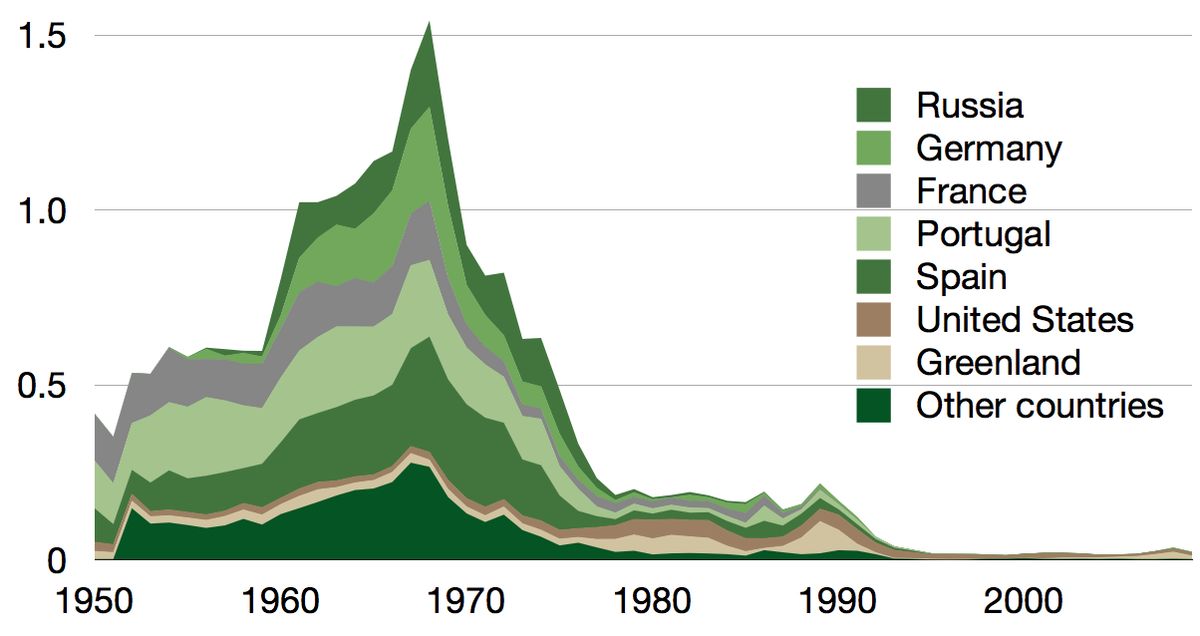
On July 2, 1992, facing catastrophic stock declines, federal Fisheries Minister John Crosbie announced a two year moratorium on the northern cod fishery from a hotel ballroom in St. John's as angry fishermen protested outside. The initial quota for that year had been set at 187,969 tonnes, but only 129,033 tonnes had been caught the previous year, signalling the fishery's imminent end. By 1993, with six cod populations in collapse, the government removed the time limit and extended the moratorium indefinitely. The spawning biomass had decreased by at least 75 percent in all stocks, by 90 percent in three stocks, and by a devastating 99 percent in the once massive northern cod stock. The moratorium constituted the largest industrial closure in Canadian history. Its impact was most acute in Newfoundland and Labrador, where the continental shelf lay beneath the most heavily fished region. Over 35,000 fishermen and fish plant workers from more than 400 communities lost their jobs, with a total of approximately 37,000 jobs lost across Atlantic Canada. The federal government responded with income assistance programs like the Northern Cod Adjustment and Recovery Program and later the Atlantic Groundfish Strategy, which included funds for worker retraining. The sociocultural shock was major, severing a 500 year old way of life and identity. The event was memorialized in folk song and media, symbolizing a tragic end to an era of abundance. The province's population fell by 10 percent within a decade due to outward migration, as communities underwent a difficult economic and social restructuring.
Post collapse management and controversy
Efforts to manage and assess the cod stocks after the collapse were mired in scientific and political controversy. In 1997, the DFO minister partly lifted the fishing ban ten days before a federal election, a move doubted by independent scientists and the International Council for the Exploration of the Sea. The following year, the Committee on the Status of Endangered Wildlife in Canada assessed the Atlantic cod. COSEWIC's process was supposed to be informed by an independent status report, authored by Dr. Kim N.I. Bell, which was the first such report on a commercial fish species in Canada. Dr. Bell's report analyzed ten geographic management units and recommended a range of designations from 'not at risk' to 'endangered' based on the severe declines in different areas. However, COSEWIC, allegedly under political pressure from the DFO, disregarded the report's population structure analysis and its arithmetic. Instead, it listed the entire Atlantic cod under a single, homogeneous population as 'vulnerable' (later renamed 'special concern'), a lower risk category than the 'endangered' status suggested for several management units in the report. COSEWIC attempted to alter the report unilaterally before the meeting, introducing errors and removing critical sections, and later refused to release the author's original version in violation of its own rules. Dr. Bell and other observers argued that the process was compromised by bureaucratic pressure to avoid a more serious 'at risk' designation, which would have been an indictment of the DFO's own management failures. This controversy highlighted the challenges of applying scientific conservation assessments to politically and economically sensitive commercial fisheries.
In 1998, the Committee on the Status of Endangered Wildlife in Canada listed Atlantic cod as vulnerable, later renamed special concern. The decision process was to be informed by a status report authored by Dr. Kim N.I. Bell. The controversy centred on stock discreteness, with DFO advocating within COSEWIC for a single homogeneous population view. This contradicted the multiple stock hypothesis supported by recent science, including DFO's own earlier demands that the report address multiple stocks. Before the meeting, COSEWIC made unauthorized edits to Bell's report, expunging sections that engaged DFO's objections.
- 1997: COSEWIC deferred its decision on Atlantic cod. DFO was accused of having "a plan to make it late."
- 1998: Dr. Kim N.I. Bell authored the COSEWIC Status Report on Atlantic cod, analyzing ten management units.
- 1998: COSEWIC unilaterally edited Bell's report, removing the word "few" from "there are few indications of improvement."
- 1998: The COSEWIC Chair was ousted for praising the Bell report's content.
- 1998: COSEWIC listed Atlantic cod as "vulnerable" on a single unit basis, contradicting its own report.
- 1998: COSEWIC refused to officially release the Bell report, violating its procedures.
- 2000: The World Wide Fund for Nature placed cod on its endangered species list, a move disputed by Norwegian scientists.
Ecological changes and slow recovery
More than three decades after the moratorium, the northern cod population has not rebounded to its historic levels, due to a combination of legacy effects and new environmental pressures. The intense fishing pressure prior to the collapse caused fisheries induced evolution, shifting the species' life history traits. Cod began maturing at younger ages and smaller sizes, a genetic adaptation to size selective fishing that has persisted into the 2000s despite the fishing halt. Scientists estimate it could take up to 84 years for the population to fully recover its original life history characteristics. The ecosystem itself underwent a major regime shift. With the predatory cod largely removed, populations of invertebrates like snow crab and northern shrimp proliferated, creating a new, economically valuable fishery that partly replaced the lost cod economy. However, the forage fish species that cod rely on, particularly capelin, also collapsed in the 1990s and have shown variable recovery, limiting the food available for cod. Recent scientific research emphasizes the role of shifting environmental conditions. A 2024 paper led by Dr. Frédéric Cyr in Nature Communications analyzed climate data from 1950 onward, finding that the northwest Atlantic experiences multi year warm and cold phases that influence ecosystem productivity. The collapse in the early 1990s coincided with one of the coldest periods of the last century, which negatively affected the plankton that form the base of the food web. Similar cold conditions in the mid 2010s have further challenged recovery. This research suggests that tracking these climate cycles is crucial for adaptive fisheries management, such as reducing fishing pressure during unfavourable environmental periods.
Current status and outlook
The Atlantic cod remains a species of special concern, with its future uncertain. In U.S. waters, such as on Georges Bank and in the Gulf of Maine, cod stocks are considered overfished and are managed under rebuilding plans that allow limited harvest. In Canadian waters, limited, small scale commercial and recreational fisheries have reopened in some areas under strict quotas, but the large scale industrial fishery of the past is gone. The World Wide Fund for Nature placed cod on its endangered species list in 2000, warning that global catches had dropped 70 percent in 30 years, though this was disputed by scientists like Åsmund Bjordal of the Norwegian Institute of Marine Research, who pointed to healthier populations like those in the Barents Sea. The legacy of the collapse is a more cautious and ecosystem based approach to fisheries management, with greater emphasis on precautionary principles, habitat protection, and bycatch reduction. The event altered Newfoundland, accelerating economic diversification, increasing emphasis on post secondary education, and shifting cultural identity. It is a global case study about the limits of natural resources, the dangers of technological overcapacity in fishing, and the major consequences of ignoring ecological warnings for short term economic gain.
Depleted populations of cod and other gadids do not appear to recover easily when fishing pressure is reduced. Intense fishing pressure contributed to fisheries induced evolution in northern cod, shifting maturation towards younger ages and smaller sizes. It has been estimated that a full recovery of the original life history characteristics in a cod population may take up to 84 years. Other factors for the slow recovery include lower genetic heritable variation from overexploitation.
| Metric or Finding | Detail | Source/Date |
|---|---|---|
| Estimated recovery time for life history traits | Up to 84 years | Scientific analysis post collapse |
| Global cod catch decline (30 year trend to 2000) | 70% | World Wide Fund for Nature (2000) |
| Key climate phases influencing recovery | 3 to 20 year warm/cold cycles | Dr. Frédéric Cyr et al., Nature Communications (2024) |
| Primary new fisheries post collapse | Snow crab and northern shrimp | Ecosystem shift observed since 1990s |
| U.S. management status | Overfished, under rebuilding plans | NOAA Fisheries, current |
| Reported historical maximum size of cod | Up to 6 feet and 200 pounds | 19th century landings records |
Questions about Collapse of the Atlantic northwest cod fishery
What caused the collapse of the cod fishery in Canada?
The collapse was primarily caused by decades of industrial overfishing enabled by new technology. From the 1950s onward, massive factory freezer trawlers equipped with radar and sonar could catch cod at an unsustainable rate. Management failures by the Department of Fisheries and Oceans, which set quotas based on overestimated stock sizes despite scientific warnings, were a key factor. The fishery also caused ecological damage through massive bycatch of species like capelin, a crucial prey fish, and induced evolutionary changes in the cod population itself.
Has the cod population recovered since the 1992 moratorium?
No, the northern cod population has not recovered to its pre collapse abundance. Despite the fishing halt, recovery has been slow and limited. Factors include a changed ecosystem, the continued low numbers of key prey like capelin, and persistent genetic changes in the cod from the era of overfishing. Recent research also indicates that unfavourable environmental conditions, including cold ocean phases in the 1990s and mid 2010s, have hindered population growth.
When was the cod moratorium announced and by whom?
The moratorium on the Northern Cod fishery was declared in 1992 by the Canadian federal minister of fisheries and oceans, John Crosbie. This decision was made after Northern cod populations fell to just 1% of historic levels, primarily due to decades of overfishing. The initial announcement was for a two year closure, but by 1993, facing the collapse of six cod populations, the government removed the limit and extended the moratorium indefinitely. The 1992 moratorium was the largest industrial closure in Canadian history. It marked a deep change in the ecological, economic, and sociocultural structure of Atlantic Canada, particularly for Newfoundland.
How many people lost their jobs because of the cod collapse?
Approximately 37,000 fishermen and fish plant workers lost their jobs due to the collapse of the cod fisheries. In Newfoundland alone, over 35,000 workers from more than 400 coastal communities became unemployed. The moratorium triggered a major social and economic crisis, forcing a dramatic restructuring of the province. This included considerable outward migration, increased economic diversification, and a greater emphasis on education. In response, the federal government provided income assistance and retraining programs like the Northern Cod Adjustment and Recovery Program and the Atlantic Groundfish Strategy.
What replaced the cod fishery in Newfoundland's economy?
A thriving invertebrate fishing industry emerged, targeting snow crab and northern shrimp that proliferated in the absence of predatory cod. This new industry provides an economic base roughly equivalent in value to the former cod fishery. The collapse forced Newfoundland into a dramatic environmental, industrial, economic, and social restructuring. This restructuring included considerable outward migration, increased economic diversification into other sectors, and an increased emphasis on education for displaced workers. The federal government supported this transition with programs for income assistance and retraining.
Sources and further reading
- Collapse of the Atlantic northwest cod fishery (Wikipedia)
- Atlantic Cod (fisheries.noaa.gov)
- A Tragedy with No End (sciencehistory.org)
- Shifting environmental conditions contribute to northern ... (mun.ca)
Checked by the Your Space Hamilton desk. Last updated 2026-10-29.