Black-billed magpie
The black-billed magpie (Pica hudsonia) is a distinctive, medium-sized bird native to the western half of North America and a familiar sight across much of western Canada. Known for its bold black and white plumage with iridescent blue-green highlights on its long tail and wings, this intelligent corvid thrives in open habitats, farmlands, and suburban areas. Historically associated with bison herds on the Great Plains, the magpie has adapted to human-altered landscapes, though it was once heavily persecuted as a pest. Today, it is considered a species of least concern and is celebrated for its complex social behaviours and remarkable cognitive abilities.
Taxonomy and Naming
The black-billed magpie was first formally described in 1823 by Joseph Sabine, who named it Corvus Hudsonius, or Hudson's Bay Magpie, after specimens from the Hudson Bay region. For much of the 19th and 20th centuries, it was considered a subspecies of the Eurasian magpie (Pica pica) due to strong visual similarities, albeit with a smaller body and longer tail. This classification persisted until genetic studies in the late 20th century revealed a significant divergence. Mitochondrial DNA analysis showed the black-billed magpie is more closely related to California's yellow-billed magpie (Pica nuttalli) than to its Eurasian counterpart. Based on this genetic evidence and differences in social behaviour and vocalizations, the American Ornithologists' Union officially recognized it as a separate species, Pica hudsonia, in the year 2000. The generic name Pica is Latin for magpie, while the specific name hudsonia references the Hudson Bay. The common name 'magpie' itself is derived from 'Mag', a nickname for Margaret associated with chattiness, and 'pie', the Middle English word for the bird. Fossil evidence suggests the ancestral North American magpie crossed the Bering land bridge around 3 to 4 million years ago, with the yellow-billed magpie lineage splitting off later due to the Sierra Nevada uplift and glacial cycles.
Physical Description
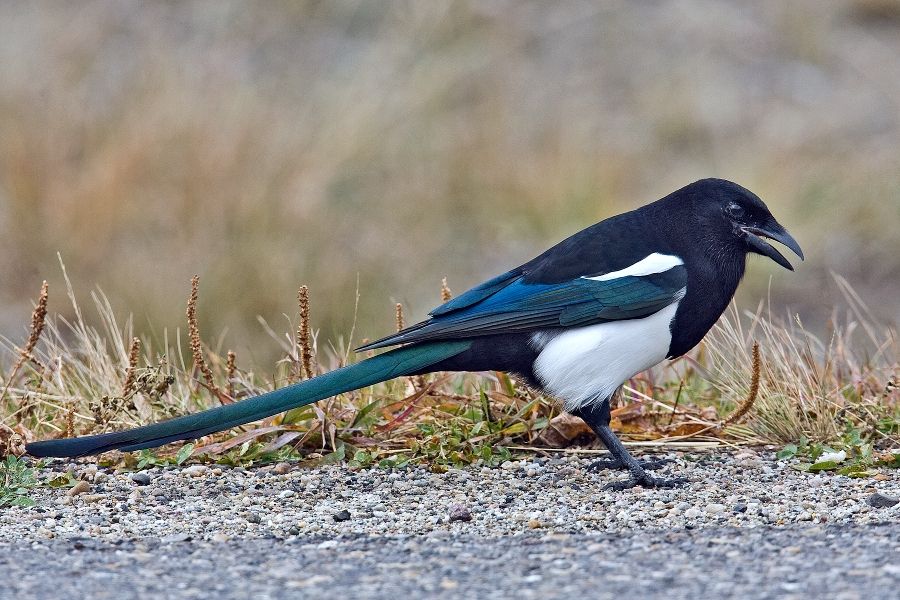
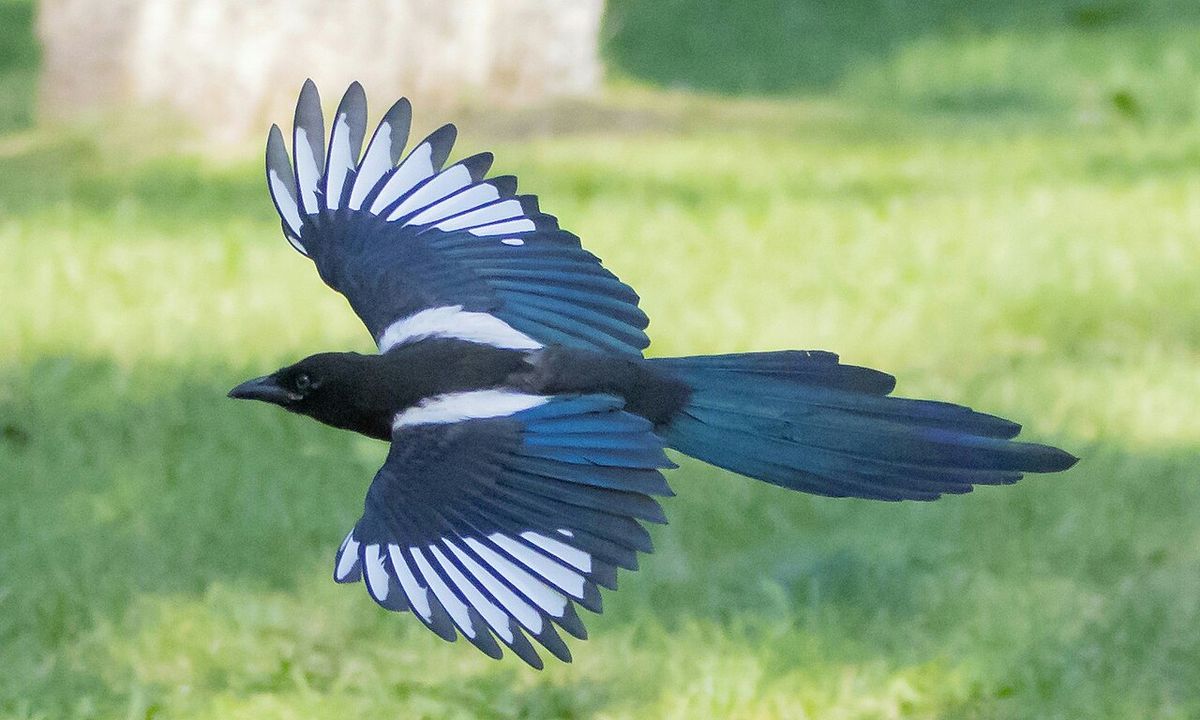
The black-billed magpie is an unmistakable bird within its range, characterized by a striking contrast of black and white plumage. Its head, upper breast, back, and long, graduated tail are black, while large patches on the wings and the lower breast are white. The black areas on the wings and tail exhibit iridescent hints of blue, blue-green, or bronze, especially noticeable in good light. The bill is uniformly black, oblong, and slightly curved, distinguishing it from the yellow-billed magpie. This species exhibits sexual dimorphism in size, with males being on average 6-9% larger and 16-24% heavier than females. Males typically weigh between 167 and 216 grams with a wing chord of 205 to 219 millimetres, while females weigh 141 to 179 grams with a wing chord of 175 to 210 millimetres. The tail is exceptionally long, making up to half the bird's total length of 45 to 60 centimetres. Juveniles are duller, with less iridescence, buffier white patches, and shorter tail feathers, acquiring adult plumage after their first moult. They also have pink mouth-linings and grey irises, which darken to black in adults, and their rectrices are typically rounder and narrower than those of mature birds.
Distribution and Habitat
The black-billed magpie's range spans western North America, from coastal southern Alaska and the southwestern Yukon, through British Columbia, Alberta, Saskatchewan, and Manitoba to northwestern Ontario. Its range extends south through the Rocky Mountain states to New Mexico and western Texas, and as far east as northern Minnesota and Iowa, with casual records in northern Wisconsin and upper Michigan. The species is generally non-migratory, though post-breeding dispersal and some winter movements do occur, sometimes covering several hundred kilometres or moving to different elevations up to 3000 metres. Its distribution is limited by high summer heat and humidity to the south and east, and by dense boreal forest to the north. The magpie thrives in open or semi-open habitats with scattered trees or thickets, particularly favouring riparian corridors, meadows, rangeland, and agricultural areas. It has adapted readily to human settlements, commonly found in farmlands, suburbs, and near feedlots, grain elevators, and landfills, where structures and planted trees provide nesting sites and refuse offers scavenging opportunities. The species is absent in California west of the Cascade and Sierra Nevada ranges, where it is replaced by the yellow-billed magpie, which occupies a more restricted range.
Behaviour and Life Cycle
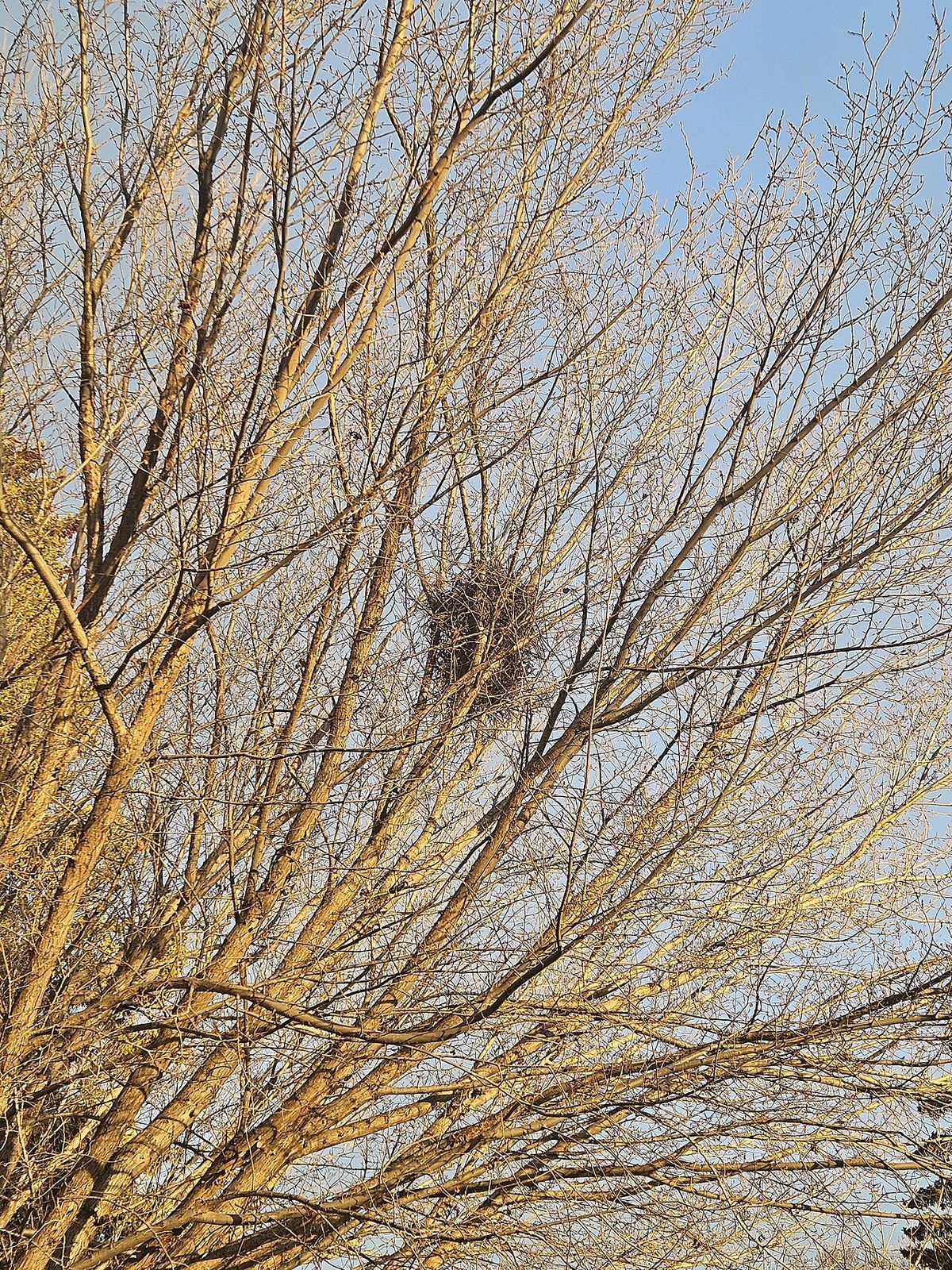
Black-billed magpies are highly social, intelligent birds known for forming monogamous pairs that often last for life, though 'divorce' rates vary regionally. Courtship involves the male performing displays with flared wings and tail and providing courtship feeding to the female. Nest building is a major undertaking, with both sexes contributing over 40 to 50 days starting as early as February. The resulting structure is a large, domed nest of twigs and branches, with a mud-lined inner cup and a protective hood, usually situated near the top of a tree. Nests can be 60 to 120 centimetres high and are sometimes reused or repaired in subsequent years. The breeding season runs from late March to early July, with females laying an average clutch of six or seven greenish-grey, brown-marked eggs. Incubation, performed solely by the female, lasts 16 to 21 days. The young are altricial, brooded by the female but fed by both parents, and fledge about three to four weeks after hatching. They remain dependent on adults for several more weeks before joining juvenile flocks. Key aspects of their annual cycle and social structure include the following.
- Pairs defend only the immediate nest area, allowing nests to be loosely clustered in areas with good resources, forming diffuse colonies.
- Outside the breeding season, magpies form loose flocks with established dominance hierarchies, where young males often appear dominant over adults.
- A notable and poorly understood behaviour is the 'funeral', where magpies gather noisily around a dead conspecific, sometimes for 10 to 15 minutes.
- In winter, they roost communally in dense trees or shrubs for protection from predators and cold, arriving earlier and leaving later on the coldest days.
- Flight is often laboured and interspersed with glides, with sustained speeds measured between 14.5 and 50 kilometres per hour.
- At roosts, birds sleep with the bill tucked under shoulder feathers and may regurgitate indigestible material as pellets.
Fledging success is typically three to four young per nest, which is lower than the average clutch size of six or seven eggs. This lower success is not unusual in species with asynchronous hatching, as some nestlings often die of starvation. Hatching is asynchronous, meaning eggs hatch over several days, which can lead to size disparities among the young. If a nest is regularly disturbed, the parents may aggressively defend it and will eventually either move the eggs or abandon the clutch altogether. Biologists who have climbed nest trees have reported that the parents recognized them personally on subsequent days and started to mob them.
Diet, Foraging, and Food Caching
The black-billed magpie is an opportunistic omnivore with a highly varied diet that shifts with season and availability. During summer, animal matter predominates, including insects like beetles and grasshoppers, as well as worms, small rodents, reptiles, amphibians, and the eggs and young of other birds. In winter, they consume more plant material such as seeds, berries, and nuts. They are adept scavengers, commonly following large predators like wolves to scavenge from kills, and historically followed bison and Indigenous hunting parties. They also engage in mutualism with large mammals, landing on the backs of cattle, moose, and deer to glean ticks. When living near humans, they readily exploit garbage, pet food, and agricultural refuse. Magpies typically forage on the ground, using their feet or bill to turn over litter. They are also accomplished scatter-hoarders, caching food in the ground for short-term retrieval. The process of caching and recovering food involves several distinct, strategic behaviours.
- To create a cache, the bird uses its bill to hammer a hole into the ground or snow, then deposits food from a sublingual pouch.
- If other magpies are watching, the individual may make several false caches before making a real one to avoid theft.
- The final cache is carefully covered with grass, leaves, or twigs for concealment.
- After covering the cache, the bird often cocks its head and stares at the site, likely to commit the location to memory.
- Food is usually recovered within several days, though some caches are never revisited.
- Magpies locate their caches primarily by sight, but also use smell, especially when robbing the caches of others.
Black-billed magpies are known to make short-term food caches in the ground in a scatter-hoarding fashion. They may make several false caches if other magpies are watching before making a real one, which they then cover and appear to commit to memory. Chicks in the nest are fed animal matter almost exclusively by their parents. The birds are opportunistic omnivores and have been known to hunt small birds and eat the eggs of other birds.
Intelligence and Vocalizations
As members of the corvid family, black-billed magpies are among the most intelligent birds, demonstrating problem-solving skills, memory, and social learning. They have shown the ability to recognize themselves in a mirror, a cognitive feat shared only with great apes, dolphins, elephants, orcas, and human children over 18 months old. They can recognize individual human faces, even distinguishing between identically dressed people, and remember individuals who have disturbed their nests. Magpies are excellent mimics, capable of imitating the sounds of other birds, mammals, and even human speech. Their own vocal repertoire is diverse, including tweets, coos, purrs, and squawks, but the most common is a loud, rattling alarm chatter described as 'ka-ka-ka-ka'. This call is distinct from that of the Eurasian magpie but similar to the yellow-billed magpie's. Their intelligence extends to abstract concept learning, where they can identify relationships between known and unknown items, and to complex social interactions within their flocks. The documented cognitive abilities of black-billed magpies place them in an elite group of animals and include several key demonstrations.
- Mirror self-recognition, indicating a sense of self-awareness.
- Individual human face recognition and memory, even when humans are identically dressed.
- Vocal mimicry of other species, including human speech, as observed in at least one captive individual.
- Abstract concept learning, identifying relational rules between objects.
- Complex social learning and problem-solving observed in foraging and caching contexts.
- Engagement in 'funeral' gatherings, suggesting social bonding and possibly grief-like behaviour.
The vocalizations of the black-billed magpie consist of a number of calls, but the most common is an alarm call described as a chatter. Their vocalizations serve various functions, from alarm calls to social communication. At least one black-billed magpie, living with humans, has learned to imitate human speech. The species exhibits different social behaviour and vocalizations from the Eurasian magpie, which contributed to it being recognized as a separate species.
Historical and Modern Relationship with Humans
The black-billed magpie has a long and complex history with people in North America. In Indigenous cultures of the Great Plains, the bird features in stories, such as the 'Great Race' where a magpie helps humans win a contest against bison, determining the relationship between hunter and prey. Early European explorers like Lewis and Clark noted the birds' boldness around their camps in South Dakota in 1804, reporting they would enter tents and take food from the hand. Magpies originally followed vast bison herds, switching to cattle after the herds' devastation in the 1870s, and later moving into the emerging towns and cities of the West. Perceived as pests for pecking at sores on livestock and preying on game bird eggs, they were systematically persecuted through bounties, trapping, and poisoning in the early 20th century. This persecution made populations in hunted areas very wary, while birds in protected areas remain relatively tolerant. Today, they are common and not considered at risk, often viewed with a mixture of annoyance for their mischievousness and admiration for their intelligence and striking appearance. They are a frequent subject of public interest and observation, as seen in social media posts from places like Calgary, Alberta, where they are a familiar part of the urban and rural landscape. The history of human-magpie conflict is marked by several specific campaigns and impacts.
- In 1933, bounty hunters in the Okanogan valley in Washington shot 1,033 magpies under a pest control program.
- Bounties were commonly offered, such as one cent per egg or two cents per head, in many states and provinces.
- Magpies also died from eating poison bait set out for other predators like coyotes.
- The species adapted to human settlements by the 1960s, moving into towns and exploiting new food sources.
- Their historical association with bison meant they also followed Indigenous hunting parties to scavenge from carcasses.
- Today, they are classified as a species of Least Concern by the International Union for Conservation of Nature (IUCN).
Black-billed magpies have a long history with humans, being featured in stories told by Indigenous tribes of the Great Plains. Due to their perceived negative impact on cattle and game birds, they were hunted as a pest during the 1900s, and their population suffered as a result. Where persecuted they become very wary, but otherwise they are fairly tolerant of human presence. Today, they are considered a species of least concern by the IUCN and are commonly seen throughout their range.
Questions about Black-billed magpie
Are black-billed magpies migratory?
Black-billed magpies are generally considered non-migratory, meaning they do not undertake long-distance seasonal migrations. However, they do exhibit post-breeding dispersal and some winter movements. After the breeding season, individuals, particularly juveniles, may move several hundred kilometres or shift to different elevations, sometimes forming large groups. These movements are likely related to finding food rather than a true migration.
What do black-billed magpies eat?
Black-billed magpies are opportunistic omnivores with a highly varied diet. They eat insects, worms, small rodents, reptiles, amphibians, and the eggs and young of other birds. They also consume seeds, berries, and nuts, shifting to more plant matter in winter. They are adept scavengers, often following predators like wolves to scavenge kills, and they glean ticks from the backs of large mammals like cattle. In human environments, they will eat garbage, pet food, and agricultural refuse.
How intelligent are black-billed magpies?
Black-billed magpies are exceptionally intelligent birds, a trait common in the corvid family. They can recognize themselves in mirrors, a test of self-awareness passed by only a handful of species. They are excellent mimics, capable of imitating other animals and even human speech. Magpies can recognize and remember individual human faces, demonstrate abstract concept learning, and engage in complex social behaviours like communal 'funerals' for dead conspecifics.
Do black-billed magpies mate for life?
Black-billed magpies typically form monogamous pairs that last year-round and often for life. However, mate fidelity can vary by region. One study in South Dakota found a low divorce rate of 8 percent, while a seven-year study in Alberta found a 63 percent divorce rate. If one mate dies, the surviving bird will usually find a new partner. Both sexes work together to build their large, domed nest and raise their young.
Why were black-billed magpies once considered pests?
During the first half of the 20th century, black-billed magpies were widely persecuted as pests. They were believed to negatively impact cattle by pecking at sores and wounds and were thought to reduce populations of game birds by eating their eggs. As a result, many states and provinces offered bounties for magpie eggs or heads, and the birds were systematically trapped, shot, and poisoned. This persecution led to population declines in some areas and made the birds very wary of humans where hunted.
Where can you find black-billed magpies in Canada?
Black-billed magpies are found from coastal southern Alaska, southwest Yukon Territory, central British Columbia, Alberta, Saskatchewan, Manitoba, and northwestern Ontario. Their range extends as far east as northern Minnesota and Iowa, with casual records in northern Wisconsin and upper Michigan. The species prefers generally open habitats with clumps of trees, such as meadows and riparian areas with thickets. They are also commonly found in farmlands, suburban areas, and near human structures like feedlots and barns. In Canada, they are most common in the Grassland and Parkland Natural Regions of Alberta and in agricultural areas.
Sources and further reading
- Black-billed magpie (Wikipedia)
- Pica hudsonia (black-billed magpie) | INFORMATION (animaldiversity.org)
- The Intelligence of Magpies (aiwc.ca)
- Black-billed Magpie | ZooAmerica (zooamerica.com)
Checked by the Your Space Hamilton desk. Last updated 2026-10-26.