Anna's hummingbird
Anna's hummingbird (Calypte anna) is a small, iridescent bird native to the western coastal regions of North America, from Baja California to southern British Columbia. Named after Anna Masséna, Duchess of Rivoli, this species is notable for being the northernmost year-round resident hummingbird, a status achieved through adaptation to urban environments and human-provided resources. In Canada, its expanding presence in coastal British Columbia, including its designation as the official city bird of Vancouver, makes it a familiar and celebrated part of the regional fauna. The bird is a nectarivore and insectivore, recognized for the male's brilliant crimson crown and its spectacular, high-speed courtship dive.
Taxonomy and naming
The species was formally described and illustrated in 1829 by French naturalist René Lesson from a specimen collected in California. Lesson placed it in the genus Ornismya and gave it the binomial name Ornismya anna. The English ornithologist John Gould later moved the species to the genus Calypte in 1856, a name likely derived from the Ancient Greek word for a woman's veil or head-dress. The specific epithet anna honours Anne d'Essling, who married the ornithologist François Victor Massena, the 3rd Duke of Rivoli. Anna's hummingbird is a monotypic species, meaning no subspecies are currently recognized within its classification.
Distribution and habitat expansion
Anna's hummingbird is found along the western coast of North America, from southern Canada through the western United States to northern Baja California. Its original breeding range was limited to the chaparral of California and Baja California, but it has undergone significant northward and eastward expansion since the 1960s. The species is now a permanent resident in regions including Oregon, Washington, British Columbia, Arizona, southern Nevada, southeastern Utah, and western Texas. This rapid range expansion is attributed to several interconnected factors, including the widespread planting of non-native ornamental plants like eucalyptus, which provide nectar and nesting sites, and the proliferation of urban bird feeders that offer a year-round food source. The bird's adaptation to cooler climates has been key to its success in the Pacific Northwest, where it endures winter conditions in cities like Seattle through extended periods of subfreezing temperatures, snow, and high winds.
Scientists describe this northward expansion as an ecological release, facilitated by acclimation to colder temperatures, milder winters potentially linked to climate change, and consistent human provision of resources. While a sizable percentage may still migrate south from the Pacific Northwest, many now overwinter at northern latitudes where food and shelter are available. In the 21st century, the species has also expanded into higher-altitude mountainous terrains in California, such as the Sierra Nevada, up to elevations of 2,825 metres (9,268 ft), likely in response to rising low-elevation temperatures. The fastest growing populations in the Pacific Northwest occur in regions with breeding-season cold temperatures similar to those of its native Californian chaparral habitat. During cold temperatures, Anna's hummingbirds employ a physiological strategy of gradually gaining weight during the day as they convert sugar to fat, which supports their energy needs through winter nights.
Notable records of vagrant birds far outside the typical range include sightings in southern Alaska, Idaho, Saskatchewan, New York, Florida, Louisiana, and Newfoundland. These birds have been spotted far outside their normal range along the western coast of North America. The sightings highlight the species' capacity for extensive postbreeding dispersal. This dispersal is a natural tendency for the species.
- Southern Alaska (recorded as early as 1971)
- Saskatchewan
- Idaho
- New York
- Florida
- Louisiana
- Newfoundland
These sporadic sightings highlight the species' capacity for extensive postbreeding dispersal. This rapid northward range expansion is attributed to the species' natural tendency for extensive postbreeding dispersal. The core resident population continues to grow in its expanded range in the Pacific Northwest. The fastest growing populations occur in regions with breeding-season cold temperatures similar to those of its native range.
Physical description and unique iridescence
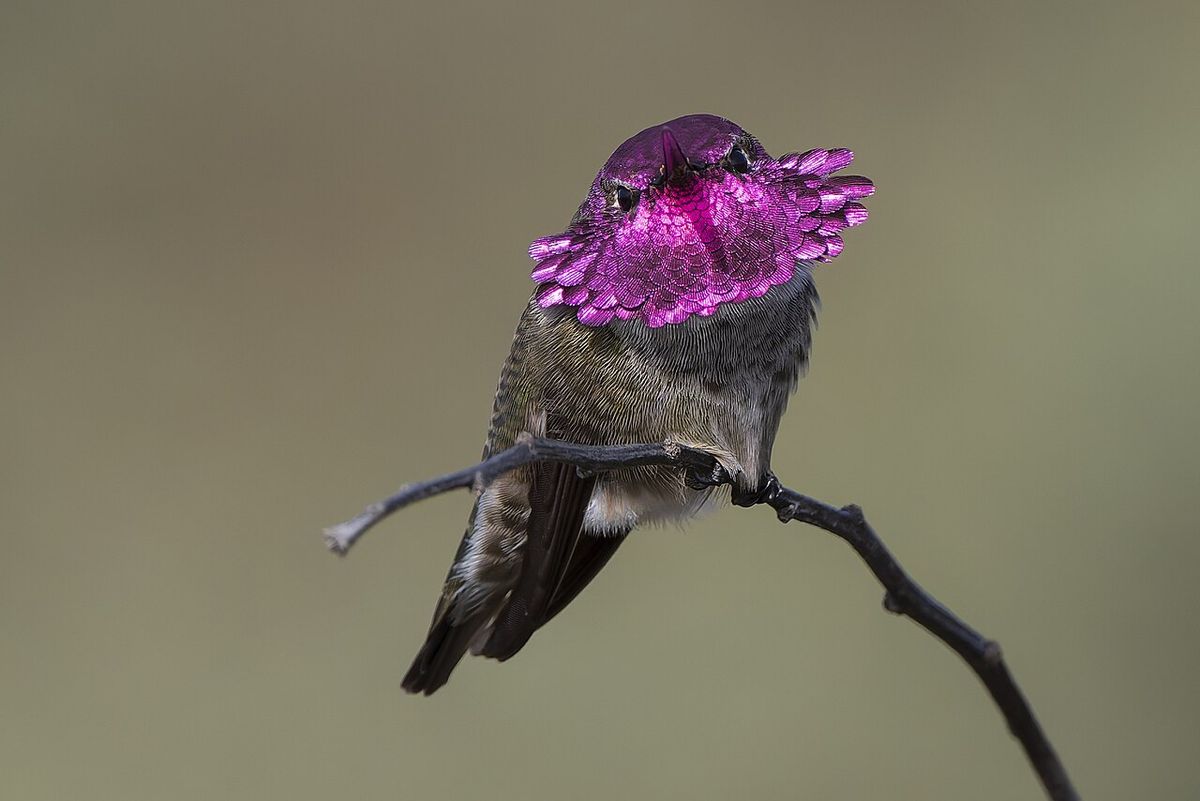
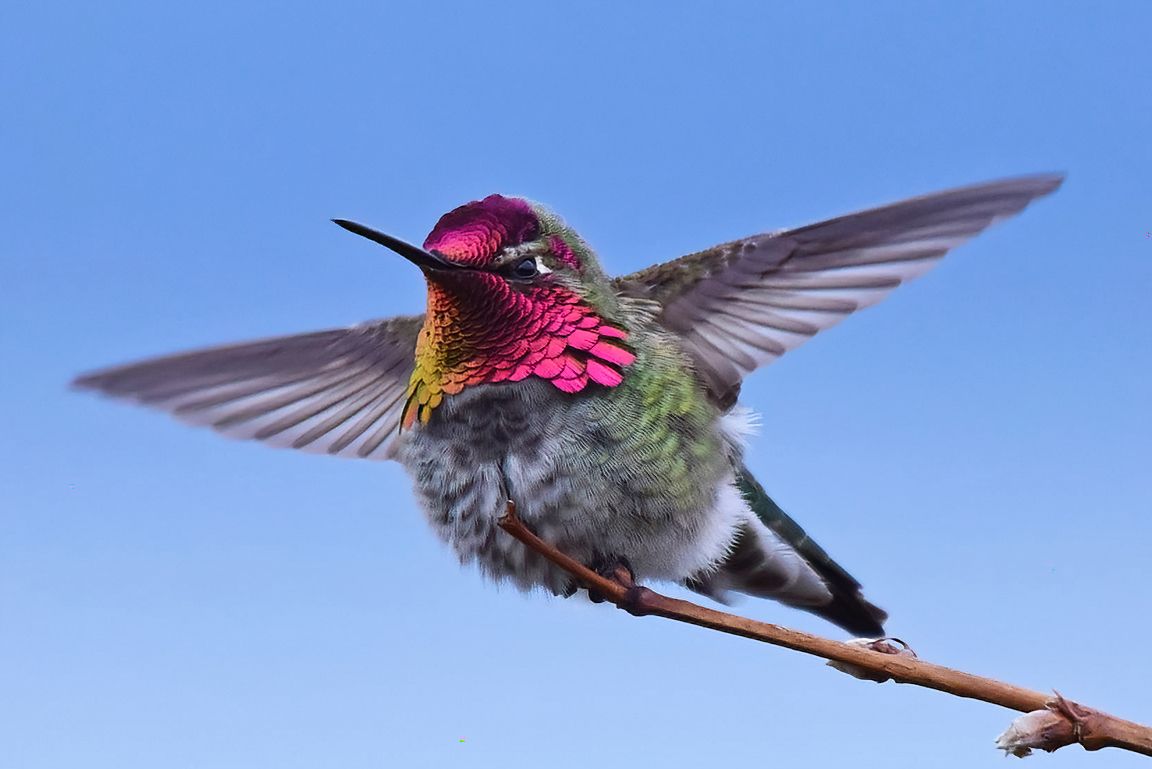
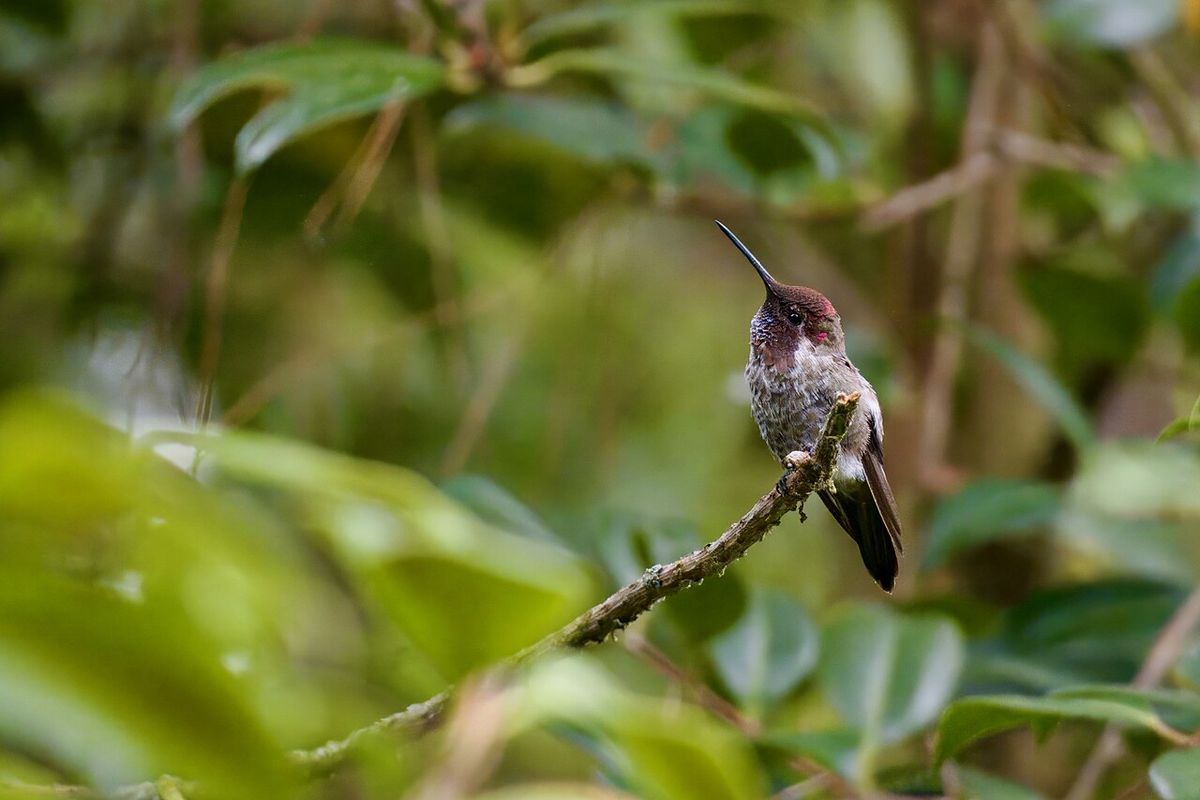
Anna's hummingbirds are small, compact birds measuring 3.9 to 4.3 inches in length with a wingspan of about 4.7 inches. They typically weigh between 0.1 and 0.2 ounces. Both sexes share an iridescent bronze-green back, pale grey underparts, and green flanks, with long, straight, slender bills adapted for feeding on nectar. The adult male is distinguished by its brilliant iridescent crown and gorget (throat feathers), which range from crimson-red to a reddish-pink colour. This red crown is unique among North American hummingbirds. Females and juvenile males have a dull green crown, a grey throat with or without some red iridescence, a grey chest and belly, and a dark, rounded tail with white tips on the outer feathers, while the male's tail is slightly forked.
The male's spectacular iridescence is a structural colour created by large stacks of melanosomes within the feather barbules, with these layers separated by keratin. This configuration reflects incident light in the manner of partially-opened Venetian blinds, enabling the iridescence which varies the head and gorget coloration with the changing angle of light. This serves as a coloration advantage for courtship attraction and territory defense, as the colour shifts dramatically depending on the angle of illumination and observation by female or male competitor birds. Without direct sunlight, the male's gorget can appear a dull brown or grey, making lighting conditions crucial for observing its full display. The specific shade of the male's crown and gorget is derived from magenta, resulting in its distinctive crimson-red to reddish-pink appearance that is so critical for visual communication within the species. Research indicates that the intensity of the male's iridescent plumage is directly linked to diet. Male birds with more protein in their diet have more colorful crowns and higher iridescence in their head feathers compared with male birds with low protein intake. This connection between nutrition and ornamental plumage shows the importance of their insect consumption alongside nectar.
Behaviour, foraging, and physiological adaptations
Anna's hummingbirds are primarily nectarivores but have a diverse diet that includes tree sap, small insects, spiders, and sugar-water from feeders. They capture insects in flight or glean them from spider webs, sometimes consuming the spiders as well. This protein intake is vital, especially during the breeding season for egg production and chick rearing. While foraging for nectar, they act as important pollinators for many flowering plants. Evidence suggests that in flight, they generate a slight electrostatic charge that helps pollen grains adhere to their beaks and feathers, facilitating the transfer of pollen to hundreds of flowers in a single day.
To survive cold nights or periods of food scarcity, Anna's hummingbirds can enter a state of torpor, dramatically lowering their metabolic rate to conserve energy. When studied in colder temperatures at mountainous elevations, Anna's hummingbirds used torpor more frequently and for longer periods than at lower elevations. Birds with inadequate stores of body fat or insufficient plumage rely on this adaptation to survive periods of subfreezing weather. Their flight is powered by large pectoral muscles composed exclusively of fast, fatigue-resistant glycolytic fibers, enabling the rapid wingbeat frequencies necessary for sustained hovering via the recruitment of motor units.
Anna's hummingbirds exhibit remarkable physical control with specific documented capabilities. They can shake their bodies 55 times per second to shed rain while in flight. In dry weather, they use this shake to remove pollen or dirt from feathers. Each twist during the shake lasts four-hundredths of a second. This shake applies 34 times the force of gravity on the bird's head.
- They can shake their bodies 55 times per second while in flight.
- This shake is used to shed rain or, in dry weather, to remove pollen or dirt from feathers.
- Each twist in this manoeuvre lasts four-hundredths of a second.
- Each twist applies 34 times the force of gravity on the bird's head.
This ability to maintain cleanliness and aerodynamic efficiency is essential for their daily survival and foraging success. They forage across varied weather conditions in their expanded range into higher altitudes. The shaking helps remove pollen which may adhere to them during pollination. This physical control aids them in their expanded northern range where they endure winter conditions.
Courtship, song, and breeding
Unlike most northern temperate hummingbirds, the male Anna's hummingbird sings during courtship. The song is thin and squeaky, interspersed with buzzes and chirps, and is drawn to over 10 seconds in duration. The male's call, used while perching in trees and shrubs, is scratchy and metallic and is typically employed for territory defense. During the breeding season, males perform a striking aerial display dive over their territories. When a female flies onto a male's territory, the male rises up about 40 metres (130 feet) before diving over the female. As the male approaches the bottom of the dive, it reaches an average speed of 27 m/s (89 ft/s), which is 385 body lengths per second. At the bottom of the dive, the male travels 23 m/s (51 mph), and produces an audible sound described by some as an 'explosive squeak', generated by its tail feathers.
Open-wooded or shrubby areas and mountain meadows along the Pacific coast from British Columbia to Arizona make up the breeding habitat for Anna's hummingbird. The female raises the young without any assistance from the male. She builds a nest in a shrub or tree, in vines, or attached to wires or other artificial substrates. The round nest, 3.8-to-5.1-centimetres (1.5 to 2.0 in) in diameter, is constructed of plant fibers, downy feathers and animal hair bound together with spider silk. The exterior is camouflaged with chips of lichen, plant debris, and occasionally urban detritus such as paint chips and cigarette paper. They are known to nest as early as mid-December and as late as June, depending on geographic location and climatic conditions, indicating a highly flexible breeding strategy.
Hybridization with other species
Anna's hummingbirds may hybridize with other hummingbird species, especially the congeneric Costa's hummingbird. These natural hybrids have been mistaken for new species by early ornithologists, leading to historic misclassifications. A bird allegedly collected in Bolaños, Mexico, was described and named Selasphorus floresii (Gould, 1861), or Floresi's hummingbird. Several more specimens were collected in California over a long period, and the species was considered extremely rare before it was determined the specimens were the hybrid offspring of an Anna's hummingbird and an Allen's hummingbird. Another single bird collected in Santa Barbara, California, was described and named Trochilus violajugulum (Jeffries, 1888), or violet-throated hummingbird. It was later determined to be a hybrid between an Anna's hummingbird and a black-chinned hummingbird.
These instances of hybridization highlight the genetic compatibility between Anna's hummingbird and several other species. Anna's hummingbirds may hybridize with other species, especially the congeneric Costa's hummingbird. Natural hybrids have been mistaken for new species by historical taxonomists. For example, a hybrid between an Anna's hummingbird and an Allen's hummingbird was once described as a new species.
Population status, conservation, and human influence
Anna's hummingbird has a large and growing population. A 2021 estimate places the population in the western United States and Canada at approximately 8 million individuals, with numbers increasing steadily since 1970. The global population is estimated at about 9.6 million mature individuals. This positive trend is reflected in its conservation status. The International Union for Conservation of Nature (IUCN) Red List of Threatened Species categorizes Anna's hummingbird as a species of Least Concern as of 2021. The population growth is closely tied to the species' successful adaptation to human-altered landscapes.
The planting of exotic, nectar-rich flowers in gardens and parks, combined with the widespread use of hummingbird feeders, has provided reliable food sources that support larger numbers and enable the species to withstand winter conditions outside its historical range. This relationship with human habitation is a defining feature of its modern ecology and a primary reason for its abundance. The northward expansion represents an ecological release associated with these introduced plants, year-round nectar availability from feeders supplied by humans, and acclimation of the species to a winter climate cooler than its native region. The species' tolerance of urban environments means it is commonly seen in backyards and parks across its range.
Significance in Canadian culture and ecology
In Canada, Anna's hummingbird holds a special place as a symbol of urban wildlife adaptation and the changing dynamics of native species ranges. Its most prominent cultural role is as the official city bird of Vancouver, British Columbia, a designation that recognizes its year-round presence in the city's parks and gardens. The species is also the official city bird of Sedona, Arizona. For Canadian birdwatchers and naturalists, the Anna's hummingbird represents both the beauty of local fauna and the ongoing ecological changes occurring within the Pacific Northwest ecosystem.
The species' expansion northward into Canada serves as a visible example of how species distributions can shift in response to climate factors and human activity. Its residence in the Pacific Northwest is a documented example of ecological release dependent on acclimation to colder winter temperatures, introduced plants, and human provision of nectar feeders during winter. The bird's ability to become a permanent resident in coastal British Columbia, where it was once only a seasonal migrant, shows a significant biogeographic shift observed over the past half-century. This shift makes the Anna's hummingbird a frequent and welcome visitor to Canadian gardens, contributing to public engagement with birdlife and a greater understanding of avian adaptation.
The documented factors enabling its Canadian presence include the widespread planting of non-native ornamental plants. These plants provided expanded nectar and nesting sites along the Pacific coast. Another factor is the human provision of nectar feeders during winter. Acclimation to colder winter temperatures and milder winters possibly associated with climate change are also factors.
- Acclimation to colder winter temperatures.
- Widespread planting of introduced, non-native ornamental plants.
- Human provision of nectar feeders during winter months.
- Milder winter temperatures possibly associated with climate change.
- Extensive postbreeding dispersal, a natural tendency of the species.
Questions about Anna's hummingbird
Where can you find Anna's hummingbirds in Canada?
In Canada, Anna's hummingbirds are year-round residents primarily in coastal British Columbia, including the city of Vancouver, which has adopted it as its official city bird. Their range expansion northward since the 1960s has been supported by ornamental planting and backyard feeders. While most are resident, some individuals may still migrate, and vagrant birds have been sporadically recorded in provinces like Saskatchewan and Newfoundland. The fastest growing populations occur in regions with breeding-season temperatures similar to its native California range.
What do Anna's hummingbirds eat?
Anna's hummingbirds primarily feed on nectar from flowers using their long, extendable tongues. They also consume tree sap and sugar-water from feeders. Crucially, they supplement their diet with small insects and other arthropods, which they catch in flight or glean from vegetation and spider webs, sometimes eating the spiders themselves. This protein is essential, particularly for breeding females and for the development of bright plumage in males, as males with higher protein intake have more colourful crowns.
How do Anna's hummingbirds survive cold winters?
Anna's hummingbirds survive cold winters through a combination of physiological and behavioural adaptations. They can enter a state of torpor, drastically lowering their metabolic rate to conserve energy during cold nights, a strategy used more frequently at higher elevations. They gradually convert sugar to fat during the day to build energy reserves. Their survival in places like the Pacific Northwest is heavily reliant on human-provided nectar feeders and the planting of non-native flowers that offer winter food sources, which supports their year-round residence.
What does the male Anna's hummingbird look like?
The male Anna's hummingbird is notable for its brilliant iridescent plumage. It has a crimson-red to reddish-pink crown and gorget (throat feathers), which is the only red crown among North American hummingbirds. Its back is bronze-green, and it has a pale grey chest and belly. The iridescence is structural, created by layers of melanosomes and keratin in the feather barbules, and changes with the angle of light. Without direct sunlight, these feathers can appear dull brown or grey.
What is special about the Anna's hummingbird courtship display?
The male's courtship display features a dramatic aerial dive and a complex song. He ascends to about 40 metres (130 feet) before diving steeply toward a female, reaching speeds averaging 27 metres per second, which is 385 body lengths per second. At the bottom of the dive, he produces a loud, explosive squeak using his tail feathers. Unlike most temperate hummingbirds, the male also sings a thin, squeaky song interspersed with buzzes and chirps that can last over ten seconds during courtship.
Are Anna's hummingbirds endangered?
No, Anna's hummingbirds are not endangered. As of 2021, the International Union for Conservation of Nature (IUCN) lists them as a species of Least Concern. Their population in the western U.S. and Canada is estimated at 8 million and is increasing, with a global estimate of 9.6 million mature individuals. Their successful adaptation to urban environments, use of feeders, and northward range expansion have all contributed to their large and growing numbers.
Sources and further reading
- Anna's hummingbird (Wikipedia)
- Meet Anna's Hummingbird, a cold-dwelling, not-so-fair- ... (naturecanada.ca)
- Animal Fact Sheet: Anna's Hummingbird (desertmuseum.org)
Checked by the Your Space Hamilton desk. Last updated 2026-11-02.





