American woodcock
The American woodcock (Scolopax minor) is a distinctive migratory shorebird native to eastern North America, including significant portions of southern Canada. Often affectionately called the timberdoodle or bogsucker, this plump, cryptically coloured bird is renowned for its unique courtship displays, comical rocking walk, and status as a popular game species. Its population has been in a long-term decline, primarily due to habitat loss, making it a species of conservation concern across its range. In recent years, the bird has also gained viral popularity on social media for its quirky behaviours, even drawing crowds to urban parks like New York City's Bryant Park in early April 2026.
Physical Description and Unique Adaptations
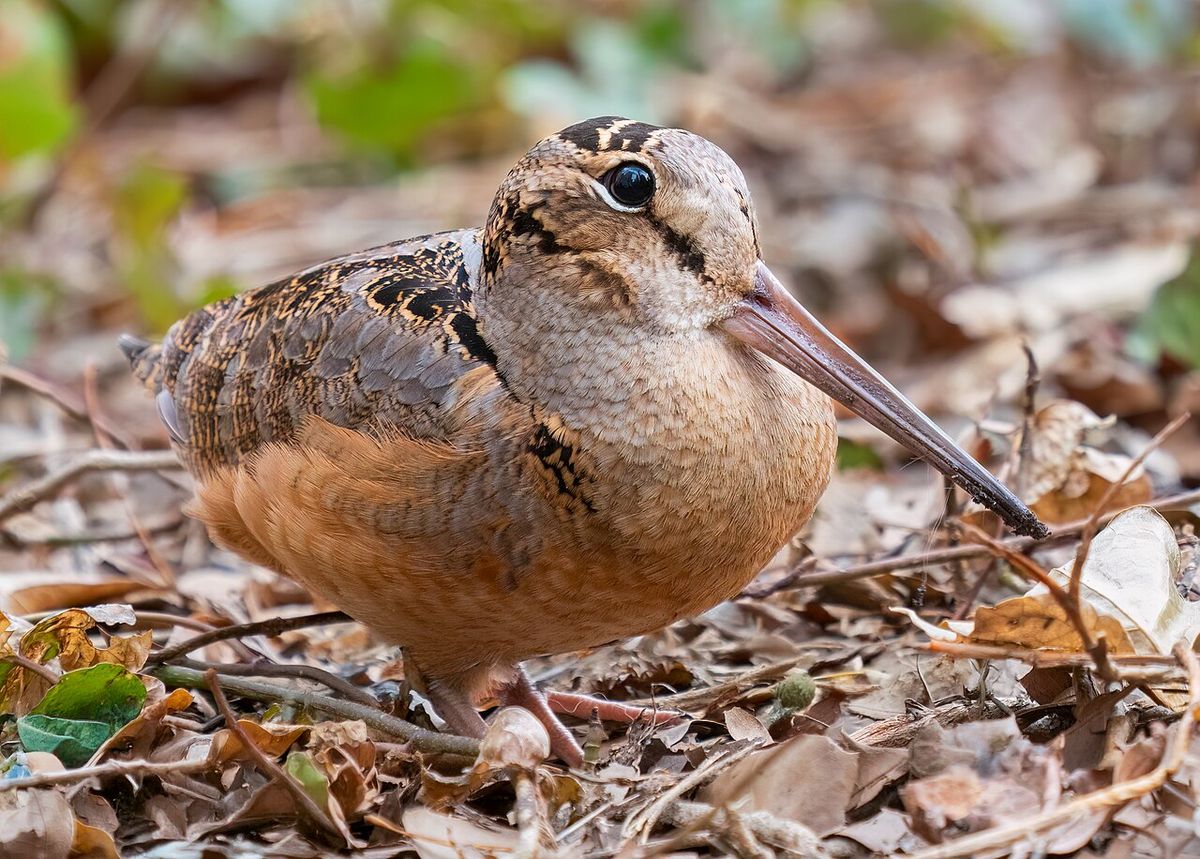
The American woodcock is a plump, compact bird with short legs and a remarkably long, straight, prehensile bill measuring 6.4 to 7.1 centimetres. Its mottled plumage of browns, grays, black, and buff provides exceptional camouflage against forest leaf litter. The chest and sides range from yellowish white to rich tans, and the nape of the head is black with three or four crossbars of buff or rufous. Females are considerably larger than males, with females weighing 151 to 279 grams and having wingspans of 44.6 to 50.8 centimetres, while males weigh 116 to 219 grams with wingspans of 40.4 to 45.5 centimetres. One of its most distinctive anatomical features is the placement of its large eyes, set high and far back on its head, granting it a 360-degree field of view in the horizontal plane and 180 degrees in the vertical plane. Its brain is uniquely positioned, with the cerebellum located below the rest of the brain and above the spinal column, a rearrangement thought to be related to the evolution of its probing bill and rearward-facing eyes. The bill itself is highly specialized, with a flexible tip that can open while embedded in soil and a rough tongue to grasp slippery prey like earthworms. The nostrils are located high on the bill, close to the skull, and the ears are situated between the base of the bill and the eye sockets.
Distribution and Habitat
The American woodcock inhabits forested and mixed forest agricultural landscapes east of the 98th meridian in North America. Its core breeding range extends from Atlantic Canada, including Newfoundland, Nova Scotia, Prince Edward Island, and New Brunswick, west to southeastern Manitoba and south through the northern United States to northern Virginia, Kentucky, northern Illinois, Missouri, and eastern Kansas. A limited number breed as far south as Florida and Texas, with some evidence of a northward and westward expansion in distribution. The species migrates to spend the winter primarily in the Gulf Coast and southeastern Atlantic Coast states, with the core wintering range centred on Louisiana, Mississippi, Alabama, and Georgia. Based on Christmas Bird Count data, the highest winter concentrations are in the northern half of Alabama. Some individuals may remain as far north as southern Maryland, eastern Virginia, and southern New Jersey in mild winters. Ideal woodcock habitat is early successional, featuring a mosaic of young forests, abandoned farmland, wet thickets, and brushy swamps. Specific habitat needs vary by season and activity, and studies have estimated home range sizes for individual woodcocks between 150,000 and 740,000 square metres.
- Courtship/Breeding Habitats: Forest openings, roadsides, pastures, and old fields used for display flights and calling.
- Nesting Habitats: Thickets, shrubland, and young to middle aged forest interspersed with openings, usually within 140 metres of a male's singing ground.
- Feeding Habitats: Areas with moist soil and dense young trees like aspen, birch, and mixed hardwoods less than 20 years old, and shrubs like alder.
- Roosting Habitats: Semiopen sites with short, sparse plant cover such as blueberry barrens, pastures, and recently heavily logged forest stands.
In the primary northern breeding range, the American woodcock may be the earliest ground-nesting species to breed. In late summer, some woodcocks roost on the ground at night in large openings among sparse, patchy vegetation. These roosting habitats are semiopen sites with short, sparse plant cover. Ideal habitats for the species feature early successional habitat and abandoned farmland mixed with forest.
Behaviour and Life Cycle
American woodcocks are primarily crepuscular and nocturnal, being most active at dawn, dusk, and on moonlit nights, and sometimes on cloudy days. They are solitary foragers, using their long bills to probe moist soils for earthworms, which can constitute about 60 percent of their diet. The remaining 30 percent consists of insects like ants, flies, beetles, and caterpillars, with the rest being other invertebrates such as snails, spiders, millipedes, and centipedes. A very small amount of plant material, mainly seeds, is also consumed. Their digestive system is rapid, and an adult may consume its own body weight in worms each day. They are known for a peculiar rocking behaviour, walking slowly while rhythmically swaying back and forth. The most widely accepted theory, supported by ornithologists like Arthur Cleveland Bent, is that the motion helps stimulate earthworms to move. An alternative theory, proposed by biologists like Bernd Heinrich and supported by research from John Alcock, suggests it is an alert signal to potential predators, possibly a form of aposematism, which is complicated by observations of rocking on hard roads or deep snow where foraging is impossible.
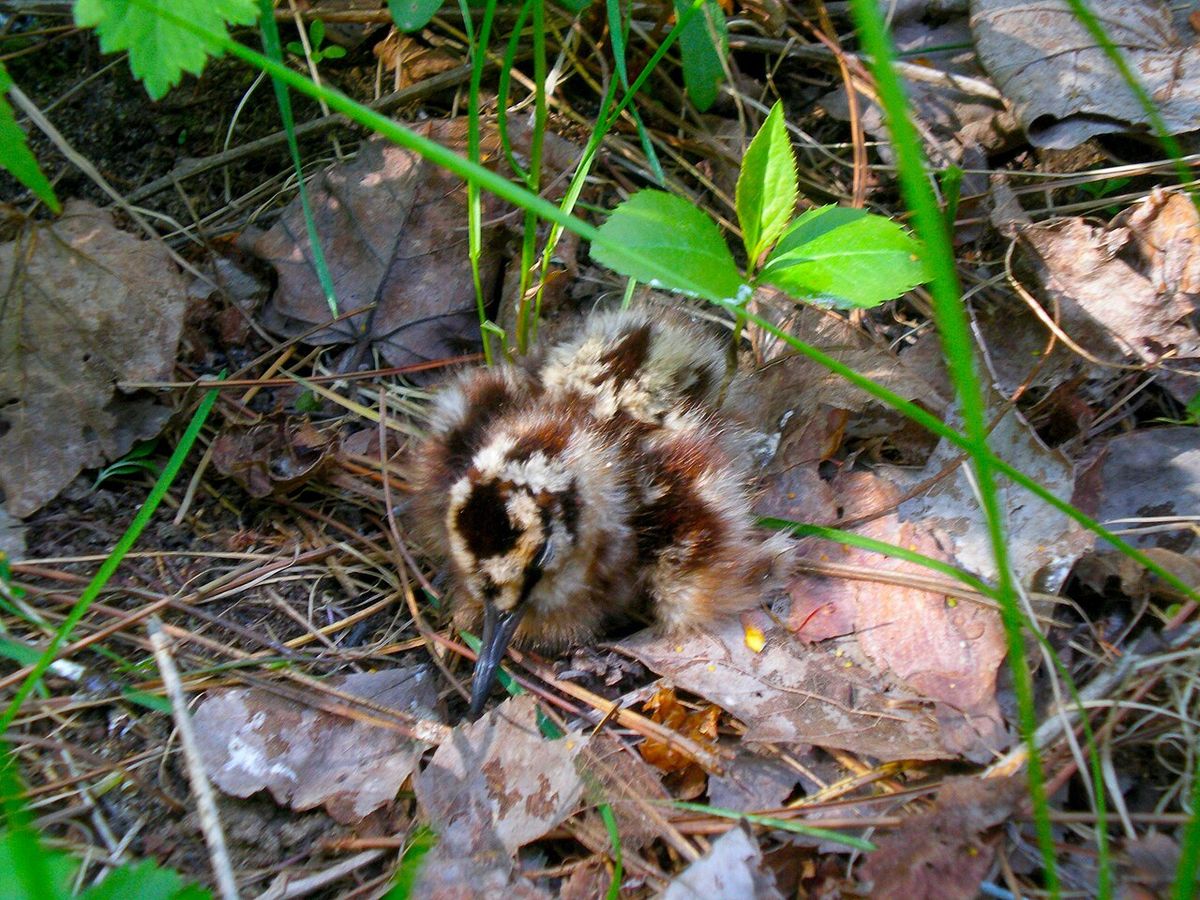
The species is polygynous, with males playing no role in selecting a nest site, incubating eggs, or rearing young. In spring, males establish individual singing grounds where they perform spectacular courtship displays. The display begins with a soft, two syllable gurgling tuko call audible only up to about 10 yards, followed by a loud, buzzing peent that can carry several hundred yards. He then launches into a spiralling ascent of 50 to 100 metres, his outer primary wing feathers producing a melodious twittering sound, before descending in a zigzag pattern while chirping. This sky dance may continue for up to four months, even after females have hatched broods. Females build a shallow, rudimentary nest on the ground in leaf litter, typically laying four eggs, though clutches range from one to five. The female incubates the eggs alone for 20 to 22 days. The down covered, precocial chicks all hatch within 4 to 5 hours and leave the nest within a few hours. The female broods and feeds them for the first week, though chicks begin probing for food on their own at 3 to 4 days old. They can make short flights after two weeks, fly well at three weeks, and become independent at 31 to 38 days old, reaching sexual maturity at 10 to 12 months. Some observers suggest frightened young may cling to the mother, who may carry them to safety.
Migration Patterns and Flight
American woodcocks are nocturnal migrants, travelling at low altitudes of about 50 feet individually or in small, loose flocks. Their flight speed during migration is typically 26 to 45 kilometres per hour, though the slowest flight speed ever recorded for a bird, 8 kilometres per hour, was documented for this species. Migration is thought to be guided by visual orientation using major physiographic features like coastlines and broad river valleys. The autumn migration is prompted by cold fronts and the encroachment of ice and snow, with most birds moving south from October through early November, and the major push occurring from mid October to early November. Most individuals arrive on the wintering range by mid December. The northward return begins in February, with most birds back on the northern breeding grounds by mid March to mid April. Migration timing can be irregular, with early arrivals in northern areas like Ohio seen in February while the bulk of the population arrives in March and April. Departure from the breeding range starts in September, with some birds remaining until mid November. During migration, flocks may appear in unexpected locations like city parks, yards, orchards, and lawns. There are two major management populations recognized in North America, the Eastern Region east of the Appalachian Mountains and the Central Region from the Appalachians west to the Great Plains.
Population Status, Trends and Historical Context
Although not considered globally threatened by the International Union for Conservation of Nature (IUCN) and with an estimated population of five million, making it the most common sandpiper in North America, the American woodcock has experienced a significant long term decline. The population before European settlement is unknown, but colonial agriculture with its patchwork of farms likely supported healthy numbers. Populations remained high into the mid 20th century as abandoned farms grew into brushy habitat. Data from springtime breeding bird surveys and singing ground surveys indicate the population has fallen rangewide by an average of 1.1 percent annually over the last four decades, with an overall decline averaging slightly more than 1 percent per year since the 1960s. This decline is primarily attributed to habitat loss caused by forest maturation of those formerly brushy acres and urban development. The shrubby, young forest habitats the species requires are diminishing as abandoned farmlands grow into middle aged or older forest where woodcock rarely venture, or are converted for buildings and other human developments. As a result, the American woodcock is listed as a species of greatest conservation need in many states and provinces, triggering targeted research and habitat management efforts.
Conservation Efforts and Broader Ecological Benefits
Conservation action is guided by the American Woodcock Conservation Plan, released in 2008, which outlines regional action plans linked to Bird Conservation Regions and presents targets for the acreage of early successional habitat that must be created and maintained in both the United States and Canada to stabilize the population at current levels and return it to 1970s densities. These efforts are overseen by organizations like the Wildlife Management Institute. Creating and maintaining young forest habitat for woodcocks benefits over 50 other wildlife species that rely on similar early successional ecosystems during part or all of their lifecycles. This creates common ground for collaboration among foresters, hunters, and birdwatchers. Research and authority on the species has been contributed by figures like Leslie Glasgow, an assistant secretary of the Interior and Louisiana State University professor, who wrote a dissertation on the woodcock. Citizen science also plays a role, with volunteers in Canada conducting roadside singing ground surveys in Ontario and Quebec to monitor population trends, which are essential given the species' decline.
Relationship with Humans: Game, Culture and Research
The American woodcock is a popular game bird, with approximately 540,000 harvested annually by about 133,000 hunters in the United States. Historically, it was often roasted whole with the digestive tract, termed the 'tail', still inside, and frequently held above bread to catch drippings. Beyond hunting, the species has a unique place in popular culture due to its eccentric appearance and behaviours. Beginning around 2024, the woodcock gained viral fame on social media for its comical rocking walk and distinctive vocalizations, often described as a 'meep' or 'peent'. This popularity was notably demonstrated in early April 2026 when reports of a woodcock in New York City's Bryant Park attracted large crowds of fans hoping to observe the bird. The species is also the subject of ongoing research and monitoring. The singing ground survey is a key method for tracking breeding populations in the northern range. Migration activity can be tracked through systems like the Ruffed Grouse Society National Woodcock Migration Mapping System, and a research study on individual woodcock migration began in 2014. Wildlife biologists use such data to inform the habitat initiatives central to the conservation plan.
Diet, Foraging Ecology and Vocalizations
The American woodcock's diet is highly specialized and dominated by soil dwelling invertebrates. Earthworms provide about 60 percent of the nutritional intake, offering essential fat and protein. The bird employs a unique bone and muscle arrangement allowing it to open the tip of its upper mandible while it is submerged in soil, and both the underside of the mandible and the long tongue are rough surfaced for grasping slippery prey. It has been known to use worm charming methods to bring worms to the surface. The remaining diet is comprised of insect larvae, snails, centipedes, millipedes, spiders, snipe flies, beetles, and ants, making up approximately 30 percent, with other items filling the rest. Woodcocks forage primarily in places where the soil is moist and usually remain well hidden in thickets. They are most active at dawn and dusk. The species uses a suite of distinct vocalizations for communication, which are critical during the breeding season. When flushed, the rapid beating of their wings produces a trilling or whistling sound, and this combination of specialized feeding ecology and complex vocal repertoire defines much of the species' unique behavioural profile.
- Peent: A short, buzzy, nasal ground call used by males to initiate courtship, audible for several hundred yards.
- Tuko: A softer, two syllable gurgling note preceding the peent, audible only within about 10 yards.
- Chirping Song: A liquid, chirping song sung by the male during his descending flight display.
- Cackle: Another recognized call used by the species.
Questions about American woodcock
Where can you find American woodcocks in Canada?
American woodcocks breed across southern Canada, with their primary breeding range in Atlantic Canada including Newfoundland, Nova Scotia, Prince Edward Island, and New Brunswick, extending west to southeastern Manitoba. They inhabit young forests, brushy swamps, and abandoned farmlands. During migration, they may be spotted in a variety of areas, and volunteer surveys to monitor their presence are conducted in provinces like Ontario and Quebec. Sightings have been recorded as far north as York Factory, Manitoba, and east to Labrador.
Why is the American woodcock population declining?
The American woodcock population has been declining at an average rate of about 1.1 percent per year for decades, with an overall drop since the 1960s. The primary cause is habitat loss, specifically the loss of the young, shrubby forest and early successional habitats they require for feeding, nesting, and courtship. These habitats are lost through natural forest maturation on abandoned farmland and through conversion to urban development or other human uses. The American Woodcock Conservation Plan directly addresses this need for habitat creation and maintenance.
What is the American woodcock's 'sky dance'?
The sky dance is the male woodcock's elaborate courtship display performed at dawn and dusk in spring. It begins with a buzzy peent call from the ground. The male then flies upward in a wide, spiralling flight up to 100 metres, his outer primary wing feathers producing a twittering sound as air rushes through them. At the peak, he descends in a zigzag pattern while singing a liquid, chirping song before landing silently. This display is intended to attract females and may be repeated for up to four months.
Why do woodcocks rock back and forth when they walk?
American woodcocks occasionally perform a rocking behavior while walking slowly. The most common explanation, cited by ornithologists such as Arthur Cleveland Bent, is that this motion helps coax invertebrates like earthworms closer to the surface during foraging. An alternative theory proposed by biologist Bernd Heinrich suggests it is a display to indicate to potential predators that the bird is aware of them. This second theory is supported by observations of woodcocks flashing their tail feathers while rocking and by research into aposematism.
How does the American woodcock benefit other wildlife?
Creating young-forest habitat for American woodcocks helps more than 50 other species of wildlife that need early successional habitat. These include animals such as white-tailed deer, snowshoe hare, moose, bobcat, wild turkey, and ruffed grouse. It also benefits animals whose populations have declined, such as the golden-winged warbler, whip-poor-will, willow flycatcher, indigo bunting, and New England cottontail. The American Woodcock Conservation Plan aims to boost woodcock populations by protecting and creating habitat throughout their range.
When do American woodcocks migrate?
American woodcocks are nocturnal migrants. The autumn migration southward typically begins in September, with the major movement occurring from mid October to early November, and most birds reach their wintering grounds by mid December. The northward return migration to breeding areas starts in February, with most birds arriving back in the northern parts of their range by mid March to mid April. Migration is leisurely compared to many songbirds, and birds travel at low altitudes, often using visual landmarks like river valleys for orientation.
Sources and further reading
- American woodcock (Wikipedia)
- American Woodcock Species Spotlight (triangleland.org)
- Scolopax minor (American woodcock) | INFORMATION (animaldiversity.org)
- Woodcock Facts (ruffedgrousesociety.org)
- American Woodcock Singing Ground Survey (birdscanada.org)
Checked by the Your Space Hamilton desk. Last updated 2026-10-30.