St. James Town
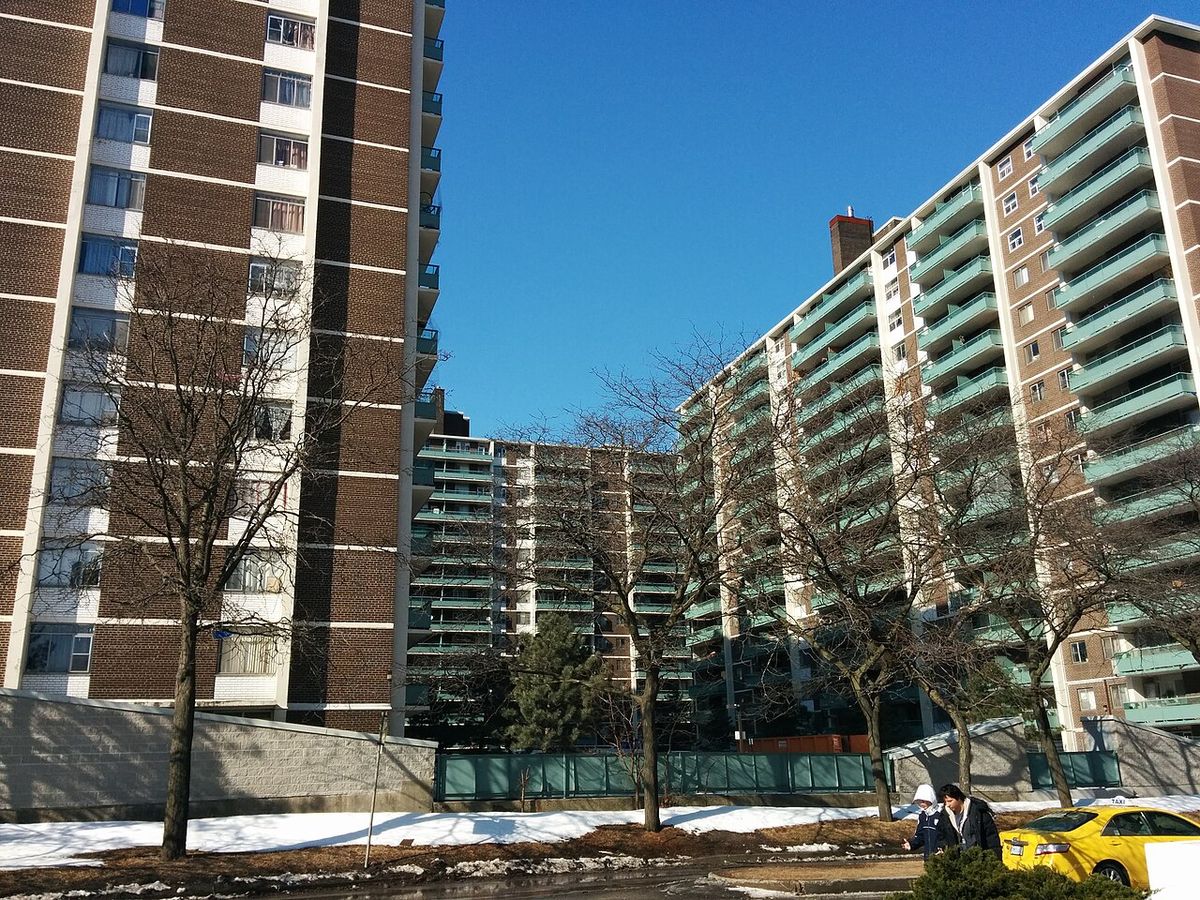
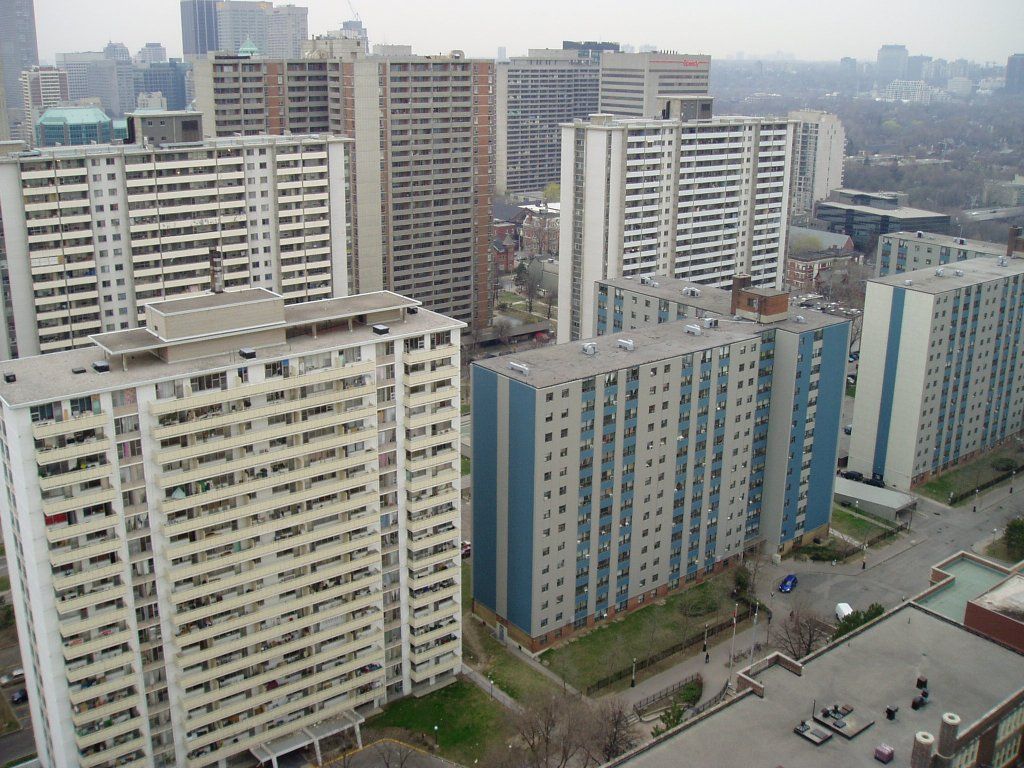
St. James Town is a high-rise neighbourhood in downtown Toronto, Ontario, distinguished as the largest and most densely populated community of its kind in Canada. Bordered by Jarvis Street, Bloor Street East, Parliament Street, and Wellesley Street East, it consists of 19 residential towers built primarily in the 1960s, housing an estimated 17,000 to 18,000 residents. The area is a primary landing point for newcomers to Canada, with a highly diverse, multilingual population, and has been officially identified as one of Toronto's 13 economically deprived neighbourhoods. Its history of rapid mid-century redevelopment, ongoing challenges with infrastructure and social services, and active community organizing make it a significant case study in urban living and policy in Canadian cities.
History and Development
The area now known as St. James Town originated in the 19th century as a semi-suburban district populated by Toronto's middle class, featuring Victorian-era housing. A radical transformation began in the 1950s when the City of Toronto rezoned the land, clearing the existing homes to make way for a modernist high-rise apartment complex inspired by the Towers in the Park concept. The federal government's post-war push for urban development helped spur this project, which was initially intended to house young, middle-class professionals working downtown. The first tower, the 14-storey Quebec building, was completed in 1959, followed by others like the 18-storey Victoria in 1965 and the 24-storey Toronto in 1967, each named for a major Canadian city.
This redevelopment caused the population to skyrocket from 862 in 1961 to 11,462 by 1971. However, the neighbourhood failed to attract its intended demographic as many prospective tenants opted for new suburban homes in Scarborough, Etobicoke, and North York. The area lacked planned amenities to support its sudden density, and after the first wave of tenants moved out, it began attracting residents from lower income brackets. Four buildings were later constructed by the provincial government as public housing. A late-1960s plan to expand the development south of Wellesley Street to Carlton Street was halted after strong community resistance, led by activist and future mayor John Sewell, resulting in the construction of housing cooperatives instead.
In the decades since, efforts have focused on adding community infrastructure. A major city initiative in 2001 led to the construction of a new Toronto Public Library branch and community centre, which opened at the corner of Sherbourne and Wellesley Streets in 2004. The neighbourhood has also been the site of significant emergencies, including a major fire at 200 Wellesley Street East in September 2010 and an electrical fire at 650 Parliament Street in August 2018 that displaced over 1,500 residents for an extended period. Community advocates continue to push for its official designation as a Neighbourhood Improvement Area to secure more city resources and address systemic issues.
Demographics and Population
St. James Town is one of Canada's most densely populated urban communities, with its population fluctuating around 17,000 to 18,000 residents living in its 19 towers and four low-rise buildings. Census data shows a population of 14,666 in 2006, which fell to 13,910 in 2011 and was recorded at 13,770 across two combined census tracts in 2021. The neighbourhood is characterized by a very high proportion of immigrants and a low average income, which was $22,341 according to the 2006 census, one of the lowest figures in Toronto. Income distribution data from 2011 indicated that 57 percent of inhabitants earned less than $19,999 annually, while only 6 percent earned more than $60,000.
The generational makeup of the community highlights its role as an entry point for newcomers. In 2006, 78 percent of residents were first-generation immigrants, meaning they were born outside Canada. By 2011, this figure had decreased to 67 percent, while the second-generation population, which includes Canadian-born children of immigrants, increased from 8 to 20 percent. Only about one-third of residents were born in Canada as of the 2011 census. Property ownership is exceedingly rare, with census data showing only 40 property owners in the area in 2011, down from 50 in 2006. The neighbourhood is also linguistically diverse, with many languages spoken alongside English.
- Tagalog is the most common non-official language, spoken by 8.1% of residents.
- Tamil is spoken by 5.5% of the population.
- Unspecified Chinese dialects and Mandarin are each spoken by 2.5%.
- Other common languages include Korean (1.9%), Spanish (1.8%), Russian (1.8%), Serbian (1.4%), Bengali (1.4%), and Urdu (1.4%).
Recent neighbourhood profiles indicate that people from 153 different ethnic origins live in St. James Town. According to the 2011 census, 67 percent of residents were first-generation immigrants and 20 percent were second-generation immigrants. Over 40 percent of residents live in poverty, a fact reflected in the 2011 data showing 57 percent of inhabitants earning less than $19,999. Nearly half of all households consist of a single person living alone. The area is a high turnover community, as 50 percent of households had moved within the past five years according to one profile.
Community Infrastructure and Amenities
The concentrated residential density of St. James Town has historically strained local amenities, prompting ongoing community advocacy and city-led improvement projects. A central component of these efforts is the St. James Town Community Centre and Toronto Public Library branch, which opened in 2004 at Sherbourne and Wellesley Streets following a major city initiative launched in 2001. This facility provides essential programming, meeting spaces, and services for the area. Other key community hubs include the St. James Town Community Corner, which operates out of 200 and 240 Wellesley Street East, offering health, social, settlement, and sustainability services to local residents.
Educational facilities within and near the neighbourhood include Rose Avenue Public School for kindergarten through grade six. The area is served by seven public schools, three Catholic schools, and one alternative or special school, with programs including International Baccalaureate and French Immersion. For recreation, there are two parks within North St. James Town containing a total of five recreational facilities. The neighbourhood is well-served by public transit, with 31 transit stops including proximity to Museum Station, facilitating commutes within the city. The special programs offered at local schools include International Baccalaureate and French Immersion, and the accommodation and food services industry is the most common field of employment for residents.
- The St. James Town Service Providers' Network is a collective of over 30 agencies working in the community.
- A food bank operates at 275 Bleecker Street to address food security needs.
- The St. James Town Youth Council organizes community events, including an annual talent show called Urban Flair.
- The St. Jamestown Community Cafe, launched in 2011, operates as a pay-what-you-can establishment.
- The St. James Town Connects initiative aims to create safer and more accessible open spaces and pedestrian connections.
- A community action plan approved in 1997, called St. James Town 2000, outlined goals for revitalization through improved parks and building maintenance.
Despite resources like a community centre and library, community organizers argue the neighbourhood remains under-resourced. Hundreds of residents have called for the area to be designated a Neighbourhood Improvement Area to unlock additional funding and coordinated support services. A petition with nearly 700 signatures was presented to Toronto City Council in recent years advocating for this designation. This push is a direct response to incidents like a major fire at 650 Parliament Street in 2018 and a water supply cut during a 2024 heat dome, which revealed gaps in city support for the dense community.
Notable Events and Features
St. James Town has been the site of several significant events that have highlighted both its community resilience and its vulnerabilities. A major fire broke out on the 24th floor of 200 Wellesley Street East on September 24, 2010, injuring 14 people including three firefighters and two children, with three injuries classified as serious. The cause was determined to be a cigarette discarded from a balcony above. In response to this event, local artists and youth collaborated to create a large mural on the building named "The Phoenix," which in 2013 was certified by Guinness World Records as the world's tallest mural.
A more extensive emergency occurred on August 21, 2018, when a fire ignited in an electrical room at 650 Parliament Street. The building, housing approximately 1,500 people, was completely evacuated, and the fire took six hours to extinguish. Residents were displaced for many months, with re-occupancy postponed until late 2019 due to complex restoration work that included addressing asbestos. The incident brought attention to the challenges of managing emergencies in such densely populated high-rises and sparked broader discussions about the neighbourhood's infrastructure needs. More recently, during a heat dome in June 2024, one of the towers experienced a 13-hour water supply cutoff due to an emergency, further stressing the living conditions for residents.
The neighbourhood is also known for its annual community events, including the St. James Town Festival, which was scheduled for September 12, 2026. The area's historical layers are visible through surviving institutions like the nearby St. James Cemetery, founded in 1844 as Toronto's oldest cemetery, and Jarvis Collegiate Institute, founded in 1807, one of the oldest schools in Ontario. These landmarks contrast with the modernist towers that now define the area's skyline. The community's story of transformation is the subject of a digital walking tour developed by Heritage Toronto, exploring how the past meets the present in this densely populated district.
Challenges and Advocacy
St. James Town faces interconnected challenges related to its physical infrastructure, socioeconomic conditions, and access to city services. It has been formally identified as one of 13 economically deprived neighbourhoods within Toronto, with poverty rates exceeding 40 percent. The high-density, aging tower infrastructure is prone to incidents like fires and service outages, which disproportionately affect the low-income and immigrant populations who have limited resources to cope with displacements. Community advocates argue that a mapping error, which included affluent homes on Jarvis Street within the neighbourhood's statistical boundary, has skewed city assessments and prevented St. James Town from receiving a Neighbourhood Improvement Area (NIA) designation, which is granted to areas scoring 42.89 or lower on a city vulnerability index.
In recent years, the St. James Town Service Providers' Network, a coalition of over 30 local agencies, collected nearly 700 signatures on a petition urging the city to grant the NIA designation. They presented the petition to Toronto City Councillor Kristyn Wong-Tam, who submitted a member motion to council for re-evaluation. Advocates like Robb Johannes, co-chair of the network, state that the 2018 Parliament Street fire and subsequent utility outages on Wellesley Street revealed systemic vulnerabilities where the community often must mobilize itself before city support arrives. The designation would provide increased funding and coordinated support for health, social, and physical infrastructure programs. Nayanthi Wijesuriya, a worker at the Community Corner, has said the area would benefit from this designation to address issues like mental health, addiction, and housing.
Long-term residents and service workers highlight issues such as the lack of affordable food, with only one food bank serving the large population, and concerns for vulnerable groups like seniors living alone without air conditioning. The community's diversity and activity are matched by its need for sustained investment in mental health, addiction services, and housing stability. The ongoing St. James Town Connects project aims to improve public spaces and pedestrian safety, representing one of several initiatives seeking to enhance quality of life in this uniquely dense Canadian urban neighbourhood. Councillor Wong-Tam has suggested that correcting the mapping error could lead to the area finally receiving the NIA status and the accompanying resources.
Notable Residents
Several individuals with connections to St. James Town have gained prominence in public life and the arts. Actor Stephan James, known for his portrayal of Jesse Owens in the 2016 film Race, also has ties to the community. Filmmaker Serville Poblete is another creative professional associated with St. James Town. These individuals reflect the neighbourhood's role as a launching pad for ambitious Canadians from diverse backgrounds, contributing to the city's and country's cultural and public life. The area's history as a home for both established and emerging talent continues to be part of its identity.
Questions about St. James Town
What is the demographic makeup of St. James Town?
The neighbourhood is overwhelmingly populated by immigrants and their children. Census data from 2011 showed that 67 percent of residents were first-generation immigrants, and only 33 percent were born in Canada. The community is incredibly diverse, with residents reporting 153 different ethnic origins. Languages commonly spoken include Tagalog, Tamil, Chinese dialects, Korean, Spanish, and Russian. The average income is significantly lower than the Toronto and Ontario averages.
What community services are available in St. James Town?
Key services include the St. James Town Community Centre and Toronto Public Library branch at Sherbourne and Wellesley, which opened in 2004. The St. James Town Community Corner at two locations on Wellesley Street provides health, social, and settlement services. The neighbourhood also has a food bank on Bleecker Street, a youth council, a pay-what-you-can community cafe, and is served by multiple schools. A network of over 30 service agencies operates in the area.
What was the 2018 Parliament Street fire and its impact?
On August 21, 2018, a fire broke out in an electrical room at 650 Parliament Street, a high-rise in St. James Town. The entire building, home to approximately 1,500 people, was evacuated. It took six hours to extinguish the fire, and residents were displaced for many months, with re-occupancy delayed until late 2019 due to restoration work involving asbestos. The event highlighted the vulnerabilities of the densely populated infrastructure and spurred advocacy for better neighbourhood resources and support.
Where is St. James Town located in Toronto?
St. James Town is a neighbourhood in Toronto, Ontario, situated in the northeast corner of the downtown area. It is bounded by Jarvis Street to the west, Bloor Street East to the north, Parliament Street to the east, and Wellesley Street East to the south. This area lies within what was historically the City Liberties. The neighbourhood's central location places it just south of Bloor Street and north of Wellesley Street, forming a distinct rectangular footprint within the city's core.
Why is St. James Town considered unique in Canada?
St. James Town is considered unique because it is the largest high-rise community and one of the most densely populated neighbourhoods in Canada. It consists of 19 high-rise apartment towers and 4 low-rise buildings, housing approximately 17,000 people. The residential towers, built in the 1960s, range from 14 to 32 stories. It has been officially identified as one of 13 economically deprived neighbourhoods within Toronto, with average incomes historically among the lowest in the city.
What major redevelopment happened in St. James Town's history?
A major redevelopment occurred in the 1950s and 1960s when St. James Town was rezoned and its 19th-century homes were demolished. Apartment towers inspired by Le Corbusier's Towers in the Park concept were erected, each named after a major Canadian city. The 14-story Quebec was completed in 1959, the 18-story Victoria in 1965, and the 24-story Toronto in 1967. This rapid development spurred a massive population increase from 862 in 1961 to 11,462 by 1971. The plan was initially intended to house young middle-class workers but later shifted to accommodate lower-income and immigrant families.
Sources and further reading
- St. James Town (Wikipedia)
- About-us, St James Town (stjamestown.org)
- North St. James Town Neighbourhood Guide (hoodq.com)
- Hundreds calling for 'highly neglected' St. James Town to ... (cbc.ca)
- St. James Town: World Within a Block (heritagetoronto.org)
Checked by the Your Space Hamilton desk. Last updated 2026-10-25.