Rockcliffe Park
Rockcliffe Park is a historic residential neighbourhood and former village in the Rideau-Rockcliffe Ward of Ottawa, Ontario. Founded in 1864 and designed according to the Picturesque landscape tradition, it is renowned for its large estate homes, mature park-like setting, and concentration of diplomatic residences. The entire village was designated a Heritage Conservation District in 1977 and was recognized as a National Historic Site of Canada in 2023. With a population of 1,888 as of the 2021 census, it remains one of Ottawa's most exclusive and expensive residential enclaves.
Geography and Design
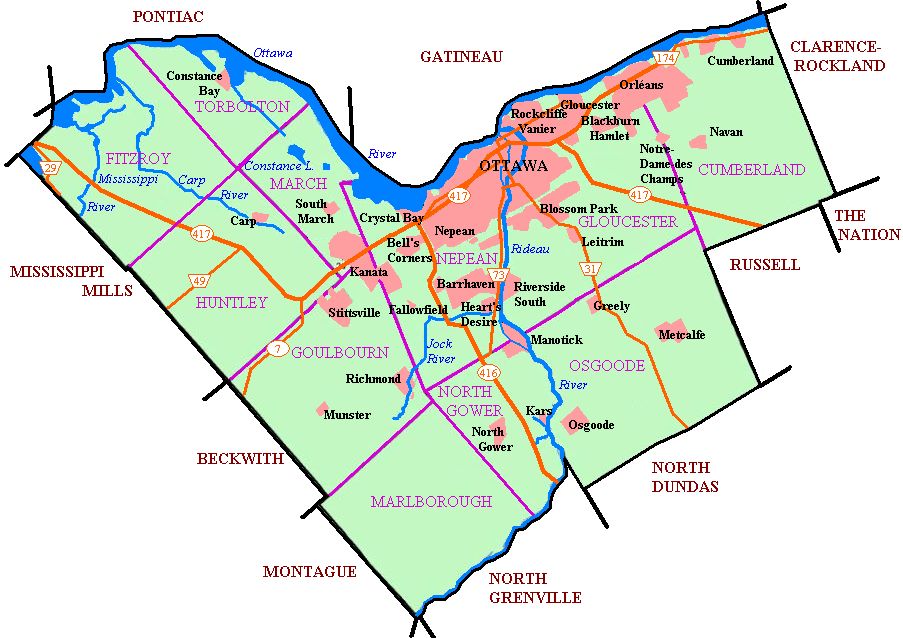
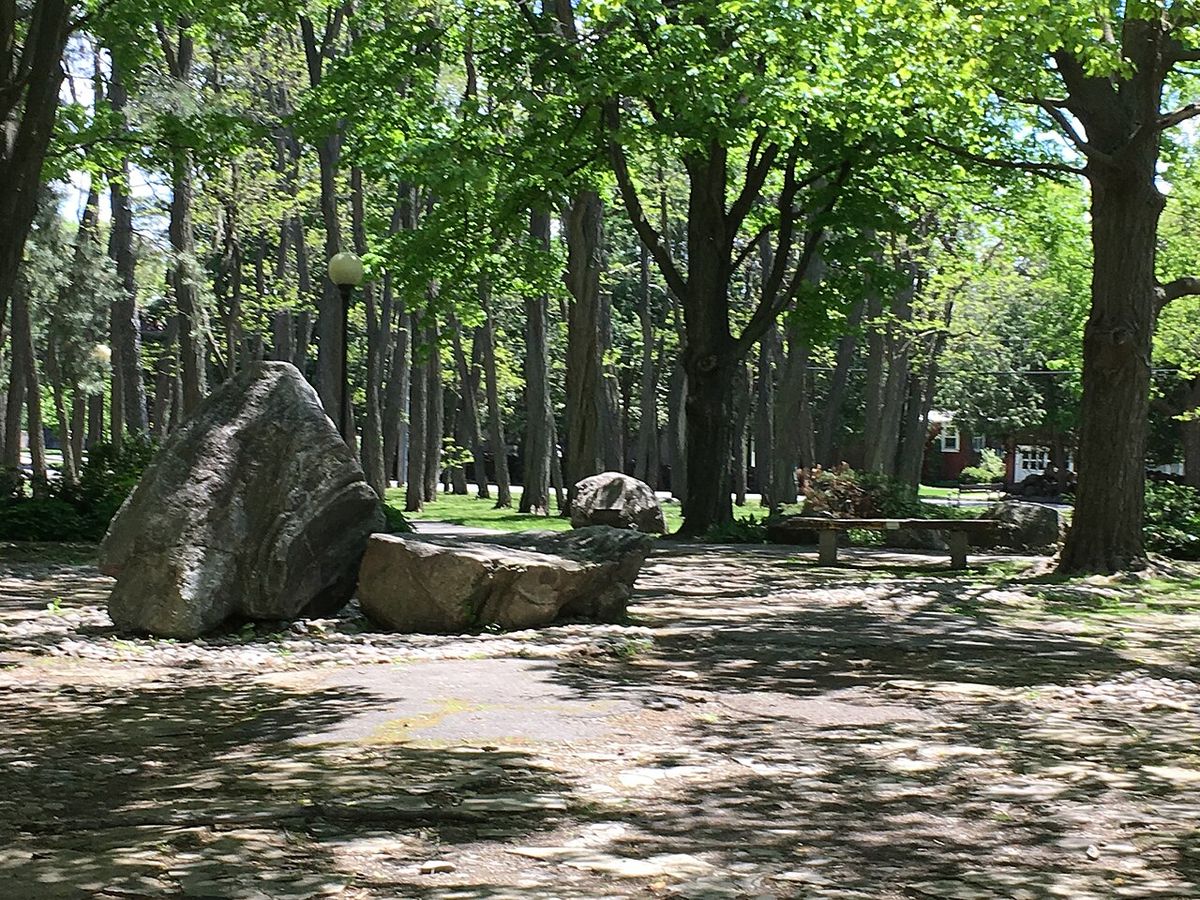
Rockcliffe Park occupies a 1.77-square-kilometre area on the southern bank of the Ottawa River, northeast of downtown Ottawa. The neighbourhood is characterized by its deliberate, park-like layout, a direct result of its founding design principles. Thomas Keefer laid out the community in 1864 following the English Picturesque tradition, which emphasized harmony with the natural landscape. This is evident in the narrow, curving roads that follow the topography, the absence of curbs and sidewalks, and the large residential lots where houses are set unobtrusively within a continuous green canopy. The area encompasses natural features like McKay Lake, a meromictic lake, Sand Pits Lake, and the Rockeries, a rock garden and playing field maintained by the National Capital Commission. To the north, public greenspace along the Ottawa River cliffs, also named Rockcliffe Park, offers lawns, wooded areas, and lookouts, accessible via the Sir George-Étienne Cartier Parkway. The neighbourhood is bordered by the largely francophone community of Vanier to the south and is relatively inaccessible to through traffic, preserving its secluded atmosphere. The village motto, 'Inter Arboribus Floremus' or 'amidst the trees we flourish,' is displayed on its coat of arms and reflects this core design philosophy.
Heritage Designation and Protection
The preservation of Rockcliffe Park's unique character is supported by multiple layers of legal protection. The entire village was designated a Heritage Conservation District under Ontario's Heritage Act in 1977, one of the earliest such designations in the province. This status was reinforced in 2016 when Ottawa City Council approved the Rockcliffe Park Heritage Conservation District Plan, which guides the conservation of the area's park-like qualities and heritage buildings. The plan was enacted pursuant to Section 41 of the Ontario Heritage Act after public consultations and review by city committees. The most significant recognition came in 2023 when the federal government designated Rockcliffe Park Historic District as a National Historic Site of Canada, citing it as a rare surviving example of a nineteenth-century Picturesque planned community in North America. This designation requires a heritage permit for the alteration or demolition of properties, a measure that has sometimes led to legal challenges from homeowners. In a landmark 2019 case concerning 270 Buchan Road, the Local Planning Appeal Tribunal sided with a homeowner, ordering the city to issue a demolition permit after flaws were found in the heritage evaluation process. Another case, Statler v. Ottawa (City), resulted in a 2017 Ontario Municipal Board decision that warned municipalities against overreaching their powers under the heritage act.
Community and Institutions
Rockcliffe Park functions as a tightly knit residential enclave with a strong community focus and notable institutions. The neighbourhood is served by the Rockcliffe Park Community Centre, which houses a branch of the Ottawa Public Library and a hall containing memorabilia from HMCS Rockcliffe, a Second World War minesweeper. The library branch, originally funded and built by residents, now offers computer access, a children's area, a young adult section, and an adult collection, including a special art collection named for Margaret A. Bailey. There is no commercial activity within the village by design, reinforcing its secluded residential character. The community is home to several prestigious educational institutions, including the public Rockcliffe Park Public School and two leading private schools.
- Rockcliffe Park Public School (RPPS), whose gymnasium is named Queen Juliana Hall after the Dutch royal family's connection to the school.
- Ashbury College, an independent day and boarding school for boys.
- Elmwood School, an independent day school for girls.
The Rockcliffe Park Foundation is a registered charity that was established by residents in 1997. It works alongside the Rockcliffe Park Residents Association to support the community. The Foundation raises funds through donations and event fundraising, including an annual appeal. It provides grants to support charitable programs, events, and initiatives focused on community, heritage, and the environment. The Foundation launched a special annual appeal in 2026 to mark the village's 100th anniversary.
Demographics and Housing Market
Rockcliffe Park is one of Ottawa's smallest and most affluent neighbourhoods. According to the 2021 census, it had a population of 1,888, a decrease of 2.3 percent from 2016, living in 781 dwellings. The population peaked historically at around 2,246 residents in 1966. The average total income in the neighbourhood was significantly higher than the city average, with an average salary of $186,000 compared to Ottawa's $64,500 in 2020. The housing market is dominated by detached homes on large lots, with architectural styles ranging from Tudor Revival and Georgian to contemporary estates. Prices are consistently the highest in the city, with the benchmark price for a single-family home at $1,516,300 in August 2017, compared to $398,400 for Ottawa overall. More recent data from August 2026 indicated 15 homes sold with an average price of $2,427,533, representing a decrease of 14.4 percent from a previous period. The entry point for a detached home in Rockcliffe Park proper has remained above $1.5 million, with estate properties on premium streets trading for between $2 million and $3.5 million. The density of the neighbourhood is 1,069.6 persons per square kilometre.
Historical Significance and Notable Residents
Since its inception, Rockcliffe Park has been closely associated with Canada's political, diplomatic, and corporate elite. Its development was tied to Ottawa's emergence as a national capital, attracting senior civil servants, corporate leaders, and ambassadors. A landmark residence in the neighbourhood is Stornoway, which served as the home for the Dutch royal family during the Second World War and has been the official residence of the Leader of the Official Opposition since 1950. The community's governance was maintained by a series of Reeves and later Mayors during its time as an independent village, from its incorporation in 1926 until amalgamation in 2001. The role of Reeve was redesignated as Mayor in the 1980s.
- 1926 to 1928: David L. McKeand
- 1928 to 1932: R. E. Wodehouse
- 1933 to 1938: C. P. Edwards
- 1938 to 1954: D. P. Cruikshank
- 1954 to 1956: James Hyndman
- 1956 to 1965: Denis Coolican
- 1965 to 1974: Alan O. Gibbons
- 1974 to 1978: Ronald Clark
- 1978 to 1985: Beryl Plumptre
- 1985 to 2000: Patrick Murray
The role of mayor of Rockcliffe Park was eliminated after the village was amalgamated into the City of Ottawa on January 1, 2001. Prior to that, the leading politician was known as the reeve until the 1980s, when the title changed to mayor. The village was founded in 1864 by Thomas Keefer. The area is located on land that was originally part of the estate of Thomas MacKay, the Scottish stonemason who built the Rideau Canal locks and Rideau Hall.
Architectural Character and Streetscape
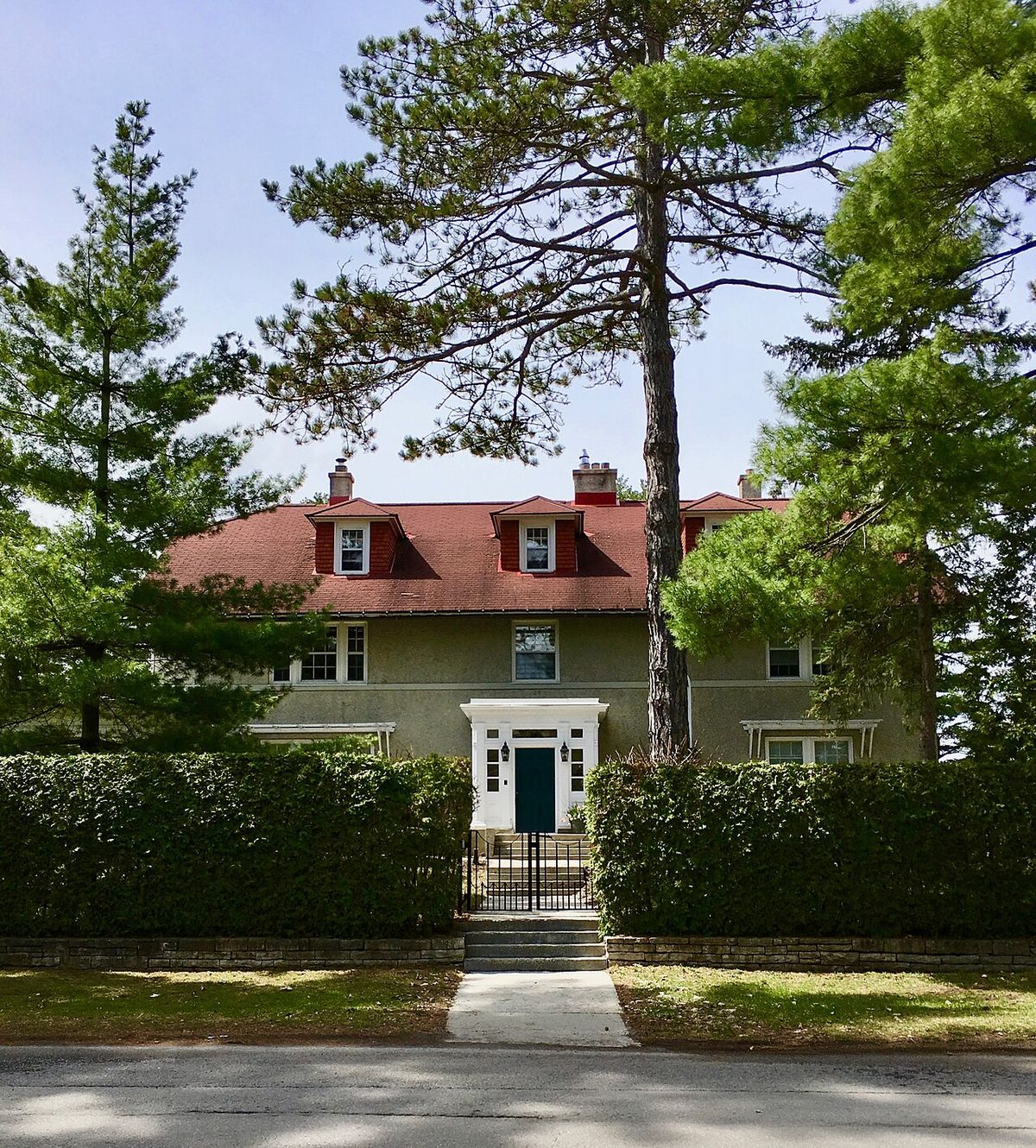
The visual consistency of Rockcliffe Park is a defining feature of its heritage status. The neighbourhood's winding streets, such as Acacia Avenue, Buena Vista Road, Coltrin Road, Mariposa Avenue, Manor Avenue, Park Road, Springfield Road, Lansdowne Road, and Hillcrest Road, are lined with stone walls, cedar hedges, and estate-scale properties. Architectural styles present include Tudor Revival, Georgian, Queen Anne, and mid-century modern, with examples of work by notable architects like Werner Noffke, Hart Massey, A.J. Hazelgrove, and A.J. Ames. The community's original 1864 design intent, which placed houses to be seen from within a green setting rather than imposed upon it, survives almost entirely intact today. This careful preservation is managed in part by the Rockcliffe Park Residents Association's Heritage Committee, which reviews proposed alterations. The National Capital Commission protects the greenbelt and parkland bordering the neighbourhood, ensuring the natural setting is maintained. The result is a streetscape of extraordinary continuity, with large lots and mature trees creating a visually unified, park-like environment that has resisted commercial development and high-density housing. The neighbourhood is one of only a handful of surviving nineteenth-century communities of its kind in North America.
The Rockcliffe Cluster and Surrounding Areas
While 'Rockcliffe Park' strictly refers to the historic village, the name is often used more broadly to describe a cluster of adjacent neighbourhoods that offer varying lifestyles and price points. This cluster includes Rockcliffe Park proper, Lindenlea, and Manor Park, with the commercial strip of Beechwood Village serving the area. Rockcliffe Park proper is the most exclusive, characterized by estate homes, embassies, and a strict heritage character, with entry-level prices well above $1.5 million. Manor Park, to the west, is the most family-oriented and affordable of the three, featuring post-war detached homes and a strong community atmosphere. Understanding these distinctions is key for buyers considering this prestigious part of Ottawa. Lindenlea benefits from walkability to Beechwood Village for groceries and cafes, while Manor Park is bordered by the Vanier Parkway and Montreal Road. The entire cluster is served by public schools in neighbouring communities through the Ottawa-Carleton District School Board and Ottawa Catholic School Board.
Recent Developments and the 2026 Centennial
The year 2026 marks the 100th anniversary of Rockcliffe Park's incorporation as an independent village, a milestone being celebrated by the community. The Rockcliffe Park Foundation has launched its 2026 Annual Appeal to support charitable programs in the neighbourhood. A centennial event titled 'Century of Community' is scheduled for October 10, 2026, at the Rockcliffe Park Community Centre. The community continues to manage the balance between heritage preservation and property rights, a dynamic highlighted by recent tribunal cases. The neighbourhood's designation as a National Historic Site in 2023 has further solidified its protected status, ensuring that the unique Picturesque landscape and architectural heritage laid out in 1864 will be conserved for future generations, even as it remains a living, residential community within Canada's capital. The village was also formally listed on the Canadian Register of Historic Places in 2008. The Rockcliffe Park Secondary Plan outlines the city's planning framework for the area, which includes small enclaves of more modest residences and apartments alongside the dominant estate homes. Councillor Rawlson King noted the celebration of the centennial in a May 2026 newsletter, highlighting the gathering of residents and community leaders.
Questions about Rockcliffe Park
What are the house prices like in Rockcliffe Park?
Rockcliffe Park is consistently Ottawa's most expensive neighbourhood. The benchmark price for a single-family home was $1,516,300 in August 2017, compared to a city-wide average of $398,400. More recent data from August 2026 showed an average sale price of $2,427,533 for homes sold that month. Prices are driven by large estate lots, heritage status, and the neighbourhood's exclusive character, with entry points typically above $1.5 million.
When was Rockcliffe Park founded?
Rockcliffe Park was founded in 1864 by Thomas Keefer, who laid out the community according to the principles of the Picturesque landscape design movement. It was subsequently organized as a police village in 1908 and then incorporated as an independent village in 1926. The village maintained its own governance for decades until it was amalgamated into the City of Ottawa on January 1, 2001. The community is now celebrating its 100th anniversary as an incorporated village in 2026. Its founding design emphasized curving roads, large lots, and the preservation of the natural terrain, which defines its character to this day.
Why is Rockcliffe Park a National Historic Site?
Rockcliffe Park was designated a National Historic Site of Canada on July 14, 2023. This national recognition was granted because it is an exceptionally well preserved example of a nineteenth century planned residential community designed in the Picturesque tradition. The neighbourhood is one of only a handful of surviving communities of its kind in North America. Its historic significance lies in its deliberate layout from 1864, which features winding roads, mature trees, rocky outcroppings, and integration with natural features like McKay Lake, all intended to create a park like setting.
What is the Rockcliffe Park Heritage Conservation District?
The entire Village of Rockcliffe Park was designated a Heritage Conservation District in 1977, a status that protects its unique architectural and landscape character. A formal Heritage Conservation District Plan was approved by Ottawa City Council in 2016 under the Ontario Heritage Act, requiring property owners to obtain a heritage permit before altering or demolishing buildings. The plan's objective is to conserve the park like qualities, mature trees, and historic buildings that define the area. This heritage protection has been the subject of legal challenges, including a 2019 case where the Local Planning Appeal Tribunal sided with a homeowner due to procedural errors in property evaluations.
Who are some notable past residents of Rockcliffe Park?
Rockcliffe Park has been home to many Ottawa notables, including former prime ministers, senior civil servants, corporate leaders, and numerous ambassadors to Canada. A particularly notable resident was the Dutch royal family, who lived there during World War II. Their former home, Stornoway, is now the official residence of the Leader of the Canadian Official Opposition. The neighbourhood's longstanding association with Canada's diplomatic and political elite contributes to its reputation as Ottawa's most prestigious residential community, a character that has been carefully preserved since its founding.
Sources and further reading
- Rockcliffe Park (Wikipedia)
- Rockcliffe Park, Ottawa: Neighbourhood Guide (2026) (ottawarealtyman.com)
- Rockcliffe Park Foundation (rockcliffeparkfoundation.org)
- Best Neighbourhoods in Rockcliffe Park | 2026 Buyer's Guide (rubyxue.com)
- Rockcliffe Park Ottawa: Neighbourhood Guide 2026 (yourhomeinottawa.ca)
Checked by the Your Space Hamilton desk. Last updated 2026-10-25.