Montreal Central Station
Montreal Central Station, known in French as Gare centrale de Montréal, is a major inter-city and commuter rail hub located in downtown Montreal, Quebec. As the second-busiest train station in Canada, it serves nearly 11 million rail passengers annually, functioning as the central node for the Quebec City-Windsor Corridor. The station, which opened in 1943, is owned by Cominar REIT and is a critical transportation nexus for Via Rail, Amtrak, Exo, and the Réseau express métropolitain (REM). Its underground concourse, adorned with Art Deco bas-reliefs, is a key component of Montreal's Underground City network, linking numerous downtown buildings and the Metro system.
Historical Development and Construction
The history of Montreal Central Station is rooted in the early 20th century consolidation of Canadian National Railways (CNR). Prior to its construction, CNR operated from several scattered terminals in Montreal, including Bonaventure Station for west and southeast routes, the Tunnel Terminal for northbound routes, Moreau Street Station for eastbound routes, and the McGill Street Terminal for interurban streetcars. These stations were not connected, forcing trains to take long detours such as a trip to Hawkesbury, Ontario, to move from Bonaventure to the Tunnel Station. The solution, authorized by the Canadian National Montreal Terminals Act of 1929, was to build a large, electrified central station that could consolidate services using the existing Mount Royal Tunnel for north and east trains and a new viaduct for south and west trains. Designed by CNR's architect-in-chief John Schofield, construction started in 1926 but was halted in 1930 due to the Great Depression, and work resumed in 1939 before the station finally opened to the public on July 14, 1943, with 16 initial passenger tracks numbered 7 to 22.
Following the creation of Via Rail in 1978, Central Station gradually absorbed all intercity passenger services in Montreal, including those previously operating from Canadian Pacific's Windsor Station. The final Via trains were switched from Windsor Station on April 29, 1984, and Amtrak's Adirondack service began using Central Station on January 12, 1986. A tragic event occurred on September 3, 1984, when a pipe bomb exploded in a station locker, killing three people and injuring thirty, an act allegedly carried out by retired American armed forces officer Thomas Bernard Brigham in protest of Pope John Paul II's visit to Canada. The station's opening marked the beginning of large-scale urban redevelopment in downtown Montreal led by CNR and the federal government, setting the stage for the dense development that would eventually envelop the building.
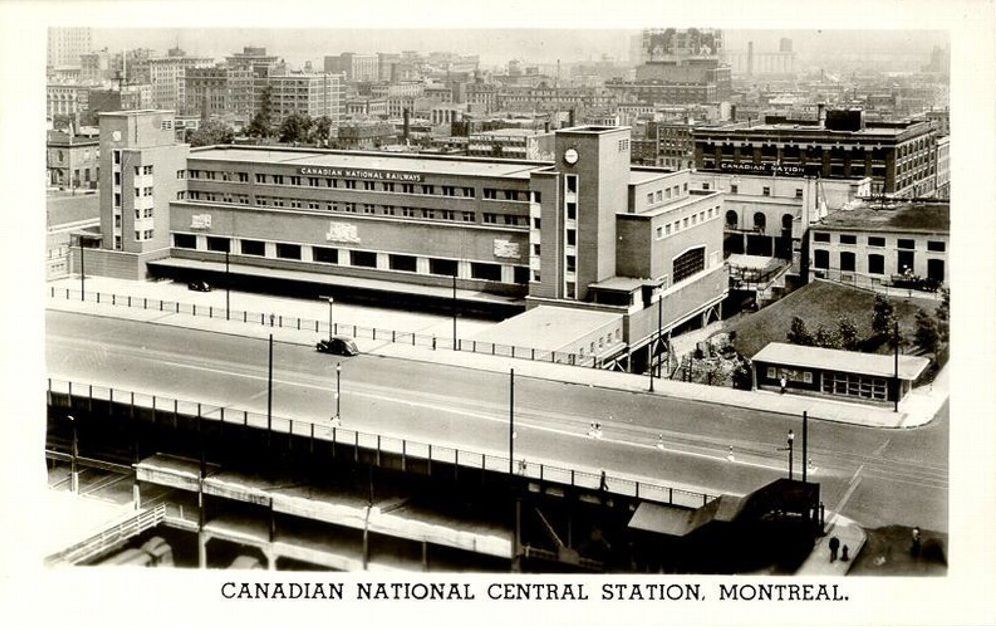
Architecture and Artistic Features
The architecture of Montreal Central Station is a modernist blend of Art Deco and International styles, overseen by architect John Schofield. The large main concourse, designed by John Campbell Merrett, is illuminated by expansive windows and was originally cluttered with ticket counters that were later moved to the periphery to create more space for passenger flow. The station features significant artistic works, including two large interior bas-relief friezes by Charles Comfort, executed by Sebastiano Aiello, depicting Canadian life, arts, and industry. These friezes incorporate lyrics from "O Canada" in French on the east wall and English on the west wall, a notable detail as the song was only an unofficial anthem when the station was built. On the station's north exterior wall, artist Fritz Brandtner created three large chiselled stone reliefs depicting Mercury, Apollo, and Poseidon, with Mercury and Poseidon each measuring approximately 2.5 by 4.5 metres. The view of the larger Apollo relief is largely obscured by the adjacent Queen Elizabeth Hotel, built in 1958, and it is disputed whether Comfort or Brandtner created the thematic stone medallions on the exterior walls depicting water, land and air transportation.
Railway Operations and Track Layout Evolution
Central Station's underground urban location necessitated unique operational procedures to manage smoke and train movements from its opening. Initially, a fleet of 14 electric locomotives hauled trains into the station to avoid smoke accumulation, with traction changes occurring at yards several kilometres away at Bridge Street for southeast trains, Turcot Yards for westbound trains, and Val Royal for trains running northwest and northeast of the junction. An elaborate signalling system allowed staff to track train status and control platform access, which was managed by ticket examiners who verified each passenger's ticket before allowing them onto the platforms. The conductor would insert a key switch to indicate a train was ready for boarding, notifying both station staff and the movement director at Wellington Tower, and the final departure decision rested with the conductor until conductors were replaced by a second engineer in the 1990s. The station's track layout has evolved significantly since its opening, with tracks numbered 4 through 23 and a complex arrangement for different services.
Key modifications to the track infrastructure over the decades include several major projects that altered the station's operations. These changes included the connection of tracks to the south following the demolition of the old Tunnel Station and a warehouse. This work allowed for the construction of the new headquarters of Canadian National Railway and Place Bonaventure. The division of tracks was once again in effect following the rebuilding of the Deux-Montagnes line. Tracks 7 to 12 are now part of the Two Mountains Subdivision, extending south for about 1,600 metres.
- Post-opening connection: The original northern tracks (7-12) were connected to the south after the demolition of the old Tunnel Station and a warehouse, enabling construction of the CN headquarters and Place Bonaventure.
- 1980 catenary removal: Catenary wire was removed from tracks 13, 14, 15, and 16 around 1980 to allow dome train cars to enter the station.
- 1994 to 1995 reconstruction: The complete rebuild of the Deux-Montagnes Line resulted in tracks 7-12 being re-electrified at 25 kV AC, replacing the original 3000-volt DC system.
- Turbo Bay workshop: Established for the UAC TurboTrain, this facility on tracks 4, 5, and 6 is still used for light commuter trains and private CN management cars.
- Platform and access changes: Platform 23 is inaccessible from the main concourse and is used for parking company cars, while the entrance to tracks 7 and 8 was sealed for commercial development before REM construction.
- REM repurposing: Tracks 7-12 were repurposed for the Réseau express métropolitain station, which opened in 2023.
Tracks 6 to 16 lead to the Mount Royal Tunnel to the north, and tracks 4, 5, and 16 to 23 are in a cul-de-sac to the north. Track 16 is provided with a switch just north of the stairs. Tracks 13 to 15 are never used in the northbound direction because of the lack of catenary wires. The tracks in the Turbo Bay workshop are protected by derails. One platform, track 23, is inaccessible to the main concourse and serves as parking for company cars belonging to upper-level management.
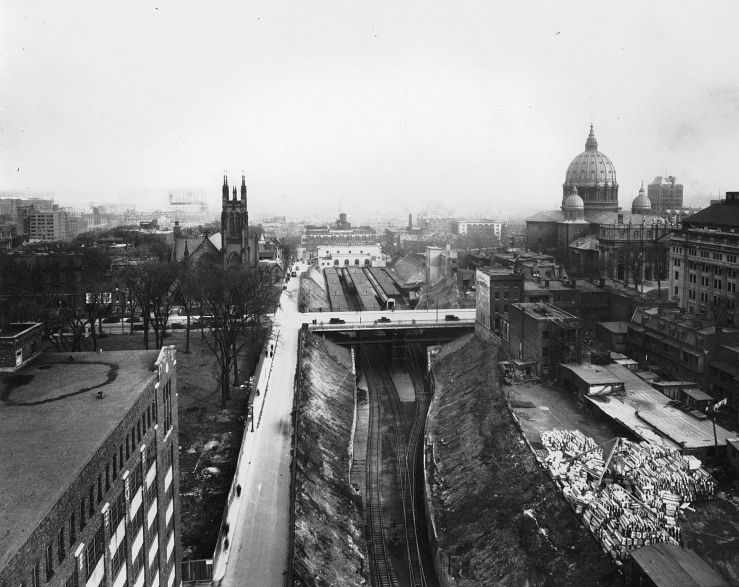
Urban Development and the Underground City
Since its opening, the air rights above and the land around Central Station have been intensively developed, largely hiding the station building from street view and creating a dense cluster of commercial and institutional buildings. This development began in 1948 when the International Civil Aviation Organization (ICAO) built its headquarters over the northeast portion of the station along University Street south of Dorchester Street. The Queen Elizabeth Hotel was constructed on the western portion of the station block at the corner of Dorchester and Mansfield in 1959, which was the first of many major redevelopments in the area. The former Tunnel Station building was demolished in 1960 to allow for the construction of the new CN headquarters, and a large parking garage was built over the southern part of the station, followed by the Terminal Tower of 1966 which completely hid the station from Dorchester Boulevard, later renamed René Lévesque Boulevard.
The north side of René Lévesque Boulevard then saw the construction of the Place Ville-Marie complex, which included a 45-storey skyscraper and an underground shopping mall that marked the beginning of Montreal's Underground City. In the mid-1960s, Place Bonaventure was built over the tracks south of De la Gauchetière Street, and in 1966 Central Station and Place Bonaventure were connected underground by the new Bonaventure metro station. All these buildings underwent major renovations over the following thirty years and are interconnected via the Underground City network, with direct pedestrian tunnels linking the station to Place Ville-Marie, Place Bonaventure, the Queen Elizabeth Hotel, 1000 de La Gauchetière, and the Bonaventure Metro station. Belmont Street, east of the station, was extended over the station itself to Mansfield Street, and the section of the station along Belmont is the only visibly exposed portion of the original exterior.
Passenger Services and Commercial Facilities
Montreal Central Station is a primary hub for multiple rail operators serving regional, national, and international destinations. Via Rail operates the majority of services, including frequent Corridor trains on the Ottawa-Quebec City route with stops like Alexandria, Drummondville, and Sainte-Foy and the Toronto-Montreal route serving Cornwall, Kingston, Belleville, and Oshawa. Via Rail also operates several long-distance services multiple times weekly, including the Montreal-Senneterre train to Shawinigan and La Tuque, the Montreal-Gaspé train to Rimouski and Matapédia, the Ocean to Moncton and Halifax, and the Montreal-Jonquière train to Chambord. Amtrak provides daily service to New York City via the Adirondack, with stops including Saint-Lambert, Plattsburgh, Saratoga Springs, and Albany. Exo operates the Mont-Saint-Hilaire commuter rail line from the station. The newest service is the Réseau express métropolitain, an automated light metro system with a dedicated platform south of the main station.
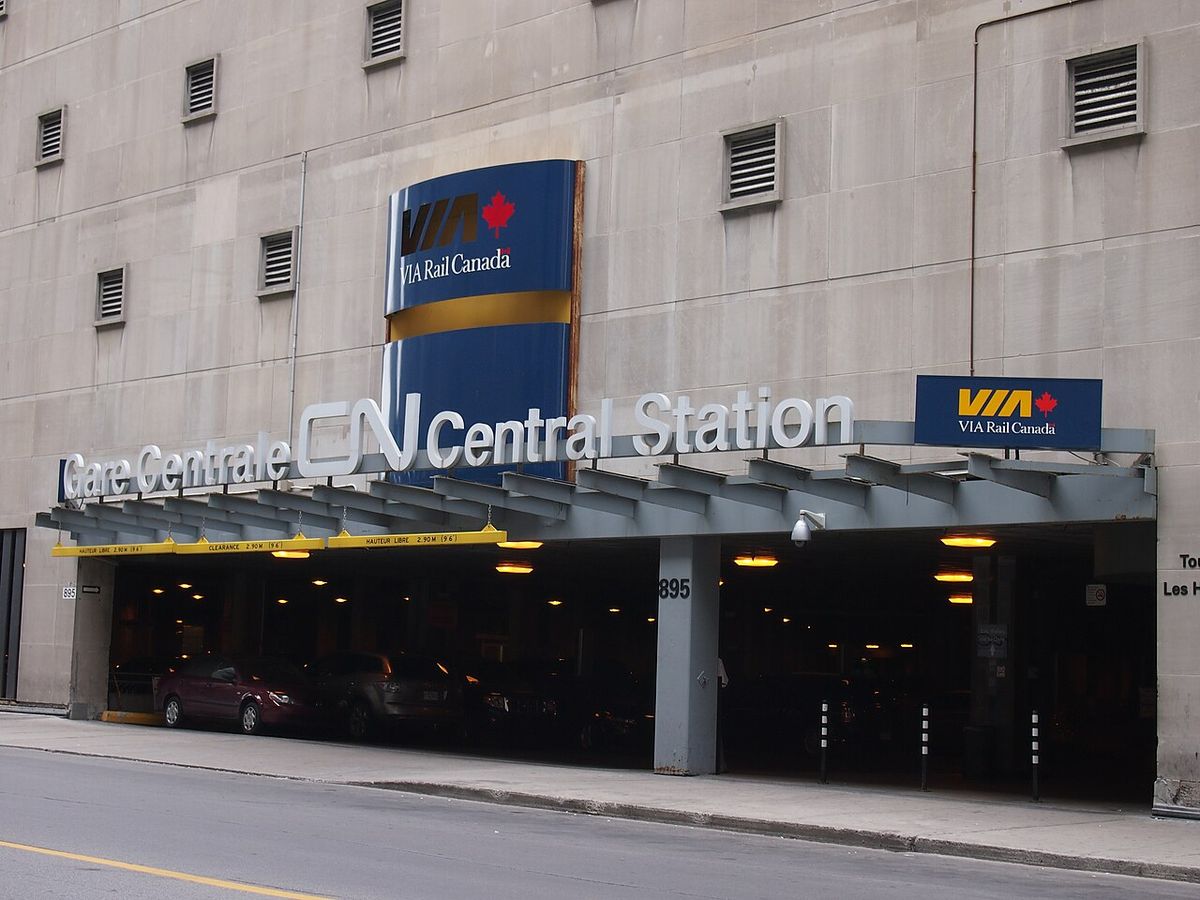
The station also features Les Halles de la Gare, a shopping and restaurant complex that has expanded over the years within the station premises due to real estate pressures. An earlier railway-themed shopping area on the north side was created in 1981 after the relocation of ICAO to Sherbrooke Street. This section was completely destroyed in 1995 during the restoration of the Deux-Montagnes Line and was replaced by the present Les Halles de la Gare complex. The station contains two parking facilities, one of which is a multi-level facility located above the station.
International Travel and U.S. Preclearance Initiative
A significant development for cross-border travel was the initiative to establish a United States Customs and Border Protection preclearance facility at Central Station. In May 2012, U.S. Senators Charles Schumer, Kirsten Gillibrand, Patrick Leahy, and Bernie Sanders sent a letter to President Barack Obama urging fast-track approval of such a facility to benefit U.S.-bound travellers on the Adirondack. This facility would allow passengers to clear U.S. immigration and customs in Montreal, removing the need for the stop at Rouses Point, New York, and also allowing for the removal of the stop in Saint-Lambert. The agreement would also enable the extension of Amtrak's Vermonter line from its current terminus at St. Albans to Montreal, which would facilitate direct travel from Montreal to Washington, D.C.'s Union Station via Massachusetts and New York City, including potential direct service to Boston. The United States and Canada signed an agreement enabling the facility on March 16, 2015, and the U.S. enacted enabling legislation on December 16, 2016, known as the Promoting Travel, Commerce, and National Security Act of 2016. This agreement must still be approved by the United States Congress and the Parliament of Canada before the preclearance facility and service extensions can be fully implemented.
Public Transit Connections and Accessibility
Central Station is integrated into Montreal's extensive public transit network through multiple indoor connections. Direct underground access is available to the Bonaventure Metro station on the Orange Line, which opened in 1966. Through the Underground City network of pedestrian tunnels, travellers can also reach the McGill Metro station on the Green Line, located approximately three blocks north, by passing through Place Ville Marie and the Montreal Eaton Centre. Numerous Société de transport de Montréal (STM) bus routes connect at the Bonaventure Metro station hub, and the station also serves as a connection point for buses operated by the Réseau de transport de Longueuil (RTL) and other inter-municipal carriers. The station's design includes seven stairwells providing access to its 14 underground tracks, five of which are equipped with escalators to facilitate passenger movement between the concourse and the platforms below.
Ridership and Service Statistics
Montreal Central Station handles nearly 11 million rail passengers every year, making it the second-busiest train station in Canada after Toronto Union Station. The station is at the centre of the Quebec City-Windsor Corridor, the busiest inter-city rail service area in the nation, which extends from Windsor and Sarnia in the west to Quebec City in the east. Inter-city trains at the station are operated by Via Rail and Amtrak, while commuter rail services are operated by Exo. The station is also a stop on the Réseau express métropolitain, which opened on July 31, 2023.
- The Ocean: Travels to Halifax, Nova Scotia, with stops including Moncton, Miramichi, Bathurst, Campbellton, Matapédia, Rimouski, Rivière-du-Loup, and Sainte-Foy.
- Montreal-Senneterre train: Serves Shawinigan, La Tuque, and Senneterre in Quebec.
- Montreal-Jonquière train: Connects to Shawinigan, Chambord, and Jonquière.
- Montreal-Gaspé train: This service, which included stops at Chandler, Percé, and Gaspé, was suspended from August 22, 2013, due to infrastructure problems between Matapédia and Gaspé.
The following table outlines the primary rail services operating from the station, reflecting its function as a multi-modal hub for a wide geographic area. Via Rail operates frequent Corridor services on routes such as Ottawa-Quebec City and Toronto-Montreal. It also operates several long-distance services, including the Montreal-Senneterre train and the Montreal-Gaspé train. Amtrak operates the Adirondack service from the station.
| Service Operator | Service Type | Key Destinations |
|---|---|---|
| Via Rail | Corridor & Long Distance | Ottawa, Quebec City, Toronto, Halifax, Senneterre, Jonquière |
| Amtrak | Inter-city | New York City, Albany, Plattsburgh, Saratoga Springs, Poughkeepsie |
| Exo | Commuter Rail | Mont-Saint-Hilaire line |
| Réseau express métropolitain | Automated Light Metro | South Shore, North Shore (2025), West Island (2026), Trudeau Airport (2027) |
Questions about Montreal Central Station
When did Montreal Central Station open?
Montreal Central Station opened on July 14, 1943. Construction had started in 1926 but was halted in 1930 as a result of the Great Depression. Construction resumed in 1939 before the station's final completion. It was the first of a series of large-scale urban redevelopment projects undertaken by Canadian National Railway and the federal government in Downtown Montreal.
Which train companies operate from Montreal Central Station?
Several major rail operators use Montreal Central Station. Via Rail operates the majority of inter-city and long-distance services within Canada, including Corridor trains and routes to Senneterre and Jonquière. Amtrak provides cross-border service to New York City via the Adirondack. Exo operates the Mont-Saint-Hilaire commuter rail line. The Réseau express métropolitain (REM), an automated light metro system, began service from a dedicated platform in 2023.
What architectural features are notable in the station?
The station is adorned with art deco bas-relief friezes on its interior and exterior. The east and west interior walls feature two large bas-reliefs depicting Canadian life, arts and industry, designed by Charles Comfort. Canadian artist Fritz Brandtner created three large chiselled stone reliefs depicting Mercury, Apollo and Poseidon on the station's north exterior wall. The station's architecture is a mixture of Art Deco and the international style, designed by John Schofield.
Is there a U.S. border preclearance facility at the station?
An agreement to establish a U.S. Customs preclearance facility at Montreal Central Station was signed by the United States and Canada on March 16, 2015. This agreement was intended to benefit U.S. bound travelers on the Amtrak Adirondack service, allowing them to clear customs in Montreal rather than at Rouses Point, New York. The enabling legislation was enacted by the United States on December 16, 2016, as the Promoting Travel, Commerce, and National Security Act of 2016. The agreement also included provisions that could allow the Amtrak Vermonter line to be extended from St. Albans to Montreal. However, this final extension required approval from both the United States Congress and the Parliament of Canada to proceed.
How is Central Station connected to the Montreal Metro?
Montreal Central Station is directly connected to the Montreal Metro subway system. The primary connection is through the Bonaventure metro station on the Orange Line, which opened in 1966 and was connected to Central Station underground. The station is a major hub within Montreal's underground city network, with pedestrian tunnels linking it to several key buildings. These connections include tunnels to Place Ville-Marie, Place Bonaventure, the Queen Elizabeth Hotel, and 1000 de La Gauchetière. While not a direct physical connection, the McGill metro station on the Green Line is also accessible via a short walk through this underground network, approximately three blocks north.
When did the new REM service start at Central Station?
Montreal Central Station became a stop on the new Réseau express métropolitain (REM) light rail system when service opened on July 31, 2023. Construction for the REM at the station began in 2019, leading to significant modifications. Specifically, tracks 7 through 12, which were originally part of the commuter rail Deux-Montagnes Line, were repurposed to serve the new REM Gare Centrale station platform. The REM service that began in 2023 initially connected the South Shore to the station, with future phases planned to extend service to the North Shore, the West Island, and Trudeau Airport in the coming years.
Sources and further reading
- Montreal Central Station (Wikipedia)
- Montréal Central Station train station (viarail.ca)
- Our Story, Montreal Central Station (garecentrale.ca)
- Central Station (mtl.org)
- Montreal, QC, Gare Centrale/Central Station (MTR) (greatamericanstations.com)
Checked by the Your Space Hamilton desk. Last updated 2026-10-20.