Moncton
Moncton is the most populous city in the Canadian province of New Brunswick, with a 2025 population of 102,378, marking the first time a city in the province exceeded 100,000 people. Situated in the Petitcodiac River Valley, it lies at the geographic centre of the Maritime Provinces, a central inland location that historically earned it the nickname "Hub City" for its role as a railway and land transportation hub. The city's economy, once dominated by shipbuilding in the mid-1840s and later by the railway industry after 1871, is now stable and diversified. Key sectors include its traditional transportation and distribution roles, supplemented by retail, information technology, health care, finance, and insurance, contributing to an unemployment rate consistently below the national average.
Early settlement and shipbuilding era
The area now known as Moncton was first settled by Acadians in 1733, who established a marshland farming community named Le Coude, a reference to the sharp bend in the Petitcodiac River. This settlement was disrupted in 1755 following the British capture of Fort Beauséjour and the subsequent expulsion of the Acadians. The modern founding of the community occurred in 1766 with the arrival of eight Pennsylvania German families from Philadelphia, who re-established the agricultural settlement and renamed it The Bend. For nearly eight decades, The Bend remained a small farming community until the Westmorland Road opened for year-round travel in 1836, making it a rest station on the route between Saint John and Halifax. The community's fortunes changed dramatically in 1847 when Joseph Salter expanded a local shipyard, employing about 400 workers and fostering a service-based economy.
The prosperity from the wooden shipbuilding industry allowed The Bend to incorporate as the town of Moncton in 1855, named for British officer Robert Monckton, albeit with a clerical error in spelling that persists. Joseph Salter became the town's first mayor. The arrival of the European and North American Railway in 1857, with lines to Shediac and Saint John, coincided with the decline of wooden shipbuilding as steam-powered ships became dominant. The closure of the Salter shipyard in 1858 led to an industrial collapse severe enough that Moncton surrendered its civic charter in 1862. This early cycle of boom and bust foreshadowed the resilient character that would define the city's later history.
Railway boom and 20th-century growth
Moncton's economy rebounded decisively in 1871 when it was selected as the headquarters for the Intercolonial Railway of Canada. This seminal event led to the town reincorporating in 1875 and achieving city status on April 23, 1890. The railway transformed Moncton into a major transportation hub, a role solidified in 1912 when it became the eastern terminus of the National Transcontinental Railway. In 1918, these railways were merged into the newly formed Canadian National Railways, with Moncton becoming the headquarters for CNR's Maritime division and home to its major locomotive repair facility. Railway employment peaked at nearly 6,000 workers in the 1950s, dominating the local economy and shaping the city's identity for over a century.
Other significant developments occurred alongside the railway boom. The T. Eaton Company's catalogue warehouse moved to the city in the early 1920s, employing over 700 people. The first scheduled air service began in 1928, and during the Second World War, a large military supply base was established. The mid-20th century saw key infrastructure projects that shaped modern Moncton, including its placement on the Trans-Canada Highway network in the early 1960s and the founding of the Université de Moncton in 1963, a vital institution for Acadian culture. However, the late 1970s and 1980s brought economic hardship as major employers like the CNR locomotive shops, the Eaton's catalogue division, and CFB Moncton closed, throwing thousands out of work.
Modern diversification and the "Moncton Miracle"
The city's dramatic economic recovery in the 1990s, termed the "Moncton Miracle," was driven by strategic diversification. Leveraging its bilingual workforce, Moncton attracted a growing information technology sector, notably call centres. Within a decade of the CNR shop closures, the city had more than compensated for its job losses through expansion in retail, manufacturing, and services. This period also saw important institutional growth, including Atlantic Baptist University achieving full university status as Crandall University and relocating to a new campus in 1996. The city's confidence was bolstered by its ability to host major events, reflecting its improved infrastructure and civic capacity.
In 2002, it was declared Canada's first officially bilingual city, and the Greater Moncton Roméo LeBlanc International Airport opened a new terminal, receiving designated international airport status. The city was designated a Census Metropolitan Area in 2006, becoming New Brunswick's largest metropolitan area. Recent annexations, such as the area including Charles Lutes Road and Zack Road on January 1, 2023, accommodate this expansion. The city's motto, Resurgo, meaning "I rise again," aptly captures its repeated economic transformations.

Geography and environment
Moncton is located in southeastern New Brunswick at the geographic centre of the Maritime Provinces, on the north bank of the Petitcodiac River where it makes a sharp 90-degree bend. This feature inspired its early Acadian name, Le Coude, and later English name, The Bend. The river valley is broad and relatively flat, bounded by Lutes Mountain to the north and the Caledonia Highlands to the south. A significant alteration to the local environment occurred in 1968 with the construction of the Petitcodiac River Causeway to Riverview, which caused extensive sedimentation downstream and rendered the river unnavigable at Moncton. In an effort to restore the river, the causeway gates were opened on April 14, 2010.
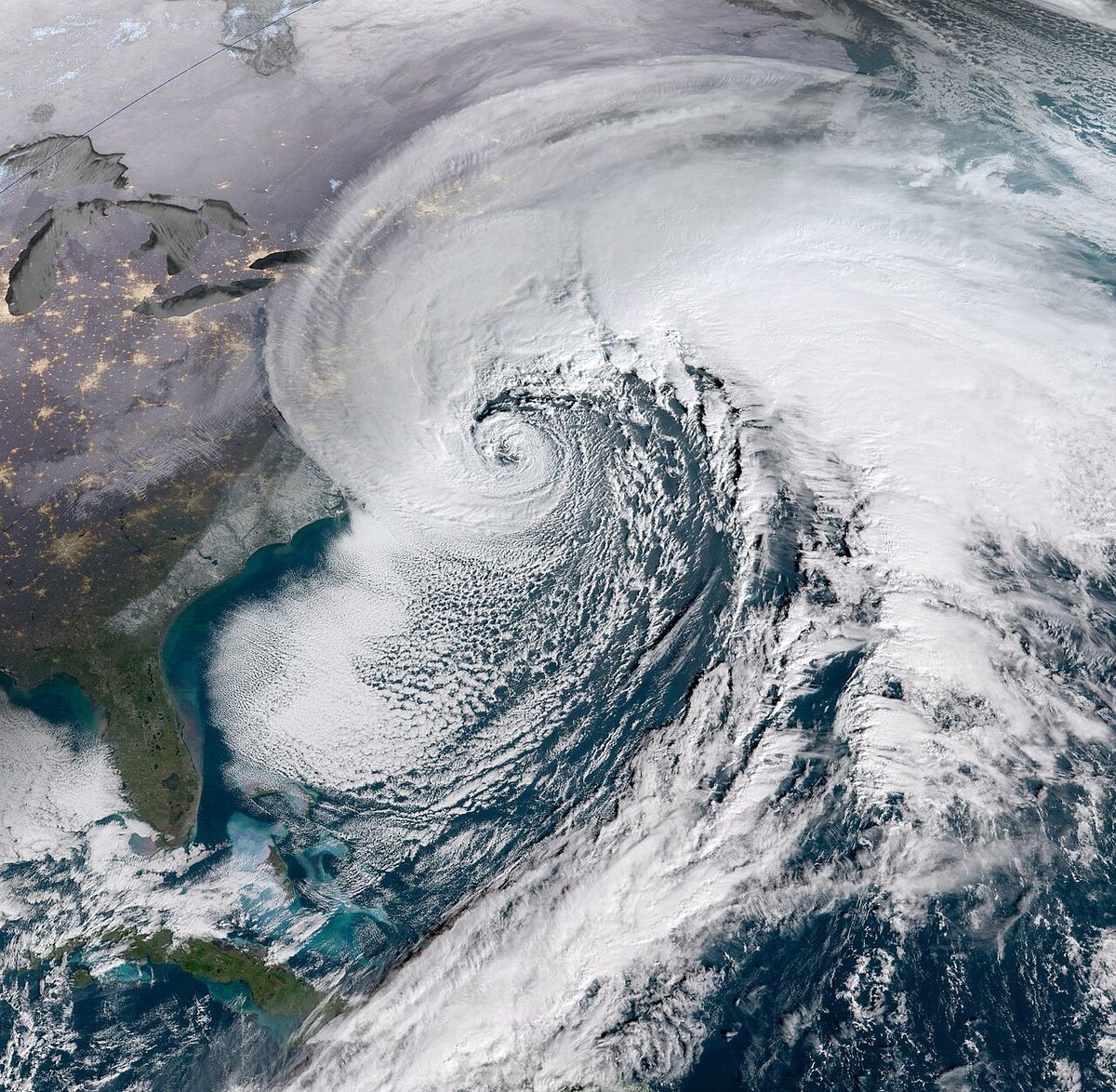
The city's climate is a warm summer humid continental type, with more continental tendencies in summer and winter, moderated by maritime influences in spring and autumn. Winters are cold and sunny, with major snowfalls frequently coming from Nor'easter storms. Summers are warm and can be humid, with daytime highs occasionally exceeding 30 °C. The highest temperature ever recorded was 37.8 °C on August 18 and 19, 1935, while the coldest was -37.8 °C on February 5, 1948. The city's proximity to the Bay of Fundy is most famously manifested in the Petitcodiac River's tidal bore, a wave that travels upriver on the incoming tide.
- The tidal bore is a result of the Bay of Fundy's extreme tides and originally reached heights of 1 to 2 metres.
- Construction of the causeway in the 1960s silted the river channel, reducing the bore to rarely more than 15 to 20 centimetres.
- The opening of the causeway gates in 2010 began a restoration effort, with a subsequent bore measuring a 2-foot-high wave, unseen for many years.
- The bore occurs twice daily at high tide and was historically a popular tourist attraction for the city.
Cityscape and notable landmarks
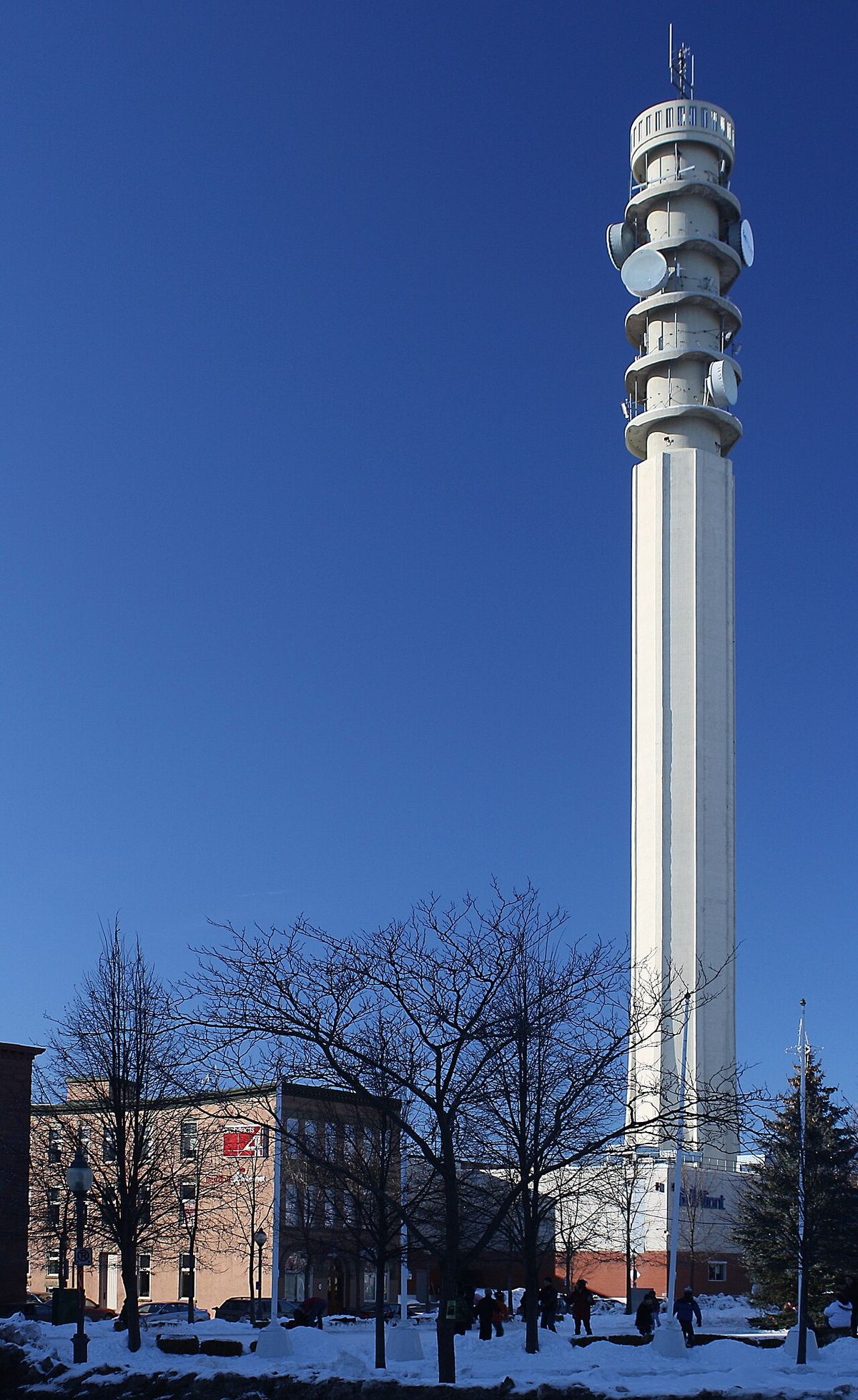
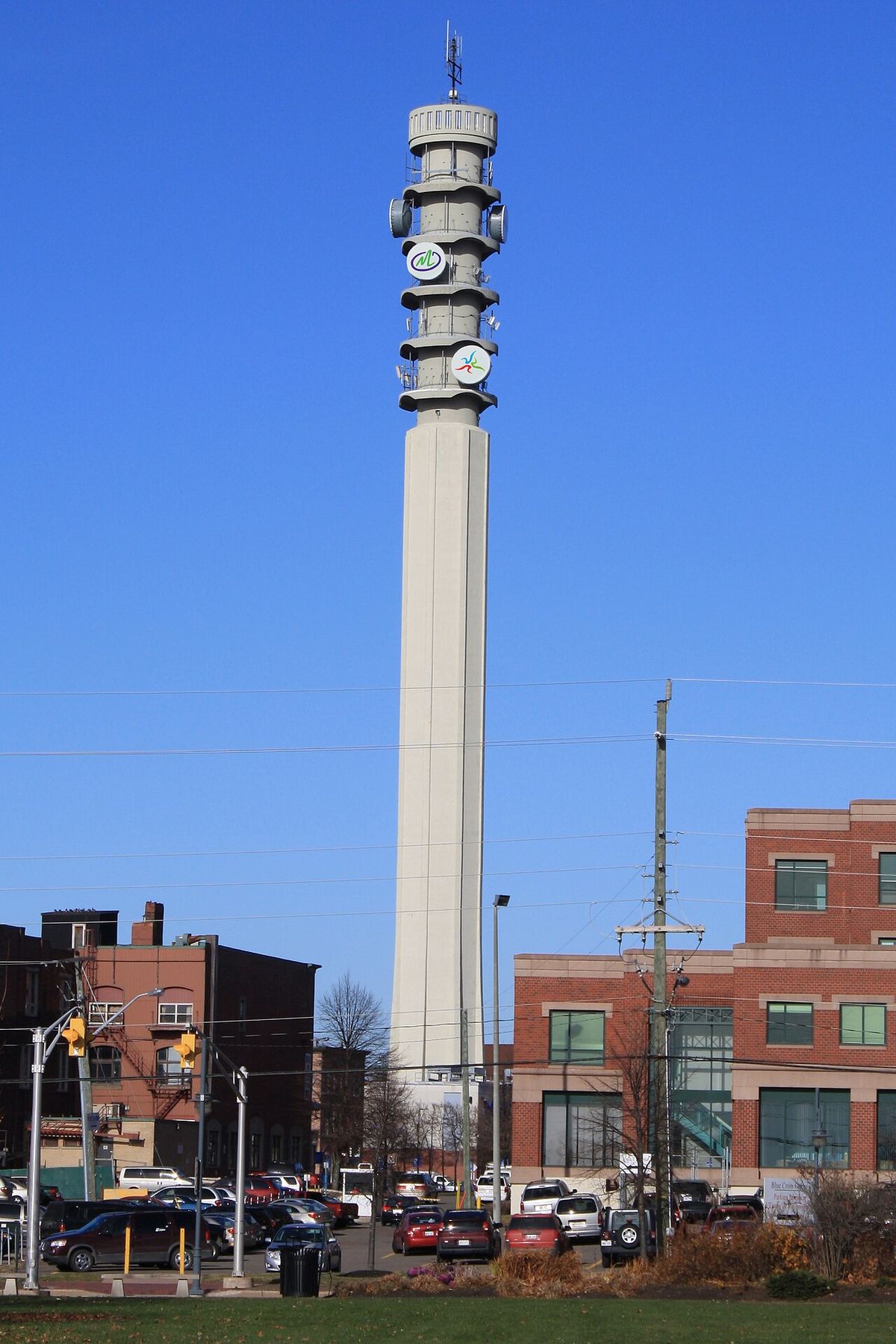
Moncton's skyline is characterized by low-rise buildings punctuated by several notable structures. The most dominant is the Bell Aliant Tower, a 127-metre microwave communications tower built in 1971 that remains the tallest structure in Atlantic Canada. The city's tallest building is Assumption Place, a 20-story office tower standing 81 metres tall, which ties for the tallest building in New Brunswick and serves as the headquarters for Assumption Mutual Life Insurance. Another architecturally distinctive building is the Blue Cross Centre, a nine-story complex encompassing a full city block. It is the city's largest office building by square footage and houses Medavie Blue Cross and the Moncton Public Library.
The city features extensive parkland. Centennial Park is the most popular, offering cross-country skiing trails, a large playground, tennis facilities, a boating pond, and Rocky Stone Field, a 2,500-seat football stadium. Other major green spaces include Mapleton Park, Irishtown Nature Park, one of Canada's largest urban nature parks, and St. Anselme Park in Dieppe. Neighbourhood parks like Bore View Park, which overlooks the Petitcodiac River, and downtown Victoria Park, with its bandshell and cenotaph, are community fixtures. An extensive network of hiking and biking trails, including the Riverfront Trail which is part of the Trans Canada Trail, connects these spaces.
Demographics and population trends
Moncton has experienced significant population growth, becoming New Brunswick's most populous city. According to 2025 estimates, the city's population reached 102,378, marking the first time a New Brunswick city exceeded 100,000 residents. The broader Census Metropolitan Area, which includes the cities of Dieppe and Riverview and adjacent suburban areas, had an estimated population of 196,143 in 2025, ranking it among Canada's fastest-growing CMAs. The 2021 census recorded a city population of 79,470, a 10.5% increase from 2016, with a population density of 564.9 persons per square kilometre. The urban area population was 119,785, making it the third largest in Atlantic Canada after Halifax and St. John's.
The demographic profile of Moncton reflects a diverse and evolving community. The 2021 census reported that immigrants comprised 10.9% of the city's population. The top countries of origin for immigrants were the Philippines, India, the United States, China, and Nigeria. In terms of ethnic origin, the most commonly reported in the 2021 census were Irish, French, and Canadian. The city's median age was 41.4 in 2016, closely aligned with the national median. Moncton's status as Canada's first officially bilingual city, declared in 2002, highlights the linguistic and cultural significance of both English and French communities.
| Year | City Population | Metro (CMA) Population |
|---|---|---|
| 2016 | 71,889 | 144,810 |
| 2021 | 79,470 | 157,717 |
| 2025 (estimate) | 102,378 | 196,143 |
Economy and major sectors
Moncton's economy is stable and diversified, built upon a traditional foundation of transportation, distribution, retailing, and commercial services. This heritage has been successfully supplemented by growing strengths in education, health care, financial services, information technology, and insurance. The city's economic resilience has been nationally recognized, partly due to an unemployment rate consistently lower than the national average. The closure of the Canadian National Railway locomotive shops in the late 1980s marked the end of the railway era but prompted a successful pivot towards a knowledge and service-based economy in the 1990s.
The rise of the information technology sector, particularly call centres capitalizing on the bilingual workforce, was a central part of the "Moncton Miracle." Major employers now span both the public and private sectors. The Université de Moncton and Crandall University are significant contributors as educational institutions and employers. The health care sector is anchored by the Moncton Hospital and other facilities. In transportation, the Greater Moncton Roméo LeBlanc International Airport serves as an important regional hub. The retail sector is strong, supported by the city's role as a shopping destination for the broader region. This economic diversification has allowed Moncton to weather national economic fluctuations and maintain steady growth.
Questions about Moncton
Why is Moncton called the Hub City?
Moncton earned the nickname "Hub City" due to its central inland location within the Maritime Provinces and its historical role as a major railway and land transportation centre. Its position at the geographic centre of the Maritimes made it a natural junction for rail lines and later highway networks, facilitating the movement of people and goods throughout the region. This central function was cemented when it became the headquarters of the Intercolonial Railway of Canada in 1871. The nickname persists today, reflecting its continued importance as a distribution and commercial hub for eastern Canada.
What is the tidal bore in Moncton?
The tidal bore is a natural wave phenomenon on the Petitcodiac River, where a visible wave travels upstream on the leading edge of the incoming tide from the Bay of Fundy. It is caused by the Bay of Fundy's extreme tides, which are among the highest in the world. Historically, the bore could be between 1 and 2 metres high and was a popular tourist attraction. Its size was greatly reduced after the construction of the Petitcodiac causeway in 1968, which caused siltation, but efforts to restore the river, including opening the causeway gates in 2010, have led to a resurgence, with waves recently measured at 2 feet high.
When did Moncton become a city?
Moncton was officially incorporated as a city on April 23, 1890. This status was achieved following a period of rapid growth spurred by its selection as the headquarters of the Intercolonial Railway of Canada in 1871. The railway boom generated significant employment and economic activity, allowing the town, which had reincorporated in 1875 after losing its charter in 1862, to meet the requirements for city designation. The city's incorporation marked its transition from a railway town to a more permanent and influential urban centre in New Brunswick.
Is Moncton a bilingual city?
Yes, Moncton is officially bilingual. In 2002, it became the first city in Canada to adopt an official bilingualism policy, recognizing both English and French as official languages for municipal services and governance. This status reflects the city's significant Acadian and francophone population, as well as its historical linguistic diversity. The presence of institutions like the Université de Moncton, a francophone university founded in 1963, reinforces the cultural and linguistic importance of both language communities in the region.
What was the "Moncton Miracle"?
The "Moncton Miracle" refers to the city's dramatic economic recovery and diversification in the 1990s following the closure of major employers like the Canadian National Railway locomotive shops in the late 1980s. Faced with significant job losses, the city successfully pivoted to a new economic model, attracting information technology and call centre industries that leveraged its bilingual workforce. Within a decade, employment in retail, manufacturing, and services had expanded to more than offset the earlier losses. This rapid turnaround, achieved without major government bailouts, became a nationally noted example of urban economic resilience.
What are the major parks in Moncton?
Moncton features several major urban parks. Centennial Park is the most popular, offering lighted cross-country skiing and hiking trails, a large playground, tennis facilities, a boating pond, and Rocky Stone Field stadium. Mapleton Park is located in the city's north end. Irishtown Nature Park is one of the largest urban nature parks in Canada. St. Anselme Park is situated in the neighbouring city of Dieppe. Notable neighbourhood parks include Bore View Park, which overlooks the Petitcodiac River and the tidal bore, and downtown Victoria Park, which features a bandshell, gardens, fountain, and the city's cenotaph. An extensive trail network connects many of these green spaces.
Sources and further reading
- Moncton (Wikipedia)
- About Moncton (chateaumoncton.ca)
Checked by the Your Space Hamilton desk. Last updated 2026-10-21.