Greektown, Toronto
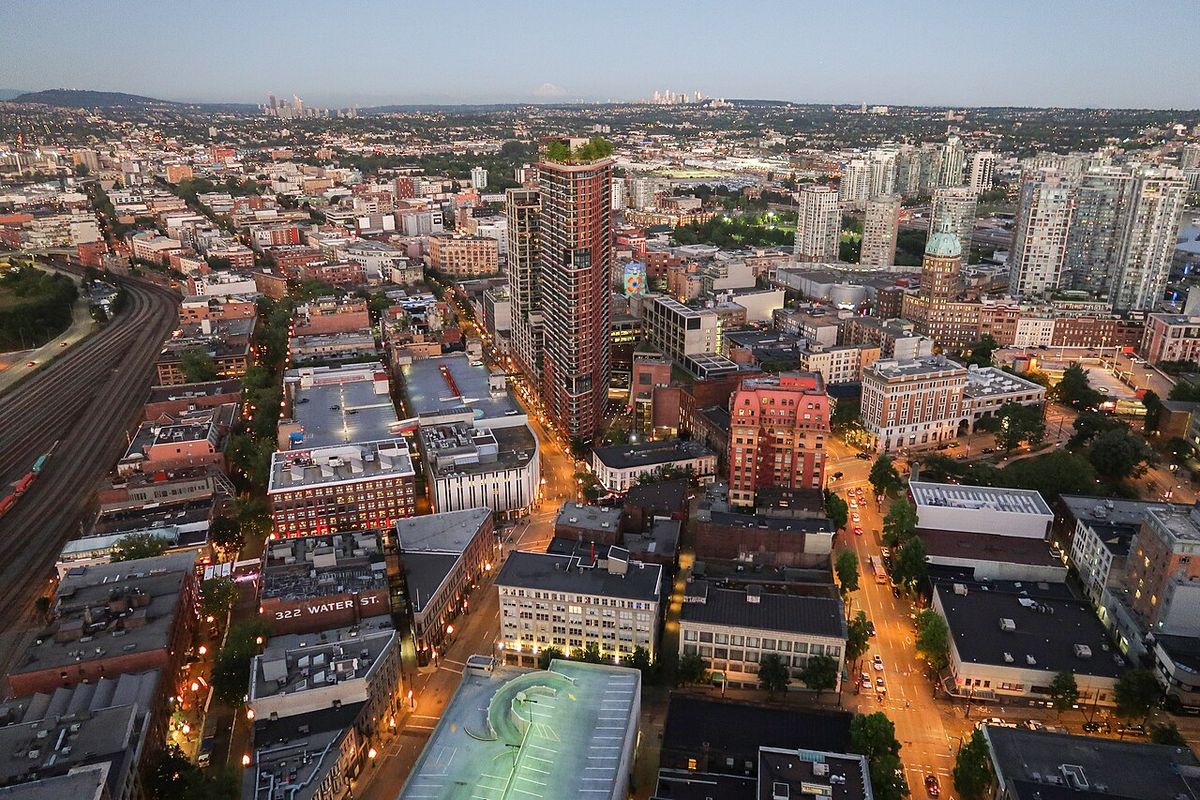
Greektown, also known as The Danforth, is a commercial and residential neighbourhood and ethnic enclave in east Toronto, Ontario, centred on Danforth Avenue. It emerged as a major settlement area for Greek immigrants after the First World War and grew to be regarded as the largest Greek neighbourhood in North America by the 1970s. The area is renowned for its high concentration of Greek restaurants and shops, its bilingual English and Greek street signs, and its deep cultural roots within Toronto's Greek Canadian community. Today, Greektown remains a significant cultural hub while evolving into a more diverse district featuring a wide array of international cuisines and businesses.
Historical Development
The origins of Toronto's Greek community date to before the Second World War, with an initial population of about 3,000 concentrated near the intersection of Yonge and Dundas streets. This early enclave was the site of the 1918 Toronto anti-Greek riot, an episode of ethnic violence largely forgotten for decades. A significant Greek neighbourhood later emerged in the Bloor Street West area before the community's focus shifted eastward. The 1950s and 1960s saw a major influx of European immigrants to the Danforth area, including many Greeks fleeing political and economic unrest, particularly after the 1967 Greek military coup. By the 1960s, the city's Greek population had grown to 12,500, though they shared the Danforth with Estonian, Lithuanian, Italian, Chinese and Finnish communities.
During the 1970s and 1980s, the area solidified its identity as North America's largest Greektown, with an estimated 65,000 Greeks living in the vicinity by 1976. English language media enthusiastically covered the restaurant and nightclub scene, highlighting bouzouki music and busy dance floors. The neighbourhood also fostered artistic expression at venues like The Trojan Horse cafe, where exiled and local musicians and poets such as Gwendolyn MacEwen gathered. The community's commercial and cultural prominence was formally recognized in 1993 when the local Business Improvement Area successfully lobbied to be renamed "GreekTown on the Danforth."
In more recent decades, the area has experienced waves of change, including gentrification noted as early as the 1980s with an influx of young urban professionals. The neighbourhood continues to evolve, welcoming higher priced restaurants and bars alongside its established Greek institutions. A tragic event occurred on July 22, 2018, when a mass shooting on the Danforth killed two people and injured 13 others. Despite these changes and challenges, the area maintains a strong Greek Canadian presence, with the 2016 census noting Greek as the third most common mother tongue in the ward, behind English and Cantonese.
Geography and Character
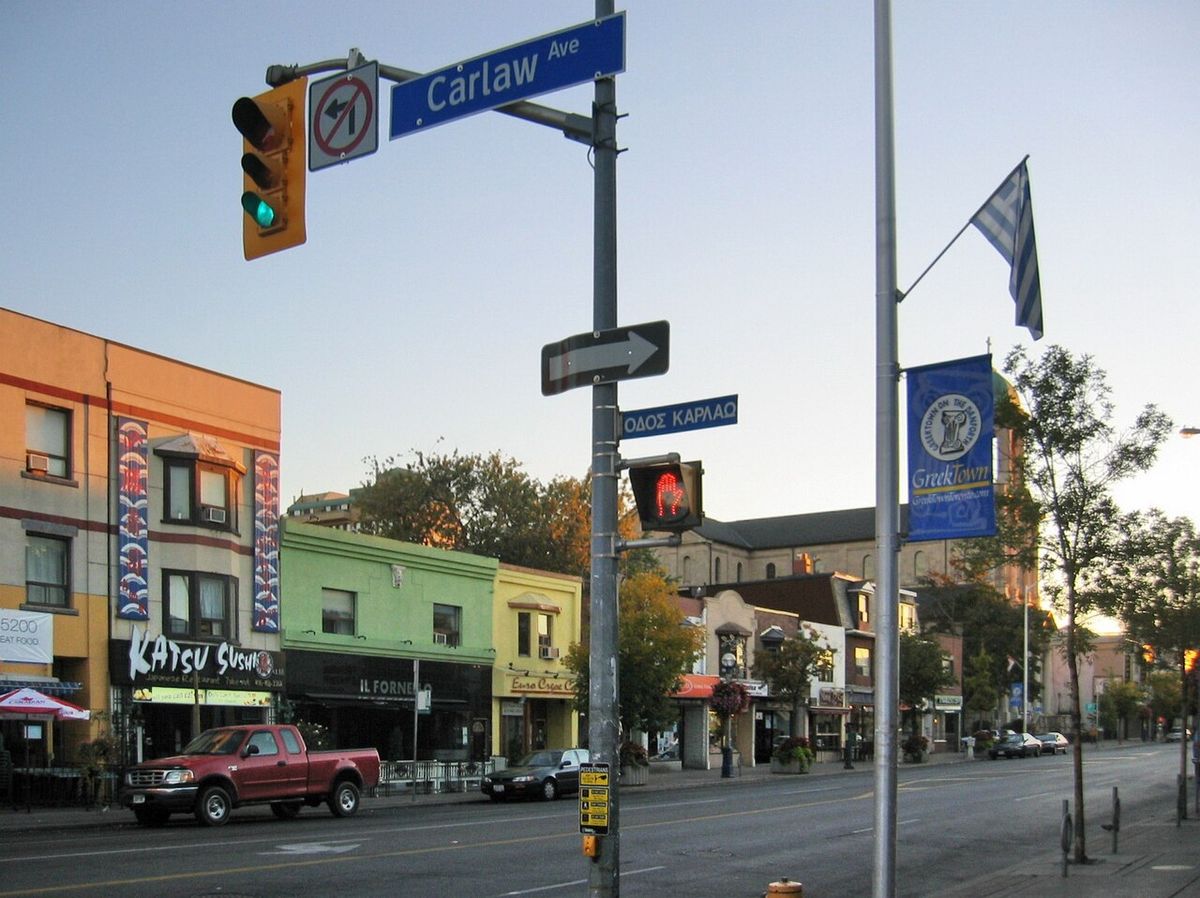
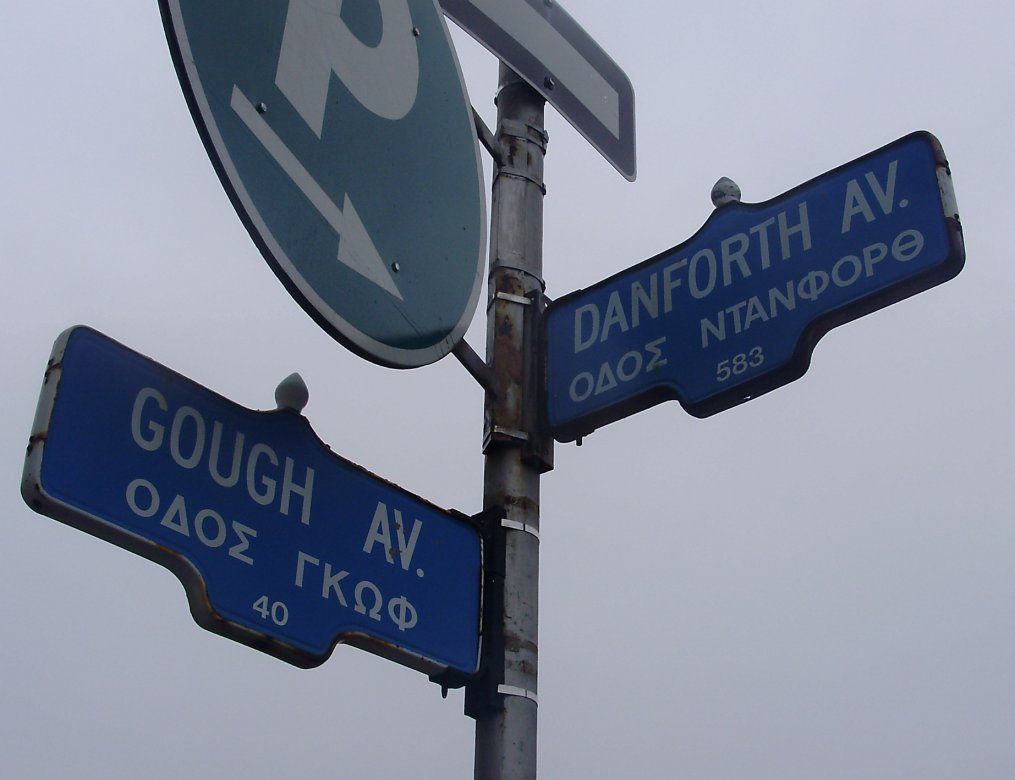
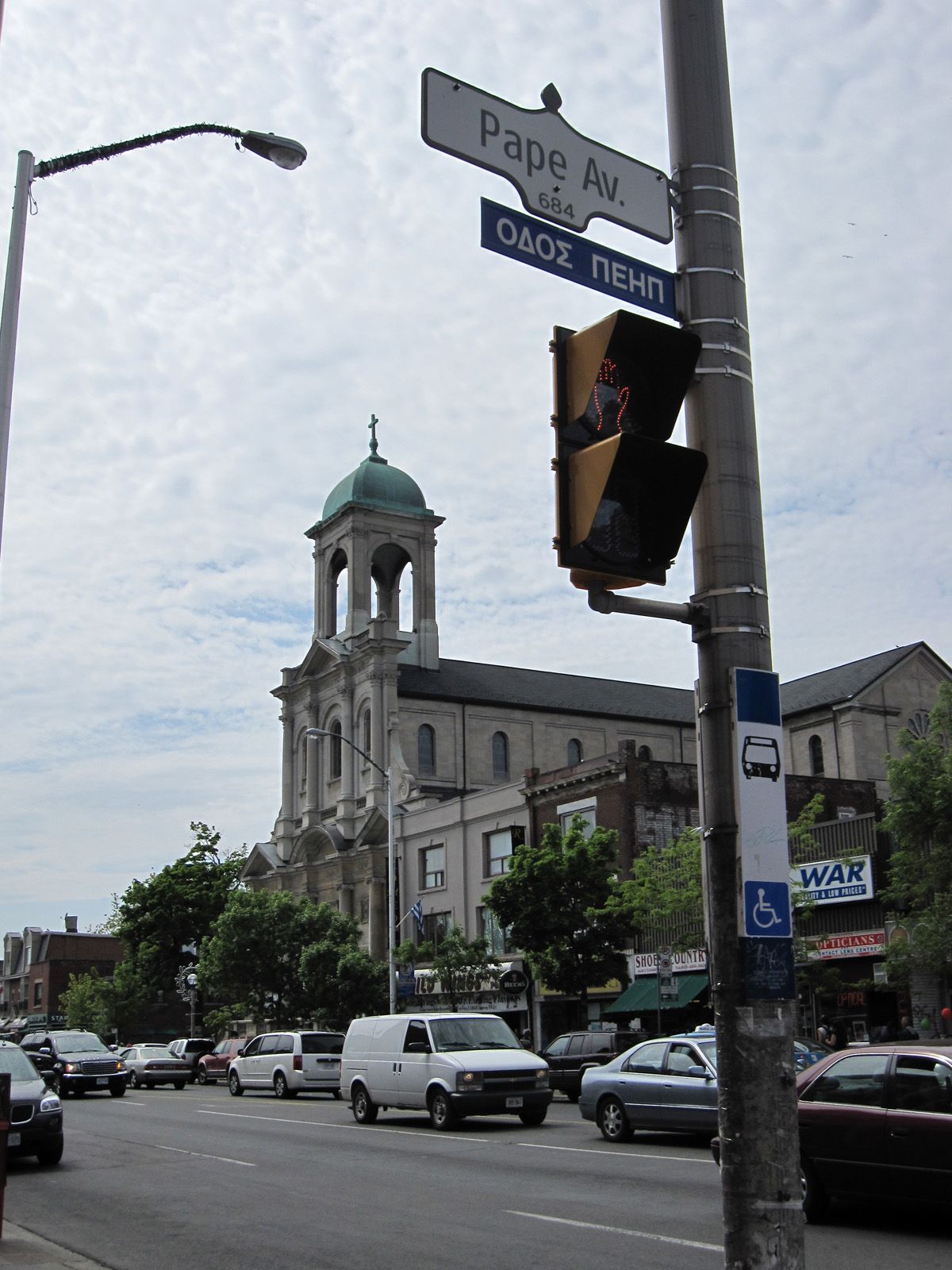
Greektown is defined by its main thoroughfare, Danforth Avenue, named after American contractor Asa Danforth, Jr. The traditional commercial core stretches from Chester Avenue to Dewhurst Boulevard, though the cultural neighbourhood is often described as extending from the Don Valley Parkway to Luttrell Avenue. The area is served by the Toronto Transit Commission's Bloor Danforth subway line, with stations at Broadview, Chester, Pape, Donlands and Main Street providing easy access. The area is known for its architecture dating back to as early as 1910, and for its number of Greek restaurants and stores. The district's Greek heritage is visibly embedded in the streetscape through bilingual street signs that display names in both English and Standard Modern Greek. Examples include Danforth Avenue as Οδος Ντανφορθ (Odos Ntanphorth) and Pape Avenue as Οδος Πεηπ (Odos Peīp). This unique feature is a constant reminder of the area's cultural identity. The neighbourhood is also home to public spaces like the Alexander the Great Parkette at 484 Danforth Avenue, which includes a public square at Logan Avenue. The area is noted for an exceptionally high density of restaurants per kilometre, a fact often cited in promotional materials.
While the Greek character remains dominant, the area has evolved into a diverse community hub. The strip now features a wide array of multicultural cuisine, shops and independent grocers alongside the traditional Greek tavernas and bakeries. This blend of the historic and the contemporary makes Greektown a dynamic destination for both residents and visitors. The area has also been featured in popular culture, including scenes filmed for the movie My Big Fat Greek Wedding and mentions in songs like "The Old Apartment" by the Barenaked Ladies and in literature such as Joseph Assenza's novel "The History of John."
Taste of the Danforth Festival
The Taste of the Danforth is the neighbourhood's signature event, a large street festival celebrating food and culture. Launched in 1994 by the GreekTown on the Danforth Business Improvement Area, the inaugural event attracted 5,000 attendees. It has since grown into one of Canada's largest street festivals, drawing over one million visitors in 2008 and approximately 1.5 million by 2015. The festival is typically held over two and a half days in mid August, stretching along Danforth Avenue from Broadview to Jones Avenues. Admission is free, allowing visitors to sample modestly priced dishes from the numerous participating restaurants.
The festival's programming extends far beyond food. A midway offers games, children's rides and interactive sports like a climbing wall, street hockey and basketball. Multiple stages provide continuous musical entertainment with a global reach, including a dedicated stage for Greek performers of music, song and dance. While Greek cuisine is prominently featured, the event reflects the area's growing diversity with samples of Thai, Chinese, Brazilian, Indian, Japanese and other international foods. The festival's economic and cultural impact is substantial, supporting local businesses and presenting Toronto's diversity to visitors from across Canada and the world.
The event faced several cancellations in the early 2020s, first in 2020 and 2021 due to the COVID 19 pandemic, and again in 2022, 2024 and 2025. Its return was announced for August 7, 8 and 9, 2026, marking the first festival in three years. The City of Toronto and the Government of Ontario each invested $200,000 to support this comeback, with organizers expecting at least one million visitors over the three days. This joint investment highlights the festival's importance to Toronto's festival sector and visitor economy, which is supported by nearly 300 annual festivals contributing over $1 billion to the national economy.
Cultural and Community Life
Community life in Greektown is anchored by its deep Hellenic heritage, which is actively preserved and promoted through various institutions and events. The Hellenic Heritage Foundation develops educational initiatives like walking tours that explore the neighbourhood's post war settlement, foundations in faith and family, and business evolution. These tours, led by educators like Tina Poulimenou Tzatzanis, cover approximately 1.5 kilometres and provide insight into Greek Canadian studies and community history. The area also hosts other cultural events, such as the summer event series "Sounds of Greektown," which adds to the neighbourhood's atmosphere. The local business community, organized under the GreekTown on the Danforth BIA, is central to maintaining the area's vitality and distinct character.
The BIA manages major events like Taste of the Danforth and advocates for local interests and promotes the neighbourhood as a destination. Their efforts help ensure that Greektown remains an active commercial corridor while honouring its roots. The neighbourhood is also home to local personalities like raconteur Tom Petkos, who contributes to the area's unique social fabric. Despite its evolution, Greektown continues to function as a central gathering place for Greek Canadians in the Greater Toronto Area. The presence of Greek Orthodox churches, social clubs, and specialty food shops serving traditional ingredients sustains daily cultural practices.
The community's resilience is evident in its recovery from challenges like the 2018 mass shooting and the pandemic related festival cancellations. The planned return of Taste of the Danforth in 2026, backed by significant public investment, signals a strong commitment to the neighbourhood's future as a cultural and economic centre for the city. The City of Toronto and the Government of Ontario are each investing $200,000 to support the festival's return. This commitment is further demonstrated by the City of Toronto's Cultural Festivals Funding Program, which invested $2.57 million to support festivals in 2025, and the renewal of the Special Events Stabilization Initiative that provided support to 98 festivals across the city.
Demographics and Evolution
Greektown's demographic story is one of concentrated settlement followed by gradual dispersion and diversification. According to the 2016 federal census, within the broader Toronto Danforth ward that contains Greektown, people reporting Greek ethnic origin constituted 4.5 percent of the total, remaining one of the ward's most significant ethnic groups. The Greek language holds as the third most commonly reported mother tongue and home language in the ward, following English and Cantonese, indicating the continued linguistic presence of the community. These figures, however, represent a change from the peak concentration in the 1970s, when the immediate vicinity was home to tens of thousands of Greek residents.
The neighbourhood's character has steadily broadened. What was once a predominantly Greek enclave now hosts a wide variety of international businesses and residents. The commercial strip features an eclectic mix, including gyros shops and Ethiopian coffee ceremonies alongside Middle Eastern restaurants and craft beer pubs. This diversification is often described as an evolution into a multicultural community hub while still honouring its foundational Greek identity. The process of gentrification has also introduced higher priced dining and retail options, altering the economic profile of the avenue. The following table illustrates the fluctuating attendance at the Taste of the Danforth festival, a key indicator of the area's drawing power and its challenges in recent years.
| Year | Attendance | Notes |
|---|---|---|
| 1994 | 5,000 | First festival |
| 2020 2021 | Cancelled | Due to COVID 19 pandemic |
| 2022, 2024, 2025 | Cancelled | Festival not held |
This cycle of growth, interruption and planned revival mirrors the neighbourhood's own adaptive resilience. The substantial public investment for the 2026 festival confirms its recognized value to Toronto's cultural economy and the ongoing effort to sustain Greektown as a destination. The festival's return is part of a broader city strategy to strengthen the visitor economy, which includes support through programs like the Community Celebration Support Fund for events during the FIFA World Cup 2026 period. Toronto is home to nearly 300 festivals each year, which contribute more than $1 billion to the national economy while supporting local businesses and cultural workers.
Notable Landmarks and Features
Greektown is distinguished by several physical and cultural landmarks that define its unique character. The most prominent feature is Danforth Avenue itself, the commercial spine lined with restaurants, cafes and shops. The Alexander the Great Parkette at 484 Danforth Avenue serves as a small public gathering space and is often used as a community meeting point. The neighbourhood's cultural landmarks are equally significant, with the bilingual street signs being a constant, visible reminder of the area's heritage.
The area was also a filming location for the popular movie My Big Fat Greek Wedding, adding a layer of pop culture recognition. Community institutions include the churches and social halls that have served as centres of Greek Canadian life for generations. The local Business Improvement Area actively promotes the district and organizes its major events, contributing to its continued profile. These elements combine to create a district that is both a functional neighbourhood for residents and a compelling destination that celebrates its unique history while continuously evolving.
Key features and attractions in Greektown include:
- Bilingual English and Greek street signs throughout the commercial core.
- Alexander the Great Parkette, a public square at Logan Avenue and Danforth.
- A high concentration of restaurants per kilometre, among the highest in the world.
- Historic buildings dating to as early as 1910 along Danforth Avenue.
- Filming locations for the movie My Big Fat Greek Wedding.
- Access to multiple TTC subway stations along the Bloor Danforth line.
- Home to the annual Taste of the Danforth street festival.
- Walking tours offered by the Hellenic Heritage Foundation exploring local history.
Questions about Greektown, Toronto
What is the Taste of the Danforth festival?
Taste of the Danforth is a large, free admission food festival held annually in mid August along Danforth Avenue from Broadview to Jones. Launched in 1994, it features modestly priced food samples from local restaurants, with a strong emphasis on Greek cuisine alongside many other international options. The festival also includes a midway, musical entertainment on multiple stages, and children's activities. It grew from 5,000 attendees at its debut to over 1.5 million by 2015, though it was cancelled several times in the early 2020s. It is scheduled to return August 7 9, 2026.
What are the bilingual street signs in Greektown?
Street signs in the heart of Greektown are displayed in both English and Standard Modern Greek, using the ISO 843 romanization system. This unique feature visually reinforces the neighbourhood's Hellenic heritage. Examples include Danforth Avenue signed as Οδος Ντανφορθ (Odos Ntanphorth) and Pape Avenue as Οδος Πεηπ (Odos Peīp). These bilingual signs are a distinctive landmark for residents and visitors alike.
Is Greektown still predominantly Greek?
While Greektown remains the heart of one of the largest Greek communities in North America, it has evolved into a more multicultural hub. The 2016 census showed Greek ethnic origin at 4.5 percent in the broader Toronto Danforth ward, with Greek as the third most common mother tongue. The commercial strip now features a diverse array of international cuisines and shops alongside the enduring Greek restaurants and bakeries. The area balances its foundational Greek identity with a growing diversity of businesses and residents.
What happened to the Taste of the Danforth in recent years?
The Taste of the Danforth festival was cancelled in 2020 and 2021 due to the COVID 19 pandemic. It was also cancelled in 2022, 2024 and 2025. The festival is scheduled to make its return on August 7, 8 and 9, 2026, marking its first occurrence in three years. Its comeback is supported by a $200,000 investment each from the City of Toronto and the Government of Ontario, with organizers expecting at least one million visitors over the three day event.
Where is Greektown located in Toronto?
Greektown is located in east Toronto on Danforth Avenue, specifically between Chester Avenue and Dewhurst Boulevard. This commercial residential neighbourhood is also known as The Danforth, named after the road's designer, Asa Danforth, Jr. The broader cultural area is often considered to stretch along Danforth from the Don Valley Parkway to Luttrell Avenue. It is served by public transit via the TTC subway line, with stations including Broadview and Main Street. The neighbourhood's architecture dates back to as early as 1910, and it remains a significant hub for the Greek Canadian community.
Why is it called Greektown?
It is called Greektown because it became a major ethnic enclave for Greek immigrants settling in Toronto after World War I and particularly in the 1950s and 1960s. By the 1970s and 1980s, the Danforth was regarded as the largest Greektown in North America, with an estimated 65,000 Greeks living in the vicinity at that time. The concentration of Greek restaurants, stores, and cultural life solidified this identity. In 1993, the local Business Improvement Area officially renamed itself "GreekTown on the Danforth". While now more multicultural, Greek Canadians remain one of the most significant ethnic groups in the area.
Sources and further reading
- Greektown, Toronto (Wikipedia)
- Neighbourhood: Greektown (destinationtoronto.com)
- Greektown on the Danforth (heritagetoronto.org)
- Toronto and Ontario invest in the return of Taste ... (toronto.ca)
Checked by the Your Space Hamilton desk. Last updated 2026-10-30.