Church and Wellesley
Church and Wellesley, commonly known as the Village, is an LGBT-oriented neighbourhood in downtown Toronto, Ontario. It is defined by the commercial strip along Church Street from Wellesley to Alexander and is recognized as the historic heart of the city's 2SLGBTQIA+ community. The area is home to institutions like The 519 community centre, hosts the annual Pride Toronto festival, and serves as a cultural and political hub. While its role as a sanctuary has evolved with broader social acceptance, it remains a central symbol of queer identity and activism in Canada.
Geography and Character
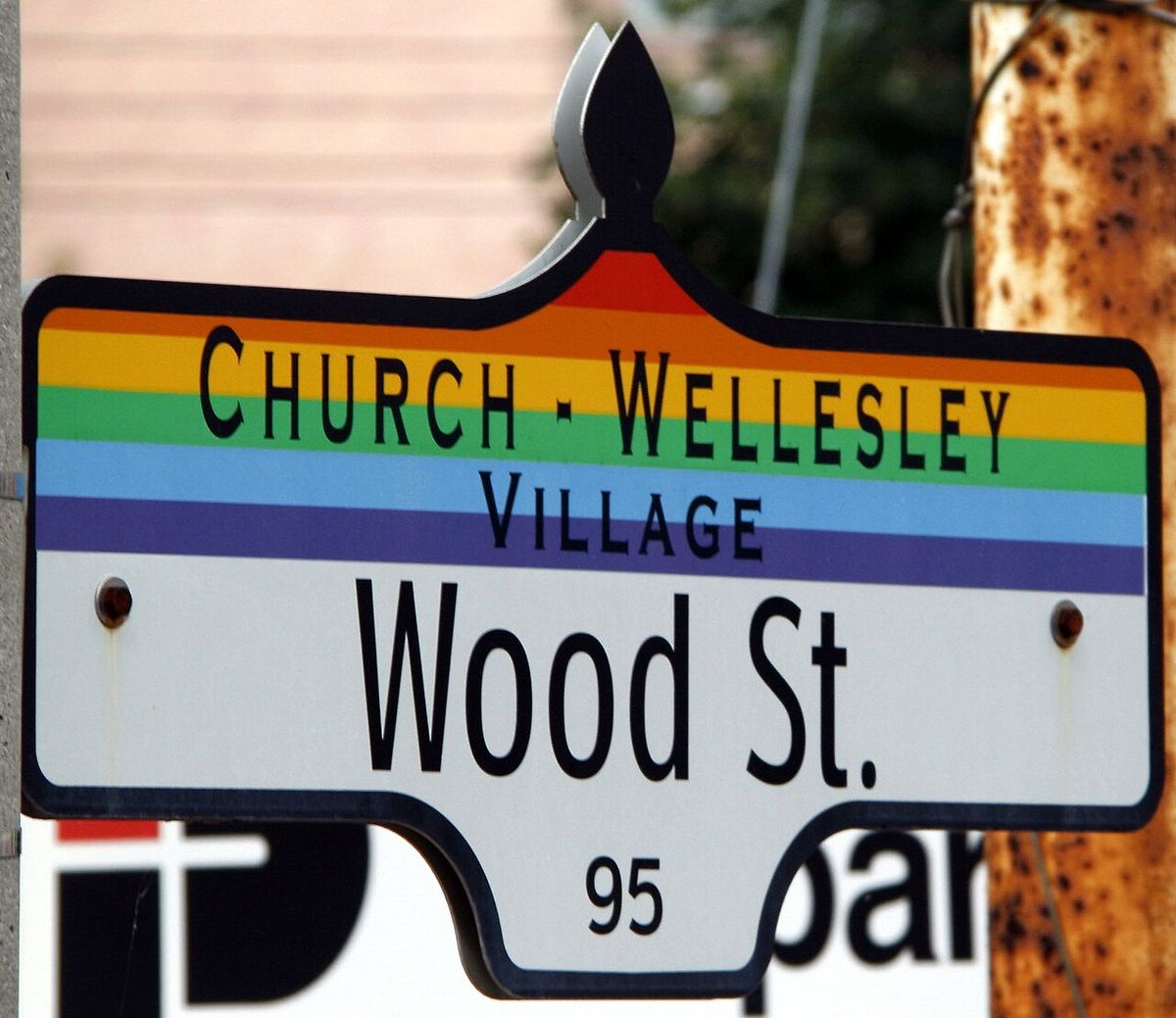
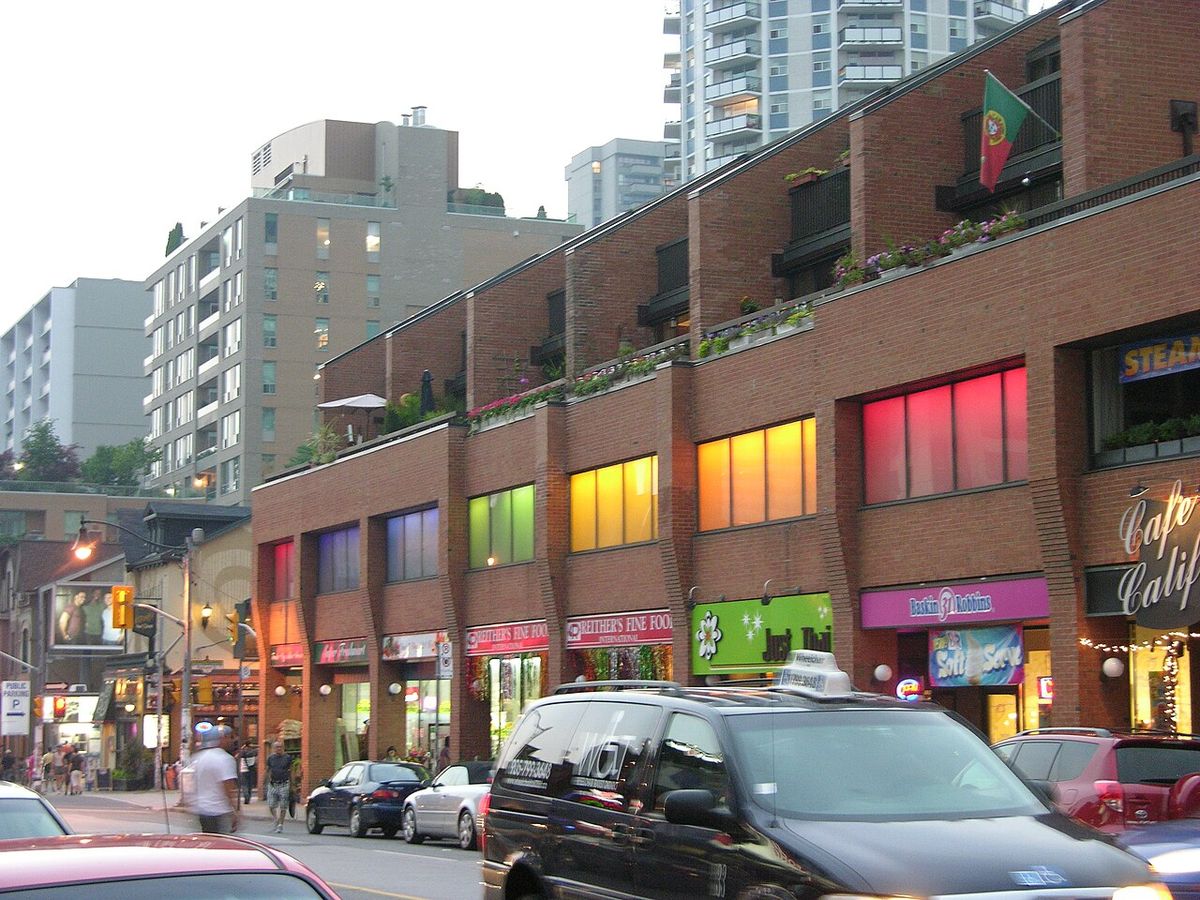
The neighbourhood's traditional boundaries are Gerrard Street to the south, Yonge Street to the west, Charles Street to the north, and Jarvis Street to the east. Its core is the two-block stretch of Church Street from Wellesley Street south to Alexander Street, which is lined with bars, restaurants, shops, and community spaces catering to the LGBT community. Beyond this commercial heart, the area features historic Victorian houses and apartments dating from the late 19th and early 20th centuries. While the Village is a focal point, many LGBT residents live in surrounding neighbourhoods like Cabbagetown, St. James Town, and The Annex, reflecting a broader integration across the city. The area's identity is visually marked by public art, including a rainbow crossing installed in 2014 and a trans pride crosswalk added in 2019, and it contains community landmarks like the statue of Alexander Wood at the corner of Church and Alexander Streets.
The physical and social centre of the neighbourhood is The 519 Church Street Community Centre, a city-run facility adopted as the de facto queer community centre. The 519, as it is commonly known, hosts meetings for numerous social and political groups and runs inclusive programming not exclusive to LGBT organizations. A major expansion was completed with a new wing opening in 2007 and upgrades finished in 2009, enhancing its capacity as a hub. Another key green space is Barbara Hall Park, home to the AIDS Memorial and the Trans Memorial, where bronze plaques honour community members lost to AIDS. The park hosts an annual candlelight vigil during Pride Week, and the nearby statue of early 19th-century merchant Alexander Wood, erected in 2005 at Church and Alexander, commemorates a historical figure linked to the area's queer history whose lands were once derisively called "Molly Wood's Bush."
History and Development
The land in the area was once part of the estate of Alexander Wood, a magistrate whose 1810 scandal led to his lands being derisively called "Molly Wood's Bush," using a historical slur for gay men. By the mid-20th century, the nearby Allan Gardens was a known cruising area, and an underground gay scene existed in bathhouses and bars around Yonge Street that were not exclusively gay but were frequented by homosexuals. From the late 1960s to early 1980s, the focus was on Yonge and Wellesley, with bars like the Parkside Tavern and the St. Charles Tavern being central, though they faced homophobic attacks, especially during the St. Charles's annual Halloween drag contest. The Glad Day Bookshop, Toronto's first gay-oriented bookstore, opened on Yonge Street near Wellesley in the mid-1970s, and the streets and alleys between Yonge and Bay became a cruising area referred to by police as "Track two."
The centre of gay life decisively shifted to Church Street following the galvanizing 1981 Toronto bathhouse raids, which spurred political mobilization and saw gay activist George Hislop run for city council. Gay-owned businesses began opening on the then-depressed Church Street as an alternative to the straight-owned bars on Yonge whose owners were accused of hostility toward their gay clientele. The 1980s saw the establishment of The 519 as a community hub and a concentration of gay bars, residences, and co-ops, solidifying the area as an open and friendly environment. The Church Wellesley Village Business Improvement Area was formally established in October 2002 to support local commerce, and it launched a pilot project in summer 2004 to close two blocks of Church Street to traffic on Sundays, though it ended early due to funding and controversy. The neighbourhood has hosted various events, including the Church Street Fetish Fair, which emerged in the mid-2000s alongside the separately organized Folsom Fair North event held in parking lots and Allan Gardens.
Key Historical Milestones- 1810: Alexander Wood estate scandal leads to area being called "Molly Wood's Bush."
- Mid-1970s: Glad Day Bookshop, the city's first gay bookstore, opens on Yonge Street.
- 1981: Toronto bathhouse raids galvanize community, accelerating shift to Church Street. George Hislop runs for council.
- 1980s: The 519 Church Street Community Centre becomes a central LGBT-friendly hub.
- 1991: Kyle Rae elected as Toronto's first openly gay city councillor for the area.
- 2002: Church Wellesley Village Business Improvement Area established.
- 2005: Statue of Alexander Wood unveiled at Church and Alexander Streets.
- 2014: Rainbow pride crosswalk installed on Church Street.
- 2019: Trans pride crosswalk installed in the Village.
Community and Cultural Life
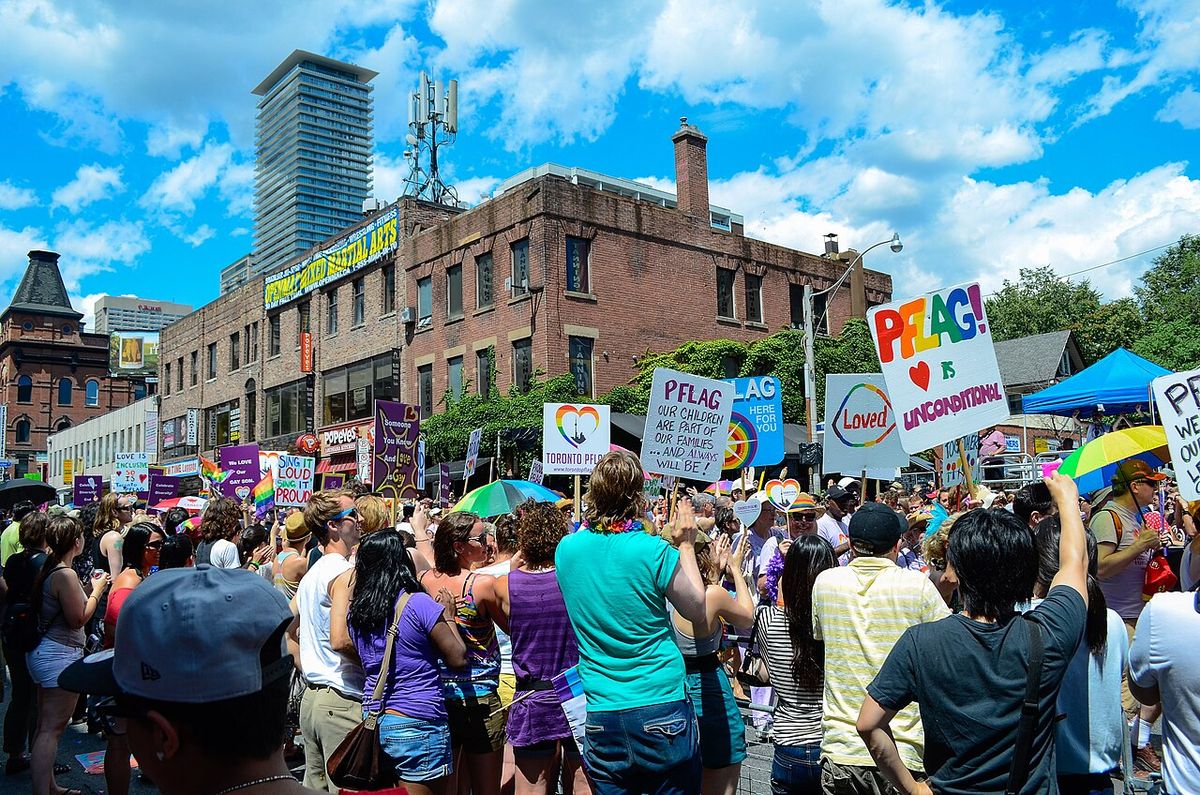
Church and Wellesley is the epicentre for Pride Toronto, Canada's largest Pride celebration, held annually on the last weekend of June with events throughout the month. The festival draws hundreds of thousands of attendees and features over 90 floats in its parade down Yonge Street on Sunday. The weekend includes the Trans March on Friday evening, the Dyke March on Saturday afternoon ending at Allan Gardens for a community fair and Dyke Stage, and a weekend-long community fair that closes Wellesley between Yonge and Church and stretches down Church Street to Dundas. Beyond Pride, the neighbourhood is a year-round cultural hub with theatres like Buddies in Bad Times, dedicated to queer theatrical expression, and numerous bars, clubs, and restaurants that cater to the community.
The area has also been a filming location and inspiration for popular culture, notably serving as the backdrop for the television series Queer as Folk, which was set in Pittsburgh but filmed recognizably in the Village. It inspired the "The Steps" sketch on The Kids in the Hall, based on real steps on the southwest corner of Church and Wellesley where people congregated. In 2020, the CBC Gem series Queens, a comedic mystery starring several real life Toronto drag queens, was set in the neighbourhood. The social fabric of the Village has undergone significant change, with rising commercial and residential rents since the 2000s displacing many independent, gay-owned businesses like This Ain't the Rosedale Library, replaced by chains like Starbucks, The Body Shop, and Subway.
The closure of the Priape chain of gay porn and clothing stores in October 2013 left its Church Street location vacant for over five years before being taken over by Friendly Stranger, a cannabis shop, in 2020. Many residents are now middle-aged professionals, as high costs make it difficult for youth to live in the core, leading to dispersal to areas like Parkdale, which has earned the nickname "Queer West Village," as well as Cabbagetown, and Leslieville. In response to concerns about the neighbourhood's evolving role, community groups like The 519 and the BIA launched a revitalization survey in 2013, questioning the future of an LGBT village in a progressive city. A major new initiative, a summer pedestrianization pilot for Church Street between Wellesley and Alexander, was approved to run from June 19 to August 21 in 2026, aiming to revitalize the streetscape, a project that received unanimous support from Community Council.
Political Representation and Activism
The neighbourhood has long been a politically active constituency with significant influence, identified as early as 1977 as perhaps the only electoral district in North America outside San Francisco where gay voters could singlehandedly determine an election winner. At the municipal level, it has been represented by pioneering openly LGBT councillors, beginning with Kyle Rae from 1991 to 2010, followed by Kristyn Wong-Tam, the city's first out lesbian councillor. Since the 2022 Toronto municipal election, the area has been represented by Chris Moise. Provincially, the riding encompassing the Village has been a bellwether for LGBT rights, with early MPPs like Margaret Campbell (1973 to 1981) and Susan Fish (1981 to 1987) being vocal allies in the Legislative Assembly of Ontario.
Despite this support, parties were initially reluctant to nominate openly gay candidates. In 1981, both the Ontario Liberals and NDP rejected gay candidates Peter Maloney and John Argue. The district later elected groundbreaking figures, with George Smitherman becoming Ontario's first openly gay MPP when elected for Toronto Centre in 1999, followed by Glen Murray. Suze Morrison, elected in 2018, came out as bisexual in 2021. Kristyn Wong-Tam was elected as the provincial MPP for Toronto Centre in 2022.
In 2012, a federal electoral redistribution proposal threatened to split the neighbourhood along Wellesley Street. Community opposition led to the final boundary being set at Charles Street to the north. This kept the Village intact within the federal electoral district of Toronto Centre. The area's political history is intertwined with activism, notably following the 1981 Toronto bathhouse raids.
Demographics, Transportation and Infrastructure
Demographic data shows a stable but shifting population in the census tract that includes the Village. In 2006, non-immigrants accounted for 58 percent of the population, immigrants for 35 percent, and non-permanent residents for 7 percent. By 2011, the non-immigrant share remained at 58 percent, but the non-permanent resident population increased to 10 percent, reducing the immigrant share to 32 percent. This reflects the area's appeal to students and temporary workers, and the ongoing densification through condominium development which has made the neighbourhood less affordable for many gay youth. The City of Toronto is also undertaking infrastructure upgrades in the area, including a three-year project to replace all 470,000 Water Meter Transmission Units across the city, with contractor Neptune Technology Group contacting residents to schedule appointments.
The neighbourhood is exceptionally well-served by public transit, anchored by the Wellesley subway station on Line 1 Yonge-University. Several other stations are within walking distance, including Bloor-Yonge and College on the same line, and Sherbourne and Castle Frank on Line 2 Bloor-Danforth. Multiple surface routes provide extensive connectivity, including the 94 Wellesley bus, which does not require a transfer at Wellesley station, the 97 Yonge bus running from Queen's Quay to Steeles Avenue, the 75 Sherbourne bus, the 141 Jarvis express bus to Davisville Village, and the 506 Carlton streetcar. The City also manages local amenities like wading pools and splash pads operating on full summer schedules, and partners on public health initiatives such as the #BeSunSafe program offering free sunscreen at select locations, expanded to include golf courses, and activates a Heat Relief Strategy from May 15 to September 30 to ensure resident safety during extreme temperatures.
Recent Developments and the Future
The Church and Wellesley neighbourhood continues to adapt to economic pressures and changing social dynamics. A significant recent development is the approval of a seasonal pedestrianization pilot for the core of Church Street. From June 19 to August 21 in 2026, the two blocks from Wellesley Street East to Alexander Street will be closed to through traffic to create a pedestrian-friendly space, a project championed by Councillor Chris Moise and the Church-Wellesley Business Improvement Area. This initiative, supported by over 2,200 petition signatures, aims to bolster the street's vitality during the summer months, echoing the shorter-lived 2004 pilot. The community also grapples with the ongoing effects of gentrification and the need to maintain its unique character amidst condo development and rising costs, which have led to a decline in small businesses and the area's appeal to younger generations.
Community organizations like the Church Wellesley Neighbourhood Association and The 519 remain active in planning and advocacy, hosting events like a 2SLGBTQIA+ history tour of the Village in October 2026. The area's role is continually reassessed, balancing its historical significance as a safe haven with its present function as a cultural destination in a city where LGBT people are more widely integrated and many popular clubs are now located outside the Village. The enduring presence of major institutions, memorials, and events like Pride Toronto, whose 2026 theme is "WE WON'T STOP," ensures that Church and Wellesley remains a symbolic and functional heart for 2SLGBTQIA+ life in Toronto, even as its residents and businesses spread across the wider metropolitan area. The City's seasonal programs, including the Heat Relief Strategy and the operation of wading pools and splash pads, demonstrate ongoing municipal support for resident wellbeing in this densely populated downtown neighbourhood.
Questions about Church and Wellesley
Where is the Church and Wellesley neighbourhood located in Toronto?
Church and Wellesley is located in downtown Toronto, with its traditional boundaries being Gerrard Street to the south, Yonge Street to the west, Charles Street to the north, and Jarvis Street to the east. The commercial and social heart of the area is the stretch of Church Street between Wellesley Street and Alexander Street. This core strip is where most of the LGBT-oriented bars, restaurants, shops, and community spaces are concentrated, making it the most recognizable part of the Village. The neighbourhood is part of the larger downtown core, adjacent to areas like the Garden District and Cabbagetown.
What is Pride Toronto and how is it connected to Church and Wellesley?
Pride Toronto is Canada's largest Pride celebration, held annually on the last weekend of June, with a program of events throughout the month. The festival is centred on the Church and Wellesley neighbourhood, which serves as its historic and cultural home. The weekend includes the Pride Parade down Yonge Street on Sunday, the Dyke March on Saturday ending at Allan Gardens, a Trans March on Friday evening, and a large community fair that closes sections of Church and Wellesley Streets. The event draws hundreds of thousands of participants and features over 90 parade floats, solidifying the area's status as the epicentre of queer celebration in the city and the country.
What is The 519 and why is it important?
The 519, officially The 519 Church Street Community Centre, is a city-run community centre at 519 Church Street that has been adopted as the primary queer community hub in Toronto. It provides meeting space for numerous social, support, and political groups and offers programming that is inclusive of the LGBT community while serving broader neighbourhood needs. It became a well-known LGBT-friendly space in the 1980s and underwent a significant expansion with a new wing opened in 2007 and upgrades completed in 2009. The 519 is a vital resource for community organizing, services, and as a safe gathering place, hosting everything from political meetings to social events.
How has the neighbourhood changed in recent years?
The neighbourhood has undergone significant changes due to gentrification and rising costs. High commercial rents have forced many independent, gay-owned businesses like This Ain't the Rosedale Library to close or relocate, with national retail chains like Starbucks, The Body Shop, and Subway often replacing them. Residential property values and rents have also risen sharply, making it difficult for younger LGBT people to live in the core, leading to a resident population that is largely middle-aged professionals. Many in the community now live in adjacent areas like Cabbagetown and St. James Town or farther neighbourhoods such as Parkdale and Leslieville. In response, initiatives like the summer pedestrianization of Church Street, planned for 2026, aim to revitalize the commercial strip and attract community activity.
Who are some notable political representatives from the Church and Wellesley area?
The area has been represented by several pioneering openly LGBT politicians. Municipally, Kyle Rae was Toronto's first openly gay city councillor, representing the ward from 1991 to 2010, followed by Kristyn Wong-Tam, the city's first out lesbian councillor. As of 2022, the councillor is Chris Moise. Provincially, George Smitherman was Ontario's first openly gay MPP when elected for Toronto Centre in 1999, and the seat was later held by Glen Murray and Suze Morrison. The current provincial MPP for Toronto Centre is Kristyn Wong-Tam, elected in 2022.
Is Church Street going to be closed to cars?
Yes, a seasonal pedestrianization pilot project has been approved for Church Street. For the summer of 2026, the two-block section from Wellesley Street East to Alexander Street will be closed to through traffic from June 19 to August 21. This initiative, led by the local Business Improvement Area and Councillor Chris Moise, aims to create a more pedestrian-friendly environment to support local businesses and community life, with over 2,200 people signing a petition in support. The east-west cross streets will remain open to vehicle traffic, and the project is seen as a major step in the area's revitalization, following a similar but shorter-lived pilot in 2004.
Sources and further reading
- Church and Wellesley (Wikipedia)
- Church Wellesley, News & Events, Councillor Chris Moise (chrismoise.ca)
Checked by the Your Space Hamilton desk. Last updated 2026-10-24.