The Annex
The Annex is a historic residential neighbourhood in Midtown Toronto, Ontario, known for its distinctive Victorian and Edwardian architecture and its deep connection to the University of Toronto. Traditionally bounded by Dupont Street to the north, Bloor Street to the south, Bathurst Street to the west, and Avenue Road to the east, its official definition by the City of Toronto also includes adjacent areas like Seaton Village and Yorkville. As a long-standing student quarter and faculty enclave, it is characterized by a high seasonal tenant turnover and a culturally diverse population, including a significant number of immigrants. The neighbourhood's main commercial strip along Bloor Street offers a wide range of retail and dining services, contributing to its status as a central and desirable Toronto district.
Character and Architecture
The Annex is primarily a residential neighbourhood distinguished by its tree-lined streets and large houses built between 1880 and the early 1900s. These Victorian and Edwardian homes coexist with mid-rise and a handful of high-rise apartment buildings constructed in the International style during the 1950s and 1960s, which were surrounded by landscaped green spaces to better fit the area. A government freeze on developments taller than 45 feet in 1975 helped preserve the original housing stock, and over 500 buildings in the area are now protected by the Toronto Historical Board, limiting redevelopment. The neighbourhood's architectural heritage includes some of architect Uno Prii's most expressive, sculptural apartment buildings, and due to its proximity to the university, the Annex has a high rate of seasonal tenant turnover with residents ranging from students to older long-time residents.
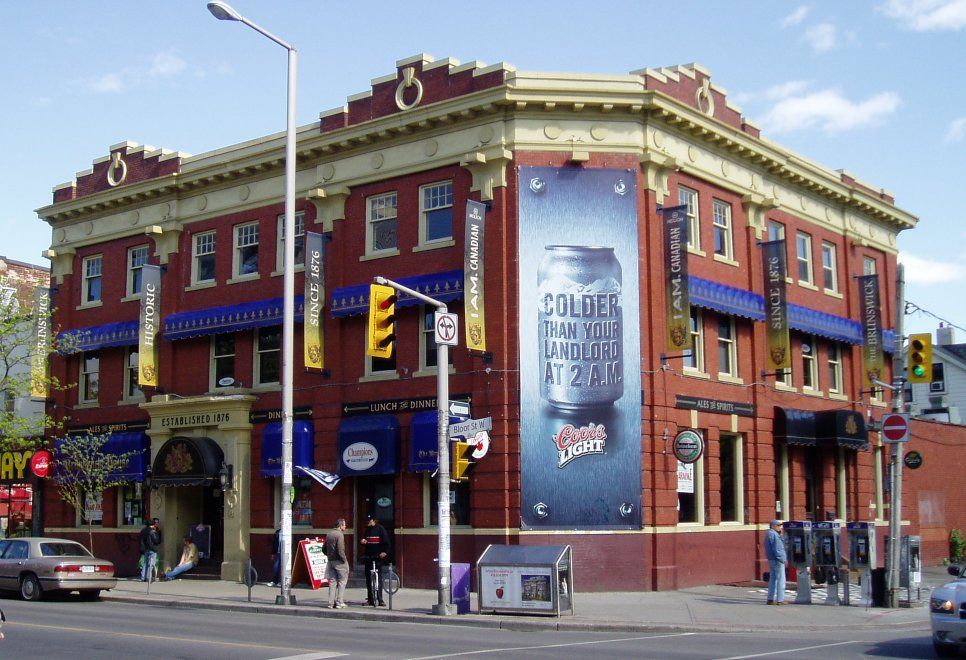
The stretch of Bloor Street between Avenue Road and Bathurst Street is a social and mixed-use area offering a wide range of services from moderate-priced dining to independent discount retailers. These services are located in buildings which often include residential space on upper floors. Just west of the Annex proper, along Bloor Street between Bathurst Street and Christie Street, there are street signs that post Koreatown due to the high percentage of Korean-owned businesses. That neighbourhood is officially called Seaton Village, but many locals refer to the area as West Annex. During the 1950s and 1960s, an influx of Hungarian immigrants moved into the neighbourhood after the 1956 Hungarian Revolution was suppressed. Some of the businesses and properties along Bloor may still be owned by Hungarian-Canadian families.
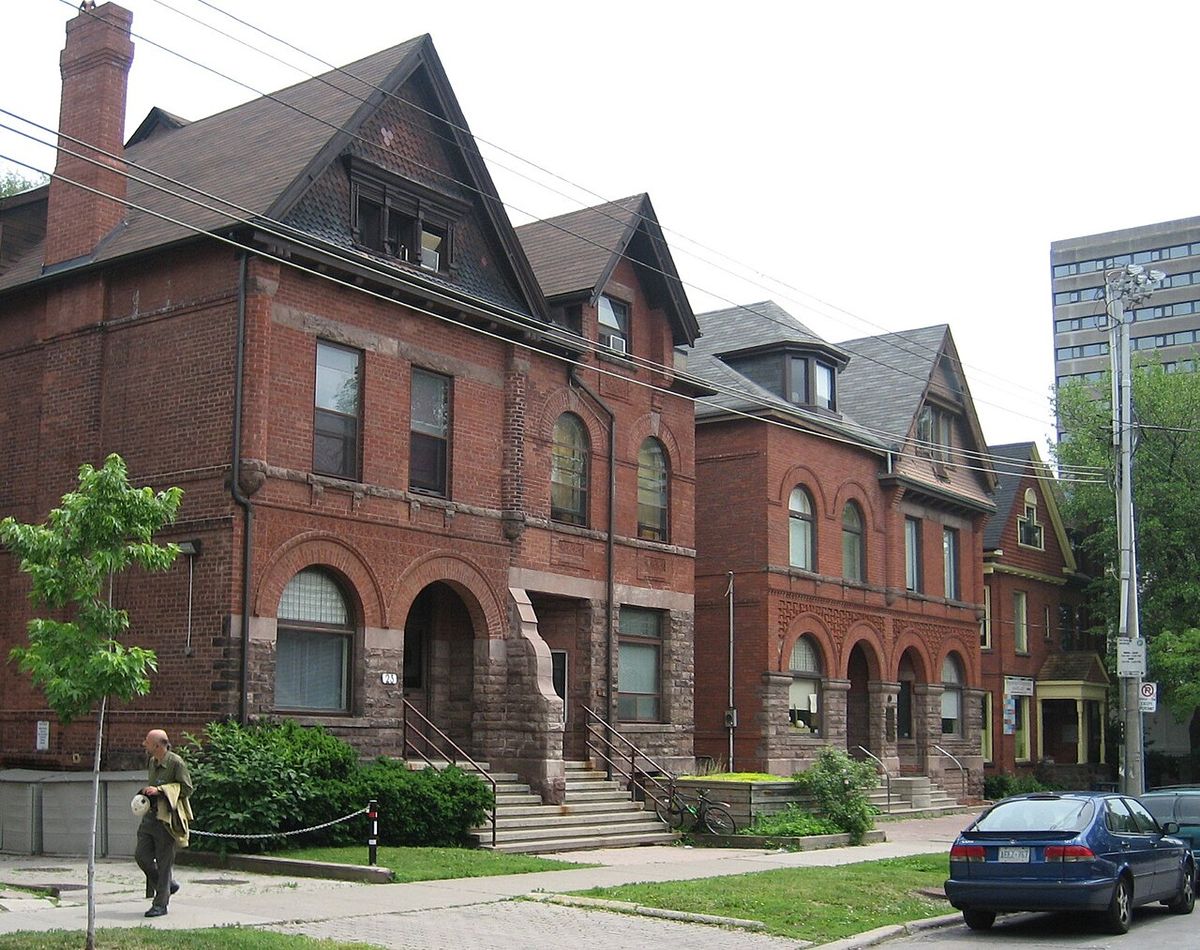
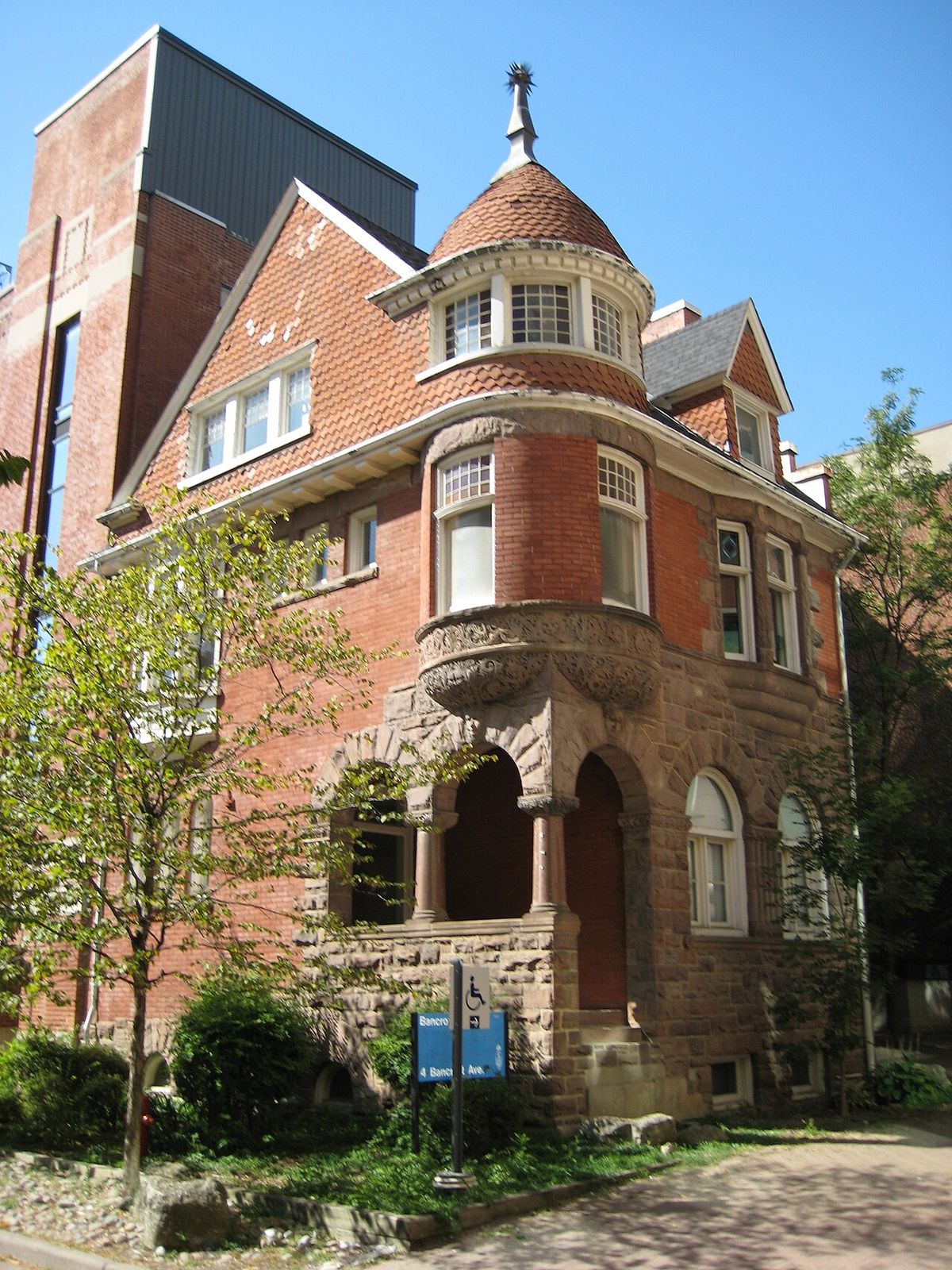
Annex Style HouseA uniquely Torontonian architectural style prevalent in the neighbourhood is the Annex style house, popular among the city's elite in the late nineteenth century and also found in former upper-class areas along Jarvis and Sherbourne Streets. The original design is attributed to architect E. J. Lennox, who completed the residence for contractor Lewis Lukes at 37 Madison Avenue in 1887, introducing a design that would be imitated and modified over the next two decades. This style blends elements of American Richardsonian Romanesque and British Queen Anne Revival, typically featuring large rounded Romanesque arches, decorative turrets such as those from the Queen Anne style, and an emphasis on the attic in the exterior design. Constructed most often of brick, sometimes with Credit Valley sandstone, these large houses were originally built for wealthy citizens but many were later subdivided into apartments as the affluent moved north to newer suburbs like Forest Hill and Lawrence Park.
History and Development
European settlement in the area began in the 1790s when surveyors laid out York Township, with the land east of Brunswick Avenue becoming part of the village of Yorkville and the region west of Brunswick becoming part of Seaton Village. Yorkville agreed to annexation with the City of Toronto in 1883, and developer Simeon Janes created a subdivision named the Toronto Annex in 1886. The Annex area officially joined Toronto in 1887, with Seaton Village following in 1888, integrating these communities into the growing city. Early prominent residents included retail patriarch Timothy Eaton, who had his residence at the corner of Lowther Avenue and Walmer Road, and distillery president George Gooderham Sr., marking the neighbourhood's first Golden Era which lasted until the early 1900s.
The Annex's first Golden Era lasted until the early 1900s, when the upper classes began to migrate northward above the Davenport escarpment to newer more fashionable suburbs in Forest Hill and Lawrence Park. The neighbourhood remained largely Anglo-Saxon until after World War II when Hungarian, Italian, and Ukrainian immigrants started to move in. In the 1960s, the proposed Spadina Expressway would have divided the Annex in half. Annex area residents, along with other resident grassroots groups, successfully opposed its construction.
Seaton Village
Seaton Village, located west of Bathurst Street and sometimes incorrectly referred to as the West Annex, shares several characteristics with the Annex including its architecture and popularity with University of Toronto students. It is generally quieter, more family-oriented, and has smaller, less expensive homes compared to the Annex proper, and includes the Koreatown shopping district at its southern border along Bloor Street. Vermont Square Park serves as a central community hub near the centre of Seaton Village, containing a playground with a wading pool, the St. Albans Boys and Girls Club, and the Bill Bolton hockey arena. A notable local curiosity is a house on Clinton Street almost entirely covered in circular woodcakes cut from billiards cues, adding to the area's distinctive character.
Seaton Village is the former home of Canadian poet and children's author Dennis Lee. It was also home to Oscar-winning sound engineer David Lee for the film Chicago, sociologist Barry Wellman, and Meghan Markle. It is the current home of novelist and playwright Ann-Marie MacDonald. The area west of Brunswick Avenue was part of Seaton Village historically. Seaton Village joined the City of Toronto in 1888, one year after the Annex area became part of Toronto in 1887.
Demographics and Population
According to the 2021 Canadian census, the three census tracts that compose the Annex have a combined population of 14,149 residents. The population density is high, averaging 9,685 people per square kilometre, reflecting the mix of single-family homes and apartment buildings in the area. The neighbourhood has long been a destination for immigrants. The 2011 census recorded about 4,665 immigrants living in the area, predominantly from the United Kingdom and the United States, contributing to its cultural diversity. The average household income in 2011 was $66,742.67, which was significantly above the average for the Toronto census metropolitan area at the time, indicating a relatively affluent community.
Bordering the St. George campus of the University of Toronto, the Annex has long been a student quarter. It is also home to many fraternity houses and members of the university's faculty. Because of its proximity to the university, the Annex has a high rate of seasonal tenant turnover. Its residents range from university students to older long-time residents. The neighbourhood remained largely Anglo-Saxon until after World War II when Hungarian, Italian, and Ukrainian immigrants started to move in.
Notable Residents
The northern Annex was home to many members of Toronto's Eaton family and members of the Baldwin, Ross, and Simpson families until the mid-twentieth century. The Baldwin family built three houses on the northern side of Lowther near Bedford Road. Frederick Banting, the co-discoverer of insulin and recipient of the Nobel Prize for Medicine, lived on the south east corner of Lowther and Bedford Road. Beatrice Worsley, who received the first PhD in what would now be called computer science and was the first female computer scientist in Canada, lived on Lowther on land which is now part of Bedford Park.
Brunswick Avenue has served as a home for many writers, including Matt Cohen, Austin Clarke, Morley Callaghan, Howard Engel, Marian Engel, and bpNichol. bpNichol lived at 59 Admiral Road with Lea Hindley-Smith, founder of Therafields, and her family, from 1966. Admiral Road in the Annex is home to the writer Margaret Atwood, as well as John Ralston Saul and his wife, the former Governor General of Canada Adrienne Clarkson. Her ex-husband Stephen Clarkson lived on nearby Lowther Avenue, across from former MP Belinda Stronach. Former Prime Minister and Nobel Laureate Lester B. Pearson lived at 12 Admiral Road from 1925 to 1928. The noted urban theorist and activist Jane Jacobs lived at 69 Albany Avenue from 1971 until her death in 2006. David Suzuki lived for years on Bernard Avenue, and Catherine O'Hara lived in the Annex for several years. Explorer Norman Elder owned the Norman Elder Museum at 140 Bedford Road.
- Margaret Atwood & John Ralston Saul (Admiral Road)
- Frederick Banting (SE corner of Lowther & Bedford Road)
- Jane Jacobs (69 Albany Avenue, 1971 to 2006)
- Lester B. Pearson (12 Admiral Road, 1925 to 1928)
- Beatrice Worsley (Lowther Avenue)
- bpNichol (59 Admiral Road & Brunswick Avenue)
- Dennis Lee (Seaton Village)
- Ann-Marie MacDonald (Seaton Village)
Transportation
The Annex is exceptionally well-served by public transit, facilitated by its central location and dense urban form. Four Toronto Transit Commission subway stations are located on its borders: Bathurst and Dupont on the Bloor-Danforth line, and St. George and Spadina, which are interchange stations between the Bloor-Danforth and Yonge-University lines. Spadina and St. George stations allow passengers both north-south travel on the Yonge-University line and east-west travel on the Bloor-Danforth line, providing comprehensive subway connectivity. Surface transportation includes streetcar services running south from both Bathurst and Spadina stations, offering direct routes into downtown Toronto and other neighbourhoods.
Bus service operates on Avenue Road, Spadina Road, Dupont Street, Davenport Road, and northward on Bathurst Street. The Annex is well served by public transit, including four Toronto Transit Commission subway stations: Bathurst, Dupont, St. George, and Spadina. Spadina and St. George stations act as interchange stations, allowing passengers both north-west subway travel as well as east-west. Streetcar services run south from Bathurst and Spadina stations. In the 1960s, the proposed Spadina Expressway would have divided the Annex in half, but Annex area residents, along with other resident grassroots groups, successfully opposed its construction.
Questions about The Annex
Where exactly is the Annex located in Toronto?
The Annex is a neighbourhood in Midtown Toronto. Its traditional boundaries are Dupont Street to the north, Bloor Street to the south, Bathurst Street to the west, and Avenue Road to the east. The City of Toronto's official neighbourhood definition is broader, also including the adjacent areas of Seaton Village and Yorkville. It directly borders the St. George campus of the University of Toronto, which heavily influences its character.
Who are some famous people who have lived in the Annex?
The Annex has been home to many notable Canadians from diverse fields. Literary figures include Margaret Atwood, John Ralston Saul, Morley Callaghan, and bpNichol. Scientific residents have included Nobel laureate Frederick Banting and computer science pioneer Beatrice Worsley. Former Prime Minister Lester B. Pearson and former Governor General Adrienne Clarkson have also lived there. Other prominent residents have been urban activist Jane Jacobs, environmentalist David Suzuki, and members of the Eaton and Baldwin families.
What is the population and demographic makeup of the Annex?
As of the 2021 census, the Annex has a population of 14,149 with a high density of 9,685 people per square kilometre. The neighbourhood has a historically high immigrant population. The 2011 census noted about 4,665 immigrants, predominantly from the UK and the US. The average household income in 2011 was $66,742.67, above the Toronto average. Its proximity to the University of Toronto ensures a significant student and faculty population, leading to seasonal tenant turnover within a mix of long-term residents.
What is the Annex style house?
The Annex style house is a uniquely Torontonian architectural style popular among the city's elite in the late nineteenth century. Its original conception is attributed to architect E J Lennox, with his design for 37 Madison Avenue in 1887 serving as an early example. The style blends elements from American Richardsonian Romanesque and British Queen Anne Revival, typically featuring large rounded Romanesque arches, decorative turrets, and emphasized attics. These houses are most often made of brick, sometimes incorporating Credit Valley sandstone. Originally large homes for wealthy citizens, many have since been subdivided into apartments, and numerous examples survive around the University of Toronto St George campus and in the Annex neighbourhood itself.
What is the difference between the Annex and Seaton Village?
Seaton Village is a distinct neighbourhood located west of the Annex's traditional boundary at Bathurst Street. While it shares architectural styles and popularity with University of Toronto students, it is generally quieter, more family oriented, and has smaller, less expensive homes. Seaton Village includes the Koreatown shopping district on Bloor Street between Bathurst and Christie Streets. It is sometimes incorrectly called the West Annex, which is actually a different official area bounded by Bloor, Bathurst, the CP Railway, and Spadina Avenue. The City of Toronto's broader neighbourhood definition does include Seaton Village with the Annex, but they remain separate communities with different characters.
How is the Annex served by public transit?
The Annex is well served by public transit through the Toronto Transit Commission. It is directly served by four subway stations: Bathurst, Dupont, St George, and Spadina. Spadina and St George stations act as interchange stations, allowing travel on multiple subway lines. Streetcar services run south from both Bathurst and Spadina stations. Bus service operates on several major roads in and around the neighbourhood, including Avenue Road, Spadina Road, Dupont Street, Davenport Road, and northward on Bathurst Street. This comprehensive network provides excellent connectivity for residents and visitors throughout Toronto.
Sources and further reading
- The Annex (Wikipedia)
- Neighbourhood: Annex | Destination ... (destinationtoronto.com)
- Annex Neighbourhood Guide (hoodq.com)
- Annex, Toronto Neighbourhood guide (neighbourhoodguide.com)
- The Annex | Toronto Neighbourhoods (jenlaschinger.com)
Checked by the Your Space Hamilton desk. Last updated 2026-10-23.