Canadian Broadcasting Centre
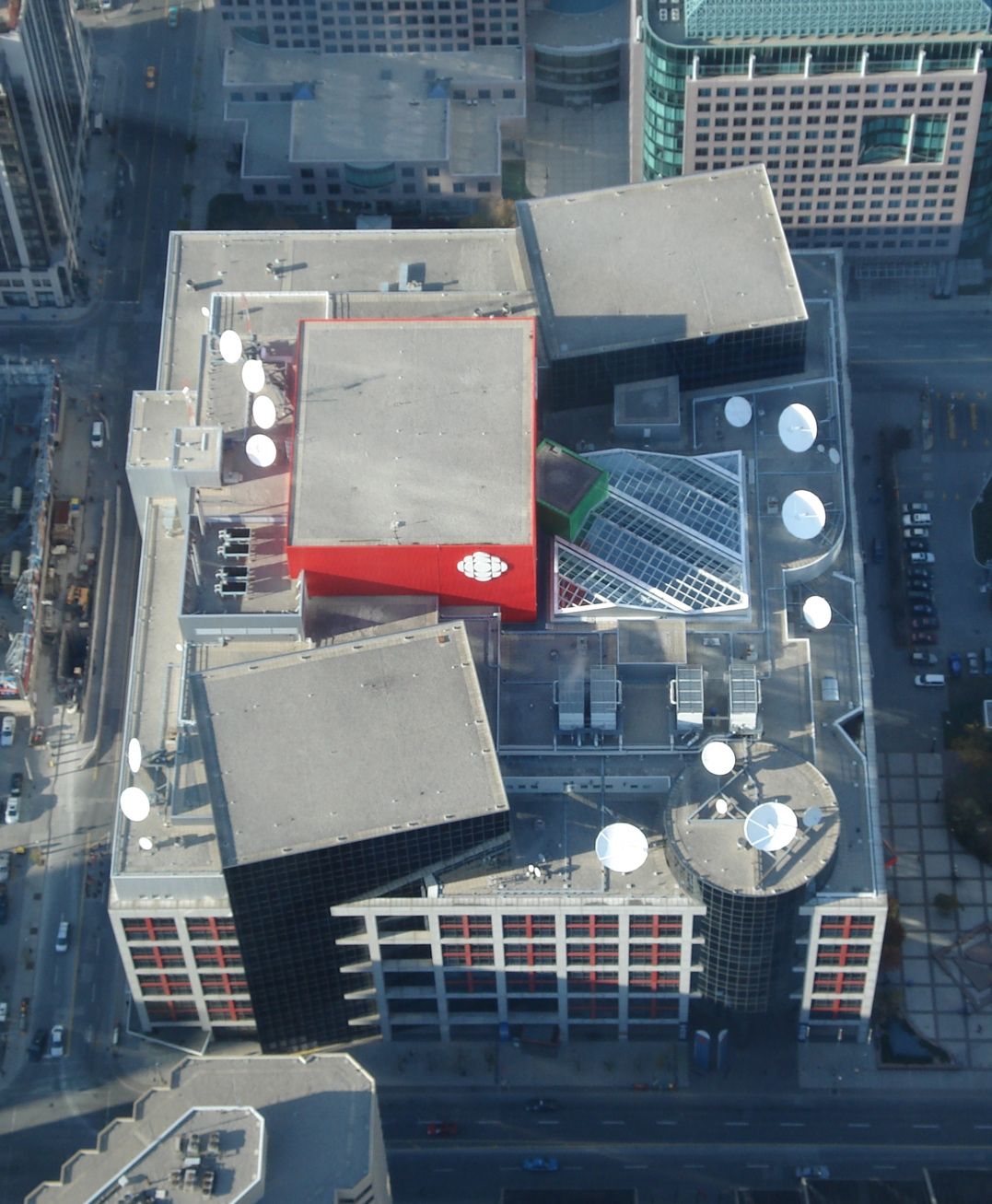
The Canadian Broadcasting Centre (CBC), also known as the Toronto Broadcast Centre, is the principal broadcast and master control facility for the Canadian Broadcasting Corporation's English-language television and radio services. Located at 250 Front Street West in downtown Toronto, the 13-storey complex opened in 1993 at a cost of $350 million to consolidate operations previously scattered across 26 Toronto locations. It serves as the production hub for national and local programming, houses the headquarters of the North American Broadcasters Association, and includes commercial studio space rented to external productions. The building is a landmark of Canadian media infrastructure, designed with advanced technological systems to support digital broadcasting into the 21st century.
History and Construction
The Canadian Broadcasting Centre was constructed on a historically significant site in downtown Toronto, the block once occupied by the First Ontario Parliament Buildings from 1832 to 1903. Planning for the new broadcast centre began over twelve years before its 1993 opening, with intensive strategic work between 1988 and 1990 focusing on digital archives, interactive television, and a corporate intranet reliant on fibre-optic infrastructure. The four-year construction phase involved erecting a sophisticated communication backbone and migrating all personnel and broadcasting systems without any loss of airtime. The $350 million project was driven by the need to integrate thousands of CBC employees from two dozen separate facilities and to modernize the corporation's technical infrastructure for the digital age. Upon completion, the facility was considered among the most advanced broadcast centres in the world, with its design incorporating future-ready concepts for high-definition television and digital radio.
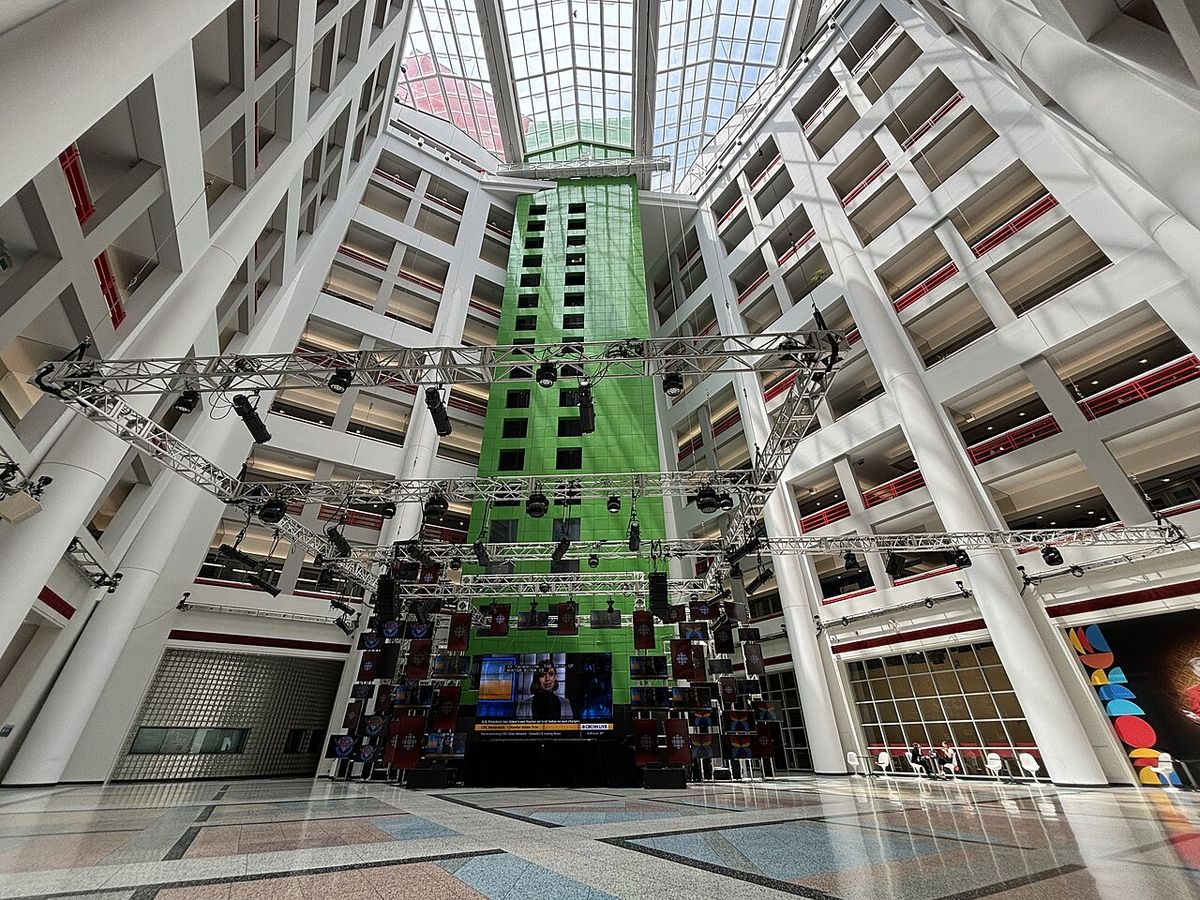
The building's design incorporated specific engineering solutions to meet the demands of broadcast production. The entire structure sits on 3,000 hard-rubber isolation pads to dampen noise and vibrations from nearby sources like the CN Tower and city traffic, ensuring studio sound quality. All production studios are located in the core of the building for further acoustic protection. The facility is equipped with four 1250-kilowatt Cummins diesel generators to maintain power for critical broadcast loads during any electrical failure. The main public atrium was named in honour of renowned Canadian journalist Barbara Frum and serves as a venue for special election broadcasts and events like the 2000 Today millennium special and episodes of Canadian Antiques Roadshow.
The project's planning required over twelve years with particular emphasis on critical IT strategic planning and high-capacity advanced corporate intranet technology design dependent on physical considerations including electromagnetic interference from nearby sources such as the CN Tower. Its architectural design features eventually incorporated the emergent concepts and information technologies underlying Digital HDTV and Digital Radio Broadcast integrated with the Internet. The project aimed to integrate a large number of CBC employees who were located at 26 separate facilities throughout Toronto and modernize the CBC corporate automation infrastructure. The personnel and the systems migrated to the new facility from the older Jarvis Street location without the loss of one minute of airtime.
Architecture and Facilities
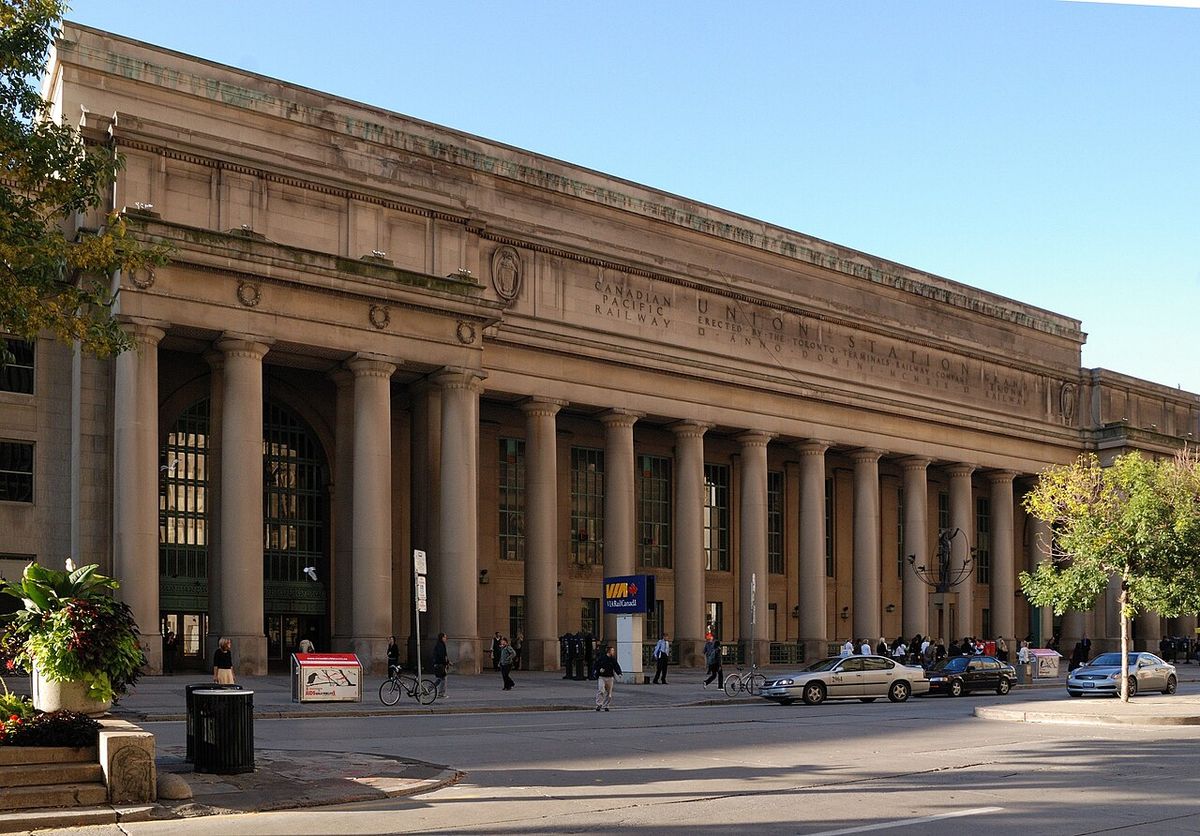
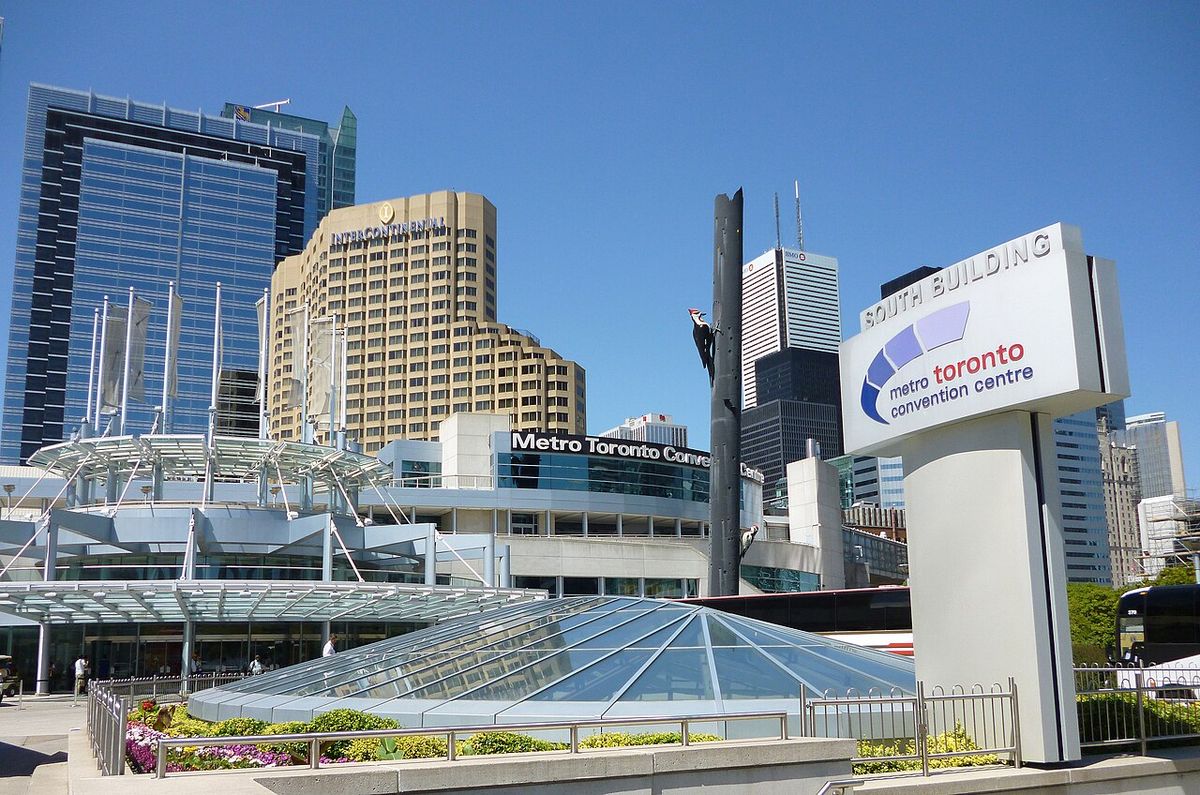
The 13-storey complex at 250 Front Street West features additional public entrances at 205 Wellington Street West and 25 John Street, placing it directly across from the Metro Toronto Convention Centre. The building is connected to Toronto's extensive PATH underground pedestrian network and is within walking distance of major landmarks like Union Station, the Rogers Centre, and the CN Tower. Television production occupies the upper floors, including three large studios on the rooftop, while radio operations are primarily housed on the second, third, and fourth floors. The facility contains a comprehensive suite of production spaces to serve the CBC's extensive broadcast needs, from local news to national network programming for both English and French services in Toronto.
- Radio Facilities: 3 main radio studios (including the Glenn Gould Theatre), 19 radio production studios.
- Television Studios: 3 large television studios, 2 local television studios, 2 all-purpose studios, 1 national news studio.
- Public Spaces: The Barbara Frum Atrium and the former CBC Museum space on the first floor.
- Commercial Tenants: Two floors house the advertising agency Bensimon Byrne and its subsidiaries Narrative and OneMethod.
- External Rentals: Large sound stages are rented to outside productions for movies, television shows, and commercials.
Simcoe Place is a commercial building that is part of the Canadian Broadcasting Centre complex and is joined by underground facilities. In 2015, the CBC announced that it was considering selling the building and leasing back parts of it. Due to zoning restrictions, the CBC opted to retain ownership of the building while leasing out parts of it. The complex was designed with infrastructure supporting digital HDTV and digital radio broadcast as part of its corporate automation modernization for the 21st century.
Programming and Production Operations
The Canadian Broadcasting Centre is the primary production base for CBC's English-language national networks and local Toronto stations, including CBLA-FM (CBC Radio One), CBL-FM (CBC Music), and CBLT-DT (CBC Television). It also produces local programming for the French-language stations CJBC (Ici Radio-Canada Première) and CJBC-FM (Ici Musique) from Toronto. The large sound stages are frequently rented to external production companies for television shows, films, and commercials, generating additional revenue for the corporation. Notable external productions filmed there have included Global's Deal or No Deal Canada and Are You Smarter Than a 5th Grader?, YTV's Life with Boys, and a multitude of commercials for major brands like Ford and Canadian Tire.
The technical configuration allows for the continuous production of both live and recorded content. The migration from the older Jarvis Street facility was executed without interrupting any broadcast schedules, a complex transition involving corporate IT platforms and software application refurbishment. The centre's design supports the emergent technologies of its time, functioning as an integrated server and multimedia cloud platform long before such concepts were commonplace. This infrastructure enables the production of everything from 24-hour news programming to elaborate studio-based entertainment shows, solidifying the building's role as the technical heart of English-language public broadcasting in Canada. The facility's only noted technological peer at the time of its completion was the CNN Center in Atlanta, Georgia, which posed a minor challenge to its claim as the world's most advanced broadcast centre.
Notable Studios and Their Uses
The building houses several specifically sized and equipped studios that cater to different genres of programming. Studio 40, on the 10th floor, is the largest multi-camera soundstage in Canada at 13,287 square feet with an 18-metre ceiling, hosting shows like Dragons' Den, Canada's Smartest Person, Deal or No Deal Canada, Family Feud Canada, The Price is Right Tonight and various Paris By Night shows. Studios 41 and 42, also on the 10th floor, are nearly identical at 11,070 square feet each and have been home to Canadian comedy programs including Air Farce Live, The Rick Mercer Report, The Ron James Show and The Red Green Show. Studio 41 was leased by Sportsnet to serve as the studio for its NHL coverage, including Hockey Night in Canada, until the operation relocated to the Rogers Building in 2021.
Smaller studios on the sixth floor, such as Studios 43 and 65 at 4,345 square feet each, have been used for talk and lifestyle programs like George Stroumboulopoulos Tonight, Steven and Chris and The Goods. The classic children's television show Mr. Dressup was taped in a former studio on Yonge Street until the broadcast centre opened in 1992. The national news operations are centred in dedicated studios: Studio 50 for the CBC News Network and Studio 55 for the flagship program The National. On the fifth floor, Studio 73, at 1,386 square feet, is equipped with a large green screen and is used to tape the hosted segments of CBC Kids, among other productions that require virtual set technology.
CBC Museum and CBC Kids Studio
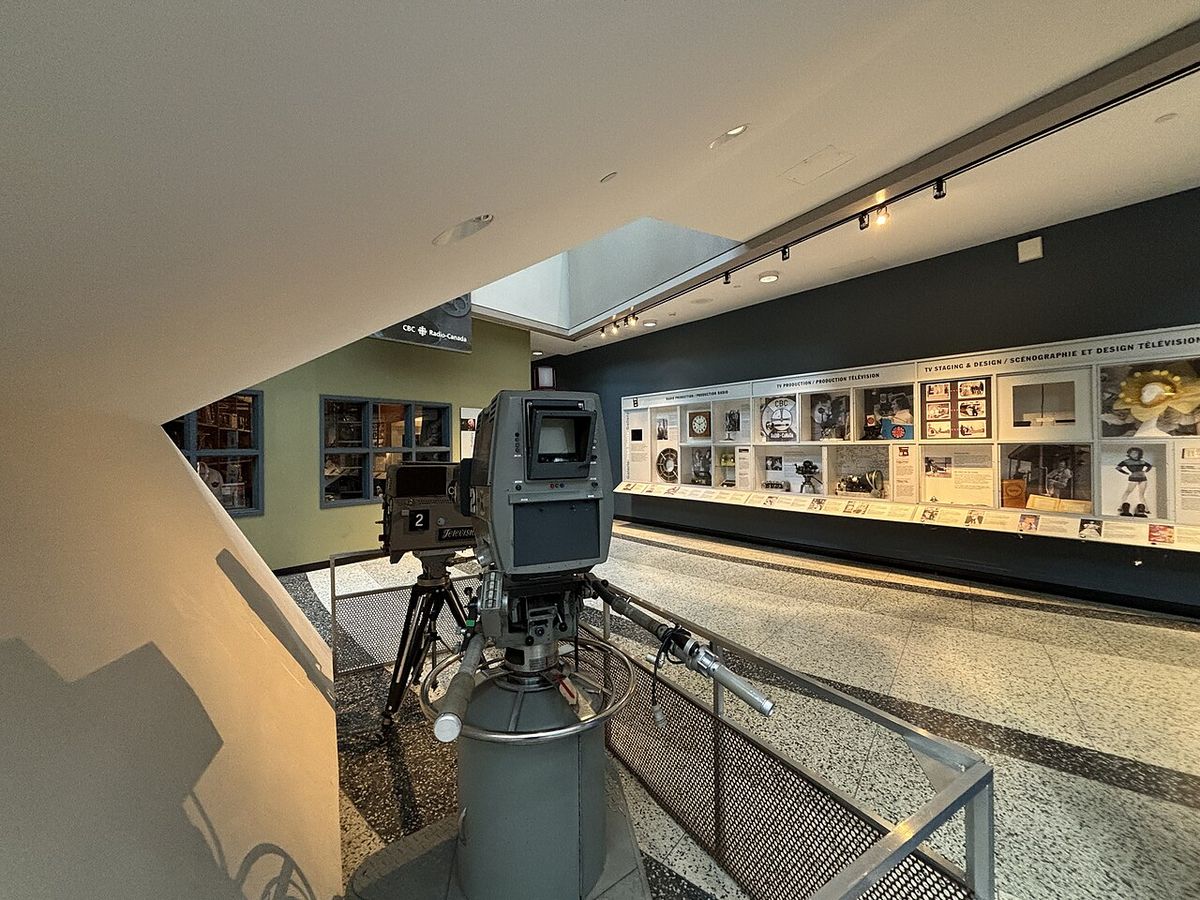
For many years, the first floor of the Canadian Broadcasting Centre housed the CBC Museum, dedicated to preserving the physical artifacts and history of the national broadcaster. Its exhibits included cherished items from Canadian children's television, such as the original "Tickle Trunk" from Mr. Dressup and Casey's treehouse from the same series displayed in the lobby. The museum also displayed a portion of the original set used for Friendly Giant, Muppet puppets from Sesame Park, vintage broadcast equipment, and video clips from decades of programming. Additional memorabilia from CBC's history was exhibited in other first-floor areas outside the museum proper. The museum closed its doors in 2017, and its entire collection was transferred to Ingenium, the federal Crown corporation that operates Canada's national science and technology museums.
In 2018, the former museum space was renovated and reopened as the new CBC Kids studio. The redesigned studio features a glass entrance and windows along the south wall, allowing the public to view productions when filming is underway. The studio design pays homage to Canadian broadcasting history, featuring a replica of the Mr. Dressup Tickle Trunk and many other nods to historic Canadian children’s television. The studio launched with a live public event called the "Thankathon," marking a new chapter in the building's public engagement and children's content production. This transformation repurposed a space dedicated to preserving the past into an active production studio for future generations of viewers, continuing the CBC's legacy in children's programming.
Security Incidents and Threats
The high-profile nature of the Canadian Broadcasting Centre has made it a subject of security concerns and incidents over the years. In 2006, the building was included on a list of potential targets by the group known as the Toronto 18 in an Ontario terrorism plot. During the 2010 G20 Toronto summit protests, the broadcast centre was inside the security perimeter, and employees were temporarily restricted from leaving the building when access gates were locked down during portions of the rioting. A Canadian Security Intelligence Service regional office located directly across Front Street West has assisted with security, leading to the identification of suspicious packages and an arrest in 2011.
The building was evacuated in November 2015 after someone taking stock of inventory in the archives stumbled upon what looked like a military shell. Police and military bomb technicians were called in and determined the shell was inert, allowing staff to return and broadcasts to resume. In 2018, a user on the website incel.me called on other users to attack the CBC and shoot employees, leading to increased security measures and the involvement of the Toronto Police Service. These incidents demonstrate the ongoing security protocols required to protect a major national media institution, its staff, and its continuous broadcast operations from various threats.
Comparative Context and Organizational Structure
The Canadian Broadcasting Centre serves as the main operational hub for the CBC's English-language services, while analogous facilities exist for other parts of the corporation. The primary centre for CBC's French-language services, known as Maison Radio-Canada, is located in Montreal. The corporation's corporate headquarters are situated in Ottawa at the CBC Ottawa Production Centre. The Toronto centre also houses the headquarters of the North American Broadcasters Association, an international organization of broadcasting companies. This placement within a major CBC facility highlights the building's importance as a nexus for both national and continental broadcasting industry activities and collaboration between different media entities.
The technical and operational design of the Toronto centre was pioneering for its time. The planning emphasized creating a "Global Information Server and MultiMedia Cloud" integrated with the internet, a forward-looking concept in the early 1990s. The only facility considered to pose a minor technological challenge to its advanced status was the CNN Center in Atlanta, Georgia. This design ensured the CBC's Toronto operations remained at the forefront of broadcast technology, supporting everything from digital archives to interactive television applications for decades after its opening. The project's leading aim was the integration of a large number of employees and the modernization of corporate automation infrastructure in preparation for the 21st century, which it achieved through its comprehensive planning and construction.
Technical Specifications and Building Features
The Canadian Broadcasting Centre was built with specific technical specifications to ensure uninterrupted broadcast operations and high-quality production. The building's structural design includes 3,000 massive hard-rubber pads that isolate the entire complex from ground-borne vibrations and unwanted noise. This isolation is critical for the studios located in the building's core, where acoustic integrity is paramount for radio and television recording. The facility's power infrastructure is supported by four 1250-kilowatt Cummins generators, which provide backup electricity to critical loads during a power failure, ensuring that broadcasts can continue without interruption under almost any circumstance.
The project required detailed planning around physical considerations like fibre-optic cabling and electromagnetic interference, both from internal equipment and nearby external sources such as the CN Tower. The information technology platform was designed not just for contemporary needs but as a scalable system acting as a corporate automation backbone. This included preparations for digital HDTV, digital radio broadcast, and a high-capacity advanced corporate intranet. The integration of these systems took place during the four-year construction and migration period, which also involved the erection of the skeletal communication structure and the refurbishment of software applications to work within the new, highly integrated environment.
Questions about Canadian Broadcasting Centre
Where is the Canadian Broadcasting Centre located?
The Canadian Broadcasting Centre is located at 250 Front Street West in downtown Toronto, Ontario. The complex has additional public entrances at 205 Wellington Street West and 25 John Street. It is directly across from the Metro Toronto Convention Centre and within walking distance of Union Station, the Rogers Centre, and the CN Tower. The building is also connected to Toronto's PATH underground walkway network, providing sheltered access to much of the downtown core.
When did the Canadian Broadcasting Centre open and how much did it cost?
The Canadian Broadcasting Centre complex entered service in 1993. It was constructed at a cost of CA$350 million, excluding technology renewal. The project required over twelve years of planning and took another four years for construction completion. It replaced a smaller CBC facility on Jarvis Street in Toronto.
What CBC programs are produced at the Canadian Broadcasting Centre?
The centre produces a vast array of national and local CBC programming. This includes flagship news programs like The National from Studio 55 and CBC News Network from Studio 50. Popular entertainment shows produced there have included Dragons' Den, Rick Mercer Report, Air Farce Live, and Family Feud Canada. Local news and programs for CBC Toronto's English and French television and radio stations are also produced within the building, alongside rented productions like Deal or No Deal Canada and Are You Smarter Than a 5th Grader?
Can the public visit the Canadian Broadcasting Centre?
While the Canadian Broadcasting Centre is primarily a working broadcast facility, there are areas accessible to the public. The Barbara Frum Atrium is used for special events and broadcasts like federal election coverage. The CBC Kids studio on the first floor has a glass entrance and windows allowing visitors to observe filming when production is on. The former CBC Museum, which closed in 2017, was also a public attraction, and its collection of artifacts like the original Mr. Dressup Tickle Trunk is now with Ingenium.
What is the largest studio in the Canadian Broadcasting Centre?
The largest studio is Studio 40, located on the 10th floor. It spans 13,287 square feet (1,234 square metres) with a ceiling height of 18 metres (60 feet). The CBC describes it as the largest purpose-built, multi-camera capable studio soundstage in Canada. It has been used for productions such as Dragons' Den, Canada's Smartest Person, Deal or No Deal Canada, and various Paris By Night shows, accommodating large sets and audiences.
Has the CBC ever considered selling the Canadian Broadcasting Centre?
Yes, the CBC has considered selling the Canadian Broadcasting Centre. In 2015, the CBC announced it was exploring the possibility of selling the building and leasing back parts of it. However, due to existing zoning restrictions, the corporation ultimately decided to retain ownership of the property. Instead of a full sale, the CBC opted to lease out portions of the complex to other tenants. For example, two floors of the facility are leased to the advertising agency Bensimon Byrne and its subsidiaries Narrative and OneMethod. This strategy allows the CBC to generate revenue from the asset while maintaining control over its primary broadcast operations. The building remains a critical hub for the CBC's English language services in Toronto.
Sources and further reading
- Canadian Broadcasting Centre (Wikipedia)
- Canadian Broadcasting Centre (thecanadianencyclopedia.ca)
- Toronto Broadcasting Centre Facilities | Services & Policies (cbc.ca)
- CBC/Radio Canada Broadcast Centre Redevelopment (glotmansimpson.com)
- CANADIAN BROADCAST CENTER, TORONTO, CANADA (archinect.com)
Checked by the Your Space Hamilton desk. Last updated 2026-10-31.