Berri-UQAM station
Berri-UQAM is a Montreal Metro station located in the Ville-Marie borough of Montreal, Quebec. It serves as the central hub of the entire Metro network, operated by the Société de transport de Montréal (STM), and is the only station served by three lines: the Green, Orange, and Yellow lines. Situated in the historic Quartier Latin, it is the busiest station in the system and a critical transit node for the city. The station is undergoing a major, multi-year renovation and waterproofing project, with significant surface work scheduled to begin in January 2026.
History and Development
Berri-UQAM station opened with the inauguration of the Montreal Metro on October 14, 1966, under the name Berri-De Montigny. The opening ceremony was attended by Mayor Jean Drapeau, transit commission president Lucien L'Allier, and Archbishop Paul-Émile Léger, with a commemorative plaque later installed in the station's mezzanine. Initially serving the Green and Orange lines, the station expanded its role on April 28, 1967, when the Yellow Line began service to connect the Metro to the Expo 67 site on Île Sainte-Hélène. The station's name was changed to Berri-UQAM in 1988 to reflect the adjacent Université du Québec à Montréal, whose abbreviation it incorporates. A significant security incident occurred on September 2, 2001, when a canister of tear gas was set off inside the station, leading to the evacuation of about 300 passengers.
Planning for a comprehensive station refurbishment began in 2007 after the STM identified compromised waterproofing. Major construction started in 2010, focusing on structural, electrical, and mechanical systems, including upgrades to fire protection and ventilation. The work also involves renovating platforms, staircases, corridors, and entrance buildings with new architectural finishes. Initially projected for completion in 2025, the project faced significant delays, with media reports in April 2024 indicating waterproofing work would likely finish between 2027 and 2029. A major new phase of integrated road and infrastructure work by the STM and the City of Montreal is scheduled to begin on Berri Street and De Maisonneuve Boulevard East in January 2026, with an anticipated completion date of December 2028. This work will involve replacing the station's waterproofing membrane and renovating municipal underground infrastructure and roadways, while the station itself remains open.
Architecture and Layout
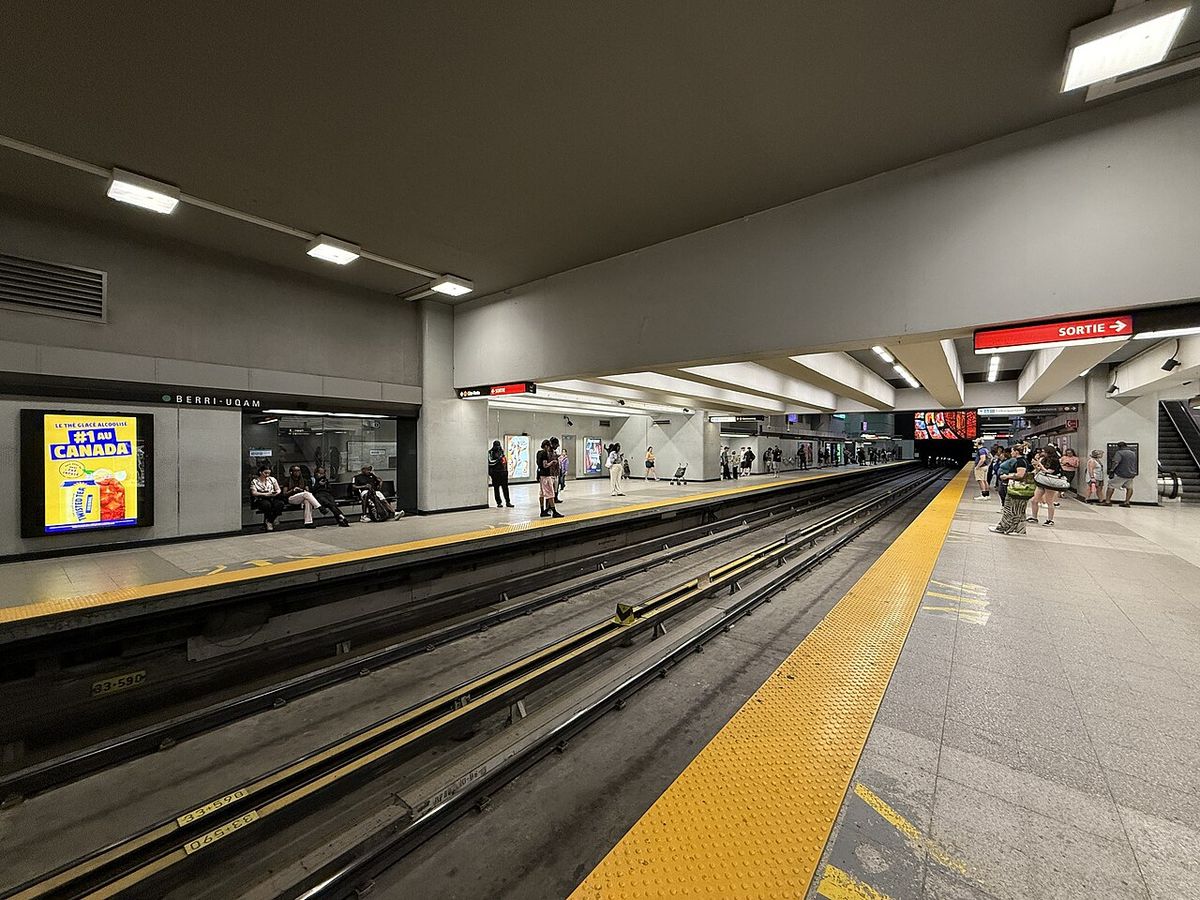
The station was originally designed by the architectural firm Longpré et Marchand. Its core is a massive cruciform cut-and-cover structure built underneath the intersection of Berri Street and De Maisonneuve Boulevard, requiring large pillars to support the street above. This central volume contains three primary levels, with a rectangular mezzanine at the top housing fare gates and commercial spaces. From the mezzanine, staircases descend to landings overlooking the Green Line platforms, which are situated one level below. The deepest part of the station is the Yellow Line terminus, located approximately 28 metres (92 feet) under rue Saint-Denis and connected to the main station by escalators and hallways. Limited space in the Yellow Line tail tracks requires trains to reverse both in the tail tracks and in the foretracks when they leave the station.
The station features five main public entrances, integrated into the urban fabric. The original 1966 design has little surface presence, but the city above has been transformed by the construction of Émilie Gamelin Square, the Grande Bibliothèque, and the University of Quebec. The project vision includes creating a new traffic roundabout at the street intersection to permit a skylight over the main entry area. The station's entrances and connections are as follows:
- Entrance A: 1500 Rue Berri
- Entrance B: 505 Rue Sainte-Catherine Est
- Entrance C: 850 Boulevard de Maisonneuve Est
- Entrance D: 1470 Rue Saint-Denis
- Unlettered entrance: 1621 Rue Berri
- Place Dupuis food court connection (open 7 am to 7 pm)
- Free-standing Sainte-Catherine kiosk entrance, designed by Gaétan Pelletier (added 1999)
An additional connection to the station exists through the Place Dupuis food court during its operating hours from 7 am to 7 pm. The station has a total of four independent exits. One of these is a free standing kiosk on Sainte Catherine Street. This Sainte Catherine exit kiosk was designed by architect Gaétan Pelletier. It was added to the station in 1999.
Public Art and Installations
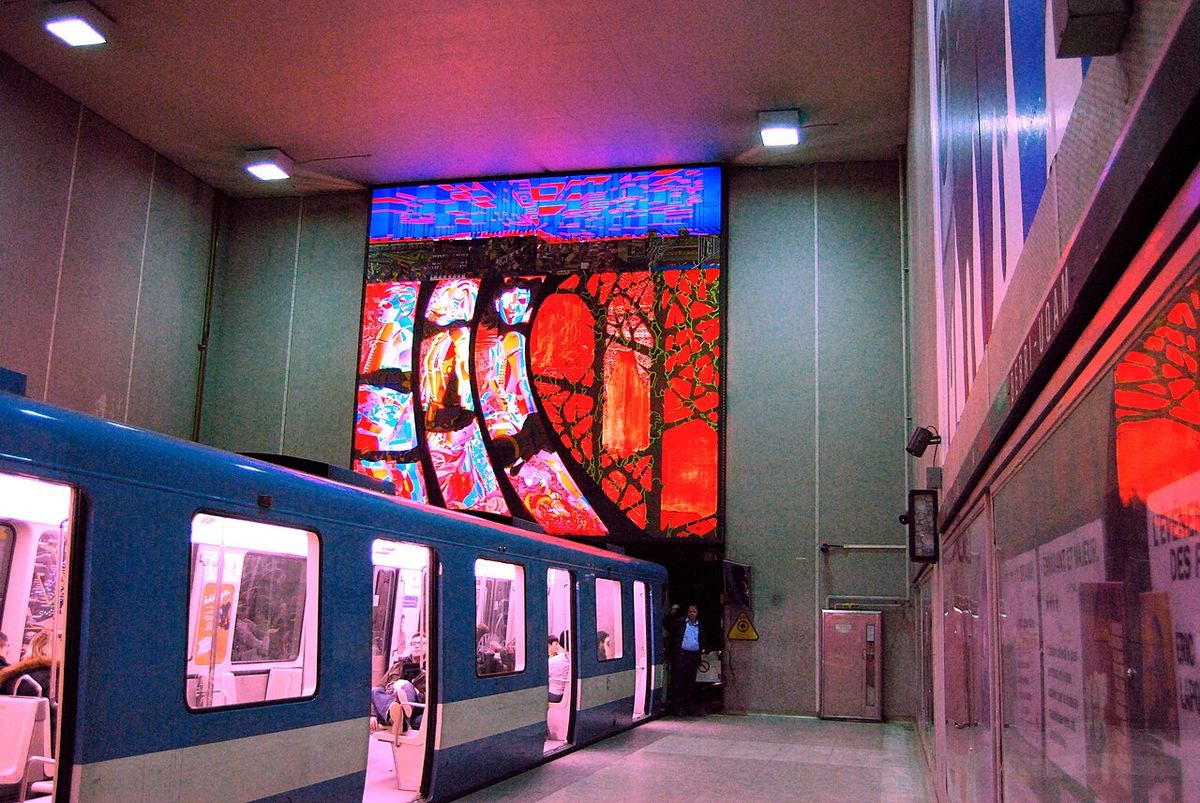
Berri-UQAM station features a notable collection of public art integrated into its spaces. The most prominent artwork is a large stained-glass mural by Pierre Gaboriau and Pierre Osterrath titled "Hommage aux fondateurs de la ville de Montréal." Installed in 1969 as a gift from the Union régionale de Montréal des caisses populaires Desjardins, it depicts city founders Jérôme le Royer de la Dauversière, Jeanne Mance, and Paul Chomedey, sieur de Maisonneuve, and is located over the eastern portal of the Green Line tunnel. Three paintings by Robert LaPalme, originally from the entrance to Expo 67, are displayed above the main staircase to the Yellow Line, representing the themes of science, recreation, and culture. A plaque by LaPalme and Georges Lauda, commemorating the inauguration of the Metro, is located at the centre of the mezzanine and is enclosed in a black circular bench.
This circular bench is a popular meeting site referred to colloquially as "la rondelle" (the hockey puck), "la pilule" (the pill), or "le banc des fous" (the crazy bench). In the newer Sainte-Catherine entrance pavilion, a statue of Mother Émilie Gamelin by Raoul Hunter commemorates Place Émilie-Gamelin, also called Berri Square, where the entrance is located. This statue is owned by the City of Montreal. The most recent art piece installed is the Wall of Peace on the concourse level of the Yellow Line, consisting of coloured metal plates bearing the word "peace" in multiple languages. The station was also the first in the network to be equipped with MétroVision information screens, which display news, commercials, and the time until the next train arrives.
Accessibility and Ongoing Upgrades
A key component of the station's renovation is the progressive addition of elevators to make all levels fully accessible. The first phase saw two elevators connecting the Orange Line platforms to the mezzanine open in September 2009, followed by an elevator from the street to the mezzanine at the Saint-Denis exit in June 2010. In November 2020, work was completed to make the Green Line platforms accessible with two more elevators. As of 2023, construction is underway to install elevators serving the deep Yellow Line platforms, a significant technical challenge given the 28-metre depth. Upon full completion of the renovation project, Berri-UQAM station will have a total of seven elevators, providing step-free access from the street to the mezzanine and to all three metro lines.
The station remains operational throughout all construction phases. While elevators within connected buildings like the Grande Bibliothèque and UQAM's Pavillon Judith-Jasmin offer access, they are subject to those buildings' hours. The elevator at the Saint-Denis exit is available during all Metro operating hours. The renovation work also includes comprehensive improvements to lighting, refurbishment of staircases, new architectural facings with wall tiling and ceilings, and the rearranging of corridors to the Orange and Green line platforms. The STM will also perform work on the tunnel vault between Berri-UQAM and Saint-Laurent stations as part of the integrated project beginning in 2026. The timeline for major accessibility milestones is as follows:
- September 2009: Two elevators open between Orange Line platforms and mezzanine.
- June 2010: Elevator opens from Saint-Denis exit to mezzanine.
- November 2020: Two elevators open for Green Line platform access.
- 2023 onward: Construction begins for Yellow Line platform elevators.
- Project completion: Seven total elevators will be in service.
Connections and Nearby Points of Interest
As a central transit hub, Berri-UQAM is a major interchange point not only for the Metro but also for the city's bus network. Several STM bus routes stop at or near the station. The Gare d'autocars de Montréal, the city's primary intercity bus terminal, is located in close proximity, facilitating easy transfers for regional travel. The station is deeply integrated into Montreal's underground city network, providing direct indoor access to major institutions. The Université du Québec à Montréal (UQAM) has its campus buildings directly adjacent and connected to the station. The Grande Bibliothèque, or National Library of Quebec, is accessible via an underground connection and features an elevator to the station's mezzanine. The Gare d'autocars de Montréal is also linked to the station via the underground network.
The station's location in the Quartier Latin places it near numerous cultural and educational landmarks. It sits at the edge of Place Émilie-Gamelin (Berri Square), a major public space. The area is also known for its theatres, cafes, and bookstores, cementing the station's role as a gateway to one of Montreal's most dynamic neighbourhoods. During the major roadwork starting in 2026, the bicycle path on De Maisonneuve East will be diverted onto Ontario Street via Atateken Street, and De Maisonneuve East will be closed to traffic between Berri and Saint-Hubert streets, while Berri Street will be closed between Ontario and Sainte-Catherine streets. Key points of interest connected via the underground city include:
- Université du Québec à Montréal (UQAM) campus
- Grande Bibliothèque (National Library of Quebec)
- Gare d'autocars de Montréal (intercity bus terminal)
- Place Dupuis commercial complex
- Place Émilie-Gamelin (Berri Square)
Future Vision and Urban Integration
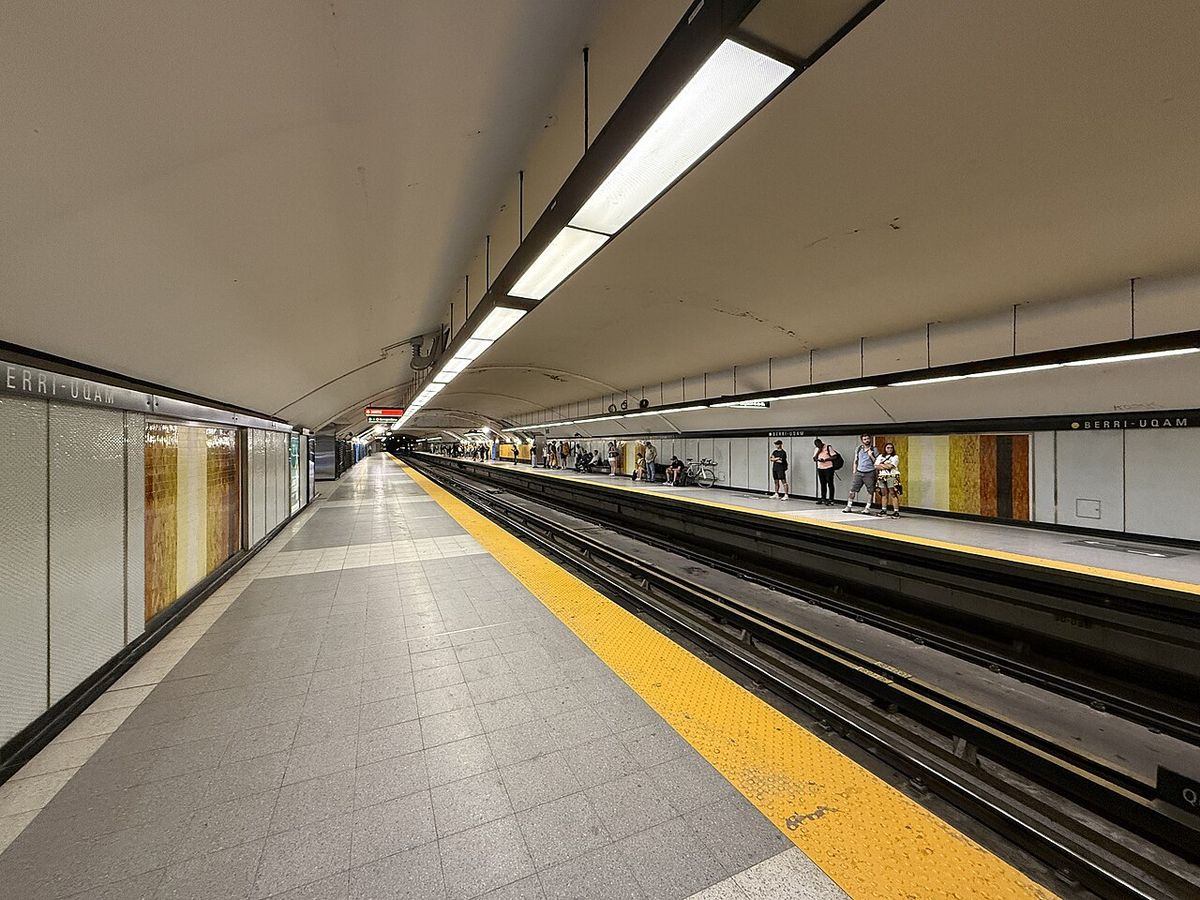
The extensive renovation project aims to fully develop Berri-UQAM's potential as a central urban node of downtown Montreal. Beyond essential repairs and waterproofing, the vision includes a new interior design scheme intended to restore the spatial clarity of the original 1966 architecture, which has been obscured over time by commercial kiosks. Based on ideas of colour, movement, and the circle as a motif, the proposed finishes take inspiration from artists like Roy Lichtenstein, with surfaces of gradated dots realized in ceramic tile and serigraphed glass. The project also seeks to better integrate the station with the city above, particularly by exploiting the natural topography of Place Émilie-Gamelin to open the square directly onto the Metro's entry level and shopping promenade.
This approach is designed to create a major new urban space that blurs the distinction between indoors and outdoors, underground and above ground. Planned exterior interventions include clearly marking the station's centre beneath the crossing of Berri and De Maisonneuve with new architectural elements. The existing red slabs marking vertical circulation inside the station are proposed to be projected upwards to create new entry aedicules and signage elements. A new traffic roundabout at this junction would permit the creation of a skylight over the station's main entry area. The STM and City of Montreal held a public information session about the 2026 works on November 6 at the Grande Bibliothèque auditorium, with online attendance also available.
Station Statistics and Role in the Network
Berri-UQAM holds several key statistical distinctions within the Montreal Metro system. It is the busiest station in the network when counting only boarding and exiting passengers, with approximately 13 million such passengers per year. When transfers between lines are included, the total annual passenger traffic through the station rises to an estimated 35 to 40 million people. This immense volume is a direct result of it being the central transfer point for three of the system's four lines. The station is also the second deepest in the entire network, with the Yellow Line platforms sitting roughly 28 metres below street level, a depth that presents unique engineering challenges for the ongoing elevator installation.
The station's role as a primary interchange shapes its design and operation. The crossing of three lines creates dramatic multi-level spaces within the large cruciform volume. The station's mezzanine, located at the centre of this volume, functions as the primary circulation hall with fare gates on all four sides and commercial shops lining its arms. The landings beside the Orange Line platforms offer views down into the great volumes over the Green Line platforms below. The station's importance is further highlighted by its selection as the site for the Metro's 60th-anniversary commemorations by the STM, with events held across the network including at Berri-UQAM.
Questions about Berri-UQAM station
Which metro lines serve Berri-UQAM station?
Berri-UQAM station is served by three lines of the Montreal Metro: the Green Line, the Orange Line, and the Yellow Line. It is the only station in the network where all three of these lines intersect, making it the system's central transfer hub. The Green and Orange lines have been served since the Metro opened in 1966, while the Yellow Line connection to Île Sainte-Hélène was added in 1967. This configuration makes it the busiest station in the system for passenger boardings and exits, with approximately 13 million such passengers annually.
When will the construction and renovation at Berri-UQAM be finished?
The major renovation and waterproofing project at Berri-UQAM station has experienced significant delays. While initial plans aimed for completion in 2025, reports from April 2024 indicate the crucial waterproofing work is now estimated to finish between 2027 and 2029. A new phase of integrated road and infrastructure work on Berri Street and De Maisonneuve Boulevard East is scheduled to begin in January 2026 and is projected to last until December 2028. The station will remain open and accessible throughout all construction phases, which include replacing the waterproofing membrane and renovating municipal underground infrastructure.
Is Berri-UQAM station accessible for people with reduced mobility?
Accessibility at Berri-UQAM is being progressively implemented. As of 2023, elevators provide step-free access from the street to the mezzanine and from the mezzanine to the Orange and Green Line platforms. Work is currently underway to install elevators for the deep Yellow Line platforms, a complex task due to the 28-metre excavation. Upon full project completion, the station will have a total of seven elevators, enabling fully accessible journeys from the street to all three metro lines. The elevator at the Saint-Denis exit is available during all Metro operating hours.
What major artworks are located inside the station?
The station houses several significant artworks. The largest is a 1969 stained-glass mural by Pierre Gaboriau and Pierre Osterrath honouring Montreal's founders. Three paintings by Robert LaPalme from Expo 67 are displayed near the Yellow Line stairs. A central black circular bench in the mezzanine encloses the inaugural plaque and is a famous meeting spot known as "la rondelle. A statue of Mother Émilie Gamelin by Raoul Hunter stands in the Sainte-Catherine entrance, and the "Wall of Peace" with multilingual inscriptions is on the Yellow Line concourse.
What buildings are directly connected to Berri-UQAM station?
Berri-UQAM is a key node in Montreal's underground city network. It offers direct indoor connections to several major institutions, including the campus of the Université du Québec à Montréal (UQAM) and the Grande Bibliothèque (National Library of Quebec). The Gare d'autocars de Montréal, the city's main intercity bus terminal, is also connected via the underground network. These connections provide sheltered access to vital services and transit options, especially during winter months, though building elevators may have limited hours.
Why is the station called Berri-UQAM?
The station's name combines two elements: Berri Street, a historic Montreal street named in 1663, and the Université du Québec à Montréal, whose main campus is adjacent to the station. From its opening in 1966 until 1988, the station was named Berri-De Montigny, referencing the former name of De Maisonneuve Boulevard in the area. The name was officially changed to Berri-UQAM in 1988 to recognize the growing importance of the university. The station uses the abbreviation UQAM, while the university's logo uses UQÀM with a grave accent over the A.
Sources and further reading
- Berri-UQAM station (Wikipedia)
- Poursuite des travaux autour de la station Berri-UQAM (actualites.uqam.ca)
- Berri-UQAM Metro Station 2012 (affleckdelariva.com)
Checked by the Your Space Hamilton desk. Last updated 2026-10-30.