Five-pin bowling
Five-pin bowling is a uniquely Canadian sport, invented in Toronto in 1909 by Thomas F. Ryan. It was created as a less strenuous alternative to ten-pin bowling, using smaller pins and a hand-sized ball. The game is distinguished by its scoring system, where pins have different point values, and is governed by a national association that oversees major tournaments. Played across the country, five-pin bowling remains a popular recreational and competitive pastime with a dedicated following.
Origins and Development
Five-pin bowling was devised around 1909 by Thomas F. Ryan at his Toronto Bowling Club. Ryan, a bowling alley owner, created the game in direct response to customer complaints that the standard ten-pin game was too physically demanding. His innovative solution was to cut five of the standard tenpins down to approximately 75 percent of their original size. He paired these smaller pins with a hard rubber ball small enough to be held comfortably in the hand, eliminating the need for finger holes. This combination of smaller equipment and a lighter ball formed the foundation of the original version of five-pin bowling, offering a faster and more accessible game.
The sport's early scoring system assigned point values from left to right as 4, 2, 1, 3, and 5. A significant change occurred in 1952 when the president of the Canadian Bowling Association proposed a new, symmetrical scoring arrangement of 2, 3, 5, 3, 2. This system was adopted in western Canada in 1952, in Ontario in 1953, and throughout the rest of the country by 1954, creating a national standard. Another major rule change involved the abolition of the counter pin, a rule which required the left counter pin for right-handed bowlers to be knocked down to score any points in a frame. The Canadian Bowling Congress decided to remove this rule in 1967, with it taking effect in eastern Canada in 1968. The Western Canada 5-pin Bowling Association initially rejected the change, leading to a suspension of national championships until 1972, when the west finally accepted the unified rule, though some local leagues continued using the counter pin for several more years.
Gameplay and Scoring
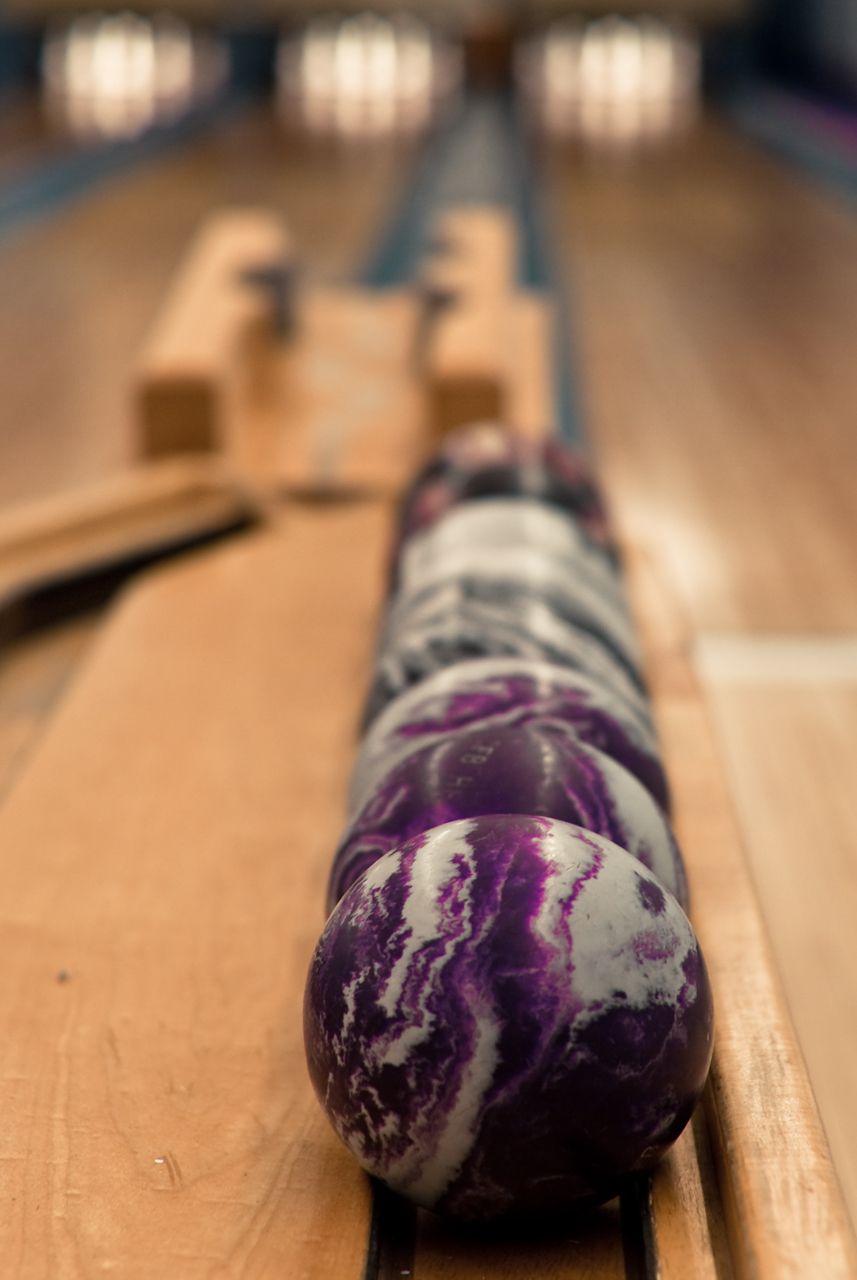
A game of five-pin bowling is played on a standard lane, at the end of which five pins are arranged in a V-formation. The pins are sized between duckpins and tenpins and feature a heavy rubber band around their middles to increase their movement when struck. Players use a small, hand-sized ball, typically without finger holes, though the C5PBA has approved balls with thumb holes. In each frame, a bowler has up to three attempts to knock down all five pins. The unique scoring system assigns different point values to each pin based on its position. The centre pin is worth five points, the two pins flanking it are worth three points each, and the two outermost corner pins are worth two points each, making a total of 15 points available per frame.
Scoring rewards skill and consistency. Knocking down all five pins with the first ball is a strike, worth 15 points plus the points from the next two balls bowled, which effectively count double. A player who clears the pins with two balls scores a spare, making the first ball of the next frame count double. Consecutive strikes are called a double or a triple, with scoring bonuses accumulating. A perfect game score of 450 requires 12 consecutive strikes, a feat the C5PBA sanctions only 15 to 30 times annually across the country. Specialized terminology describes various pin leaves and results, such as a 'chop' for clearing one side of the V, 'headpin' for hitting only the centre pin first, or a 'split' for taking out the headpin and one three-pin.
Governance and Major Tournaments
Competitive five-pin bowling in Canada is overseen by several major organizations, each with its own tournaments and championships. The primary governing body for rules and regulations is the Canadian 5 Pin Bowlers Association. The C5PBA operates three major national tournaments. Its premier event is the Open, a scratch tournament for teams and singles with a multi-day national final using a stepladder format. The Youth Challenge is a similar tournament for bowlers aged 12 to 19. The Inter-Provincial tournament, which became a national event in 2008, uses a pins-over-average team format. Bowl Canada represents bowling centre owners and oversees several major programs, including Youth Bowling Canada and Club 55+. It runs national championships like the YBC's Four Steps to Stardom and the Club 55+ Cup, and previously operated televised events like the Canadian Bowling Championships.
The Master Bowlers Association of Canada serves as the technical branch of the sport, offering a national championship with Tournament, Teaching, and Seniors divisions. Bowlers in the Teaching Division are required to coach in the YBC program. The Western Canadian Bowling Tour has grown significantly, featuring several major cash tournaments. As of the 2025 schedule, the tour includes events like the Beef Bowl in Medicine Hat, the Autumn Open in Calgary, the TPC at Sherwood in Sherwood Park, the Manitoba Open in Winnipeg, and the Heritage Traditional in Red Deer. The season ends with the WCBTour Championship for the top 12 members. The Regina Classic was discontinued in 2025. Qualifying for national championships typically involves progressing through centre, zone, and provincial rounds, with Ontario often holding separate north and south provincial finals.
- C5PBA Open: Premier national scratch tournament for teams and singles.
- C5PBA Youth Challenge: National tournament for bowlers aged 12 to 19.
- Inter-Provincial Tournament: National pins-over-average team event.
- YBC Four Steps to Stardom: National championship for youth bowlers.
- Club 55+ Cup: National handicap-format tournament for seniors.
- Western Canadian Bowling Tour: Series of major cash tournaments in Western Canada.
- Master Bowlers National Championship: Features Tournament, Teaching, and Seniors divisions.
Equipment and Technology
The equipment used in five-pin bowling has evolved significantly since the sport's invention. The pins were originally made of plastic-coated maple but are now constructed from durable hard plastic, often with UV-glow capabilities for glow bowling. A distinctive red plastic tape forms the neck stripes, which can wear out and be replaced. In 2011, the C5PBA approved a new pin base that added an eighth of an inch to the pin's height, raised its centre of gravity, and lowered its contact area with the lane, giving the visual impression of the pin floating. The small, hard rubber balls remained standard until 1990, when the C5PBA sanctioned the use of personalized bowling balls, moving beyond the house balls previously supplied by centres.
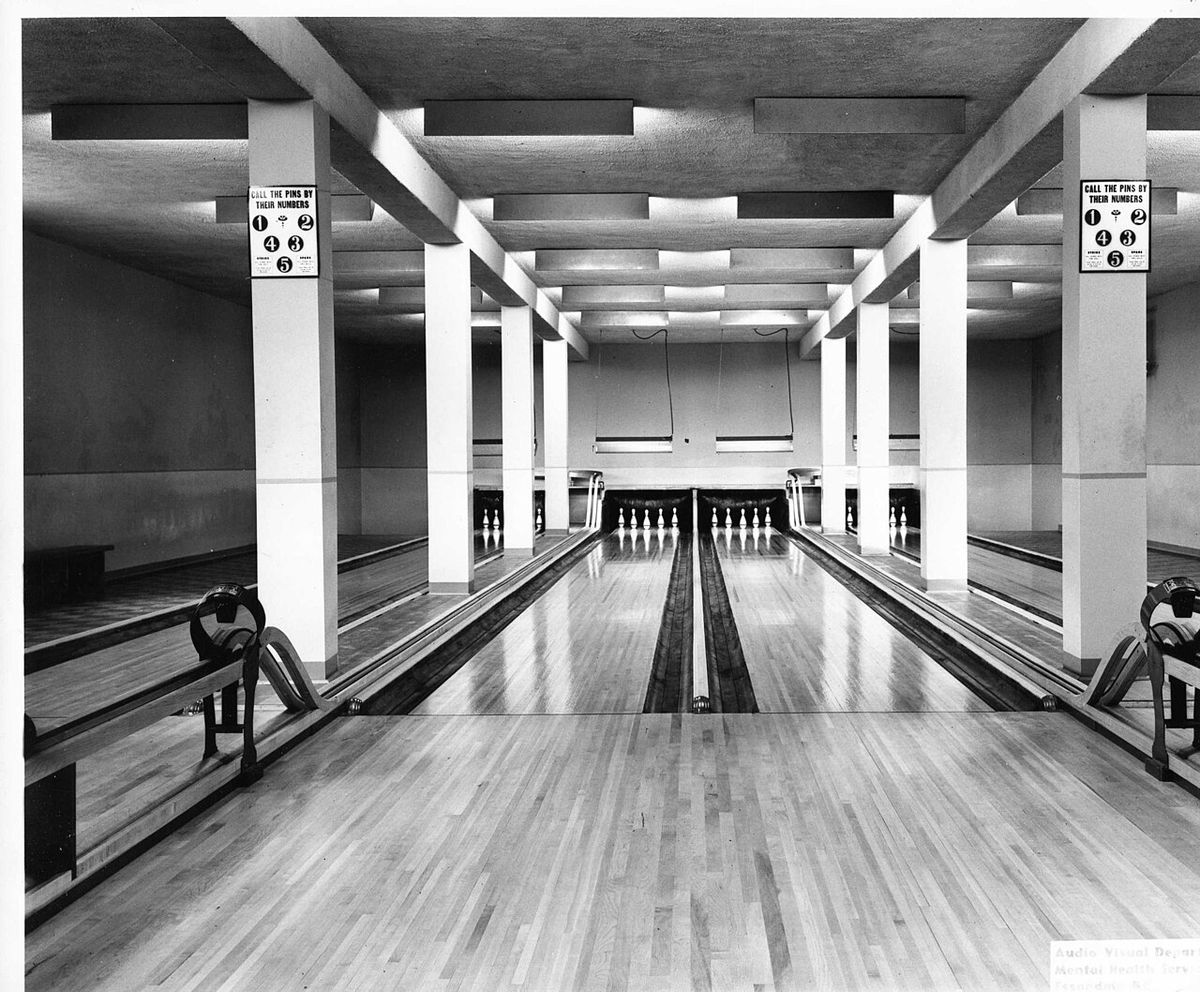
Technology has also transformed scoring and lane maintenance. Modern automatic scoring systems from companies like Steltronic, Brunswick, and QubicaAMF are certified for five-pin use. These systems can be connected directly to pinsetter circuitry or use scoring cameras mounted between lanes. Some centres use lane protection devices, which are plexiglas sheets mounted about 15 centimetres above the lane past the target arrows to discourage bowlers from lofting the ball and causing damage. Under C5PBA rules, a ball that dislodges or flies over this guard scores zero. A foul line violation incurs a 15-point penalty assessed at the game's end, unlike other bowling disciplines where the ball counts for zero. The sport is played on various pinsetting systems, with only 22 active free-fall five-pin lanes remaining across Canada as of July 2026.
Geographic Reach and Cultural Impact
Five-pin bowling is played in every Canadian province and territory, but its popularity varies significantly by region. It is the dominant form of bowling in most of the country, particularly in Ontario and the western provinces. In Quebec, the game is known as 'cinq quilles,' while 'Petites Quilles' refers to duckpin bowling. The sport faces stronger competition from other bowling variants in certain areas. New Brunswick has only one five-pin bowling alley in the entire province. In Nova Scotia, the American sport of candlepin bowling, which originated in Worcester, Massachusetts, is more popular, with five-pin alleys found primarily on Canadian Armed Forces bases. Nunavut is home to a unique two-lane facility at CFS Alert, which is the world's most northerly bowling alley, accessible only to military personnel and base visitors.
The sport holds a distinct place in Canadian culture and history. It was featured as one of four sports on the Canadian Inventions: Sports series of postage stamps issued by Canada Post on August 10, 2009. In 2007, during the CBC miniseries The Greatest Canadian Invention, five-pin bowling was ranked fourth. The sport has also influenced Canadian slang, with some believing the hockey term 'five-hole,' referring to the space between a goaltender's legs, is derived from the five-pin bowling term for the valuable centre pin. The game's structure fosters community through countless local leagues, provincial associations like the Calgary 5 Pin Bowlers' Association, and major events like the Saskatchewan Games, which include a five-pin bowling competition.
Recent and Upcoming Events
The competitive calendar for five-pin bowling remains active, with tournaments scheduled years in advance and results tracked across the country. The Western Canadian Bowling Tour made schedule changes in 2025, adding new events and discontinuing others. The WCBTour Championship, which crowns the tour champion from the top 12 players, was scheduled to be filmed in Medicine Hat, Alberta, in 2026, the day before the start of the Beef Bowl tournament. Provincial and regional qualifiers continue to be held, such as the 2026 Region 7 and 8 5-Pin Regional Qualifier hosted by Special Olympics BC in Quesnel. Local associations promote league play, with centres like HJ's 5 Pin Bowling Centre advertising roll-off events for the 2026/2027 season.
National championships are a central part of the sport. The C5PBA has scheduled its Open Championships for Winnipeg, Manitoba, from June 1 to 5, 2027. Provincial championships, such as the Ontario Open 5 Pin Championships, have entry deadlines and zone finals set between November 2025 and January 2026. Results from tournaments like the BC 5 Pin Bowlers Association Youth Challenge in Vernon are published online, providing both scratch and pins-over-average standings. These events demonstrate the ongoing vitality of the sport, from local youth leagues to the national stage, ensuring five-pin bowling remains a fixture of Canadian recreational life.
| Organization | Key Tournament/Event | Notes |
|---|---|---|
| C5PBA | Open Championships | 2027 host: Winnipeg, MB |
| Western Canadian Bowling Tour | WCBTour Championship | Filmed in Medicine Hat in 2026 |
| Bowl Canada | YBC Four Steps to Stardom | National youth championship |
| Master Bowlers Association | National Championship | Includes Teaching & Seniors divisions |
| Ontario 5 Pin | Ontario Open Championships | Zone finals Nov 2025 - Jan 2026 |
Questions about Five-pin bowling
How is five-pin bowling scored?
Five-pin bowling uses a unique scoring system where each pin has a different point value. The centre pin is worth five points, the two pins on either side of it are worth three points each, and the two outermost corner pins are worth two points each, for a total of 15 points per frame. A strike, knocking all pins down with the first ball, scores 15 plus the points from the next two balls. A spare, clearing the pins in two throws, scores 15 plus the points from the next ball. A perfect game score is 450, achieved by bowling 12 consecutive strikes.
What is the difference between five-pin and ten-pin bowling?
The primary differences are in the equipment and scoring. Five-pin uses only five pins that are smaller than ten-pins, and a small, hand-sized ball typically without finger holes. Ten-pin uses ten larger pins and a heavy ball with finger holes. Five-pin features a unique scoring system where pins have different values, while ten-pin pins are all worth the same. Five-pin also gives players three throws per frame instead of two, and a foul incurs a 15-point penalty rather than a zero for the ball.
Where is five-pin bowling played in Canada?
Five-pin bowling is played in all Canadian provinces and territories. It is the dominant form of bowling in most regions, especially Ontario and Western Canada. However, its popularity varies. Quebec has many alleys where it is known as 'cinq quilles.' New Brunswick has only one five-pin alley. In Nova Scotia, candlepin bowling is more popular, with five-pin primarily on military bases. Nunavut has a single two-lane facility at CFS Alert, which is the world's most northerly bowling alley.
What are the major five-pin bowling tournaments?
Major tournaments are run by several organizations. The Canadian 5 Pin Bowlers Association operates the Open Championships, the Youth Challenge, and the Inter-Provincial tournament. Bowl Canada oversees the Youth Bowling Canada's Four Steps to Stardom and the Club 55+ Cup. The Master Bowlers Association of Canada holds a national championship with multiple divisions. The Western Canadian Bowling Tour features cash tournaments like the Beef Bowl, Autumn Open, and Manitoba Open, culminating in the WCBTour Championship for the top qualifiers.
Who invented five-pin bowling and why?
Five-pin bowling was invented around 1909 by Thomas F. Ryan at his Toronto Bowling Club in Toronto, Ontario. He created it in direct response to customers who complained that the ten-pin game was too strenuous. Ryan devised a lighter, faster game by cutting five tenpins down to about 75 percent of their size and using hand-sized hard rubber balls. This innovation led to the original version of the sport. Consequently, five-pin bowling became a uniquely Canadian pastime, often offered in alleys alongside or instead of ten-pin bowling.
How many perfect games are bowled in five-pin each year?
A perfect score in five-pin bowling is 450, which requires a bowler to achieve 12 consecutive strikes in a single game without fouling. This feat does not happen as frequently as in tenpin bowling. According to the Canadian 5 Pin Bowlers Association, the national governing body, between 15 and 30 perfect games are officially sanctioned across Canada each year. The scoring system, where pins have different point values, contributes to the challenge of achieving this perfect score.
Sources: Wikipedia and current public reporting, checked by the Your Space Hamilton desk. Last updated 2026-10-26.