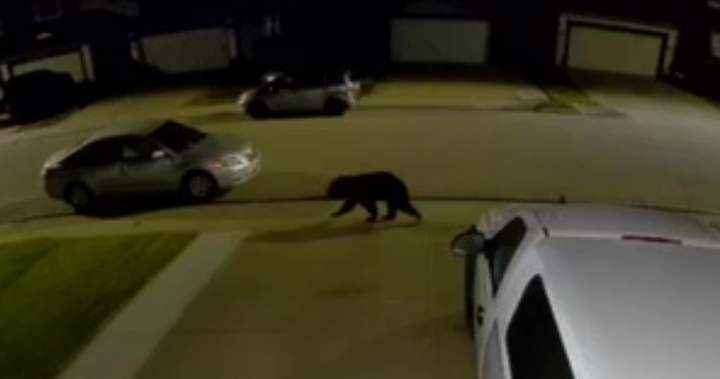
Black bear spotted roaming residential neighbourhoods in northwest Edmonton
Residents in Edmonton's northwest were startled to find a black bear wandering through their neighbourhoods overnight, prompting wildlife officials to issue safety reminders.
Residents in northwest Edmonton had an unusual start to their Tuesday morning when a black bear was spotted wandering through multiple residential neighbourhoods. The unexpected wildlife sighting occurred in the Castle Downs area, with the bear appearing on security cameras in both the Cumberland and Canossa communities, located about 15 blocks apart. The animal was first observed around midnight, moving through streets and front yards in what wildlife experts describe as typical foraging behavior during peak feeding season.
Surprise encounters captured on camera
Homeowner Meagan Hamilton reviewed her security footage to find the bear casually strolling through her Cumberland property.
"We saw a little black bear just walking down our yard and past our vehicles, then down our road,"Hamilton told Global News, still processing the unusual sight.
"I was just flabbergasted. I couldn't believe that was actually happening."The footage shows the bear exhibiting calm behavior, alternating between quick trots and slower movements as it investigated the urban environment.
In nearby Canossa, Donna Davies experienced an even more dramatic wildlife interaction when unusual noises woke her around midnight.
"I got up to see what the fuss was about and I saw a coyote chasing a bear into our cul-de-sac,"Davies recounted. Unlike Hamilton's peaceful sighting, this encounter involved interspecies dynamics that startled both residents and the bear itself. Davies expressed concern for the animal's safety, stating
"I would love for it to be captured and taken safely out of the city."
Wildlife response and urban bear behavior
Alberta Fish and Wildlife officials were notified of the sightings through reports filed by Edmonton Police Service between midnight and 1:30 a.m. The bear was observed in areas near Cumberland and Oxford neighbourhoods, specifically east of St. Albert Trail and south of Anthony Henday Drive. A spokesperson for Alberta's Ministry of Public Safety and Emergency Services confirmed that there were no reports of aggressive behavior or property damage associated with the bear's visit.
University of Alberta ecology professor Mark Boyce provided context for the unusual urban sighting, explaining that the northwest Edmonton location sits adjacent to important wildlife corridors.
"They come up the river valley and that area up in the northwest is right close to Lois Hole Provincial Park and the Sturgeon River and there's lots of good berry habitat,"Boyce noted. He emphasized that September represents a critical biological period for black bears as they prepare for winter hibernation by consuming about 25 percent of their body weight in fall.
Historical context and seasonal patterns
This isn't the first time Edmonton has experienced urban bear sightings. In June 2015, a black bear was observed multiple times along the North Saskatchewan River valley, demonstrating how wildlife occasionally ventures into city limits. Boyce explained that these incidents typically coincide with natural food scarcity or seasonal behavioral patterns rather than any change in bear populations.
The timing of this sighting aligns with known biological cycles, as bears enter hyperphagia - an intense feeding period before winter dormancy.
"This time of year they are feeding heavily,"Boyce said.
"Anything they can get to eat, they're after it."This natural behavior can sometimes lead bears into human-populated areas when natural food sources become scarce or when urban attractants like unsecured garbage are available.
Public safety recommendations
Alberta wildlife officials issued specific guidelines for residents who might encounter bears. The primary advice includes remaining calm, avoiding sudden movements or running, and slowly backing away while speaking in a quiet voice. Additional precautions include keeping pets leashed and temporarily avoiding areas where bears have been recently sighted.
The province also emphasized preventive measures to reduce human-wildlife conflicts, particularly securing potential food sources that might attract bears. These include properly storing garbage, removing bird feeders, not leaving pet food outdoors, cleaning barbecue grills, and collecting fallen fruit from yards. Such measures become especially important during fall when bears are actively seeking high-calorie foods.
Reporting procedures and current status
Residents are encouraged to immediately report any bear sightings to either the Edmonton Police Service or Alberta Fish and Wildlife's 24-hour Report-A-Poacher line at 1-800-642-3800. Prompt reporting helps wildlife officials track animal movements and implement appropriate response measures when necessary.
As of the latest updates, no additional sightings have been reported since the initial midnight encounters. Wildlife officials believe the bear may have returned to more natural habitat areas, though they continue monitoring the situation. The lack of subsequent reports suggests the animal was likely passing through rather than establishing territory in the urban area.
Urban wildlife coexistence strategies
This incident highlights the ongoing challenge of managing wildlife interactions in expanding urban areas adjacent to natural habitats. Edmonton's river valley system provides essential ecological corridors that sometimes bring wildlife into contact with human communities. Wildlife experts stress that such encounters are generally not cause for alarm but do require proper protocols to ensure safety for both residents and animals.
The sighting serves as an important reminder of Alberta's rich biodiversity and the need for continued public education about wildlife behavior. Understanding seasonal patterns, proper food storage practices, and appropriate response protocols can help minimize conflicts while allowing urban residents to safely coexist with the province's diverse wildlife populations.