Virginia opossum
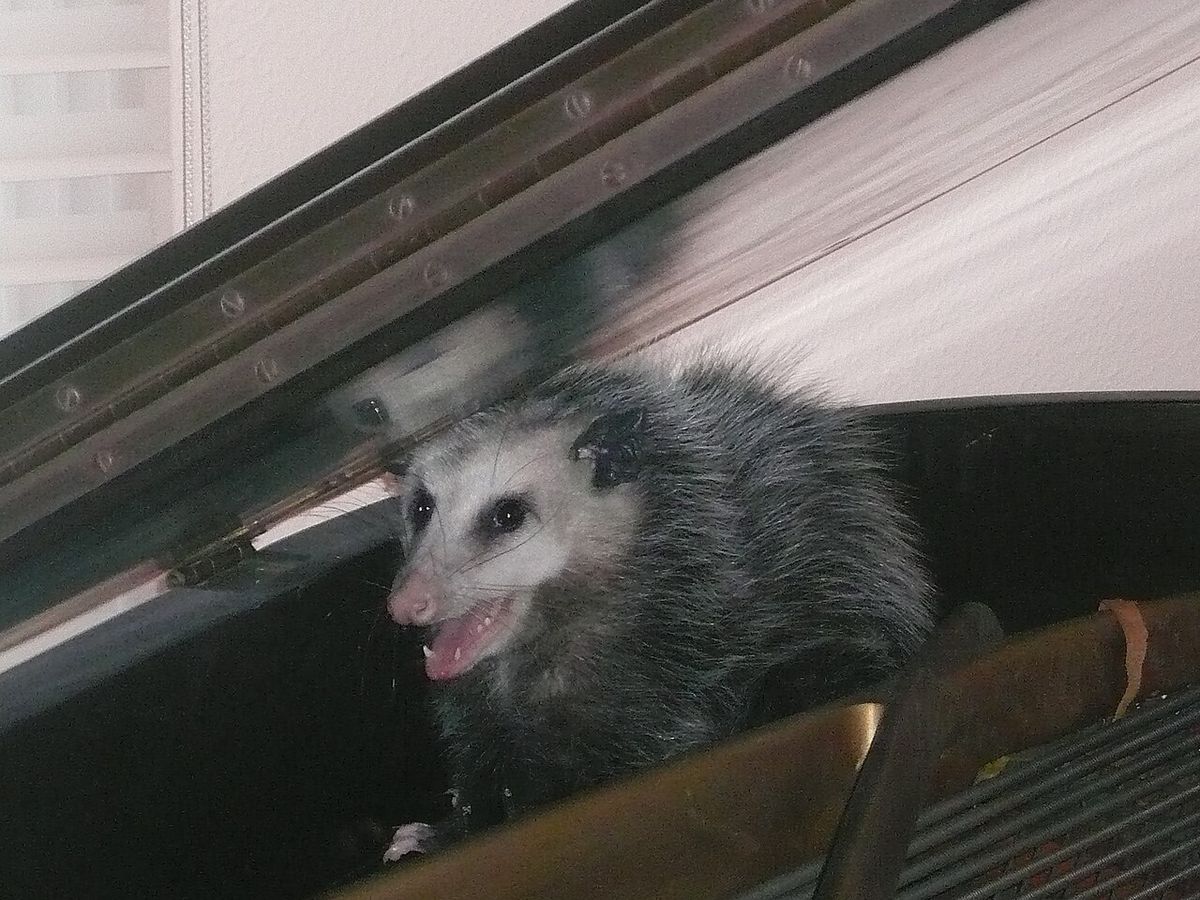
The Virginia opossum (Didelphis virginiana), commonly called the North American opossum or simply possum, is a solitary nocturnal marsupial native to the Americas and the northernmost marsupial species in the world. Its range extends from Costa Rica northward into southern Canada, including parts of Ontario, Quebec, and increasingly British Columbia, making it a familiar, if recent, part of the Canadian wildlife landscape. This opportunistic omnivore is known for its distinctive appearance, including a prehensile tail and 50 teeth, and its famous defensive behaviour of feigning death, known as "playing possum. While not originally native to much of Canada, the species has significantly expanded its range northward over the last century, a trend linked to habitat changes and warmer winters.
Physical Description and Characteristics
The Virginia opossum exhibits considerable size variation across its extensive range, with larger individuals typically found in northern areas and smaller ones in the tropics. An adult's body length from snout to the base of the tail ranges from 33 to 55 centimetres, with the hairless, prehensile tail adding another 25 to 54 centimetres. Males are slightly larger on average than females, with an average body length of 40.8 centimetres compared to 40.6 centimetres for females. Weight ranges from 2.1 to 2.8 kilograms for males and 1.9 to 2.1 kilograms for females. Their fur is generally a dull grayish brown, contrasting with a distinctive white face, hairless ears, and a long, flat nose.
The species possesses several unique anatomical features. No other mammal in North America has more than 6 upper incisors, making the opossum's dentition exceptional. On its rear feet, the opossum has opposable, clawless thumbs, which aid in climbing and leave distinctive tracks. Females have 13 nipples arranged in a circle of 12 with one in the centre to accommodate their large litters. Despite its widespread success, the Virginia opossum has one of the lowest encephalization quotients, or relative brain size, of any marsupial, with a brain only one-fifth the size of a raccoon's.
Range and Expansion into Canada
Its pre-European settlement range in North America was limited to areas roughly as far north as Maryland, southern Ohio, Indiana, Illinois, Missouri, and Kansas. Elimination of its main predators in these newly opened areas was a key factor in its successful colonization. Since 1900, the opossum's range has grown to encompass most of New England, including Maine, New York, and most of Michigan, Wisconsin, Minnesota, southeastern South Dakota, and most of Nebraska. In Canada, its presence has become established in extreme southwestern Quebec, most of southern and eastern Ontario, and it is expanding steadily northward into British Columbia from introduced populations on the United States West Coast. The species was intentionally introduced to the West Coast during the Great Depression, likely as a food source. Areas like the Waterloo Region and Simcoe County in southern Ontario, which rarely reported sightings in the 1960s, now have regular opossum populations.
This northward expansion is often attributed to warmer winters associated with global warming, as the species is not well adapted to severe cold or heavy snow. It may not leave its den for several days if temperatures drop below -7 to -4 degrees Celsius. Some speculate that expansion into Ontario occurred partly by opossums accidentally crossing major rivers like the St. Lawrence, Niagara, Detroit, and St. Clair on motor vehicles or trains. Isolated populations in Eastern New Mexico and around Tucson, Arizona, also exist, though it is unclear if they are native or introduced. The species' range continues to change, with populations potentially facing significant reductions during unusually harsh northern winters with heavy snow.
Behaviour and Diet
The Virginia opossum is primarily nocturnal and most active during the spring and summer months. It does not hibernate but will significantly reduce its activity, sometimes remaining in its den for several days, when temperatures fall below -7 to -4 degrees Celsius. A famous aspect of its behaviour is the defensive tactic of "playing possum," or feigning death in response to extreme fear. When threatened, an opossum will first attempt to appear larger by baring its 50 teeth, snapping its jaw, hissing, drooling, and raising its fur. If this fails, it may enter a catatonic state, lying limp on its side with mouth and eyes open, heart rate slowed by half, and breathing so shallow it is hardly detectable. This state, which can last for several hours, often discourages predators and may be accompanied by the release of a foul-smelling green fluid from its anal glands. The behaviour stops when the threat withdraws, but employing it in response to oncoming traffic frequently results in the animal's death.
Virginia opossums are opportunistic omnivores with a highly varied diet. Their animal-based food includes a wide array of small invertebrates, with insects like grasshoppers, crickets, and beetles forming the bulk of this portion. They also consume carrion, eggs, fish, amphibians, reptiles, birds, and small mammals such as young rabbits, meadow voles, mice, rats, and other small animals. The opossum possesses a unique resistance to snake venom due to specialized blood proteins like lethal toxin neutralizing factor. Contrary to a popular and widely publicized claim from a 2009 laboratory study, a 2021 examination of wild opossum stomach contents in Illinois found no evidence of ticks, and no scientific paper as of 2023 has reported ticks in their diet, indicating they are not a significant part of their natural foraging.
Plant-based foods become more important in late summer, autumn, and early winter. These include fruits like persimmons, which are a favourite, as well as raspberries, blackberries, apples, acorns, beechnuts, seeds, grains, bulbs, and vegetables. In urban and suburban environments, opossums readily scavenge from compost piles, garbage cans, bird feeders, and outdoor pet food dishes. They are also considered a common predator in poultry farming operations. While cannibalism has been observed in captivity, it is believed to be rare in wild populations, and placing an injured opossum with healthy ones is inadvisable. Their attraction to roadside carrion significantly increases their risk of being hit by motor vehicles.
Reproduction and Life Cycle
The breeding season for Virginia opossums is lengthy, potentially running from December through October, with most young born between February and June. A female may produce one to three litters per year. During the mating season, males attract females by making clicking sounds with their mouths. The female's estrus cycle lasts 28 days, with receptivity spanning about 36 hours. Gestation is remarkably brief, lasting only 11 to 13 days, after which a large litter of 8 to 9 infants is typical, though litters can exceed 20. Newborn opossums are among the smallest of any mammal, each no larger than a honeybee. They have a very high mortality rate, with only one in ten offspring surviving to reproductive adulthood.
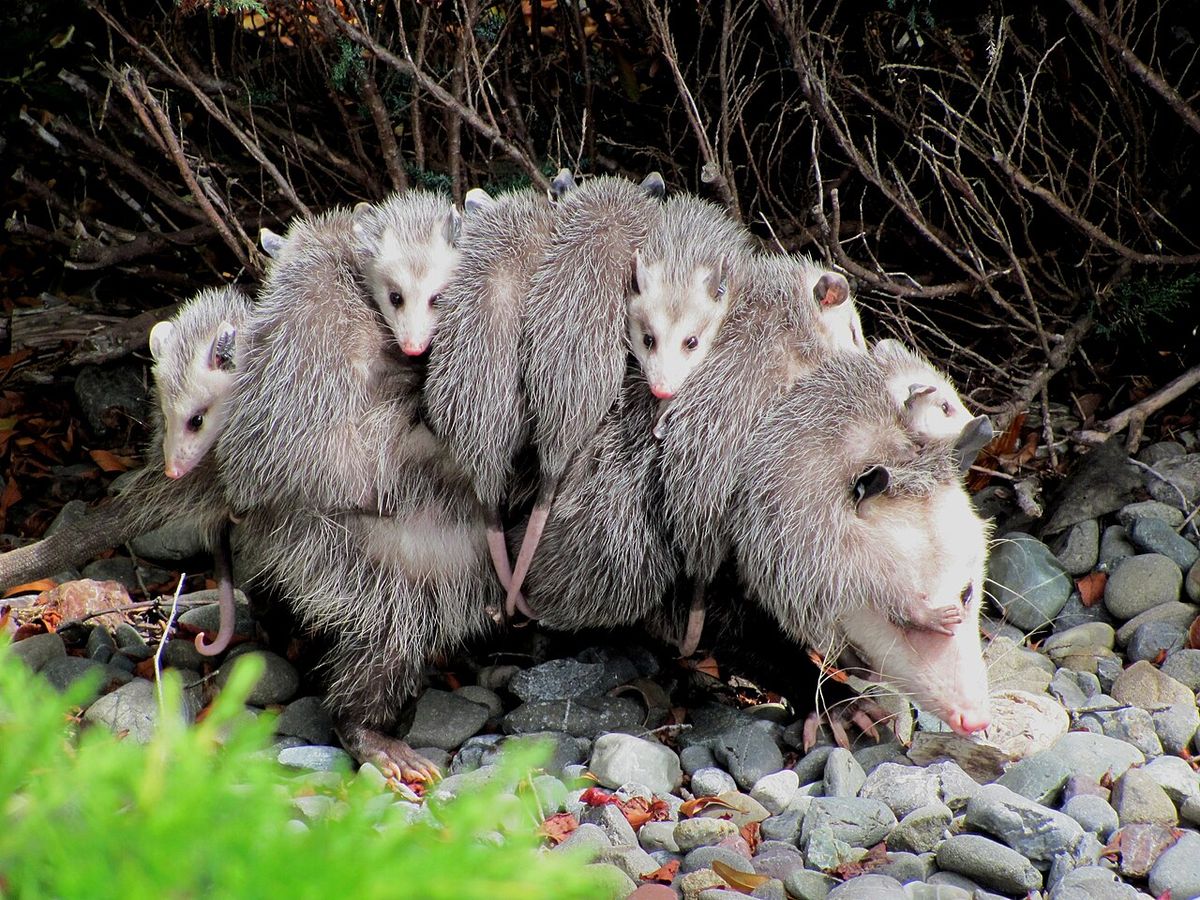
Immediately after birth, the tiny, underdeveloped young must climb from the median vagina or central birth canal into the mother's pouch and latch onto one of her 13 teats. They remain attached for about two months and stay within the pouch for approximately two and a half months. After emerging, the young opossums climb onto their mother's back, where she carries them for several more weeks as they learn essential survival skills. They typically become independent and leave their mother after about four to five months. The female's reproductive system is bifid, with two lateral vaginae, uteri, and ovaries, and the male has a bifid penis with two heads.
The species has an unusually short lifespan for its size and metabolic rate, a trait shared with few other marsupials except dasyuromorphians. In the wild, Virginia opossums rarely live beyond two years, and even in captivity, their lifespan averages only about four years. This rapid senescence is thought to be an evolutionary adaptation to high predation pressure, reducing selective pressure for long-term biochemical repair mechanisms given their low prospect of long life. Supporting this theory, an isolated population on Sapelo Island, Georgia, which has lived without natural predators for thousands of years, was found by Dr. Steven Austad to have evolved a lifespan up to 50 percent longer than mainland opossums.
Tracks and Identification
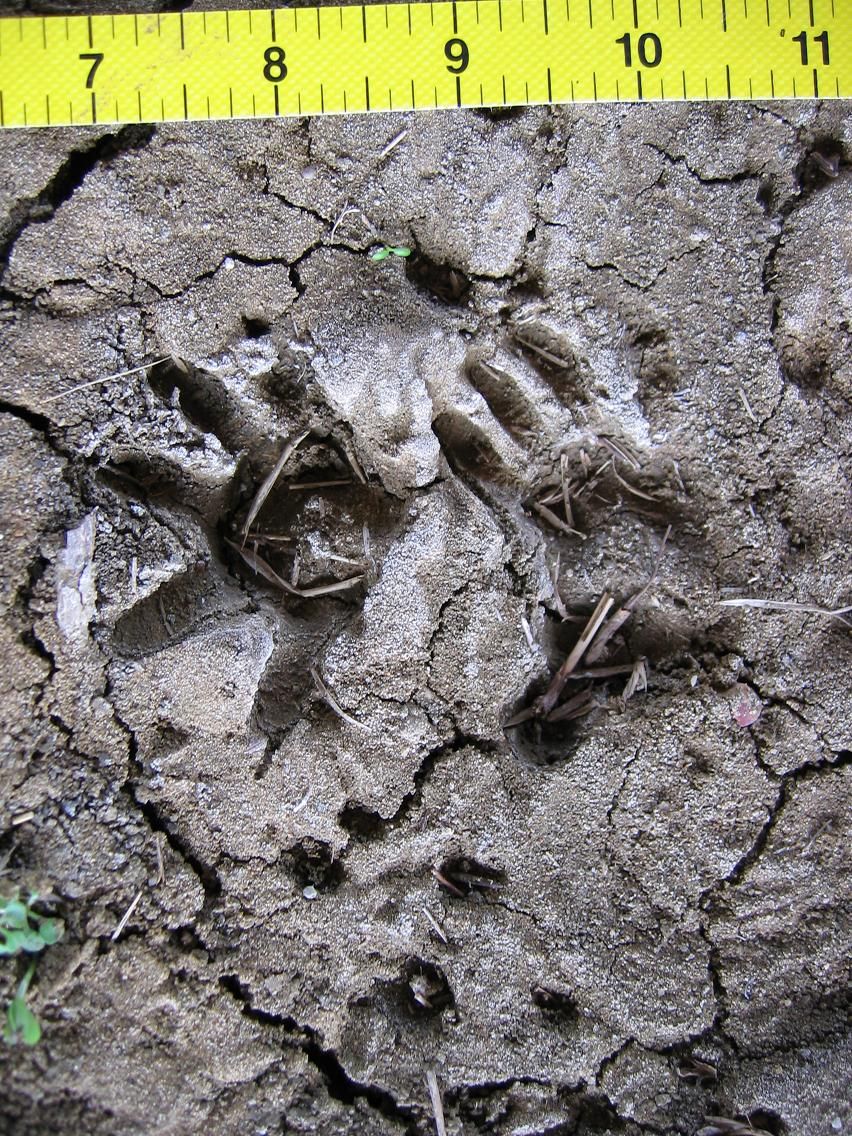
The tracks of the Virginia opossum are distinctive and aid in identifying its presence in an area. Both fore and hind prints generally show five finger-like toes. The hind print is particularly unique due to the opposable thumb, which prints at an angle of 90 degrees or more relative to the other toes, sometimes near 180 degrees. Claw marks are present on all digits except the two thumbs, and in soft mediums like mud, the foot pads are clearly visible. Average track dimensions are approximately 4.8 centimetres long by 5.1 centimetres wide for the fore prints and 6.4 centimetres long by 5.7 centimetres wide for the hind prints.
Opossums typically move with a pacing gait, where the limbs on one side of the body move forward simultaneously, just prior to moving both limbs on the other side. This results in a track pattern where the left fore print and the right hind print are generally found close together, and vice versa. The stride length during a pacing walk generally measures between 18 and 25 centimetres. Other animals that commonly use a pacing gait include raccoons, bears, skunks, badgers, woodchucks, porcupines, and beavers. Careful measurement of stride length and track size can help distinguish opossum tracks from those of similar-sized animals, even when individual print details are unclear or obscured.
Historical References and Human Interactions
The Virginia opossum has been documented in North America for centuries. One of the earliest written descriptions comes from explorer John Smith in 1608, who wrote in "Map of Virginia" that "An Opassom hath an head like a Swine, and a taile like a Rat, and is of the bignes of a Cat. Under her belly she hath a bagge, wherein she lodgeth, carrieth, and sucketh her young." A more formal anatomical description was published in a 1698 letter entitled "Carigueya, Seu Marsupiale Americanum Masculum" from William Cowper to Dr Edward Tyson, which suggested even earlier descriptions existed. The animal's name derives from the Proto-Algonquian word *wa·p-aʔθemwa, meaning "white animal," which entered English via Powhatan languages recorded as opassom or aposoum.
Historically, the opossum was a favoured game animal in the United States, especially in the South, where a large body of recipes and folklore developed around it. Traditional preparations included baking the meat, sometimes in a pie, though modern "possum pie" usually refers to a sweet dessert. The opossum has also featured in music and popular culture. The minstrel song "Carve dat Possum" was written in 1875 by Sam Lucas. In animation and media, it has often been used to depict uncivilized characters or "hillbillies," such as in the 1965 "Possum Day" episode of The Beverly Hillbillies. The title character in Walt Kelly's long-running comic strip Pogo was an opossum.
- 1608: John Smith provides an early description in "Map of Virginia."
- 1698: Formal anatomical description published in a letter to Dr Edward Tyson.
- 1875: Minstrel song "Carve dat Possum" written by Sam Lucas.
- Early 1900s: Character Billy Possum promoted unsuccessfully as an icon for President William Howard Taft.
- 1965: "Possum Day" episode of The Beverly Hillbillies airs.
- 2010: Cross-eyed opossum named Heidi at Leipzig Zoo becomes an international celebrity, predicting Oscar winners.
- 2013: Designated the official marsupial of North Carolina.
- 2025: Designated the official marsupial of New Hampshire.
The species is also represented architecturally. The Perelman Building in Philadelphia originally was the Fidelity Mutual Life Insurance Company Building from the late 1920s. It features a polychrome possum sculpture which symbolizes protection. The possums of Australia have a name that derives from their similarity to the American species. They are also marsupials but belong to a different order called Diprotodontia.
Relationship with Humans and Health
Virginia opossums are common in suburban and urban environments across their range, drawn to human-associated food sources like garbage, pet food, compost, and garden produce. This proximity has led to an observed increase in body size for opossums living in or near urban environments. While their open-mouthed hissing and teeth-baring when frightened is sometimes mistaken for rabies, opossums are naturally resistant to the rabies virus, though a few cases are reported annually. They can, however, carry other diseases such as tuberculosis, leptospirosis, and tularemia, and host various parasites. Like raccoons, they can be found in urban settings eating pet food, rotten fruit, and human garbage, and they are considered a common predator of poultry farming in North America.
Opossums are generally not dangerous to humans and are beneficial in some contexts as consumers of insect pests, snails, and carrion. Their habit of scavenging roadside carrion, however, coupled with their slow, nocturnal movements and tendency to feign death in the road, makes them highly susceptible to becoming roadkill. During breeding season, both males extending their range in search of mates and females foraging earlier and later to support young are at increased risk of injury from motor vehicles and predators. While sometimes mistakenly considered to be rats, opossums are marsupials and not closely related to rodents or any other placental mammals. Their adaptability ensures they will remain a visible part of the ecosystem in many Canadian and American communities.
Questions about Virginia opossum
Are Virginia opossums native to Canada?
Virginia opossums were not originally native to most of Canada. Their pre-settlement range ended well south of the Canadian border. However, over the last century, they have significantly expanded their range northward. They are now established in southern and eastern Ontario, extreme southwestern Quebec, and their range is expanding into British Columbia from introduced populations in the western United States. This expansion is linked to habitat changes, elimination of predators, and warmer winters, with some populations possibly established via accidental transport on vehicles.
Why do opossums play dead?
"Playing possum," or feigning death, is an involuntary defensive response to extreme fear or threat. When this happens, the opossum enters a catatonic state, lying limp with its mouth and eyes open, tongue hanging out, and heart rate slowed by half. It may also release a foul-smelling green fluid from its anal glands. This behaviour is thought to discourage predators that prefer live prey or to convince larger animals that the opossum is not a threat. The state can last for several hours and ends when the threat withdraws, but using this tactic in front of vehicles often leads to fatal collisions.
What do Virginia opossums eat?
Virginia opossums are opportunistic omnivores with a highly varied diet. They eat insects like grasshoppers, crickets, and beetles, which make up the bulk of animal foods, as well as small animals such as mice, voles, birds, snakes, lizards, frogs, fish, and crayfish. They also consume carrion and eggs. Plant foods, including fruits like persimmons, berries, nuts, seeds, and vegetables, become more important in autumn and winter. Contrary to a popular myth, scientific studies of wild opossum stomach contents have not found evidence that they eat ticks. In urban areas, they scavenge from garbage, compost, pet food, and gardens.
Are opossums dangerous or likely to have rabies?
Opossums are generally not dangerous to humans. While their defensive hissing and baring of 50 teeth can appear threatening, they are not aggressive. They are also notably resistant to the rabies virus due to their lower body temperature, though a few cases are reported each year. They can carry other diseases such as leptospirosis, tularemia, and tuberculosis, and host parasites, so it is advisable to avoid direct contact. Their primary risks to humans are occasional raids on poultry or gardens, and they can be a nuisance when scavenging trash.
How can you tell if an opossum has been in your yard?
Signs of an opossum include distinctive five-toed tracks, with the hind print showing a thumb at a wide angle of 90 degrees or more. Scattered garbage, raided compost bins, or disturbed pet food dishes at night are common indicators. You may also hear rustling or slow-moving noises after dark. Given their nocturnal and solitary nature, sightings are often brief. Their droppings may contain visible seeds or insect parts. In winter, reduced activity may mean fewer signs unless there is a warm spell.
What is the lifespan of a Virginia opossum?
Virginia opossums have exceptionally short lifespans for mammals of their size. In the wild, they rarely live beyond two years due to high predation rates, road accidents, and disease. Even under protected captive conditions, their average lifespan is only about four years. This rapid aging is an evolutionary trait linked to high mortality pressure, meaning there is little selective pressure to develop mechanisms for a long life. An isolated, predator-free population on Sapelo Island, Georgia, has evolved to live up to 50 percent longer, supporting this theory.
Sources and further reading
- Virginia opossum (Wikipedia)
- Virginia opossum (nationalzoo.si.edu)
- Opossums (nationalgeographic.com)
- Virginia opossum, Invasive Species Council of BC (bcinvasives.ca)
- Virginia Opossum | Ohio Department of Natural Resources (ohiodnr.gov)
Checked by the Your Space Hamilton desk. Last updated 2026-10-23.