Vanessa cardui
The painted lady butterfly ( Vanessa cardui ) is the most widespread butterfly species in the world, found on every continent except Antarctica. In Canada, it is a notable summer migrant, arriving in large numbers from the deserts of the southwestern United States and Mexico to temporarily colonize regions across the country, sometimes in spectacular population booms. This highly adaptable species is known for its extraordinary long-distance, multi-generational migrations, which can span thousands of kilometres and involve billions of individuals. The painted lady's distinctive orange, black, and white patterned wings make it a familiar and welcome sight in gardens, meadows, and open fields from coast to coast.
Physical Description and Identification
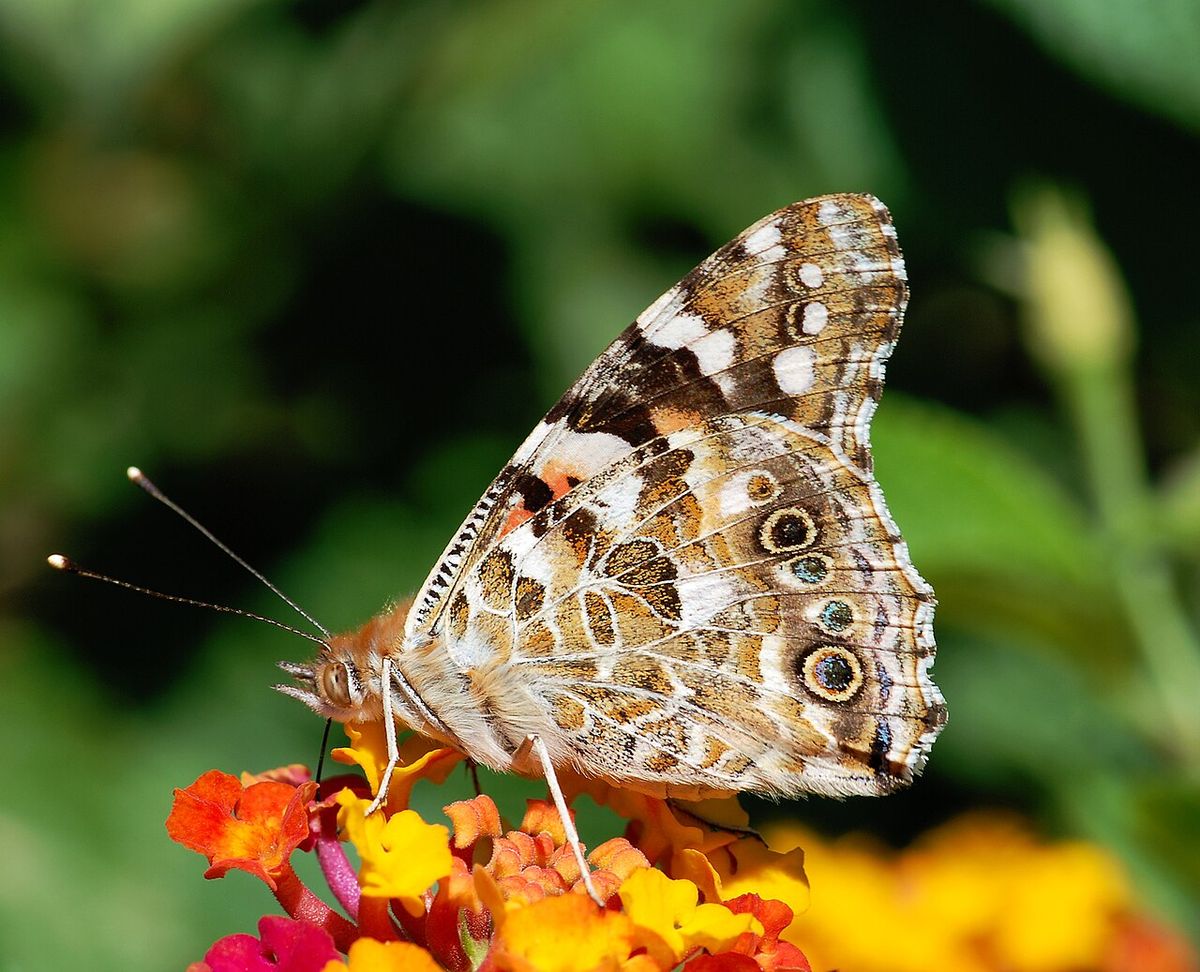
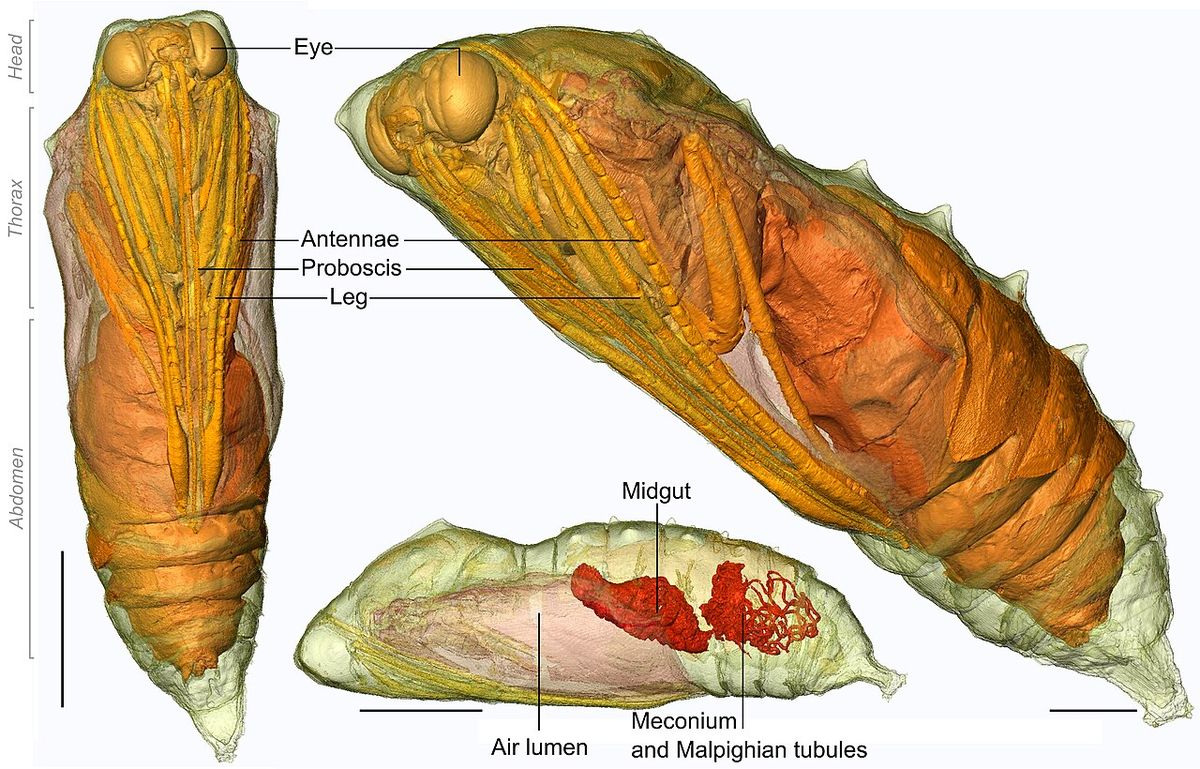
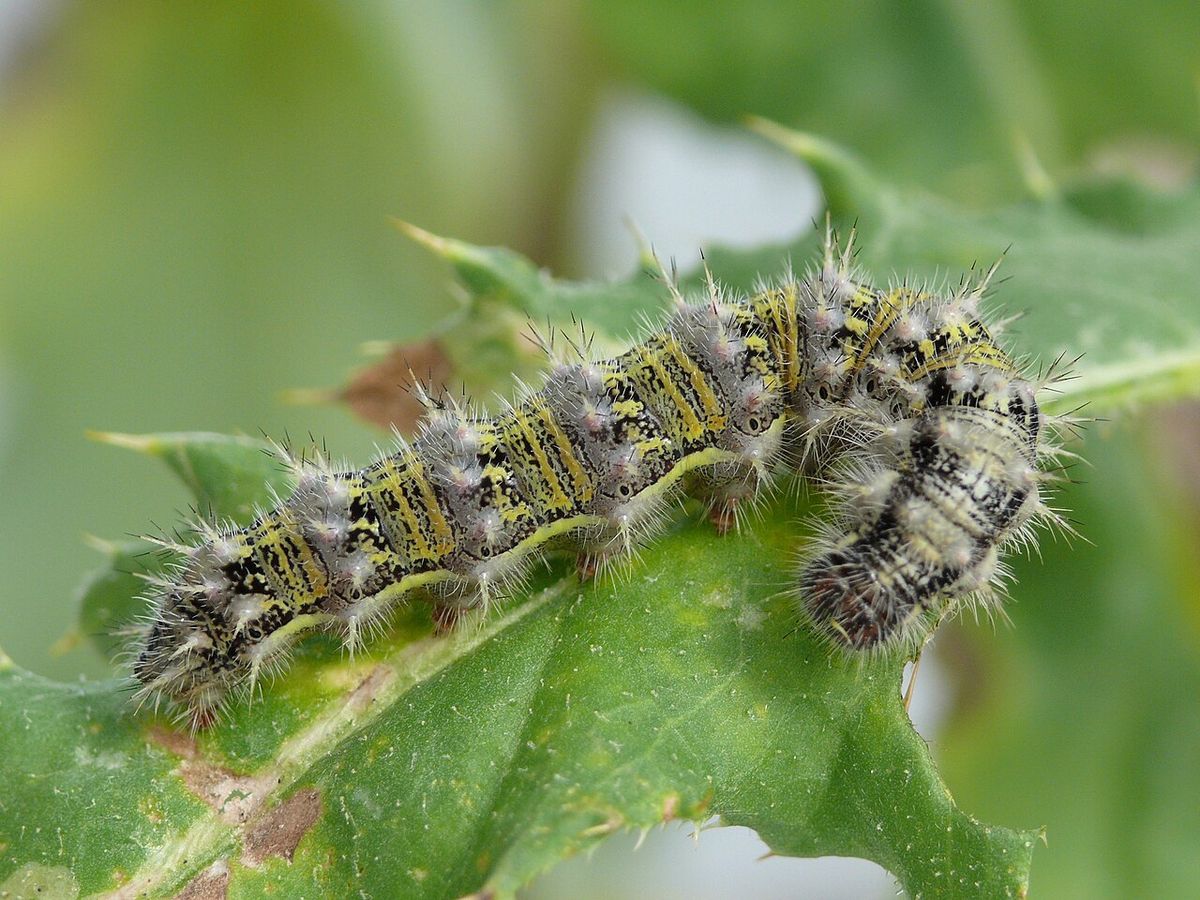
The painted lady is a medium-sized butterfly with a wingspan ranging from 5.1 to 7.3 centimetres. The upper side of the wings is primarily a pinkish-orange or reddish-ochre colour with a complex pattern of thick black lines and white spots near the tips of the forewings. The wing bases are darker, often appearing olivescent brown. The hindwings feature a row of five tiny black dots. The underside presents a more cryptic pattern of brown, black, and grey marbling with four small submarginal eyespots, which aids in camouflage when the butterfly is at rest. Eggs are pale green with 14 to 19 vertical ribs, while the spiny caterpillars are greyish-brown or purple-black with a distinctive yellow stripe running down the back. The pupae, or chrysalides, can vary in colour from metallic green to brown or bluish-white.
Males and females are similar in colouration, though females are generally larger. The cilia, or fringe of hairs on the wing edges, are black alternated with white. On the forewing upperside, there is an outwardly oblique black irregular band crossing from the middle of the cell to the disc, and the apical area from the end of the cell and the exterior border are also black. Before the apex is a short white outwardly oblique streak and a curved row of four round spots. The body is olivescent ochreous-brown, with the abdomen having ochreous bands, and the antennae are black above with a reddish tip and underside. The underside of the forewing is brighter reddish-ochreous with a paler apical area, and the hindwing is transversely-marbled with olivescent ochreous-brown and speckled with black scales, crossed by whitish fasciae.
Global Distribution and Habitat
Vanessa cardui holds the title of the world's most widespread butterfly, found on every continent except Antarctica. Its vast territory covers all biogeographic regions including the Nearctic, Palearctic, Neotropical, Ethiopian, and Oriental zones. The species is extremely adaptable and can prosper in an astonishing variety of habitats. While it favours sunny, brightly lit open environments like fields, meadows, and gardens, it is also found in suburban areas, agricultural land, swamps, bogs, marshes, tundra, taiga, deserts, chaparral, forests, rainforests, scrub forests, and mountain regions. This adaptability allows it to exploit seasonal resources across its migratory range. In North America, its range extends from Panama northward, temporarily colonizing the United States and Canada each summer. The species is resident only in warmer areas but migrates in spring and sometimes again in autumn to occupy temperate zones. It can be found at all elevations during migration but is usually found at sea level year-round in non-migratory periods.
Its close relative, the Australian painted lady (Vanessa kershawi), ranges over half of Australia, while V. cardui itself has a more limited range there around Bunbury, Fremantle, and Rottnest Island. Other related species in North America include the American painted lady (Vanessa virginiensis) and the West Coast lady (Vanessa annabella). The painted lady is rare or considered a vagrant in South America, though the 2024 transatlantic crossing to French Guiana demonstrates its capacity to reach the continent. The species' territory size is vast enough to cover all of North America south to Panama, and it is also naturalized in Asia, Africa, and Europe.
Life Cycle and Development
The painted lady undergoes complete metamorphosis (holometabolism), progressing from egg to larva to pupa to adult. Females lay their pale green eggs singly on the leaves of host plants, providing the emerging larvae with an immediate food source. After hatching in three to five days, the spiny caterpillars feed continuously, constructing loose silken tents on the host plant for shelter from predators. They pass through five growth stages, or instars, over five to ten days before pupating. The caterpillar hangs upside-down, attached with a single silken string, and forms a naked chrysalis from which the adult butterfly will emerge 7 to 10 days later. Development speed is highly dependent on climate, completing in 33 to 44 days in warm subtropical areas but taking up to 60 days in cooler climates.
In laboratory conditions, scientists have observed up to eight generations in a single year, though in temperate regions like Canada, typically only two generations occur annually. The total lifespan from egg to adult death is about one year, with adults living an average of 10 to 24 days. Both males and females become sexually mature five to seven days after emerging from the chrysalis. Offspring are independent of the mother immediately after the eggs are laid, and adults provide no further parental care beyond the provisioning of eggs laid on a suitable host plant. The number of generations per year varies but is generally two in areas like the American Midwest, and the species overwinters as adults but rarely survives harsh winters in northern regions.
Extraordinary Migratory Behaviour
The painted lady is renowned for its complex, multi-generational migrations, which rank among the longest of any insect. In the Palearctic region, populations undertake annual round-trip journeys of up to 15,000 kilometres between tropical Africa and northern Europe. Each spring, butterflies move northward from overwintering areas in Africa, crossing the Sahara Desert and the Mediterranean Sea to reach Europe, with some individuals travelling as far as Iceland. A landmark 2024 study in Nature Communications provided the first evidence of an insect crossing an entire ocean, documenting painted ladies that travelled over 4,200 kilometres from West Africa to French Guiana on favourable trade winds. In North America, a similar pattern sees populations migrating north from Mexico and the southwestern U.S. to colonize Canada each summer. These migrations are not undertaken by a single individual but are a stepped, multi-generational process. The butterflies mate and lay eggs along the route, with successive generations continuing the journey north. The return southward migration in autumn was long debated but radar entomology has confirmed high-altitude flights that are seldom witnessed from the ground.
Migration patterns are highly erratic and population sizes fluctuate dramatically from year to year, influenced by climatic conditions. Heavy winter rains in desert regions, which spur the growth of larval host plants, can trigger enormous population booms and subsequent mass migrations. For instance, heavy rains led to a migration of millions across Southern California in March 2019, and an estimated billion individuals were observed migrating in Israel at the end of March 2019. Influxes into northern Europe, like the one observed in Britain in April 2026, depend on strong southerly winds carrying butterflies from Africa. The migration allows populations to take advantage of changing seasonal resources, moving north in summer to avoid hot temperatures in Africa and moving south in autumn to escape cold winters in northern Europe. Key factors influencing their navigation and behaviour include the use of a solar compass for orientation, the utilization of favourable high-altitude winds for rapid travel, and adaptive headings that respond to local topography and weather.
- Solar Compass: Laboratory studies show painted ladies require a direct view of the sky to orient themselves, using the sun to maintain a straight flight path. When isolated from the sun, they are unable to orient in a specific direction.
- Wind Assistance: They utilize favourable high-altitude winds to travel rapidly across continents, with the 2024 transatlantic crossing occurring during "exceptionally favorable" trade wind conditions.
- Adaptive Headings: Migrants may adjust their direction in response to local topography and weather patterns rather than following a strict compass bearing, with a range of headings observed in northern Europe.
- Courtship and Territoriality: During migration, males perch in the late afternoon in areas where females are likely to appear to establish temporary territories. They chase other males or pursue females, with groups sometimes flying in circles for one to five seconds as part of courtship.
- Continuous Reproduction: Mating and egg-laying occur throughout the migration, with females temporarily suspending flight when ready to oviposit, and males exhibiting polygynous mating behaviour to maximize progeny.
Global climatic events, such as El Niño, may affect the migratory behaviour of the painted lady butterflies, causing large-scale migrations. Some evidence suggests that these butterflies do not migrate every year, and their migration patterns are highly erratic. Scientists have not been able to find clear evidence of their overwintering in temperate zones. This may be because they migrate to warmer locations to survive and reproduce continuously. Research suggests that British painted ladies do undertake an autumn migration. They make a 14,500 km return journey from tropical Africa to the Arctic Circle in a series of steps by up to six successive generations.
Diet, Reproduction, and Behaviour
Painted lady caterpillars are polyphagous, feeding on a remarkably wide array of host plants. Records from the HOSTS database document over 300 species, with a strong preference for plants in the aster family (Asteraceae), particularly thistles (Cirsium, Carduus), as well as knapweeds (Centaurea), burdocks (Arctium), Scotch thistle (Onopordum), sunflowers (Helianthus), and wormwoods (Artemisia). They also feed on plants from the families Boraginaceae and Malvaceae, including mallows, hollyhocks, and sunflowers. Adults feed exclusively on flower nectar and aphid honeydew, favouring tall plants like blazing star, cosmos, Joe-pye weed, and purple coneflower, but will also visit red clover, milkweed, and many garden varieties.
Reproduction is continuous in warm climates and occurs throughout their migrations, a unique system possibly attributed to their migratory patterns. Males exhibit polygynous mating behaviour, often mating with multiple females to ensure as much progeny as possible since no permanent breeding ground is used. They establish temporary territories at landmarks like hilltops, forest-meadow edges, or other perches, waiting for females. Females have a high biotic potential, each laying about 500 eggs singly on host plants. They show a notable lack of discrimination in host plant choice, not taking into account volatile chemicals released from plants. They prioritize plants with immediately available nectar for themselves, even if it leads to higher larval mortality, favouring quantity of offspring over quality. This continuous reproductive strategy, combined with high biotic potential, contributes to the species' success and ability to quickly exploit new areas. An interesting observed behaviour is that these butterflies are attracted to fly towards rain, with studies suggesting large rainfall may activate more eggs or induce better larval development.
During European migrations, the butterflies immediately begin to mate and lay eggs upon arrival in the Mediterranean in the spring, starting in late May. In the United States, painted lady butterflies migrating towards the north experience poor mating conditions, and many have limited breeding capabilities. The "local adult generation" develops during this time, roughly from the middle of May through early June in conjunction with the butterfly progression throughout their flight. Inhabited locations begin to observe a large influx of new generations in the fall, particularly in September and October, though reproductive success declines through November.
Ecology, Predation, and Human Interaction
The main defence mechanisms for painted ladies are flight and camouflage. The cryptic underside of their wings, with its marbled brown, black, and grey patterns and tiny eyespots, helps conceal them at rest, while their strong flight aids escape. Caterpillars hide in small silk nests on top of leaves for protection from predators such as wasps, spiders, ants, and birds. The species plays a role in pollination as adults visit a wide variety of flowers. Their visual system resembles that of a honey bee, containing ultraviolet, blue, and green opsins, but unlike monarchs or red postman butterflies, they lack red receptors and cannot distinguish red light from orange light or yellow light from orange light.
Human interaction with Vanessa cardui is predominantly positive. The species is commonly bred in schools for educational purposes due to its fast life cycle and ease of rearing. They are also used for butterfly releases at events like weddings, memorials, and hospice ceremonies. In gardens, they are attracted to nectar-rich plants and can be encouraged by providing shallow water sources or wet sand and avoiding pesticides. While not a permanent resident in most of Canada due to harsh winters, its annual arrival is a celebrated sign of summer. Its close relatives in Canada include the American painted lady (Vanessa virginiensis) and the red admiral (Vanessa atalanta), which can be distinguished by differences in wing patterns. The American lady has two larger spots on the underside and thinner black lines above, while the red admiral has distinct red bands.
Adult painted lady butterflies may spend time in small depressions in the ground on overcast days. In recent years, thanks to the activity of The Worldwide Painted Lady Migration citizen science project, the huge range of their migration has begun to be revealed. This project is led by the Barcelona-based Institute of Evolutionary Biology. For example, some butterflies have been documented migrating from Iceland to the Sahara desert, and even further south. This highlights the incredible scope of their movements.
Notable Migration Events and Population Fluctuations
Painted lady migration patterns are highly erratic and they do not migrate every year. Their numbers can swell dramatically in a single season, with one event in Israel estimated at a billion individual butterflies. These large-scale migration events are closely tied to environmental conditions in their winter breeding grounds. In particular, heavy rainfall in desert regions controls the growth of larval food plants. For example, heavy winter rains in the desert caused a migration of millions across Southern California in March 2019.
| Year | Location | Estimated Scale / Notes |
|---|---|---|
| 2009 | United Kingdom | Approximately 11 million butterflies arrived in spring. Research indicated that as many as 21 million began the southward journey in autumn. |
| 2019 | Israel | An extraordinarily large migration of an estimated one billion individual butterflies at the end of March, linked to heavier than usual winter rain. |
| 2019 | Southern California, USA | Millions migrated across the state in March following heavy winter rains in the desert that produced an abundance of vegetation. |
| 2019 | Eastern Ukraine | First noticeable wave in late April, with numbers growing to hundreds observable in city streets like Kharkiv by mid-May. |
| 2024 | Transatlantic | First evidence of an insect ocean crossing. Specimens found in French Guiana originated from West Africa/Europe, confirmed by pollen grain and isotope analysis. |
| 2026 | Southern Britain | A significant influx was observed in late April and early May, with observers counting 16 or more in a single location, though smaller than the 2009 event. |
These fluctuations demonstrate the species' explosive population dynamics. The triggers are often climatic, such as the El Niño Southern Oscillation or exceptional rainfall in arid regions, which leads to a boom in host plant availability and subsequent caterpillar survival. The resulting mass migrations allow the butterflies to disperse en masse to exploit seasonal resources across continents, making their presence in any given location, including Canada, highly variable from year to year. For example, in Wisconsin, it is a common visitor in some years but can be locally very abundant during these periodic enormous migrations from southern deserts. The migration is a round trip, with the autumn movement likely made for the inspection of resource changes. Periodically, enormous migrations from these deserts inundate other areas of the country, so it can be locally very abundant at times.
Questions about Vanessa cardui
Are painted lady butterflies found in Canada?
Yes, painted lady butterflies are found in Canada as summer migrants. They are not permanent residents in most of the country because they cannot survive harsh winters. Each year, populations migrate north from the deserts of Mexico and the southwestern United States, arriving as early as June to temporarily colonize areas across southern Canada. Their abundance varies greatly from year to year depending on climatic conditions in their southern breeding grounds. In most years, they move north to colonize the United States and Canada south of the Arctic, with the first adults usually arriving in June to begin egg-laying.
What is the difference between a painted lady and a monarch butterfly?
Painted ladies and monarchs are both migratory butterflies but belong to different families and have distinct appearances and behaviours. Monarchs are larger, with bold orange-and-black patterned wings and white spots along the black borders. Painted ladies are smaller with a more complex pattern of orange, black, and white, including white bars on the forewings and several small black dots on the hindwings. While monarchs famously migrate to specific overwintering sites in Mexico and California, painted lady migrations are more erratic, multi-generational, and not tied to a single overwintering location. Painted lady caterpillars feed on a vast range of plants like thistles, while monarch caterpillars feed exclusively on milkweed.
How far can a painted lady butterfly migrate?
Painted lady butterflies undertake some of the longest known migrations of any insect. The species' migratory circuit in Europe and Africa can span up to 15,000 kilometres round trip, a series of steps by up to six successive generations. In 2024, research confirmed an unprecedented journey: a transatlantic flight of over 4,200 kilometres from West Africa to South America, the longest single journey ever recorded for the species and the first evidence of an insect crossing an ocean. It is crucial to understand that this vast distance is not covered by a single butterfly but by successive generations, with each continuing the journey north or south.
What plants attract painted lady butterflies to a garden?
Adult painted ladies are attracted to gardens with abundant nectar sources. They prefer to feed from tall plants (three to six feet high), including blazing star, cosmos, New England aster, Joe-pye weed, Mexican sunflower, purple coneflower, and zinnias. They will also visit butterfly bush, heliotrope, anise hyssop, marigolds, scabiosa, sedums, sweet William, and Verbena bonariensis. To support their full life cycle, gardeners can include larval host plants such as thistles (including Canada thistle), mallows, hollyhocks, sunflowers, and other plants from the aster family. Providing shallow water or wet sand and keeping the area pesticide-free also helps attract them.
How long does a painted lady butterfly live?
The total lifespan of a painted lady from egg to adult death is approximately one year. However, the adult butterfly stage is relatively short. After emerging from its chrysalis, an adult painted lady typically lives for only 10 to 24 days in laboratory conditions. During this brief period, its primary goals are to feed on nectar, mate, and, for females, lay eggs. The species compensates for this short adult lifespan through high reproductive output, with females laying about 500 eggs, and continuous breeding throughout its migrations, which can produce up to eight generations in a year in warm climates.
Why are there so many painted ladies some years and hardly any in others?
The dramatic population fluctuations are due to the painted lady's ecology and migratory patterns. Their numbers are heavily influenced by rainfall in their winter breeding areas, such as the deserts of North Africa and the southwestern United States. Exceptionally wet winters lead to a boom in host plants like thistles, resulting in massive caterpillar survival and huge population explosions the following spring. These booms trigger the large-scale migrations that bring millions of butterflies to regions like Europe and Canada. In drier years, populations remain much lower, leading to few migrants. This makes their appearance highly variable and unpredictable from one year to the next, with events like the 2009 UK influx or the 2019 Israel migration being prime examples of boom years.
Sources and further reading
- Vanessa cardui (Wikipedia)
- Vanessa cardui | INFORMATION (animaldiversity.org)
- Painted Lady Butterfly, Vanessa cardui, Wisconsin Horticulture (hort.extension.wisc.edu)
- Painted Lady (Vanessa cardui) - Detail, Biodiversity Maps (maps.biodiversityireland.ie)
- An influx of Painted ladies, earthstar (earthstar.blog)
Checked by the Your Space Hamilton desk. Last updated 2026-10-31.