Timber rattlesnake
The timber rattlesnake (Crotalus horridus) is a large, venomous pit viper native to the eastern United States. It is the only rattlesnake species found throughout much of the populous northeastern U.S. and represents one of the most northerly distributed venomous snakes in North America. While historically present in southern Ontario and Quebec, the species was declared extirpated in Canada in 2001. The timber rattlesnake is a significant predator of small mammals and holds cultural importance as a historic symbol of American resolve, but its populations face serious threats across the northern parts of its range.
Description and Identification
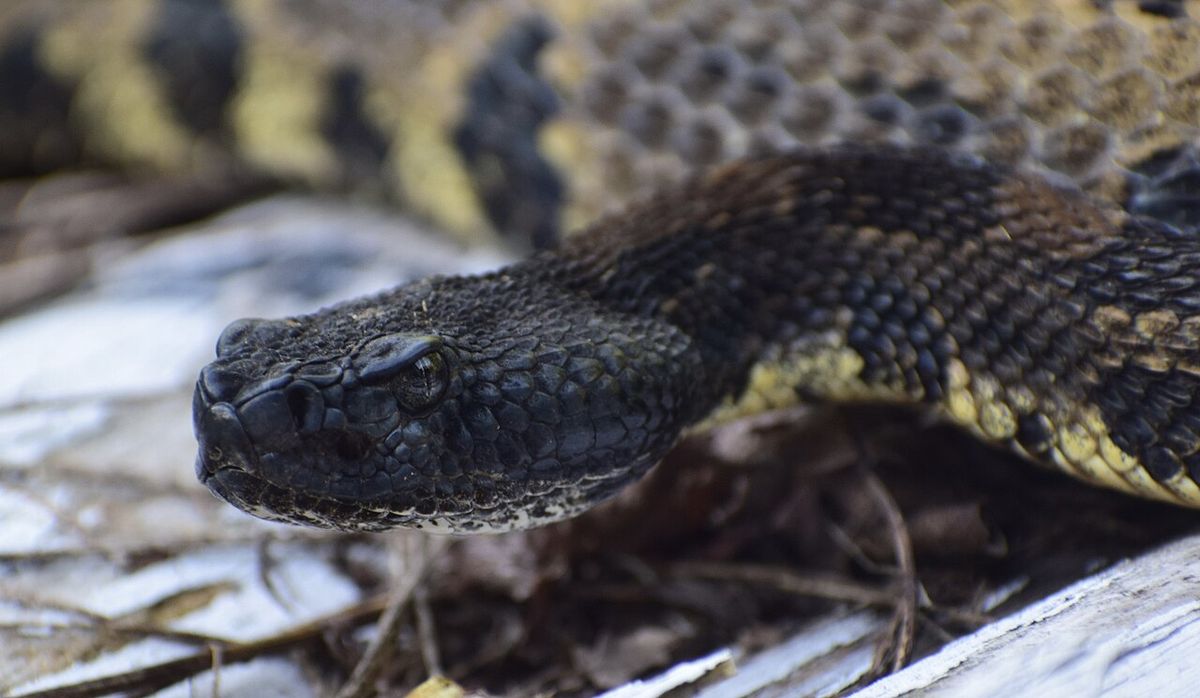
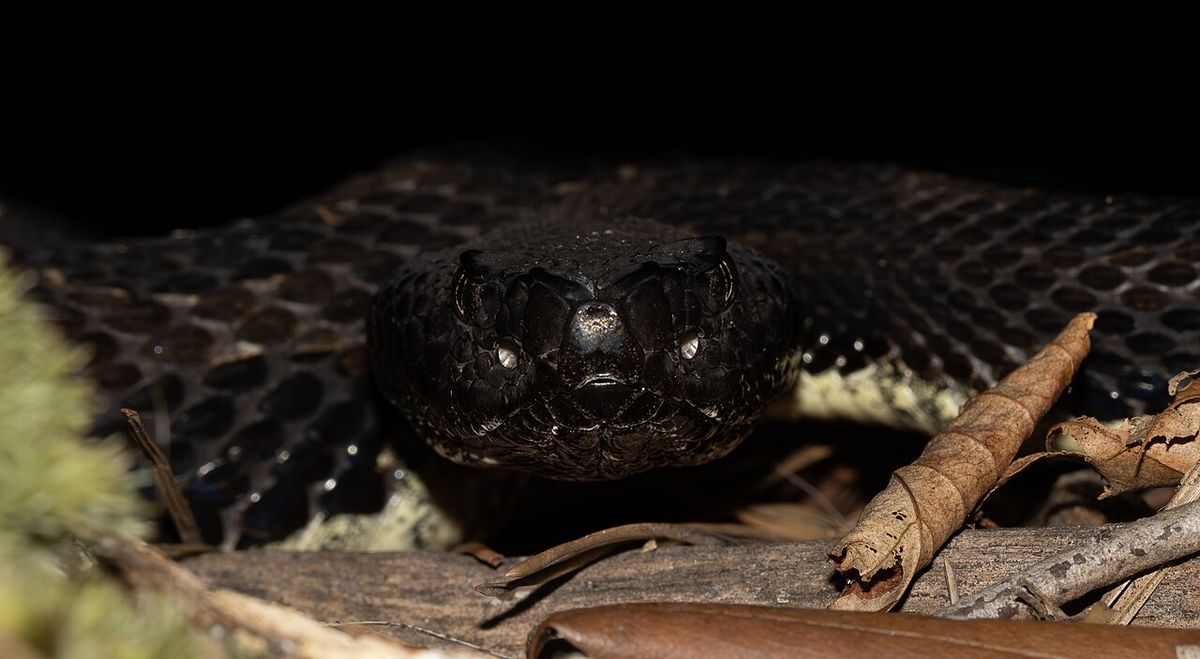
The timber rattlesnake is a large, heavy-bodied pit viper. Adults typically reach total lengths between 91 and 152 centimetres, though the maximum reported length is 189.2 centimetres. Most adults weigh between 500 and 1,500 grams, with exceptionally large specimens reported to weigh up to 4.5 kilograms. The species exhibits two primary colour morphs. The more common morph features a yellowish-brown, brown, or grey background with a pattern of dark brown or black crossbands that have irregular, zig-zag edges. A rust-coloured vertebral stripe is often present. The melanistic, or black, morph appears almost solid black, though the dark banding is still faintly visible. Both morphs have a black, velvety tail tipped with a rattle made of interlocking keratin segments. The head is unmarked and triangular with vertical pupils, and like all pit vipers, it possesses heat-sensing pits between the eyes and nostrils. Dorsal scales are keeled, and the number of scale rows at midbody usually varies geographically, with about 25 rows in southern populations and 23 rows in northern ones. The ventral scales number 158 to 177 in males and 163 to 183 in females, while males have 20 to 30 subcaudal scales compared to 15 to 26 in females.
Distribution and Habitat
The timber rattlesnake's range spans the eastern United States from eastern Kansas, Texas, Iowa, and central Wisconsin eastward to Georgia, the Carolinas, and north to New England. Its northern limits historically included southern Minnesota, southern New Hampshire, and, notably, southern Ontario and southern Quebec in Canada. The species is now extirpated in Canada, Michigan, Delaware, Maine, and Rhode Island, and is considered close to extirpation in New Hampshire. It is not present in the major urban areas of Pennsylvania, such as Philadelphia and Pittsburgh, or west of Chestnut Ridge in the Laurel Highlands. In Indiana, one of the few remaining populations is marked within Brown County State Park. The snake inhabits a variety of deciduous forest habitats in rugged terrain. These include mountainous or hilly forests, hardwood and pine forests, lowland cane thickets (giving rise to the name 'canebrake rattlesnake'), swamps, river floodplains, and agricultural field edges. Specific plant communities vary by region. In northeastern New York, they occupy mixed-hardwood forests dominated by red oak and shagbark hickory, while in southern New Jersey they are found in pitch pine barrens. In summer, gravid females often prefer warmer, open rocky ledges for basking, while males and non-gravid females frequent cooler, denser woodland with more closed canopy.
Behaviour and Life History
Timber rattlesnakes are ambush predators that primarily consume small to medium-sized rodents. Their diet, by genera, consists mainly of Peromyscus (deer mice, 33.3%), Microtus (voles, 10.9%), Tamias (chipmunks, 10.6%), Sylvilagus (cottontail rabbits, 10.4%), Sigmodon (cotton rats, 5.3%), and Sciurus (squirrels, 4.2%). Juveniles tend to eat smaller prey like shrews, averaging 8 grams, and are unable to tackle subadult rabbits. They employ a sit-and-wait strategy, often using fallen logs as a waiting site, which gives them a position to effectively strike terrestrial prey. They have been observed indicating a vertical tree posture, leaning against a tree while looking up at arboreal prey like squirrels, waiting for them to descend. Prey sometimes exhibit anti-snake displays like tail-flagging, but timber rattlesnakes show no immediate defensive response to these behaviours. The species is viviparous, giving birth to live young. Mating occurs from spring to late summer, and males may engage in a courtship dance involving sliding next to the female, rubbing against her, and curling his tail under hers. After a gestation period, females give birth to an average of 7.7 young per litter, with litters ranging from 3 to 13 snakes. Nonviable offspring are found in about 20% of field litters. Females reproduce infrequently, with a mean reproductive cycle of 4.2 years and a reproductive lifespan of about 9.6 years, and first reproduce at a mean age of 9.6 years. Timber rattlesnakes are long-lived, with some individuals thought to survive over 30 years.
A key behavioural trait is their high degree of philopatry, or site fidelity, particularly regarding hibernation. They brumate communally in dens within rock crevices or limestone shelves, often alongside other snake species like copperheads and rat snakes. They return to the same hibernaculum year after year, and individuals within a den, especially juveniles and pregnant females, are often more closely related to each other than to snakes in neighbouring dens. This behaviour is thought to involve juveniles tracking chemical cues from relatives. During winter, they may briefly emerge on warmer days to bask. Males often mate farther away from winter dens than females. When threatened, a timber rattlesnake will typically rattle its tail as a warning and attempt to retreat, striking only as a last resort if cornered or provoked. Their relatively mild disposition and long brumation period offset some of the danger posed by their potent venom.
Venom and Bite Treatment
The venom of the timber rattlesnake is a complex mixture of toxins and is considered extremely potent. It is both hemorrhagic, damaging blood vessels and tissues, and can contain neurotoxic components that affect the nervous system. Considerable geographic and ontogenetic variation exists in venom composition. Four broad patterns have been identified: Type A is largely neurotoxic and found in various parts of the southern range, with one effect being generalized myokymia. Type B is hemorrhagic and proteolytic, found consistently in the north and parts of the southeast. Type A+B is a mix found in intergrade zones like southwestern Arkansas and northern Louisiana. And Type C is relatively weak. The neurotoxic component, when present, is known as canebrake toxin, a phospholipase A2 analogous to toxins in other rattlesnake venoms. Other components include a small basic peptide that acts as a myotoxin, a fibrinogen-clotting enzyme that can cause defibrination syndrome, and a bradykinin-releasing enzyme. Despite its potency, the timber rattlesnake has a relatively mild disposition and provides ample warning with its rattle. Historical accounts, such as from a resident of western Pennsylvania in the 19th century, note the species was common but deaths from its bite were exceedingly rare. Bites on humans are uncommon and typically occur only when the snake is startled or deliberately harassed. However, a bite is a medical emergency. Treatment involves the use of CroFab antivenom, which is effective against envenomations from this species though not specific to it. The remote, wooded habitat of these snakes can make accessing emergency care difficult given the rapid progression of venom effects, which makes avoiding disturbance the best practice for safety.
Conservation Status and Threats
While the International Union for Conservation of Nature (IUCN) listed the timber rattlesnake as a species of Least Concern in its 2007 assessment due to its wide distribution, this status masks severe regional declines. The species is considered threatened or endangered across much of its northern range. It is listed as endangered in New Jersey, Vermont, Massachusetts, Virginia, New Hampshire, Indiana, and Ohio. It is listed as threatened in New York, Connecticut, Illinois, and Texas. A 2007 introductory report noted the species is listed as vulnerable, imperiled, or critically imperiled in 20 of the 30 U.S. states where it occurs. In Canada, it was officially declared extirpated under the Species at Risk Act in 2001, with the last confirmed sighting in Ontario in 1941. In New York, timber rattlesnakes are extirpated at 26% of historically known dens and nearly extirpated at another 5%, with denning populations reduced by an estimated 50 to 75% from historical numbers. Primary threats include habitat loss and fragmentation, deliberate persecution, road mortality, illegal collection for the pet trade, and disturbance of hibernation dens. Their slow reproductive rate and communal denning make them particularly vulnerable to local extirpation. Emerging diseases like snake fungal disease, first noted in New York in 2006, pose an additional, significant threat, causing skin lesions, frequent shedding, and lack of appetite.
- Historic Bounty Hunting: In the 19th century, organized hunting parties would raid hibernacula, killing all snakes present. In Massachusetts, the town of Westborough paid men to clear a hill of snakes in 1680.
- Habitat Loss: Urbanization and agricultural expansion have destroyed and fragmented forested habitats. In Massachusetts, their range is now reduced to the Blue Hills, Berkshires, and parts of the Connecticut River Valley.
- Road Mortality: Snakes are killed while crossing roads during seasonal migrations to and from dens, which can be several kilometres away.
- Illegal Collection: Poaching for the black-market pet trade targets dens, removing multiple individuals. In New York, collecting from the wild is now prohibited by law.
- Human Persecution: Fear and misunderstanding continue to lead to the killing of snakes, a practice dating back to early settlement.
- Disease: Snake fungal disease causes severe skin infections and increased mortality, similar to white-nosed syndrome in bats.
- Genetic Isolation: Small, isolated populations, as in the last known group in New Hampshire, face inbreeding, reduced genetic diversity, and vulnerability to stochastic weather events and pathogens.
Conservation efforts for the timber rattlesnake are focused on habitat protection and public education. In many states, there are strict legal protections that prohibit killing, collecting, or harassing these snakes. In Canada, where the species is listed as extirpated, a government sponsored recovery strategy has been studied to support the reintroducing of this predator to its former Canadian habitat. The timber rattlesnake is classified as endangered in several states, including New Jersey, Ohio, and Massachusetts, and as threatened in others like Illinois and New York.
Cultural and Historical Significance
The timber rattlesnake holds a unique place in American history and symbolism. A 1778 20-dollar bill from Georgia also featured a timber rattlesnake alongside the Latin motto 'Nemo me impune lacesset' ('No one attacks me with impunity'). In 2008, the timber rattlesnake was officially designated the state reptile of West Virginia, a move championed by the eighth grade class at Romney Middle School. Historically, the snake's fearsome reputation was widespread. In Massachusetts, early settlers organized paid hunts to eradicate them from hillsides, with one location in Westborough reportedly named 'Boston Hill' because the number of snakes killed rivaled the human population of Boston at the time. In the 19th century, bites were a documented hazard, as evidenced by a founding family of the Amana Colony in Iowa losing a three-year-old daughter to a bite received while playing on a woodpile.
Taxonomy and Naming
The timber rattlesnake was first scientifically described by Carl Linnaeus in his 1758 work Systema Naturae, and it retains its original binomial name, Crotalus horridus. The genus name 'Crotalus' is Latin for 'rattle' or 'castanet,' while the species epithet 'horridus' means 'dreadful' or 'bristly,' likely in reference to its venom. Historically, a subspecies known as the canebrake rattlesnake (C. h. atricaudatus) was recognized for southern populations, but modern analyses of morphology and genetics, beginning with Pisani et al. in 1972, do not support this division, and no subspecies are currently considered valid. The name 'canebrake' is still used informally for populations in lowland thickets in the southeastern U.S., and 'atricaudatus' is Latin for 'black-tailed.' The timber rattlesnake is one of 36 species within the genus Crotalus, which is distinguished from the other rattlesnake genus, Sistrurus, by the many small scales on the top of the head rather than nine large plate-like scales. A putative hybrid between a timber rattlesnake and a western diamondback rattlesnake has been reported in Texas.
Population Data and Research
Research on timber rattlesnake populations provides specific data on their demography and decline. A long-term reproduction study in the Adirondack Mountains of New York yielded precise figures: the mean age of first reproduction is 9.6 years, the mean reproductive cycle length is 4.2 years, and the average fecundity is 7.7 offspring per litter. Macrogeographic differences within populations correlate with resource levels influencing growth rates and survival impacted by human encounters. In Pennsylvania, the smallest female found to produce viable eggs measured 72.2 centimetres in length. Population monitoring is ongoing. For instance, 115 rattlesnakes were marked within Brown County State Park in Indiana. In New York, the Department of Environmental Conservation notes that collecting timber rattlesnakes from the wild is prohibited under Environmental Conservation Law. The IUCN's 2007 Least Concern assessment is based on the species' wide distribution and presumed large population, but a current, long-term monitoring study may change this status. The table below summarizes the conservation status of the timber rattlesnake in selected northern states and jurisdictions, illustrating the severity of its decline. In Iowa, bites were once widespread in localized areas like Geode State Park, Credit Island Park, and forested parts of Clinton County, indicating historically strong populations that have since diminished.
| Jurisdiction | Status | Notes |
|---|---|---|
| Canada (Ontario & Quebec) | Extirpated | Last confirmed sighting 1941. Listed under SARA 2001. |
| New Hampshire | Endangered | Only one population remains. Close to extirpation. |
| New York | Threatened | Extirpated at 26% of known dens. Populations down 50-75%. |
| New Jersey | Endangered | Considered among the state's most endangered species. |
| Massachusetts | Endangered | Range reduced to Blue Hills, Berkshires, Connecticut Valley. |
| Vermont | Endangered | Protected but populations declining. |
| Maine | Extirpated | No longer present in the state. |
| Rhode Island | Extirpated | No longer present in the state. |
Questions about Timber rattlesnake
Are timber rattlesnakes found in Canada?
No, timber rattlesnakes are no longer found in Canada. They were historically present in southern Ontario and southern Quebec, but the last confirmed sighting in Ontario was in 1941. The species was officially declared extirpated in Canada under the federal Species at Risk Act in May 2001. A government-sponsored recovery strategy has been considered to explore reintroduction, but no wild populations currently exist in the country.
How dangerous is a timber rattlesnake bite?
A timber rattlesnake bite is a serious medical emergency due to the snake's potent venom, which contains both hemorrhagic and neurotoxic components. However, bites are rare because the snake is generally shy and will almost always rattle and try to escape before striking. It only attacks if it feels cornered or threatened. Prompt treatment with CroFab antivenom is effective. More people die annually from insect stings than from rattlesnake bites in North America.
What do timber rattlesnakes eat?
Timber rattlesnakes are ambush predators that primarily eat small mammals. Their diet consists mainly of mice, voles, chipmunks, squirrels, and cottontail rabbits. They also occasionally eat small birds, lizards, and frogs. Juveniles start by eating smaller prey like shrews. They do not chase prey but instead wait motionless, often using a fallen log as a perch, and strike with venomous fangs when an animal passes within range.
Why are timber rattlesnake populations declining?
Populations, especially in the northern U.S., are declining due to multiple threats. These include habitat loss from development and agriculture, deliberate killing by humans, road mortality during seasonal movements, and illegal collection for the pet trade. Their communal hibernation in dens makes them vulnerable to events that can wipe out entire groups. An emerging fungal disease and genetic isolation in small populations further exacerbate their decline.
How long do timber rattlesnakes live and how do they reproduce?
Timber rattlesnakes are long-lived, with some individuals surviving over 30 years. They are viviparous, giving birth to live young every two to six years. After mating in spring or summer, females give birth to an average litter of 7 to 8 young, though litters can range from 3 to 13 snakes. Females first reproduce at an average age of 9.6 years. Newborn snakes are independent at birth, resembling miniature adults with a single 'button' on their tail.
How can you identify a timber rattlesnake?
Timber rattlesnakes can be identified by their pattern of dark brown or black crossbands on a yellowish-brown or grayish background, with the crossbands having irregular zig-zag edges and sometimes a rust-colored vertebral stripe. They have keeled dorsal scales arranged in 21 to 26 rows at midbody. Adults usually grow to a total length of 91 to 152 centimetres. Their tails are black and velvety, ending in a rattle made of keratin. Colour variation is common, with melanistic individuals appearing almost solid black, which can obscure the crossband pattern.
Sources and further reading
- Timber rattlesnake (Wikipedia)
- Timber rattlesnake (nationalzoo.si.edu)
- » Timber Rattlesnake (ontarionature.org)
- Timber Rattlesnakes: Cool Facts and an Uncertain Future (blog.nature.org)
- Crotalus horridus: INTRODUCTORY (fs.usda.gov)
Checked by the Your Space Hamilton desk. Last updated 2026-10-24.