Star-nosed mole
The star-nosed mole (Condylura cristata) is a small, semiaquatic mammal native to the moist lowlands and wetlands of northeastern North America, including significant portions of eastern Canada. It is the sole living member of its genus and tribe, renowned for its unique star-shaped nose composed of 22 fleshy appendages. This extraordinary organ, covered in over 25,000 microscopic sensory receptors called Eimer's organs, allows the mole to identify and consume prey with astonishing speed, earning it a Guinness World Record as the world's fastest-eating mammal. The species' remarkable sensory biology and adaptations for life in cold, aquatic environments make it a subject of significant scientific interest and a fascinating component of Canada's wetland ecosystems.
Physical Description and Unique Snout
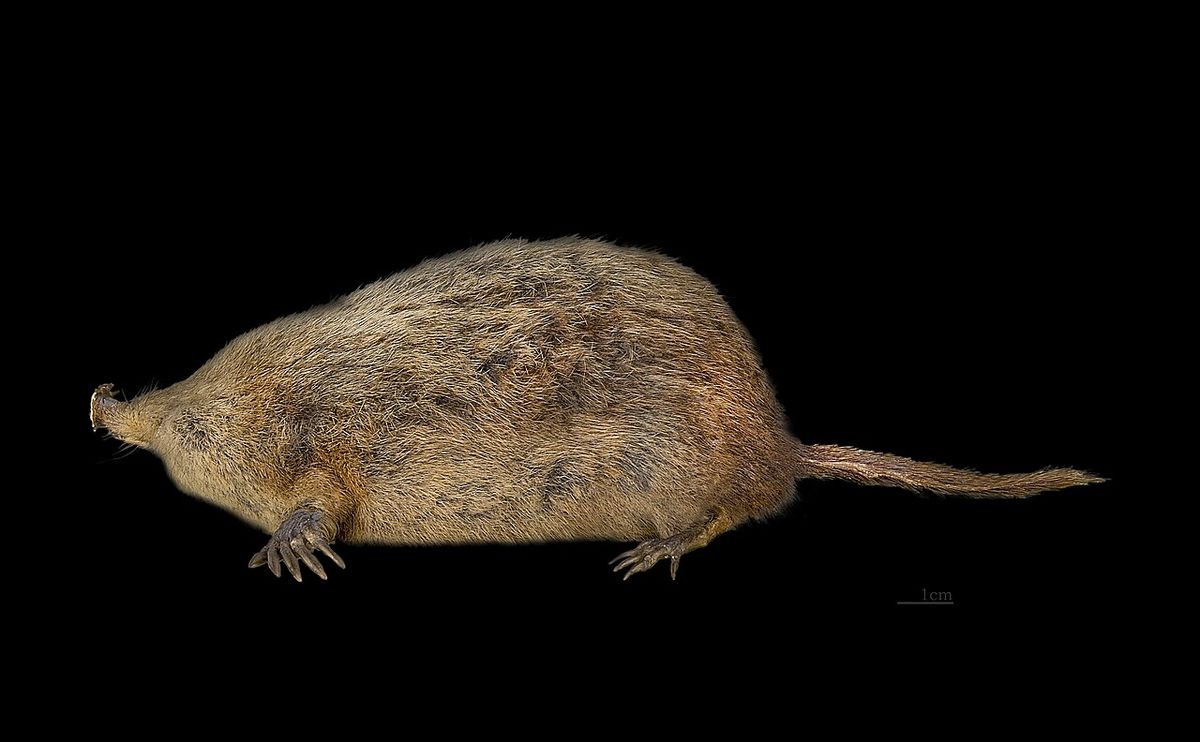
The star-nosed mole is a hamster-sized mammal, typically measuring about 15 to 20 centimetres in length including its short tail. Its most defining characteristic is the pink, fleshy star that surrounds its nostrils, measuring roughly 1.5 centimetres in diameter. This star is composed of 22 finger-like appendages, or rays, that are in constant motion as the animal explores its environment. Unlike the noses of other mole species, the star is not used for digging or manipulating objects, as the rays contain no bones or muscles. Instead, it is a highly specialized sensory organ. The entire surface of the star is covered with more than 25,000 minute sensory domes known as Eimer's organs, which are tactile receptors. This dense array makes the star's tactile sensitivity approximately six times greater than that of the human hand, which contains about 17,000 touch receptors. The structure of the star is functionally analogous to a visual system. The peripheral rays, numbered 1 through 10 on each side, act like a wide-angle lens, scanning the environment with rapid, saccadic movements. When something of interest is detected, the mole repositions its nose to bring the central, 11th pair of rays, which are shorter, directly onto the object. This central pair acts as a high-resolution tactile fovea, providing detailed information. Neuroscientific research has shown that this 11th pair has a disproportionately large representation in the mole's somatosensory cortex, similar to how the fovea in the primate eye is over-represented in the visual cortex. This organization allows for rapid and detailed tactile inspection of potential food items.
Habitat and Distribution in Canada
The star-nosed mole inhabits wet, poorly drained environments across northeastern North America. In Canada, its range extends from southeastern Manitoba through Ontario, Quebec, and into the Maritime provinces. It thrives in a variety of moist habitats including marshes, swamps, the edges of streams and ponds, and wet meadows. Although strongly associated with aquatic environments, it has also been found in drier meadows farther from water and at higher elevations, such as in the Great Smoky Mountains up to 1,676 metres. The mole is an excellent swimmer and can forage along the bottoms of streams and ponds, even under ice in winter. It digs shallow surface tunnels for foraging that often exit underwater, and it remains active year-round, tunneling through snow and swimming in ice-covered waterways. Its exceptional thermoregulation allows it to maintain a high body temperature in cold aquatic conditions better than other talpid moles. This adaptation is key to its survival in Canadian winters. Specific habitats where star-nosed moles have been documented include:
- Moist, low elevation areas across the northeastern parts of North America.
- Wet lowland areas and marshes with poor drainage.
- The bottoms of streams and ponds, where it swims to forage.
- Dry meadows located farther away from water sources.
- High elevation zones such as the Great Smoky Mountains at 1,676 m (5,499 ft).
- Areas with ice-covered streams during winter months.
Diet and Extraordinary Foraging Behaviour
The star-nosed mole is an opportunistic feeder with a diet consisting primarily of small invertebrates. Its prey includes aquatic insect larvae, terrestrial insects, earthworms, leeches, mollusks, aquatic crustaceans, and occasionally small amphibians and fish. It is the speed of its foraging, however, that sets it apart in the animal kingdom. Using its star, the mole can touch between 10 and 15 different spots on the ground every second. When its peripheral rays lightly contact a potential food item, it foveates by swiftly moving the central 11th pair of rays over the object for detailed inspection. The entire process from identification to consumption is breathtakingly fast. The mole's brain can decide if something is edible in about 8 milliseconds, and it can locate and consume individual prey items in as little as 120 milliseconds, with an average time of 227 milliseconds. This has earned it the title of the world's fastest-eating mammal in the Guinness Book of World Records. It can consume eight separate prey items in less than two seconds before resuming its search. The mole also possesses a unique ability to smell underwater. It achieves this by exhaling tiny air bubbles, each between 0.06 and 0.1 millimetres in size, onto objects or scent trails at a rate of 8 to 12 bubbles per second. It then inhales the bubbles back into its nostrils, wafting any captured odorant molecules over its olfactory epithelium. This clever adaptation allows it to detect prey hidden in murky water or buried in sediment where vision is useless.
The star-nosed mole eats small invertebrates such as aquatic insects, terrestrial insects, and worms. Its diet also includes mollusks and aquatic crustaceans. This mole consumes small amphibians and small fish. It forages along the bottoms of streams and ponds as a good swimmer.
- Aquatic insects like caddisfly, midge, dragonfly, and damselfly larvae.
- Other insects including crane flies, horseflies, predaceous diving beetles, and stoneflies.
- Worms such as earthworms, leeches, and other annelids.
- Mollusks and aquatic crustaceans.
- Small amphibians and small fish.
Life Cycle and Reproduction
Star-nosed moles mate in late winter or early spring. The female typically gives birth to a single litter each year, usually containing four or five young, in late spring or early summer. If the first litter is unsuccessful, females are known to produce a second. At birth, the offspring are about five centimetres long, hairless, and weigh approximately 1.5 grams. Their eyes, ears, and the rays of their star are all sealed shut. These features open and become functional about 14 days after birth. The young become independent from their mother after approximately 30 days and reach full maturity at around 10 months of age. Little is known about their detailed social structure, but they are suspected to live in loose colonial groups. Their lifespan in the wild is not precisely documented but is likely a few years given their small size and numerous predators.
Predators and Ecological Role
As a small mammal, the star-nosed mole faces predation from a variety of animals. Its predators include birds of prey such as red-tailed hawks, great horned owls, barn owls, and screech owls. Mammalian predators include foxes, weasels, minks, various skunks and mustelids, and domestic cats. Large fish, particularly the northern pike, also prey on these moles when they are swimming or foraging underwater. Ecologically, the star-nosed mole plays a significant role in its wetland habitat. Its constant foraging helps aerate soil and sediment, and its consumption of large quantities of invertebrates, including many aquatic insect larvae, influences local population dynamics. By serving as prey for higher trophic levels, it contributes to the flow of energy through the ecosystem.
Neuroscientific Significance and Brain Organization
The star-nosed mole has become an important model organism in neuroscience for understanding how brains process sensory information. Research led by scientists like Kenneth Catania of Vanderbilt University has revealed striking similarities between the mole's tactile system and the visual systems of primates. The rapid, saccadic movements of the star resemble eye movements, and the over-representation of the tactile fovea in the brain mirrors the over-representation of the visual fovea. Remarkably, about 52 percent of the star-nosed mole's somatosensory cortex is dedicated to processing input from the star, even though the nose constitutes only about 10 percent of the animal's body surface. This demonstrates a fundamental principle of brain organization where sensory space is allocated based on behavioural importance rather than physical size. The neural pathways involved are exceptionally fast. Tactile information from the environment is transmitted to the cortex so rapidly that the mole can make a decision on edibility within a 25-millisecond window. This includes just 12 milliseconds for cortical neurons to respond to touch and another 5 milliseconds for motor commands to return to the star. In comparison, a similar sensorimotor loop takes about 600 milliseconds in humans. This speed approaches the theoretical limit of neural processing, making the mole a living example of ultra-rapid sensory integration. Electrophysiological studies show that 97 percent of neurons in this cortical area respond to light touch with a mean latency of 11.6 milliseconds, and 41 percent are inhibited by stimulation outside their immediate receptive field, sharpening the tactile image.
Sensory Physiology of Eimer's Organs
The extraordinary sensitivity of the star stems from its Eimer's organs. Research has characterized these receptors into different classes based on their adaptation to stimuli. Tonic receptors respond with a sustained discharge to maintained pressure, allowing the mole to sense texture and constant contact. Phasic receptors adapt rapidly and are specialized for detecting vibration and transient touches. Studies have shown these receptors have specific frequency sensitivities. Some respond maximally to compressive vibrations at 250 to 300 Hz, while others are activated by brushing stimuli across a broad range of lower frequencies from 5 to 150 Hz. The receptors also exhibit directional sensitivity, meaning they respond more strongly to stimuli applied from a particular direction. This complex array allows the mole to build a detailed tactile picture of its surroundings. The minimum velocity required to trigger a response in these cells is about 46 millimetres per second, which matches the typical speed of the nose during active foraging. The innervation density varies across the star, with rays 1 through 9 having about 4 nerve fibers per Eimer's organ, while the more sensitive rays 10 and 11 have 5.6 and 7.1 fibers per organ, respectively.
The star is densely innervated with tactile information transmitted rapidly to the somatosensory neocortex. Roughly 52 percent of the cortex is devoted to processing sensory information from the nose. The total number of myelinated fibres for the entire star varies from roughly 106,000 to 117,000. The sensory periphery is differentially specialized, with rays 10 and 11 having higher innervation densities than the others.
- The total number of myelinated nerve fibers for the entire star ranges from roughly 106,000 to 117,000.
- The 11th pair of rays (the tactile fovea) has a larger representation in the somatosensory cortex despite being the shortest appendages.
- Each cerebral hemisphere has a set of 11 stripes representing the contralateral star, with a possible smaller third set sometimes visible.
- The sensory surface is subdivided into a large, low-resolution periphery and a small, high-resolution area, an evolutionary solution also seen in primate vision and bat echolocation.
- The threshold for deciding if something is edible is 25 milliseconds: 12 ms for sensory response and 5 ms for motor command return.
Behavioural Observations and Adaptations
Despite its poorly developed eyes, the star-nosed mole has a complex system to detect prey and understand its environment. During exploration, the star produces brief touches lasting 20 to 30 milliseconds that compress the Eimer's organs against objects. When foraging, the mole uses random patterns of these touches. High-speed video studies confirm that the mole always uses the 11th appendage pair to foveate on and explore a food item, a process identical to how human eyes explore a visual scene. This handling behaviour is central to its status as the fastest eater. The mole's ability to function in winter is another critical adaptation. It maintains activity by tunneling through snow and swimming in ice-covered streams, a feat supported by its superior thermoregulation compared to other moles. The species' colonial tendencies, while not fully understood, suggest a social structure more complex than the solitary life of many other mole species. The tactile organ is preferentially innervated by light touch fibers, and the outer appendages make slight contact to trigger the foveation response. This foraging behaviour is so fast that the mole touches between 10 and 15 separate areas of the ground every single second.
Questions about Star-nosed mole
Why does the star-nosed mole have a star on its nose?
The star is a highly specialized tactile organ used to detect and identify prey. Covered in over 25,000 microscopic Eimer's organs, it acts as a super-sensitive touch system. The 22 fleshy rays constantly move to scan the environment, and the central pair acts like a high-resolution fovea for detailed inspection. This adaptation is crucial because the mole is functionally blind and relies on touch to hunt in complete darkness, both underground and underwater.
How fast can a star-nosed mole eat?
The star-nosed mole holds the Guinness World Record as the world's fastest-eating mammal. It can identify and consume an individual prey item in as little as 120 milliseconds, with an average time of 227 milliseconds. Its brain makes the decision on whether something is edible in approximately 8 milliseconds, which is at the limit of neural processing speed. It can locate and eat eight separate items in under two seconds.
What do star-nosed moles eat?
Their diet consists mainly of small invertebrates. This includes aquatic insect larvae (like caddisflies and dragonflies), terrestrial insects, earthworms, leeches, mollusks, and small crustaceans. They will also occasionally eat small amphibians and fish. They forage both in their underground tunnels and along the bottoms of streams and ponds, using their star to detect prey in the sediment and water.
Can star-nosed moles smell underwater?
Yes, star-nosed moles have a unique ability to smell underwater. They accomplish this by exhaling small air bubbles onto objects or scent trails and then rapidly inhaling the bubbles back into their nostrils. This process carries odorant molecules from the water back to the olfactory receptors in their nose, allowing them to detect hidden prey. They can produce 8 to 12 of these tiny bubbles per second while foraging.
Are star-nosed moles blind?
The star-nosed mole is functionally blind. It has small eyes and a tiny optic nerve. It does not use sight to find prey, instead relying heavily on the mechanical information from its specialized nose. Its brain processes sensory information from this organ to create a tactile map of the environment.
Where can you find star-nosed moles in Canada?
Star-nosed moles are found in moist, low elevation areas in the northeastern parts of North America, which includes regions of eastern Canada. They primarily inhabit wet lowland areas, marshes, and poorly drained areas. However, they have also been located in dry meadows farther away from water. Their range includes high elevations, such as the Great Smoky Mountains, up to 1676 metres. These moles are semiaquatic, are good swimmers, and can forage along stream and pond bottoms, remaining active even in winter by tunneling through snow and swimming in ice covered streams.
Sources and further reading
- Star-nosed mole (Wikipedia)
- Why do star-nosed moles have a 'hand' on their face? (nhm.ac.uk)
- Star-Nosed Mole: The Nose that “Sees” (carnegiemnh.org)
- A star for a nose, Bioparc (bioparc.ca)
Checked by the Your Space Hamilton desk. Last updated 2026-10-31.