Sandhill crane
The sandhill crane (Antigone canadensis) is a large, long-legged wading bird native to North America and extreme northeastern Siberia. In Canada, it is a widespread species, with significant populations breeding across the northern territories and provinces and staging in immense numbers during migration. The species is known for its loud, rolling calls, complex mating dances, and impressive long-distance migratory journeys, with key stopover sites like Nebraska's Platte River Valley hosting up to 450,000 birds each spring. While the species as a whole is not considered threatened, several of its southern subspecies are endangered, and conservation efforts, including captive breeding and habitat protection, are critical for their survival.
Taxonomy and Evolution
The sandhill crane was first formally described by British naturalist George Edwards in 1750 from a specimen brought to London from Canada's Hudson Bay area by James Isham. Swedish naturalist Carl Linnaeus later assigned it the binomial name Ardea canadensis in 1758, citing Edwards' work. For many years, the species was placed in the genus Grus, but a 2010 molecular phylogenetic study found that genus to be polyphyletic, leading to the sandhill crane's reclassification into the resurrected genus Antigone, originally erected by Ludwig Reichenbach in 1853. The specific epithet canadensis is Latin for 'from Canada', reflecting the early specimen's origin. The species has one of the longest fossil histories of any living bird, with a 10-million-year-old crane fossil from Nebraska potentially related, though the oldest unequivocal sandhill crane fossil is 2.5 million years old.
Five subspecies are currently recognized, exhibiting considerable variation in size and migratory behaviour. These are the lesser sandhill crane (A. c. canadensis) of northeast Siberia and northern Canada, the Cuban sandhill crane (A. c. nesiotes), the Florida sandhill crane (A. c. pratensis), the Mississippi sandhill crane (A. c. pulla), and the greater sandhill crane (A. c. tabida) of southern Canada and the west-central United States. A 2025 genetic study revealed a deep divide between inland and coastal populations, with minimal gene flow and consistent differences in morphology, behaviour, and habitat preference. The authors argue that conservation strategies must better reflect this internal diversity to protect vulnerable populations, as geographic barriers have resulted in significant genetic separation.
Genetic analysis of mitochondrial DNA shows two major lineages, with the lesser sandhill cranes of the Arctic and subarctic representing one distinct group whose divergence from other populations dates back 2.3 to 1.2 million years ago during the Late Pliocene or Early Pleistocene. The other lineages include the greater sandhill crane and the resident southern subspecies. Some authorities no longer recognize the Canadian sandhill crane (A. c. rowani) as distinct due to minimal genetic and morphological differentiation from the greater sandhill crane, a difference likely resulting from recent genetic drift due to population reduction and range fragmentation. The two endangered resident subspecies in the southern United States, the Mississippi and Florida sandhill cranes, are more distinct, and the Cuban population appears to have been established on the island for a long time.
Physical Description
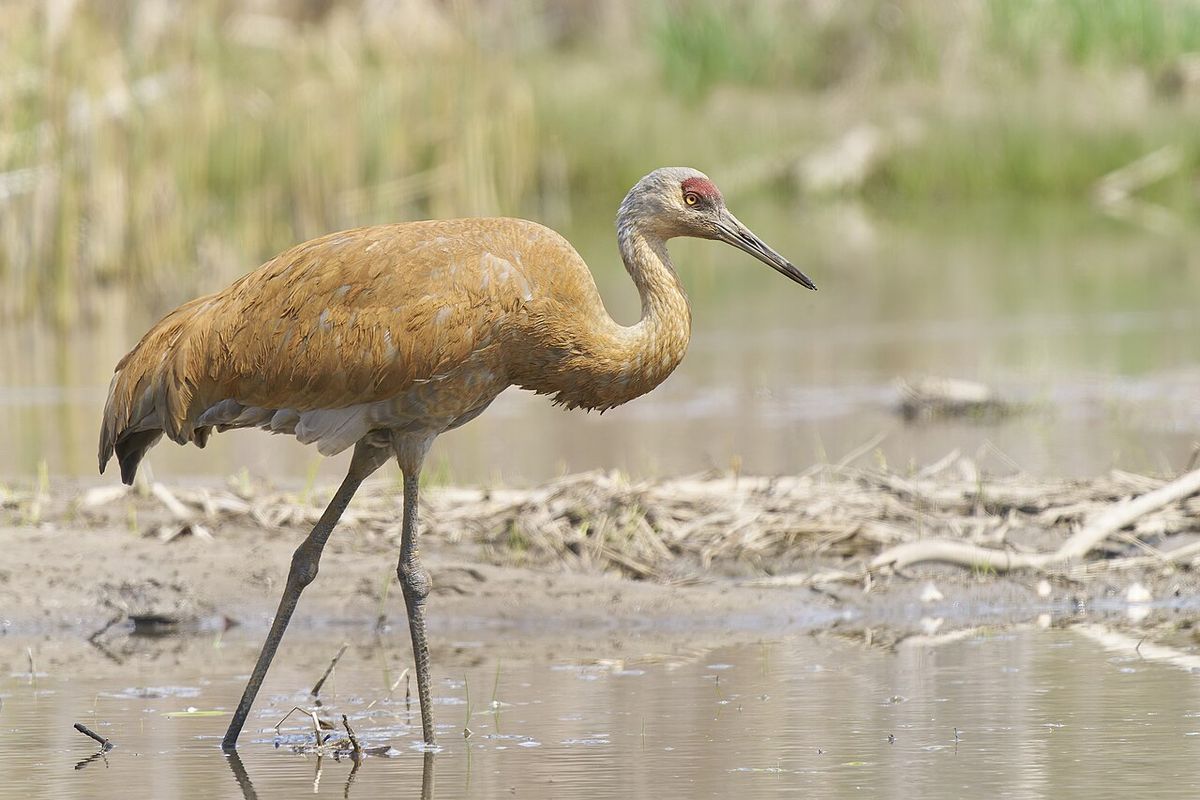
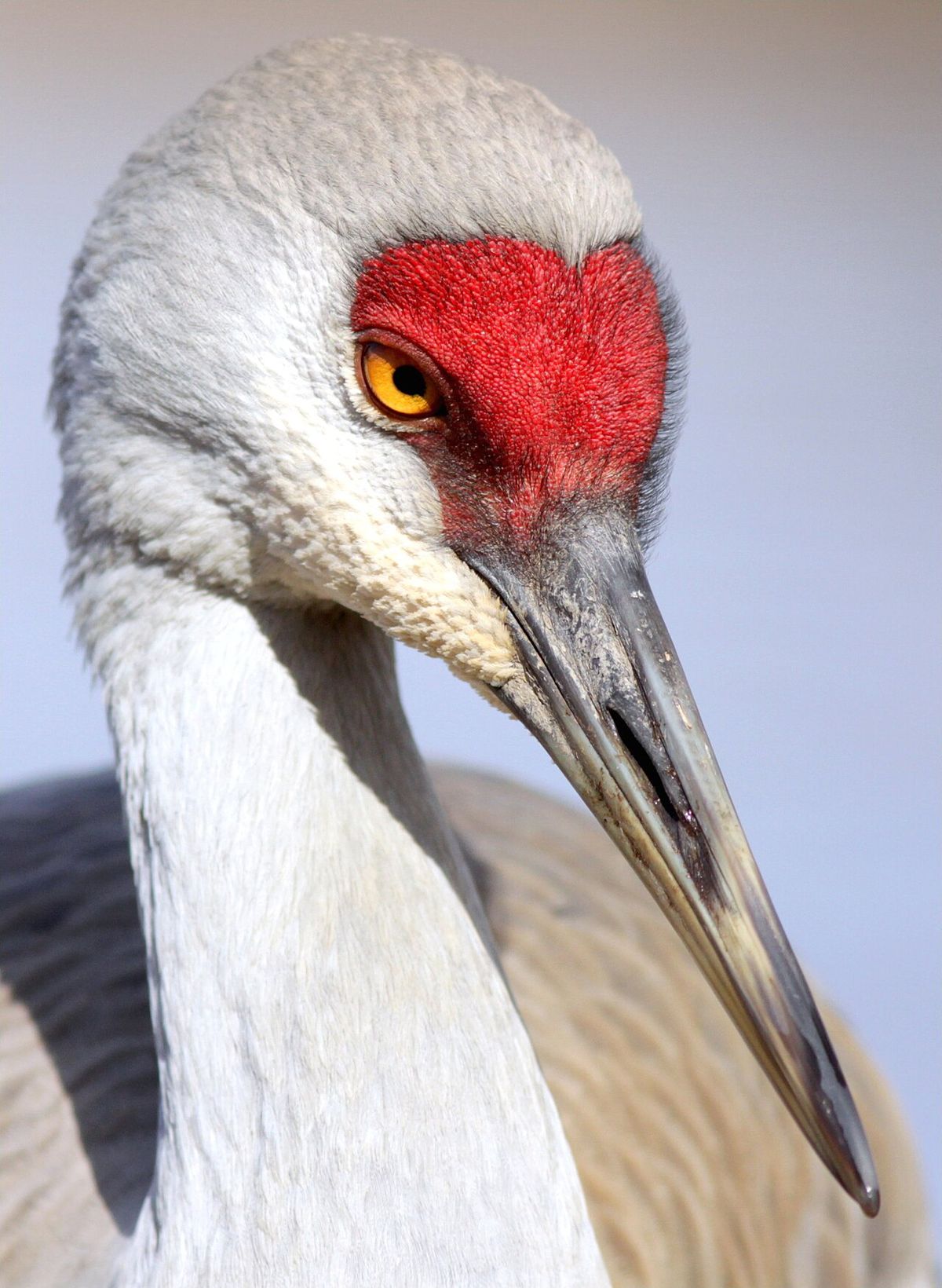
Adult sandhill cranes are predominantly grey, though breeding plumage in migratory populations can appear much worn and stained, looking nearly ochre. They possess a distinctive red crown on the forehead, white cheeks, and a long, dark, pointed bill. Their long, dark legs trail behind in flight, while the neck is held straight. The sexes are visually identical, though males are typically larger, averaging 4.57 kilograms compared to the female average of 4.02 kilograms, with weights across all subspecies ranging from 2.7 to 6.7 kilograms.
Size varies considerably among subspecies, with heights ranging from 80 to 136 centimetres and wingspans from 1.65 to 2.30 metres. For example, a female lesser sandhill crane averages 3.46 kg, 94 cm in length, and a 1.6 m wingspan, while a male greater sandhill crane averages 5 kg, 119 cm in length, and a 2.12 m wingspan. Immature birds lack the red crown and have reddish-brown upper parts with grey underparts, making them distinguishable from adults even when they reach full height. Sandhill cranes are renowned for their loud, trumpeting calls that suggest a rolled 'r', which can be heard from a long distance.
Mated pairs perform a synchronized 'unison call', a complex duet where the cranes stand close together and call in a coordinated manner, with the female typically producing two calls for every one from the male. Their large wingspans make them very skilled soaring birds, similar in style to hawks and eagles. Using thermals to obtain lift, they can stay aloft for many hours with minimal flapping, and migratory flocks containing hundreds of birds can create clear outlines of the rising columns of air they ride. These thermals are normally invisible, but the flocks reveal their outlines as they travel.
Distribution, Migration and Habitat
Sandhill cranes have a broad range across North America and extreme northeastern Siberia. The northern populations, including the lesser and greater sandhill cranes, are highly migratory. The central Platte River Valley in Nebraska is the most critical spring stopover area for the lesser sandhill crane, with up to 450,000 of these birds migrating through annually. These birds winter in the southwestern United States and Mexico, forming immense flocks sometimes exceeding 10,000 individuals at locations like Bosque del Apache National Wildlife Refuge in New Mexico, where an annual Sandhill Crane Festival is held in November.
Since the early 2000s, the species has expanded its wintering and breeding ranges northward, including into upstate New York. In the 21st century, parts of the Midwestern United States have seen an extensive rebound of the species, especially in Wisconsin and Indiana. Three subspecies are non-migratory residents: the Florida sandhill crane in Florida and Georgia, the Mississippi sandhill crane on the Gulf Coast of the U.S., and the Cuban sandhill crane on Cuba and the Isle of Youth. These resident birds inhabit pastures, open prairies, and freshwater wetlands, such as the Everglades and Okefenokee Swamp. The migratory subspecies utilize a wider variety of habitats throughout their annual cycle, including Arctic tundra for breeding, agricultural fields for foraging, and shallow wetlands for roosting. They are rare vagrants to China, South Korea, and Japan and very rare vagrants to Western Europe. The northern populations exist as a large and contiguous population from Canada to Beringia, while their former range in the contiguous U.S. is more fragmented.
- Lesser Sandhill Crane (A. c. canadensis): Breeds in northeast Siberia through Alaska and northern Canada to Baffin Island. Migrates through the Great Plains.
- Greater Sandhill Crane (A. c. tabida): Breeds in southern Canada and the west-central U.S.. Winters in the southwestern U.S.
- Florida Sandhill Crane (A. c. pratensis): Non-migratory resident of Georgia and Florida.
- Mississippi Sandhill Crane (A. c. pulla): Endangered, non-migratory resident of Mississippi.
- Cuban Sandhill Crane (A. c. nesiotes): Endangered, resident on Cuba and Isla de la Juventud.
Behaviour and Ecology
Sandhill cranes are fairly social birds that usually live in pairs or family groups through the year. During migration and winter, unrelated cranes come together to form 'survival groups' that forage and roost together, often congregating at migration and winter sites in the thousands. Their diet is mainly herbivorous but varies with availability, and they often feed with their bills down to the ground as they root for seeds in shallow wetlands or upland habitats. They readily eat cultivated foods such as corn, wheat, cottonseed, and sorghum, with waste corn being particularly useful for cranes preparing for migration.
Among northern breeding birds, the diet is most varied and can include berries, small mammals, insects, snails, reptiles, and amphibians. Sandhill cranes raise one brood per year, with laying in migratory populations usually beginning in April or May. Both members of a breeding pair build the nest using plant material, usually in marshes, bogs, or swales, though occasionally on dry land. Females lay one to three, usually two, oval, dull brown eggs with reddish markings, and both parents incubate them for about 30 days.
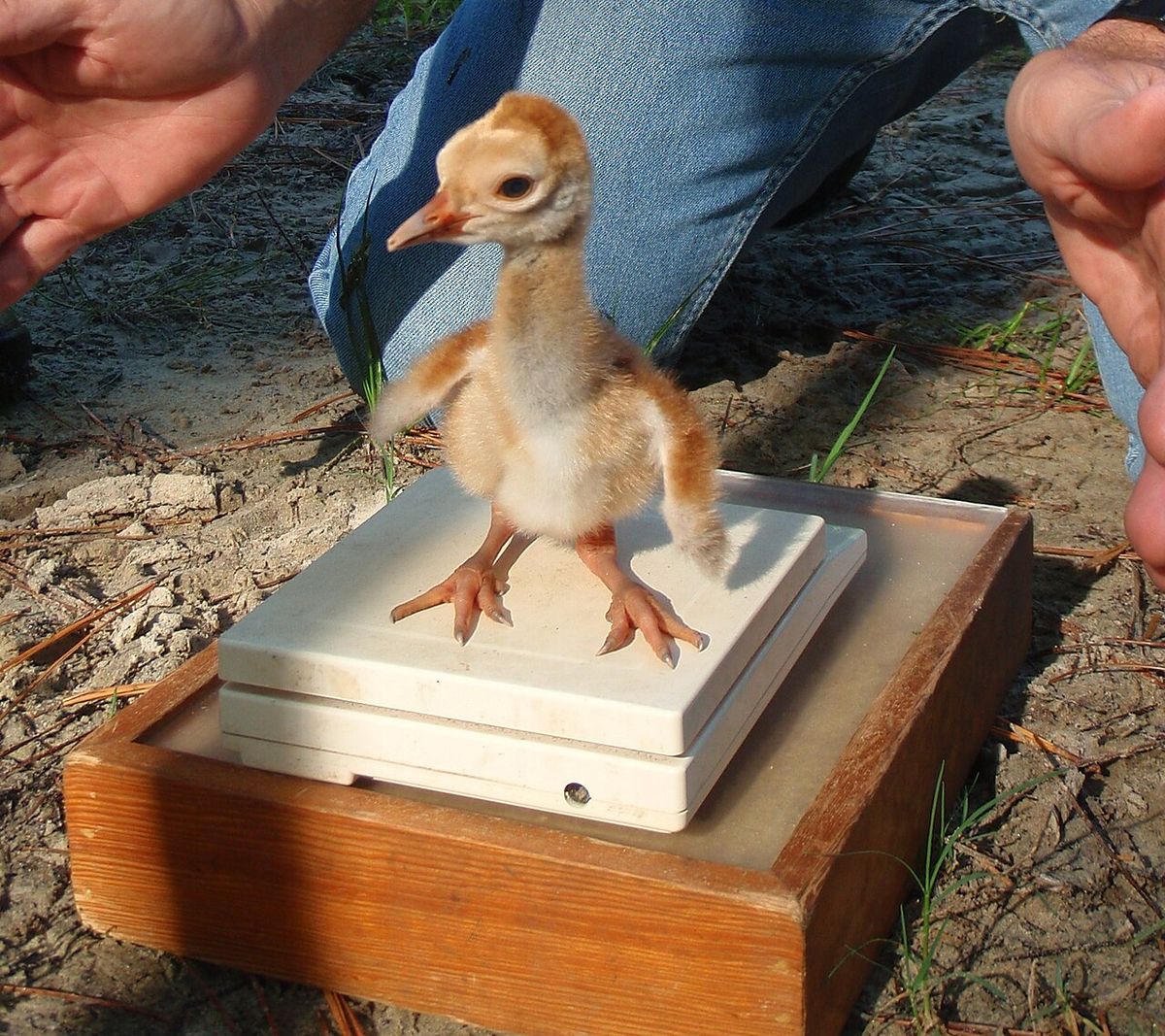
The chicks are precocial, hatching covered in down with their eyes open and able to leave the nest within a day. The parents brood the chicks for up to three weeks, feeding them intensively at first, then gradually less until they reach independence at 9 to 10 months old. The chicks remain with their parents for 10 to 12 months, leaving one to two months before the next clutch is laid. After leaving their parents, the chicks form nomadic flocks with other juveniles and nonbreeders, remaining in these flocks until they form breeding pairs between two and seven years old.
It is possible for sandhill cranes to hybridize with whooping cranes, a critically endangered species. Offspring resulting from these pairings are sterile and inherit intermediate characteristics of both parents. The monogamous habits of both species means that crossbreeding can threaten conservation efforts, and direct intervention may be needed to prevent hybridization. Sandhill cranes have been used as foster parents for whooping cranes in reintroduction schemes. The attempt failed when the whooping cranes imprinted on their foster parents and later unsuccessfully tried to pair with sandhill cranes instead of other whooping cranes.
Predators and Defence
As a conspicuous ground-dwelling species, sandhill cranes are at risk from a wide array of predators throughout their life cycle. Common egg and chick predators include corvids like ravens and crows, gulls, jaegers, various raptors, and mammals such as foxes, coyotes, and raccoons. In Oregon and California, the most serious predators of chicks are reportedly coyotes, ravens, raccoons, American mink, and great horned owls, roughly in descending order. Cranes of all ages can be hunted by both North American species of eagles, bobcats, and possibly American alligators, and a peregrine falcon was reported to have killed a 3.1 kg adult sandhill crane in a stoop.
Sandhill cranes actively defend themselves and their young from aerial predators by jumping and kicking. Actively brooding adults are more likely to react aggressively to potential predators to defend their chicks than wintering birds, which most often try to evade attacks on foot or in flight. For land predators such as dogs, foxes, and coyotes, they move forward, often hissing, with their wings open and bills pointed. If the predator persists, the crane stabs with its bill and kicks, and it can even kill predators by piercing through the skull with its sharp beak, with coyotes being vulnerable to such attacks.
In Florida, sandhill cranes face a newer threat from invasive constrictor snakes, which may eat them at some growth stage. These snakes include Burmese pythons, reticulated pythons, Southern and Central African rock pythons, boa constrictors, yellow anacondas, Bolivian anacondas, dark-spotted anacondas, and green anacondas. Human hunting is another significant pressure, permitted by lottery in 17 U.S. states, primarily within the Central Flyway from the Dakotas and Wyoming south to Oklahoma and Texas, though it is illegal in Nebraska, the state containing the crucial Platte River stopover. In New Mexico, humans hunt them with a permit granted in a lottery draw during late fall.
Conservation Status and Efforts
While the sandhill crane species as a whole is abundant and not threatened, several of its subspecies are at serious risk. The Mississippi and Cuban sandhill cranes are listed as endangered under the U.S. Endangered Species Act. The greater sandhill crane population plummeted to fewer than 1,000 birds by 1940 but has since recovered to nearly 100,000. The lesser sandhill crane remains the most numerous, with a continental population estimated at about 400,000 individuals. Overall populations have rebounded significantly since the 1930s, when they were generally extirpated east of the Mississippi River, with an estimated 98,000 in that region in 2018, a substantial increase over the previous year.
Major threats include habitat loss, hunting, and interspecies competition. Migratory cranes face population threats due to competition for waste corn with snow geese, which has been an issue since the 1990s. Conservation efforts are intensely focused on the endangered subspecies. The Mississippi Sandhill Crane National Wildlife Refuge was established in 1975 when fewer than 35 of the birds existed and now runs the world's largest crane release program, with about 90% of the cranes there raised in captivity. Starting in 1965, the second viable egg from two-egg nests was occasionally removed to build a captive breeding flock.
This breeding flock is divided between the Audubon Institute's Species Survival Center and White Oak Conservation in Yulee, Florida, and has produced offspring for annual releases into the refuge. A landmark event for this program was the first bird hatched from an egg fertilized by sperm thawed from a cryogenic state, which occurred at the Audubon Institute as part of this subspecies' endangered species recovery plan. The Florida sandhill crane was once listed as easily confused to facilitate a failed whooping crane reintroduction attempt, but it is no longer listed as endangered. The Cuban sandhill crane population, once believed to be about 300 birds, was estimated at about 525 individuals from surveys conducted from 1994 to 2002, and surveys from 2004 to 2015 indicated the population is now increasing.
| Subspecies | Population Status & Trends | Key Conservation Measures & Locations |
|---|---|---|
| Lesser Sandhill Crane (A. c. canadensis) | ~400,000 individuals, most plentiful crane. | Protection of migratory stopovers like the Platte River Valley, Nebraska. |
| Greater Sandhill Crane (A. c. tabida) | ~100,000, recovered from <1,000 in 1940. | General habitat protection. Expanded northward breeding range. |
| Mississippi Sandhill Crane (A. c. pulla) | ~25 breeding pairs (2013), endangered. | Captive breeding & release at Mississippi Sandhill Crane NWR (established 1975). |
| Cuban Sandhill Crane (A. c. nesiotes) | Increasing but endangered; ~525 birds (1994 to 2002). | Population monitoring and habitat protection in Cuba. |
| Florida Sandhill Crane (A. c. pratensis) | Stable, resident in Florida/Georgia wetlands. | Protection of wetland habitats. No longer listed as endangered. |
The transplantation of wild birds and introduction of captive-reared birds into suitable low-population areas have been called viable management techniques. Since the early 2000s, the sandhill crane has expanded both its winter and breeding ranges northward. A 2025 study showed a deep genetic divide between the sandhill crane populations, with geographic barriers resulting in minimal gene flow between inland and coastal populations. The inland and coastal populations show consistent morphological differences in size, colour, and facial structure. The authors of the study argue that the diversity within the species must be better reflected in conservation efforts in order to protect vulnerable populations.
Questions about Sandhill crane
Where can you see sandhill cranes in Canada?
Sandhill cranes breed across much of Canada, particularly in the northern territories, the Prairie provinces, and parts of British Columbia and Ontario. The lesser sandhill crane subspecies breeds in northeast Siberia through Alaska and northern Canada to Baffin Island, while the greater sandhill crane breeds in southern Canada and the west-central United States. During migration, they stage in enormous numbers at key stopover sites outside Canada, most notably the Platte River Valley in Nebraska. In Canada, look for them in wetlands, agricultural fields, and grasslands during the spring and summer breeding season.
Are sandhill cranes endangered?
The sandhill crane species as a whole is not endangered and is quite abundant, with a total population estimated in the hundreds of thousands. However, several of its subspecies are at serious risk. The Mississippi sandhill crane and the Cuban sandhill crane are both listed as endangered. The greater sandhill crane was once reduced to fewer than 1,000 individuals but has since recovered significantly due to conservation efforts. The lesser sandhill crane, with about 400,000 individuals continent-wide, is the most plentiful extant crane.
What do sandhill cranes eat?
Sandhill cranes are omnivorous but primarily herbivorous. Their diet consists largely of seeds, grains, and berries. They frequently forage in agricultural fields for waste corn, wheat, cottonseed, and sorghum, which is especially important for building energy reserves prior to migration. During the breeding season in the north, their diet becomes more varied and can include insects, snails, small mammals, reptiles, and amphibians. They feed by probing the ground with their long bills in shallow water or upland habitats.
How can you tell a sandhill crane from a great blue heron?
While both are large, greyish birds often seen in wetlands, they can be distinguished by several features. In flight, sandhill cranes hold their necks straight out, while herons fold their necks into an 'S' shape. Sandhill cranes have a bushy bustle of feathers over their tail, which herons lack. On the ground, sandhill cranes have a distinctive red crown on their forehead, which herons do not possess. Their calls are also very different, with the crane producing a loud, rolling trumpet call that suggests a rolled 'r' in the throat.
Why are sandhill cranes important to the ecosystem?
Sandhill cranes play several roles in their ecosystems. As omnivores, they help control populations of insects and small rodents. Their foraging and nesting activities can influence plant communities in wetlands and grasslands. They are a key prey species for predators like eagles, coyotes, and foxes. Their massive migratory congregations contribute nutrient cycling to stopover sites through their droppings. Their presence or absence is often an indicator of the health of wetland ecosystems, and they serve as a potential foster species in conservation experiments for other cranes.
Is it legal to hunt sandhill cranes?
Yes, regulated hunting of sandhill cranes is legal in 17 U.S. states, primarily within the Central Flyway which includes states from the Dakotas and Wyoming south to Oklahoma and Texas. Hunting is typically managed through permit lotteries and specific seasons, often in late fall, as in New Mexico. Notably, Nebraska, which hosts the largest migratory staging area on the Platte River, prohibits crane hunting. In Canada, sandhill cranes are protected under the Migratory Birds Convention Act and cannot be hunted without specific authorization, which is rarely granted.
Sources and further reading
- Sandhill crane (Wikipedia)
- Sandhill crane, National Zoo (nationalzoo.si.edu)
- Sandhill Crane (nature.org)
- Sandhill Crane | Ohio Department of Natural Resources (ohiodnr.gov)
- Fish and Wildlife: Sandhill Cranes (in.gov)
Checked by the Your Space Hamilton desk. Last updated 2026-10-22.