Ruby-throated hummingbird
The ruby-throated hummingbird (Archilochus colubris) is a small, migratory bird and the sole breeding hummingbird species in eastern North America. It is the most common hummingbird in the region, with a 2021 population estimate of about 35 million individuals. The species is distinguished by the male's brilliant, iridescent ruby-red throat patch and its remarkable long-distance migrations, including a nonstop flight across the Gulf of Mexico. For Canadians, the annual spring arrival of these birds from their Central American wintering grounds is a celebrated sign of the season, with their range stretching across southern provinces from Nova Scotia to Alberta.
Physical Description and Identification
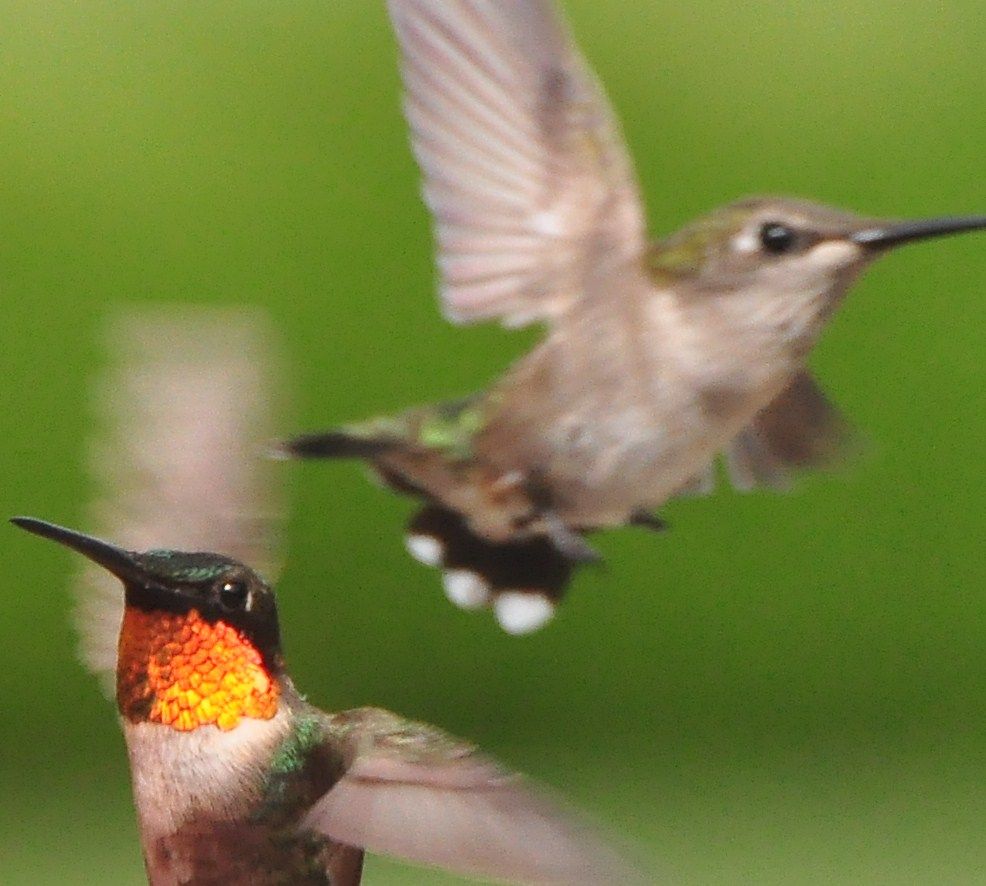
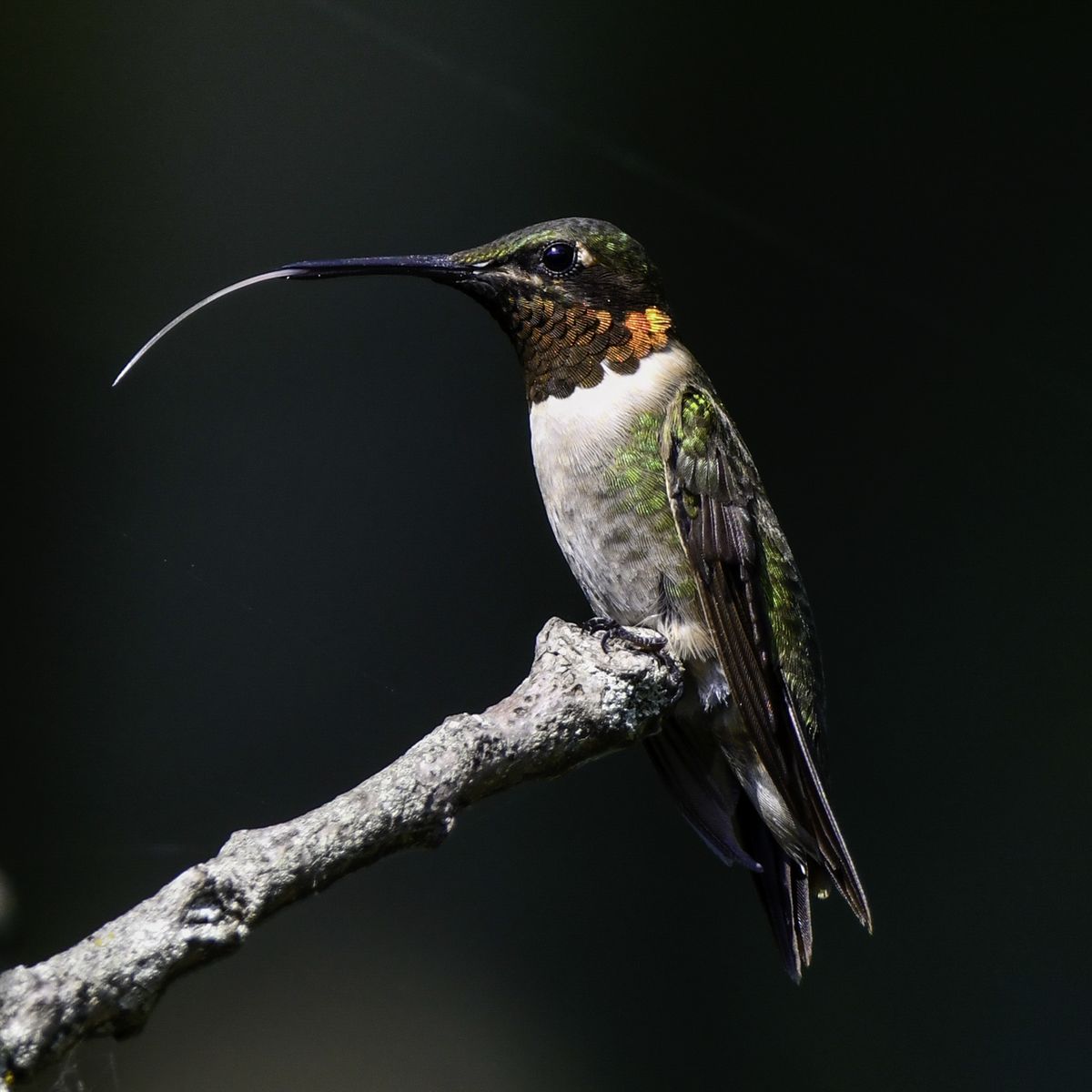
The ruby-throated hummingbird is a diminutive bird, measuring only 7 to 9 centimetres in length with a wingspan of 8 to 11 centimetres. Its weight ranges from 2 to 6 grams, with females averaging slightly heavier than males at 3.8 grams versus 3.4 grams. Adults are metallic green on their upperparts and grayish white below, with near-black wings and a long, straight bill measuring up to 2 centimetres. The species exhibits pronounced sexual dimorphism, meaning males and females look different. The adult male possesses a distinctive gorget, or throat patch, of iridescent ruby red that is bordered narrowly with velvety black. This red iridescence is not due to pigment but to microscopic structures in the feathers that refract light, making it appear dull black from many angles. The male's tail is forked and black with a faint violet sheen. In contrast, the female lacks the colourful gorget, having a white throat that may be plain or lightly marked with dusky streaks. Her tail is notched with outer feathers banded in green, black, and white. Juvenile males resemble adult females but usually have heavier throat markings. The birds molt their plumage once a year while on their wintering grounds.
Distribution, Migration, and Habitat
The ruby-throated hummingbird has the largest breeding range of any North American hummingbird. Its summer habitat extends throughout most of the eastern United States, east of the 100th meridian, and across south-central and southeastern Canada, including Ontario and the Maritime provinces. It inhabits deciduous and pine forests, forest edges, orchards, and gardens. The species is strongly migratory, spending the winter primarily in Florida, southern Mexico, Central America as far south as Panama, and the West Indies. A key aspect of its migration is a formidable nonstop flight across the Gulf of Mexico and Caribbean, a journey of approximately 800 to 900 kilometres undertaken by portions of the population each spring and fall. To prepare for this marathon overwater flight, the birds double their fat mass, which is then expended during the 20-hour crossing. Migration timing is influenced by daylight duration and food availability rather than temperature alone. Males typically migrate north first, followed by females about 10 to 14 days later. Recent migration tracking in spring 2026 showed the species reaching its northern limits, with reports from LaCorey, Alberta, in the west and Nova Scotia, New Brunswick, and Prince Edward Island in the east by mid-May.
Behaviour and Ecology
Ruby-throated hummingbirds are solitary and highly aggressive outside of brief courtship interactions. Both sexes vigorously defend feeding and breeding territories, chasing away other hummingbirds and even larger animals. They possess one of the highest metabolic rates in the animal kingdom, with a resting heart rate up to 1260 beats per minute and a breathing rate of about 250 breaths per minute. To conserve energy, especially on cold nights, they can enter a state of hypothermic torpor, significantly lowering their body temperature and metabolic rate. Their primary food is floral nectar, which provides essential sugars for energy. They show a slight preference for red, orange, and bright pink tubular flowers but will visit many types. An equally critical part of their diet is small arthropods like insects and spiders, which supply necessary protein, minerals, and vitamins. They also occasionally consume tree sap from sapsucker wells. They catch insects on the wing or glean them from vegetation and spider webs.
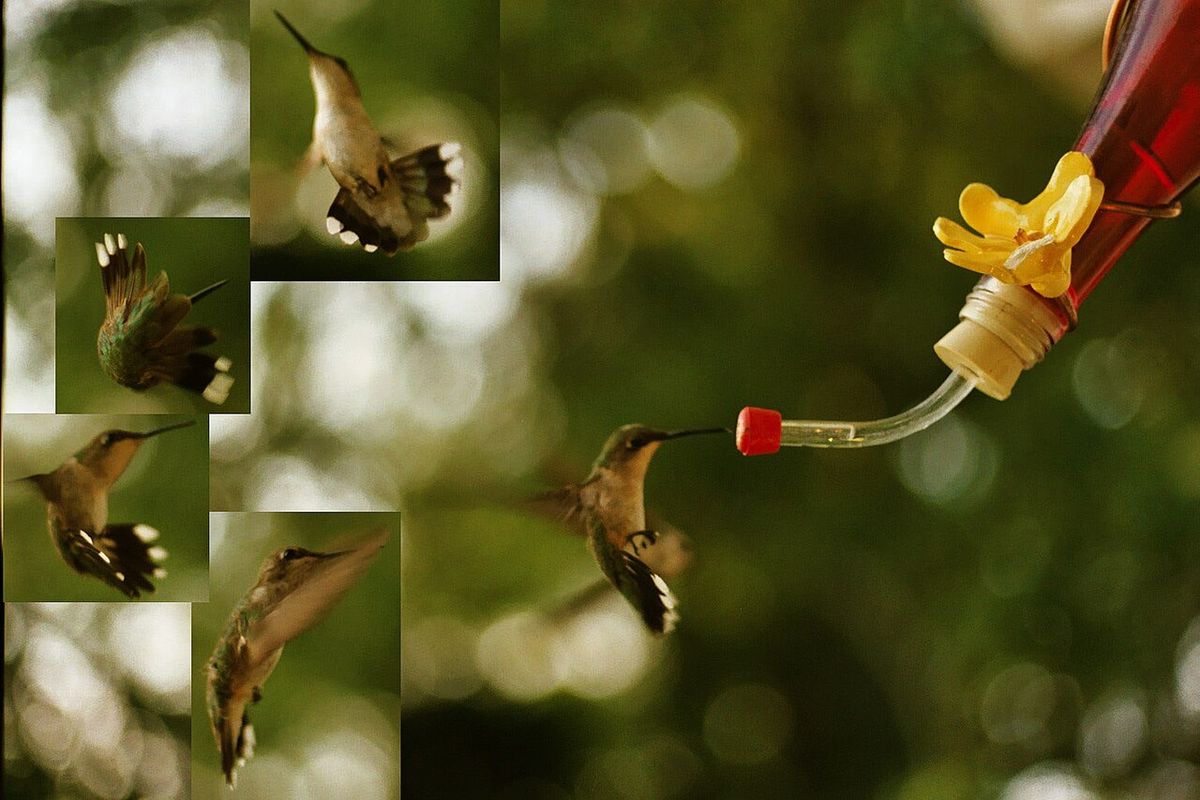
The species' flight capabilities are extraordinary and unique among birds, allowing them to hover, fly backwards, and manoeuvre with insect-like agility. Key adaptations enabling this include wings that connect to the body only at the shoulder joint, allowing almost 180-degree rotation. Their flight muscles make up 25 to 30 percent of their body weight, and they have a short humerus bone with massive deltoid-pectoral muscles for powerful wing supination during the upstroke. They generate lift on both the downstroke, which provides 75 percent of the lift, and the upstroke, which provides the remaining 25 percent. During hovering, their wings beat up to 80 times per second, creating the characteristic humming sound that gives the family its name.
Breeding and Life Cycle
Ruby-throated hummingbirds are polygynous, with males mating with multiple females and providing no parental care. Males arrive on the breeding grounds in spring to establish territories before the females return. Courtship involves elaborate aerial displays. The male performs a 'dive display,' rising 2.45 to 3.1 metres above and 1.52 to 1.82 metres to each side of a female. If she perches, he flies rapid horizontal arcs in front of her. Receptive females give a call and assume a solicitous posture. The female alone builds the nest, a tiny, camouflaged cup typically placed on a small, downward-sloping tree limb 3.1 to 12.2 metres above ground. Favoured trees include oak, hornbeam, birch, poplar, and hackberry. The nest is constructed from bud scales, covered with lichen on the exterior, bound with spider silk, and lined with plant down and animal hair. Old nests may be reused and repaired annually. The female lays a clutch of two tiny white eggs, though the number can range from one to three. She incubates them for 12 to 14 days. After hatching, she feeds the chicks by regurgitation one to three times per hour while continuing to hover. The young leave the nest and make their first flight when they are 18 to 22 days old. The species can produce one to two broods each summer.
Population Trends and Conservation
With an estimated 34 to 36 million individuals in 2021, the ruby-throated hummingbird is the most populous hummingbird in North America and is listed as Least Concern on the IUCN Red List. However, this status masks concerning trends. Following a period of steady population increases from 1970 through the early 2000s, numbers declined by 17 percent according to the 2021 census. Research indicates populations have been declining steadily for approximately the past two decades. Scientists from the Canadian Wildlife Service and others suspect multiple contributing factors, including habitat loss in their tropical wintering grounds and exposure to agrochemicals in their summer breeding range. Climate change presents another significant threat, as shifting temperatures are altering migration timing. Studies show the species' fall migration in eastern Pennsylvania shifted to significantly earlier dates between 1990 and 2014, and similar shifts have been noted in spring. These changes risk desynchronising the birds' arrival with peak flowering seasons in both their summer and winter habitats, potentially affecting their food supply. Conservation efforts that benefit the species include reducing pesticide use in gardens and agriculture, protecting natural habitats across their migratory range, and actions to mitigate climate change.
Longevity, Mortality, and Predators
The oldest known ruby-throated hummingbird was a banded individual that lived 9 years and 1 month. Notably, almost all hummingbirds reaching 7 years or more are females, as males rarely survive past 5 years. This higher male mortality is likely due to the intense energetic demands of defending breeding territories followed by the strenuous migration. Despite their speed and agility, ruby-throated hummingbirds face predation from a variety of animals. Their small size makes them vulnerable even to insect-eating birds. Key avian predators include smaller, swift raptors like sharp-shinned hawks, merlins, American kestrels, and Mississippi kites. Other significant predators are domestic cats, loggerhead shrikes, and greater roadrunners, which often ambush perching or distracted birds. Predatory lizards and black ratsnakes prey on them, especially on wintering grounds. Surprisingly, large invertebrates also pose a threat, with documented cases of praying mantises ambushing adults at feeders, along with orb-weaver spiders and green darner dragonflies. Nests are commonly raided by blue jays, other corvids, some icterids, bats, squirrels, and chipmunks.
Several specific predators have been documented preying on adult ruby-throated hummingbirds or their nests. Chief among their predators are swift raptors like sharp-shinned hawks, merlins, American kestrels and Mississippi kites. Other predators include domestic cats, loggerhead shrikes and greater roadrunners. Blue jays are common predators of nests, as are several other corvids, icterids, bats, squirrels and chipmunks. Even large, predatory invertebrates such as praying mantises, orb-weaver spiders, and green darners have been seen to prey on these hummingbirds.
- Sharp-shinned hawks, merlins, American kestrels, and Mississippi kites (avian raptors).
- Domestic cats and loggerhead shrikes.
- Greater roadrunners and black ratsnakes.
- Praying mantises, which ambush adults at feeders.
- Orb-weaver spiders and green darner dragonflies.
- Blue jays and other corvids (common nest predators).
- Bats, squirrels, and chipmunks (nest predators).
Key Flight and Physiological Adaptations
The ruby-throated hummingbird's unique flight abilities are made possible by a suite of specialised anatomical and physiological traits. Their long, blade-like wings connect to the body only from the shoulder joint, allowing the wing to rotate almost 180 degrees. This enables the bird to fly forward, backward, and hover in mid-air. Proportionally massive major flight muscles make up 25 to 30 percent of their body weight. A hummingbird's ability to hover is also due to its small mass, high wingbeat frequency and relatively large margin of mass-specific power available for flight.
- Flight muscles constituting 25 to 30 percent of total body weight.
- A wing structure that connects only at the shoulder joint, enabling almost 180-degree rotation.
- A short humerus bone with massive deltoid-pectoral muscles for wing supination.
- The ability to generate lift on both the downstroke (75%) and upstroke (25%) of the wingbeat.
- A hovering wingbeat frequency of up to 80 beats per second.
- A resting heart rate of up to 1260 beats per minute.
- A resting breathing rate of about 250 breaths per minute.
- The capacity to enter hypothermic torpor to conserve energy on cold nights.
These extreme characteristics support a lifestyle of high-energy foraging and long-distance migration. Hummingbirds have one of the highest metabolic rates of any animal, with heart rates up to 1260 beats per minute. They feed frequently while active during the day to support this metabolism. As part of their spring migration, portions of the population fly non-stop across the Gulf of Mexico, a journey of about 800 kilometres. To prepare, the tiny birds can double their fat mass before this long flight over water where food is unavailable.
Historical Spring Arrival Dates in Key Regions
The first arrival of ruby-throated hummingbirds each spring is a highly anticipated event for birdwatchers across North America. Historical data from citizen science projects like Journey North provides a baseline for when scout males typically appear in different regions. These dates represent historical first-arrival windows, and actual timing can vary yearly, with recent trends showing earlier arrivals linked to climate change. The migration follows a predictable northward progression, with males arriving about 10 to 14 days before females. The table below outlines typical first arrival periods for several key Canadian and northern U.S. regions based on compiled historical records.
| Region | Typical First Arrival Period |
|---|---|
| Southern United States (e.g., Gulf Coast) | Late February to March |
| Mid-Atlantic & Midwestern U.S. | Mid-April to early May |
| Ontario, Canada | Early to mid-May |
| New Brunswick, Canada | Early to mid-May |
| Nova Scotia, Canada | Early to mid-May |
| Saskatchewan, Canada | Mid-May |
| Alberta, Canada | Mid to late May |
In spring 2026, real-time tracking confirmed the pattern of the ruby-throated hummingbird migration. Reports showed the species stretching to the northern reaches of its range, with sightings in Alberta. Specific reports came from Alberta's LaCorey area on May 17. There were also widespread sightings in the Maritimes in the first two weeks of May. These arrivals demonstrate the birds' incredible navigational abilities and endurance. They complete their long migratory journey from their winter homes in Central America, Mexico, and Florida to breed in Canada and eastern North America.
Questions about Ruby-throated hummingbird
When do ruby-throated hummingbirds arrive in Canada?
Ruby-throated hummingbirds typically begin arriving in Canada in early to mid-May, though timing varies by region and year. In spring 2026, sightings were reported in New Brunswick and Nova Scotia around the first week of May, in Ontario during early to mid-May, and in Saskatchewan and Alberta by mid to late May. Males, distinguished by their ruby-red throats, arrive first to establish territories, with females following about 10 to 14 days later. Their migration is triggered by daylight length and food availability, not temperature, so they may arrive even during late cold snaps.
What do ruby-throated hummingbirds eat?
Ruby-throated hummingbirds have a diet consisting primarily of floral nectar, which provides the high sugar content needed to fuel their extreme metabolism. They show a slight preference for red, orange, and bright pink tubular flowers. An essential component of their diet is small arthropods like insects and spiders, which supply crucial protein, vitamins, and minerals for adults and are the sole food source for growing chicks. They also occasionally drink sugar-rich tree sap from wells created by yellow-bellied sapsuckers. They feed by hovering and extending their long, specialised tongue to lick nectar and by catching insects in mid-air or gleaning them from plants and spider webs.
How far do ruby-throated hummingbirds migrate?
Ruby-throated hummingbirds undertake one of the most impressive migrations for their size. They winter primarily in Central America, Mexico, and Florida, then migrate north to breed across the eastern United States and southern Canada. The most remarkable leg of this journey is a nonstop flight across the Gulf of Mexico, covering approximately 800 to 900 kilometres over open water. To accomplish this 20-hour flight, the birds double their body fat beforehand as fuel.
Are ruby-throated hummingbird populations declining?
Yes, ruby-throated hummingbird populations have been in a steady decline for approximately the past 20 years. This follows a period of increase from 1970 through the early 2000s. The 2021 population census indicated a 17 percent decline from previous counts, despite an overall estimate of 34 to 36 million birds. Scientists from organisations like the Canadian Wildlife Service attribute the decline to multiple factors, including habitat loss in their wintering grounds in Central America, exposure to pesticides in their summer range, and the broader effects of climate change, which can disrupt the timing of migration and flower blooming.
How can I attract ruby-throated hummingbirds to my garden?
To attract ruby-throated hummingbirds, provide a clean nectar feeder filled with a solution of one part white sugar to four parts water, with no red dye needed. Place feeders in a safe, visible location, ideally by mid-April in southern Canada to catch early arrivals. Plant native, nectar-rich flowers with tubular shapes, such as bee balm, cardinal flower, trumpet vine, and native salvias, which provide natural food sources. Avoid using pesticides in your garden, as these can poison the birds or kill the insects they rely on for protein. Providing a shallow water source or mister for bathing can also make your garden more attractive to these energetic birds.
What are the main predators of ruby-throated hummingbirds?
Despite their speed, ruby-throated hummingbirds face predation from various animals. Key avian predators include swift raptors like sharp-shinned hawks, merlins, American kestrels, and Mississippi kites. Domestic cats, loggerhead shrikes, and greater roadrunners are also significant threats, often ambushing birds at perches or feeders. On their wintering grounds, predatory lizards and black ratsnakes prey on them. Surprisingly, large invertebrates like praying mantises, orb-weaver spiders, and green darner dragonflies have been documented capturing adults. Nest predators are numerous and include blue jays, other corvids, some blackbirds, bats, squirrels, and chipmunks.
Sources and further reading
- Ruby-throated hummingbird (Wikipedia)
- Ruby-throated Hummingbird Archilochus colubris (ebird.org)
- Ruby-throated Hummingbirds stretch from Alberta to Nova ... (journeynorth.org)
- Ruby-throated Rulers, Your Connection to Wildlife (blog.cwf-fcf.org)
- Ruby-throated Hummingbird Arrival Dates by State 2026 (thebirdinginsights.com)
Checked by the Your Space Hamilton desk. Last updated 2026-10-28.