Red-shouldered hawk
The red-shouldered hawk (Buteo lineatus) is a medium-sized forest raptor native to North America, recognized by its reddish chest, barred belly, and distinctive screaming call. Its breeding range spans eastern North America, including southern Canada, and a separate western population exists along the California coast and into Baja California. The species is a permanent resident throughout most of its range, though northern populations migrate to the southern United States and Mexico. For Canadians, particularly in southern Ontario and New Brunswick, the red-shouldered hawk is a notable component of riparian and mixed woodland ecosystems, though its populations have faced historical declines due to deforestation and habitat loss.
Taxonomy and Subspecies
The red-shouldered hawk was formally described in 1788 by the German naturalist Johann Friedrich Gmelin, who placed it in the genus Falco and gave it the binomial name Falco lineatus. Gmelin based his account on earlier descriptions by naturalists John Latham and Thomas Pennant, who had specimens from North America and Long Island, respectively. The species is now classified within the genus Buteo, a Latin term for "buzzard," which was introduced in 1799 by Bernard Germain de Lacépède. The specific epithet lineatus is Latin for "marked with lines," referring to the bird's distinctive plumage patterns. Five subspecies of red-shouldered hawk are currently recognized across its range, each with distinct geographic distributions. The subspecies Buteo lineatus lineatus is found across eastern North America, while Buteo lineatus alleni ranges from central south Texas to North Carolina and north Florida. The subspecies Buteo lineatus extimus is restricted to south Florida and the Florida Keys, and Buteo lineatus texanus occurs from south Texas into southeast Mexico. The western population is represented by Buteo lineatus elegans, which breeds from southern Oregon to Baja California in Mexico.
Physical Description
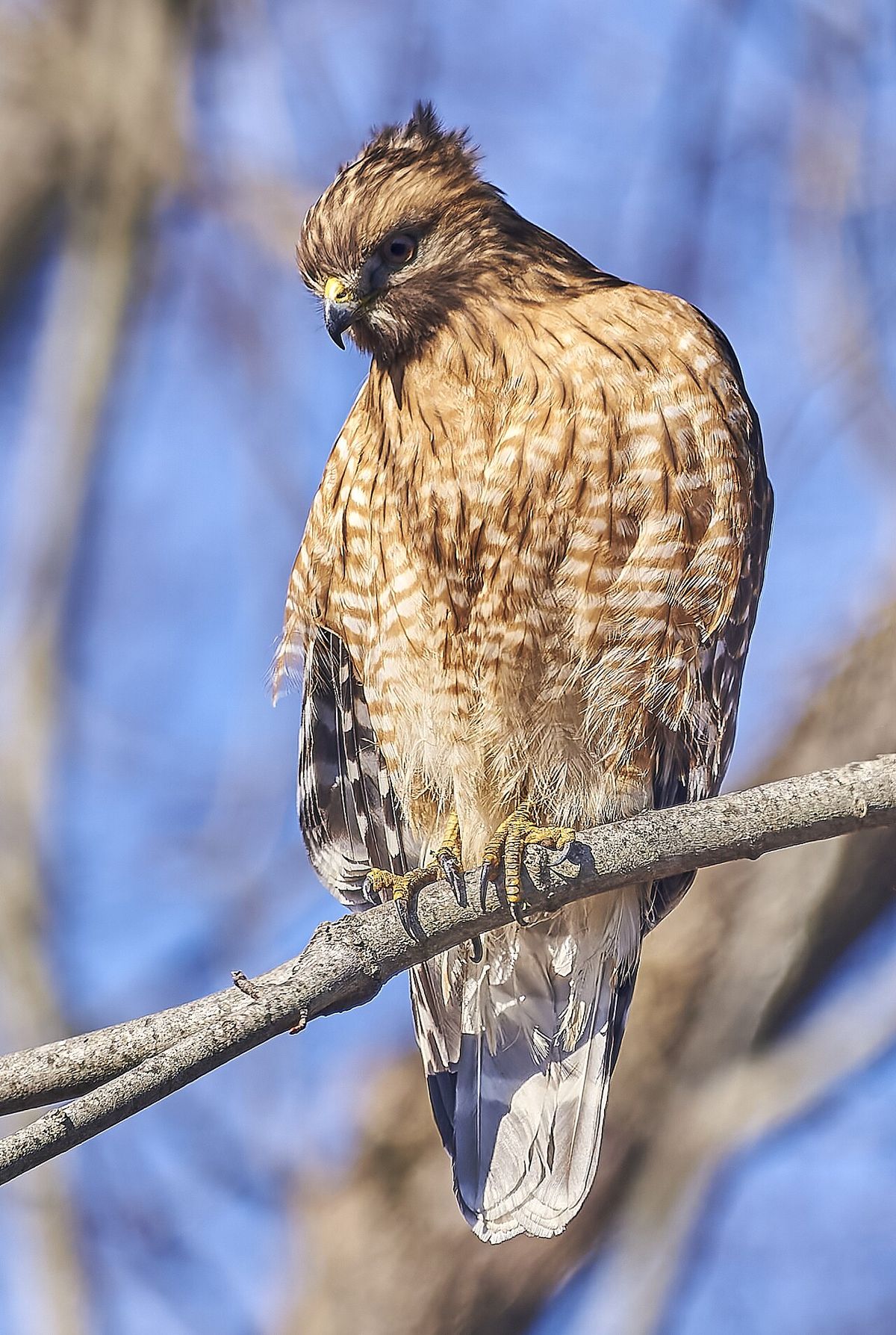
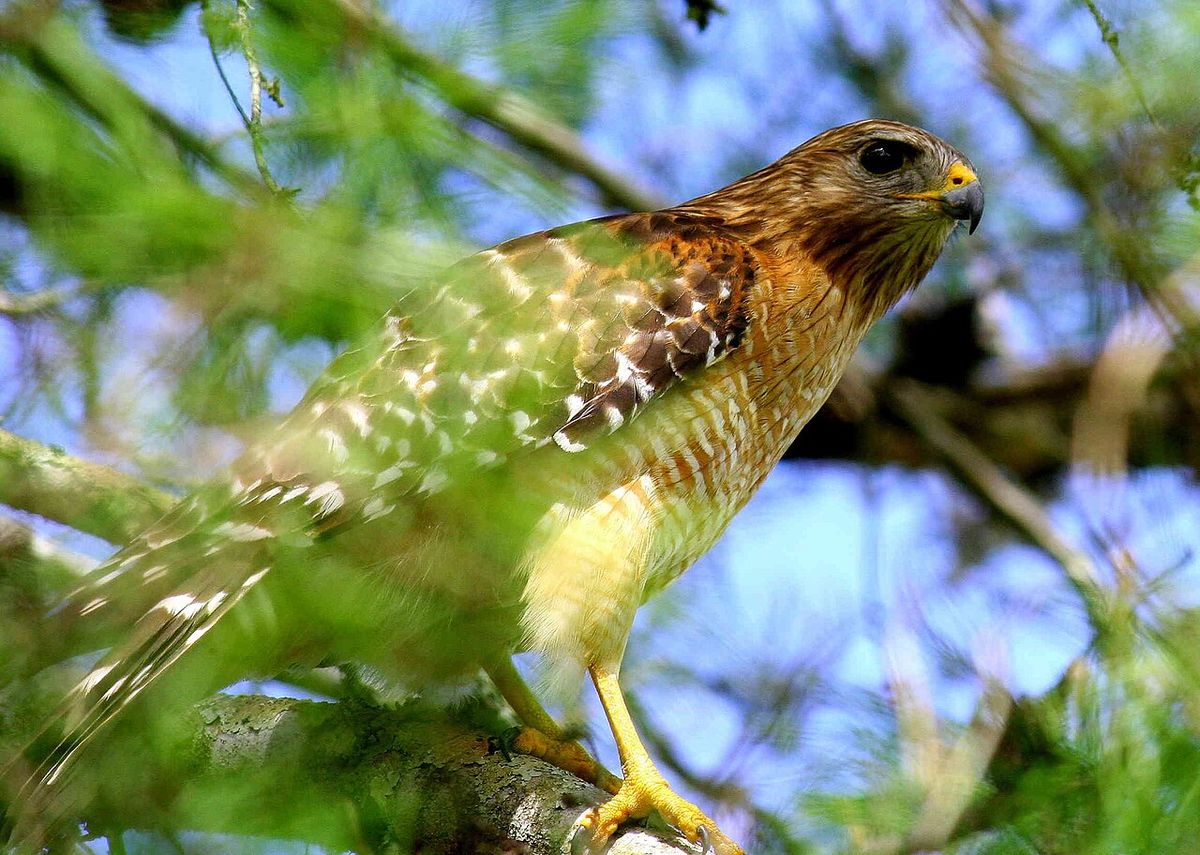
The red-shouldered hawk is a medium-sized buteo, generally more slender and longer-tailed than many of its North American relatives. Males typically measure 38 to 58 centimetres in length and weigh an average of 550 grams, while females are slightly larger, ranging from 47 to 61 centimetres long with a mean weight of 700 grams. The wingspan for both sexes can vary widely from 90 to 127 centimetres, and overall adult mass ranges from 460 to 930 grams. Standard measurements include a wing bone length of 28 to 35 centimetres, a tail length of 16 to 24 centimetres, and a tarsus length of 7.5 to 9 centimetres. Adults have brownish heads, reddish chests, and pale bellies adorned with reddish bars, with their long tails marked by narrow white bands. The namesake red "shoulders" are visible on perched birds, and their upper parts are dark with pale spots, complemented by long yellow legs. Plumage can vary regionally, with western birds often appearing more red and Florida birds generally paler. Juvenile red-shouldered hawks can be confused with juvenile broad-winged hawks but are distinguished by their longer tails, crescent-like wing markings, and a more flapping, Accipiter-like flight style. Compared to the common red-tailed hawk, the red-shouldered hawk is smaller, less bulky, and has more evenly broad wings, with the red-tail also being paler underneath and more likely to soar steadily with wings in a slight dihedral.
Distribution, Habitat, and Migration
The red-shouldered hawk has two primary population ranges in North America. An eastern population ranges west through southern Canada from southern New Brunswick and Ontario to the eastern edge of the U.S. Great Plains, extending south to Florida, the Gulf Coast, and eastern Mexico. A western population breeds west of the Sierra Nevada from northern California to northern Baja California and has recently expanded its range into Oregon, Arizona, and east of the Sierra Nevada in California and southern Nevada. This species is a forest raptor, favouring specific woodland habitats in both regions. In the east, it inhabits bottomland hardwood stands, flooded deciduous swamps, and upland mixed deciduous-conifer forests with an open subcanopy to facilitate hunting. In the west, it lives in riparian and oak woodlands, eucalyptus groves, and some residential areas. The species has shown fair adaptability to human-altered landscapes, a critical trait given that riparian forest habitat in California's Central Valley diminished by 98 percent between 1850 and 1977. A study in southern California found an average home range of 1.2 square kilometres for these hawks.
Migration patterns vary significantly between populations. Only northernmost populations of the eastern range are migratory, wintering from southern Wisconsin, Oklahoma, Ohio, and southern New England south to the Gulf Coast and occasionally as far as Jalisco and Veracruz in Mexico. Western populations are largely nonmigratory. Red-shouldered hawks are short- to moderate-distance migrants, with most individuals traveling between 300 and 1,500 kilometres each way. They follow leading lines such as inland ridges and coastlines, with larger numbers counted at coastal watch sites than inland ones. Juveniles often precede adults on autumn migration, while adults precede juveniles in the spring. They typically migrate alone, though small flocks of three or more birds sometimes form, and they usually avoid crossing large bodies of water. Eastern birds occasionally wander west during migration to areas like Colorado, Kansas, and Manitoba, while western birds have strayed east to Arizona, Nevada, and Utah.
Diet and Hunting Behaviour
Red-shouldered hawks are versatile predators that employ several hunting techniques. They often search for prey while perched on a treetop or soaring over woodlands, and when they sight a target, they kill it by dropping directly onto it from the air. In clearings, they may fly high and then drop to surprise prey, and they sometimes cache food near their nest for later consumption. Like most raptors, they possess excellent vision, a reasonably good sense of hearing, and talons capable of killing animals as large as themselves. Their diet is diverse and varies based on local abundance, but small mammals are typically the most common prey. Rodents such as voles, gophers, mice, moles, and chipmunks are frequently taken, and slightly larger mammals like rabbits and tree squirrels are also occasional prey. Other important food items include amphibians, reptiles (especially small snakes), birds, fish, and large insects. They will attack birds up to the size of a ruffed grouse or ring-necked pheasant. In some areas, particularly where they are common, crayfish can be an important prey item. During winter, these hawks sometimes habituate to preying on birds commonly found at bird feeders. Unusual food items recorded include nocturnal animals like eastern screech owls and flying squirrels, and even road-killed deer. Notably, potential prey species like Steller's jays and blue jays sometimes imitate the red-shouldered hawk's call so accurately they can be difficult to distinguish by voice alone.
Breeding and Life Cycle
The breeding season for red-shouldered hawks occurs between April and July, with activity usually peaking between April and mid-June. They are monogamous and territorial, selecting nesting sites in deciduous and mixed wooded areas, often near water and with greater tree species richness. Courtship displays involve soaring together in broad circles while calling or soaring and diving toward one another. Males may perform a "sky-dance," soaring high and then making a series of steep dives, each followed by a wide spiral and rapid ascent, usually in late morning and early afternoon. The distinctive, screaming kee-aah call, usually repeated three to four times, is heard during courtship and territory defence. The breeding pair builds a stick nest, sometimes including shredded bark, leaves, and green sprigs, in a major fork of a large tree. They often reuse and refurbish the same nest annually. The typical clutch size is three to four blotchy-marked eggs, often brown to lavender in colour, measuring on average 54.5 by 43 millimetres.
The incubation period ranges from 28 to 33 days, and hatching is asynchronous, with the first chick hatching up to a week before the last. The hatchlings weigh about 35 grams initially and are brooded almost constantly by the female for up to 40 days. The male more often captures food but will also incubate and brood occasionally. Pairs that nest earlier in the season tend to lay more eggs and have higher productivity. The young leave the nest at about six weeks of age but remain dependent on their parents until they are 17 to 19 weeks old. They may continue to roost near the nest site until the following breeding season, and breeding maturity is usually attained at one or two years of age. Overall nesting success can be lower than 30 percent each year, and only around half of all hatchlings survive their first year. Although they have lived as long as nearly 20 years, few live half that long. Early mortality is often due to harsh weather or starvation, and young hawks are frequently parasitized by species such as Trichomonas gallinae, Protocalliphora avium, and various blood parasites.
- Breeding season: April to July.
- Typical clutch size: 3 to 4 eggs.
- Incubation period: 28 to 33 days.
- Nestling period: Young leave nest at ~6 weeks.
- Dependence period: Up to 17-19 weeks post-fledging.
- Age at breeding maturity: 1 or 2 years.
Mortality and Predation
Red-shouldered hawks face numerous threats throughout their life cycle, from natural predators to human-caused dangers. Natural predation is a common cause of mortality, with a variety of animals preying on eggs, hatchlings, fledglings, and occasionally incubating adults. Key nest predators include raccoons, martens, fishers, and large arboreal snakes. Non-nesting adults, being fairly large and powerful, have fewer natural predators but may still be preyed upon by other raptors. Significant avian predators include other red-shouldered hawks, great horned owls, red-tailed hawks, barred owls, American goshawks, peregrine falcons, prairie falcons, and bald and golden eagles. In western New York, the main cause of nest failure was identified as great horned owl predation. Many of these same predators also compete with red-shouldered hawks for territory and food. Despite highly similar diet and habitat preferences, red-shouldered hawks have been found nesting within 48 metres of barred owls without interspecies conflict. In a unique cooperative behaviour observed in Florida, red-shouldered hawks sometimes collaborate peaceably with American crows to cooperatively mob mutual predators like great horned owls and red-tailed hawks.
Human activity poses significant threats, both intentional and unintentional. Historical hunting pressure in the early 1900s, before conservation laws took effect in the latter half of the 20th century, significantly impacted populations. Current human-related threats include collisions with electric wires and automobiles, logging, and poisoning from insecticides and industrial pollutants. Before its ban in the United States, the pesticide DDT caused eggshell thinning and breakage, reducing reproductive success. Despite these dangers, habitat loss remains the single biggest threat to the species. Red-shouldered hawks have also been recorded hybridizing with other raptor species, including gray hawks (Buteo plagiatus), red-tailed hawks (Buteo jamaicensis), and common black hawks (Buteogallus anthracinus).
Conservation Status and Population Trends
Prior to 1900, the red-shouldered hawk was one of the most common raptors in North America, but its population densities have decreased precipitously since then due primarily to the clearing of mature forests, especially the wet hardwood forests it prefers. This habitat change also contributed to a general population increase of the red-tailed hawk, an occasional predator and competitor. The greater availability of firearms in the early 1900s led to unchecked hunting of this and other raptor species until conservation laws were enacted later in the 20th century. Subsequent local forest regrowth and hunting bans have allowed red-shouldered hawk populations to stabilize, and the species is not currently considered conservation dependent. In Florida, it is perhaps the most commonly seen and heard raptor species, aside from abundant black and turkey vultures. However, ongoing human activities continue to pose significant threats. Logging remains a primary concern, as does poisoning from insecticides and industrial pollutants. Accidental encounters with power lines and automobiles also take a regular toll on hawk populations. In spite of these persistent dangers, deforestation and habitat loss remain the most significant overarching threat to the species' long-term survival across its range.
Cultural Depiction
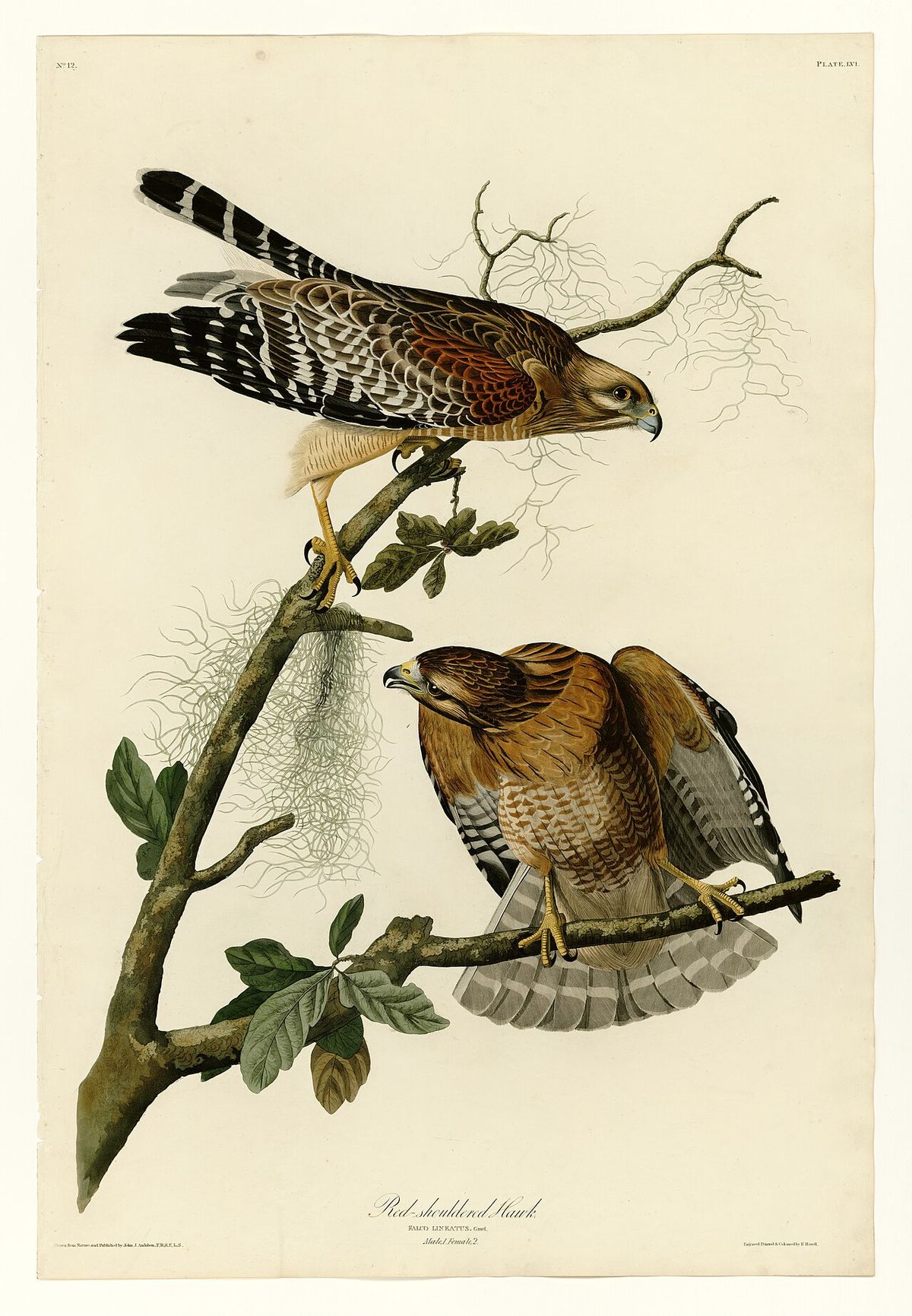
The red-shouldered hawk has been featured in notable works of natural history art. The renowned ornithologist and painter John James Audubon illustrated the species in his seminal work, Ornithological Biographies. This inclusion highlights the bird's recognition and significance within North American ornithology during the 19th century. Audubon's detailed illustrations contributed to public awareness and scientific documentation of North American bird species, including this distinctive forest raptor.
Questions about Red-shouldered hawk
Where can you find red-shouldered hawks in Canada?
In Canada, red-shouldered hawks are found in the southern parts of the country. Their eastern population ranges west through southern Canada from southern New Brunswick and Ontario to the eastern edge of the U.S. Great Plains. They inhabit bottomland hardwood stands, flooded deciduous swamps, and upland mixed forests. Only the northernmost populations in Canada are migratory, with these birds wintering in the southern United States and Mexico.
What does a red-shouldered hawk sound like?
The red-shouldered hawk has a distinctive, screaming call described as a loud 'kee-aah.' This call is usually repeated three to four times. It is most commonly heard during courtship displays or when the birds are defending their territories. Interestingly, potential prey species like Steller's jays and blue jays sometimes imitate this call. Their imitation can be so accurate that it is difficult to distinguish them from the actual hawk by voice alone.
What do red-shouldered hawks eat?
Red-shouldered hawks are carnivorous predators with a diverse diet that varies by location and season. Small mammals, especially rodents like voles, mice, and chipmunks, are typically their most common prey. They also eat slightly larger mammals such as rabbits and tree squirrels, along with amphibians, reptiles (particularly small snakes), birds, fish, and large insects. In some areas, crayfish are an important food source, and they have been known to take unusual prey like nocturnal owls, flying squirrels, and even road-killed deer.
How can you tell a red-shouldered hawk from a red-tailed hawk?
Several key features distinguish the red-shouldered hawk from the more common red-tailed hawk. The red-shouldered hawk is smaller and more slender with a longer tail marked by narrow white bars. It has reddish barring on a pale belly and reddish 'shoulders' visible when perched. The red-tailed hawk is larger and bulkier with more even-sized, broad wings, is paler underneath, and typically has a reddish tail that is often apparent in flight. The red-tail also soars more steadily with its wings held in a slight dihedral, or V-shape.
Are red-shouldered hawks endangered?
Red-shouldered hawks are not currently classified as endangered or conservation dependent. Their populations declined significantly in the 20th century due to deforestation and hunting, but have stabilized somewhat due to forest regrowth and legal protections. However, they still face ongoing threats from habitat loss, logging, poisoning from pesticides and pollutants, and collisions with vehicles and power lines. Habitat loss remains their most significant conservation challenge.
When do red-shouldered hawks nest and how many eggs do they lay?
The red-shouldered hawk's breeding season runs from April to July, with activity usually peaking between April and mid-June. They build stick nests in the major fork of a large tree, often reusing and refurbishing the same nest year after year. The typical clutch size is three to four eggs, which are blotchy-marked and often brown to lavender in colour. The incubation period lasts 28 to 33 days, and the young leave the nest at about six weeks of age but remain dependent on their parents for several more weeks.
Sources and further reading
- Red-shouldered hawk (Wikipedia)
- 15 Amazing Red-Shouldered Hawk Facts (chattnaturecenter.org)
- Red-shouldered Hawks a Threat to Pets, Feeder Birds? (georgiawildlife.com)
Checked by the Your Space Hamilton desk. Last updated 2026-10-31.