Pronghorn
The pronghorn (Antilocapra americana) is a unique, even-toed ungulate native to the grasslands and deserts of western and central North America. Though often called the American antelope, it is not a true antelope but the sole surviving member of the family Antilocapridae, with its closest living relatives being the giraffe and okapi. Renowned as the fastest land mammal in the Western Hemisphere, capable of sustained speeds up to 88.5 kilometres per hour, the pronghorn is a significant species for conservation and ecological study across Canada and the United States. Its historical range once supported vast herds, and it was a principal food source for many Indigenous peoples of the Plains and Northwest Plateau.
Physical Characteristics and Adaptations
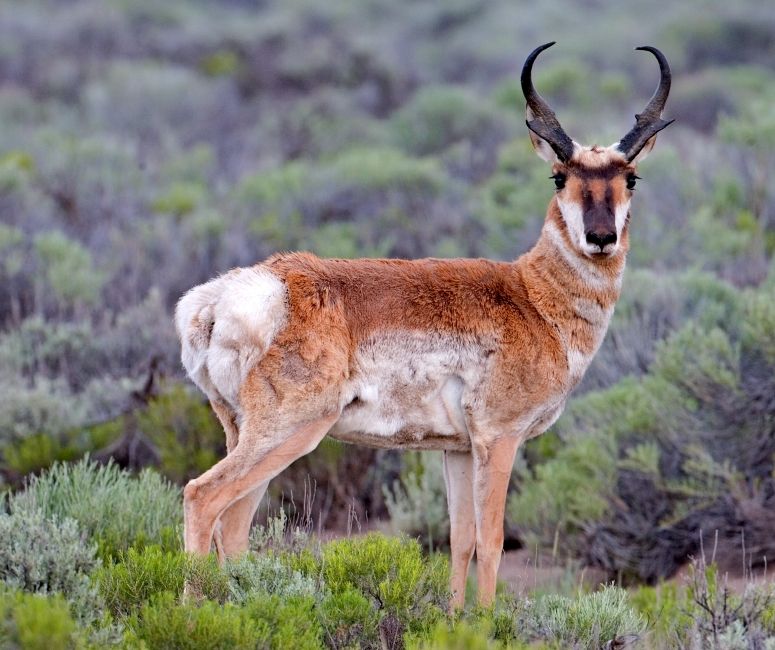
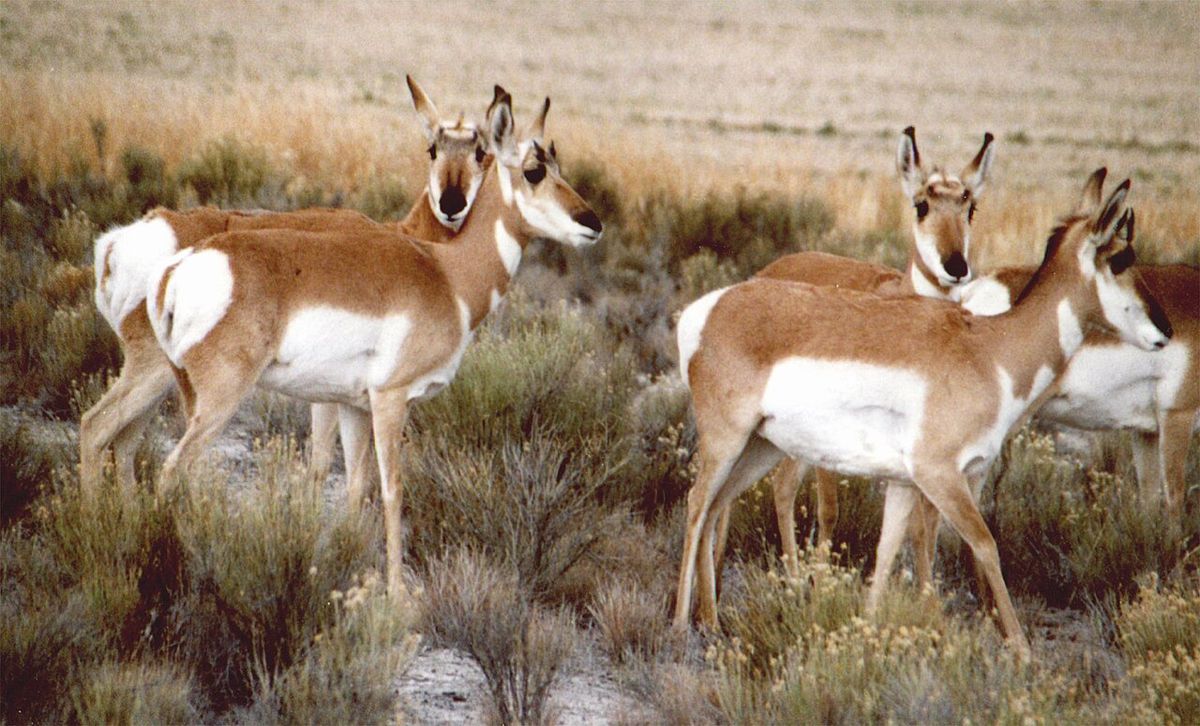
The pronghorn is a slender, deer-like mammal with a tan to reddish-brown coat and distinctive white markings on its rump, belly, breast, and throat. Adult males and females are similar in height, but males are noticeably heavier, averaging between 40 and 65 kilograms compared to the female range of 34 to 48 kilograms. A key distinguishing feature is the presence of horns, which are composed of a bony core covered by a keratinous sheath that is shed and regrown annually. Males possess prominent horns with a characteristic forward-pointing prong, averaging about 25 centimetres in length, while female horns are much smaller, often straight and sometimes barely visible. The animal's head features extremely large, high-set eyes that provide a 320-degree field of vision, an adaptation crucial for detecting predators across open terrain. Pronghorns possess several scent glands used for communication, including preorbital glands on the head and rump glands that release an odour reminiscent of buttered popcorn when the animal is alarmed.
The pronghorn's physiology is superbly adapted for high-speed, endurance running, making it the fastest land mammal in the Americas. Its skeleton is extremely lightweight, and it has a large windpipe, heart, and lung capacity to support intense aerobic activity. The hooves have two long, cushioned toes that absorb shock during rapid movement, and well-developed interdigital glands on each hoof contain antimicrobial compounds. While its top speed can reach 88.5 kilometres per hour, it is the pronghorn's stamina that is exceptional, as it can maintain a pace of 56 kilometres per hour for over six kilometres. This cursorial adaptation is supported by a greater blood volume relative to body size, particularly in males, and a body temperature maintained at approximately 38 degrees Celsius. Male pronghorns are further differentiated from females by a small patch of black hair at the angle of the mandible. The species has a distinct musky odour, and males mark territory using the preorbital scent gland on the sides of the head, whose secretion contains the highly odoriferous compound 2-ethyl-3-methylpyrazine. This dual visual and olfactory signal effectively communicates danger to other pronghorns in the vicinity, enhancing group survival in open habitats.
Range, Habitat and Diet
The pronghorn's contemporary range extends from the southern Canadian prairies through the western United States and into northern Mexico. In Canada, populations are found in the grasslands of southern Saskatchewan and Alberta, though the species has been extirpated from Manitoba. Its primary range is west of the Mississippi River, encompassing states such as Montana, Wyoming, Colorado, Arizona, and into Mexico where the Sonoran pronghorn subspecies inhabits the Sonoran Desert region. Pronghorns prefer open terrain like grasslands, sagebrush plains, and deserts, typically at elevations between 910 and 1,800 metres. The species has been lost from parts of its historical range, including Iowa and Minnesota in the U.S., and other regional subspecies include the Rocky Mountain, Mexican, Oregon, and critically endangered Baja California pronghorn.
Pronghorns are herbivorous ruminants with a highly varied diet that shifts with seasonal availability. Studies show their diet primarily consists of forbs (broadleaf herbaceous plants), shrubs, and grasses, with a notable ability to consume plants that are unpalatable or toxic to domestic livestock. One dietary analysis found forbs comprised 62% of intake, shrubs 23%, and grasses 15%, while another study in a desert region noted a diet of 40% cacti, 20% forbs, 22% grass, and 18% shrubs. This dietary flexibility allows them to inhabit arid regions where they sometimes compete with cattle for forage. Their foraging behaviour and movement are influenced by water availability, and they are known for long-distance seasonal migrations, such as a documented 260-kilometre route in Idaho between the Pioneer Mountains and the Continental Divide, which researchers have called a major overland mammal migration.
Prior to European arrival, the pronghorn was particularly abundant in regions west of the Mississippi, and the prehistoric American Prairie supported millions-strong herds of bison, elk, and pronghorn, leading to its comparison with the African Serengeti. The present-day range still reflects this historical centre of abundance, though populations are now managed and monitored. In Mexico, the Sonoran pronghorn may be found from Baja California Sur east through Sonora to San Luis Potosí, but in gradually diminishing numbers. The species' preference for open habitats at specific elevations and rainfall levels makes it sensitive to landscape changes, and conservation efforts often focus on maintaining connectivity between these preferred areas to facilitate natural movement and genetic exchange.
Predators and Evolutionary History
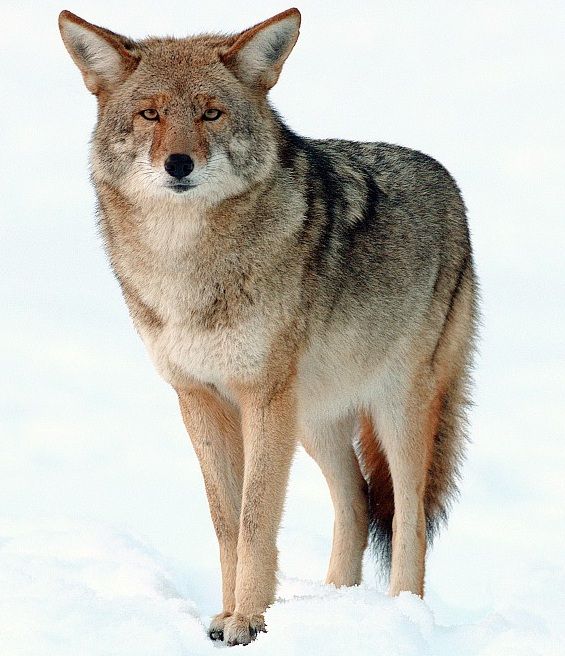
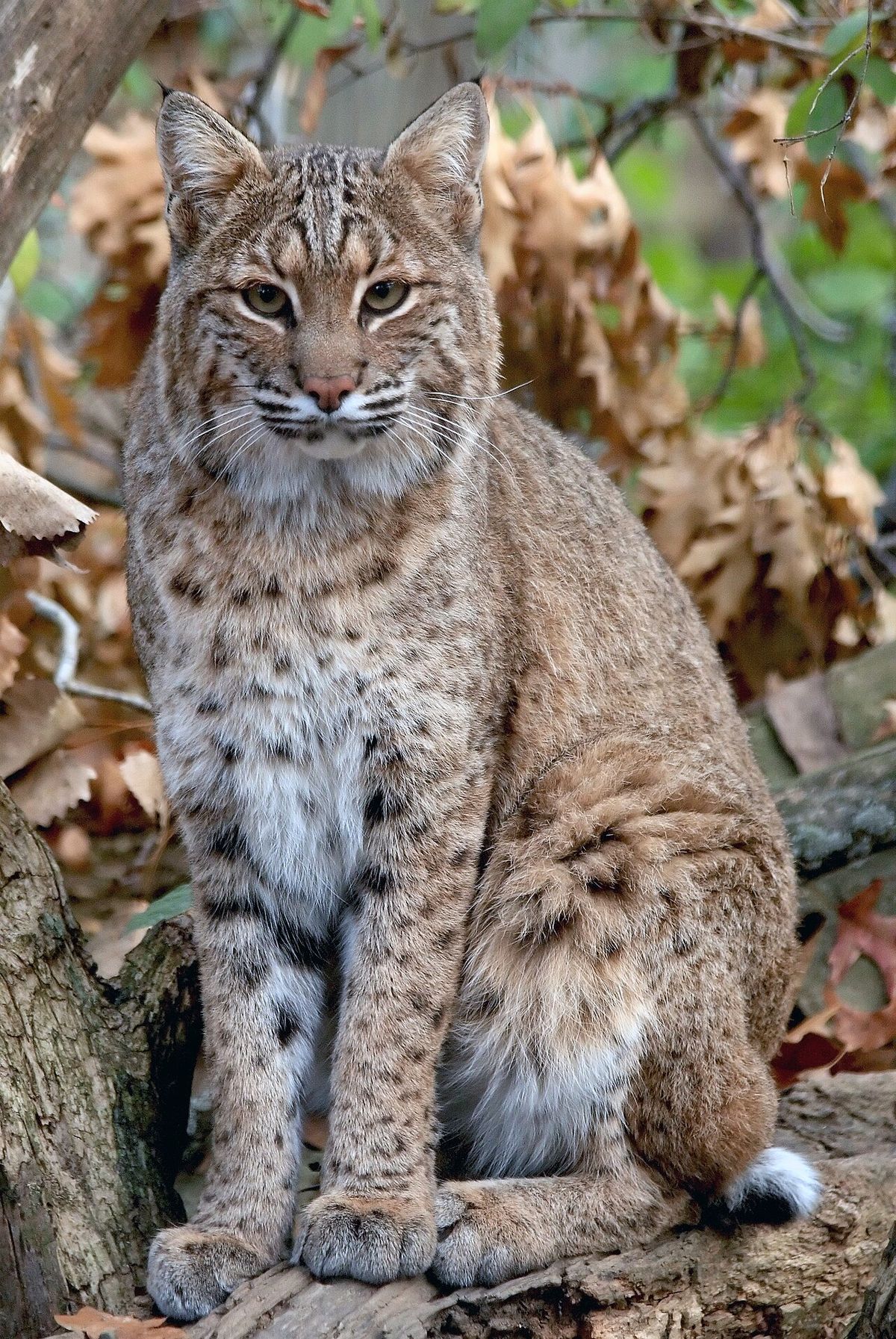
Primary predators of pronghorns include cougars, wolves, coyotes, bobcats, and grizzly bears, with golden eagles preying on fawns. Historically, jaguars and the extinct American cheetah (Miracinonyx) were also significant predators, with jaguars likely acting as short-range ambush hunters in the southwestern U.S. and Mexico. The pronghorn is the only surviving member of the family Antilocapridae, which was far more diverse during the Pleistocene epoch when approximately 11 other antilocaprid species, many with long or spectacularly twisted horns, roamed North America. Three other genera (Capromeryx, Stockoceros and Tetrameryx) existed when humans entered North America but are now extinct. The evolutionary drivers behind the pronghorn's exceptional speed have been a subject of scientific debate, with a long-held theory proposing an evolutionary arms race with pursuit predators like Miracinonyx.
Recent research has challenged and refined this theory. A 2025 study by Nascimento and Pires suggested that competition among herbivores, driven by the expansion of open grasslands in the late Miocene from 10 to 7 million years ago, was a key factor in the diversification of the pronghorn's subfamily, Antilocaprinae. That study also proposed that felid predators like Miracinonyx may have later influenced both their adaptations and decline, based on a correlation between felid diversification and antilocaprine extinction rates. In 2026, analysis by Hardy and Kort of ankle bone proportions found that early Miocene antilocaprids already had limb adaptations for speed similar to modern pronghorns, indicating these traits developed prior to the appearance of Miracinonyx. This research concluded that antilocaprid limbs were already adjusted to open habitats before the first appearance of these pursuit predators.
Additional evidence from 2026 by Cassatt-Johnstone and colleagues, based on isotopic analysis and fossils of Miracinonyx trumani from the Yukon, proposed that the species was not exceptionally specialized for hunting cursorial prey like pronghorns. Instead, it had a more flexible diet comparable to modern lions and cougars, both of which have broad geographic ranges and are not exclusive pronghorn hunters. Isotopic analysis has shown that Miracinonyx preyed not only on pronghorns but also on larger herbivores like bighorn sheep, bison, and prehistoric horses, with isotopic values overlapping with those of American lions and wolves. This points to a more complex evolutionary history where open habitat structure and herbivore competition played significant early roles in shaping the pronghorn's form, with predation being one of several selective pressures.
Social Structure and Reproduction
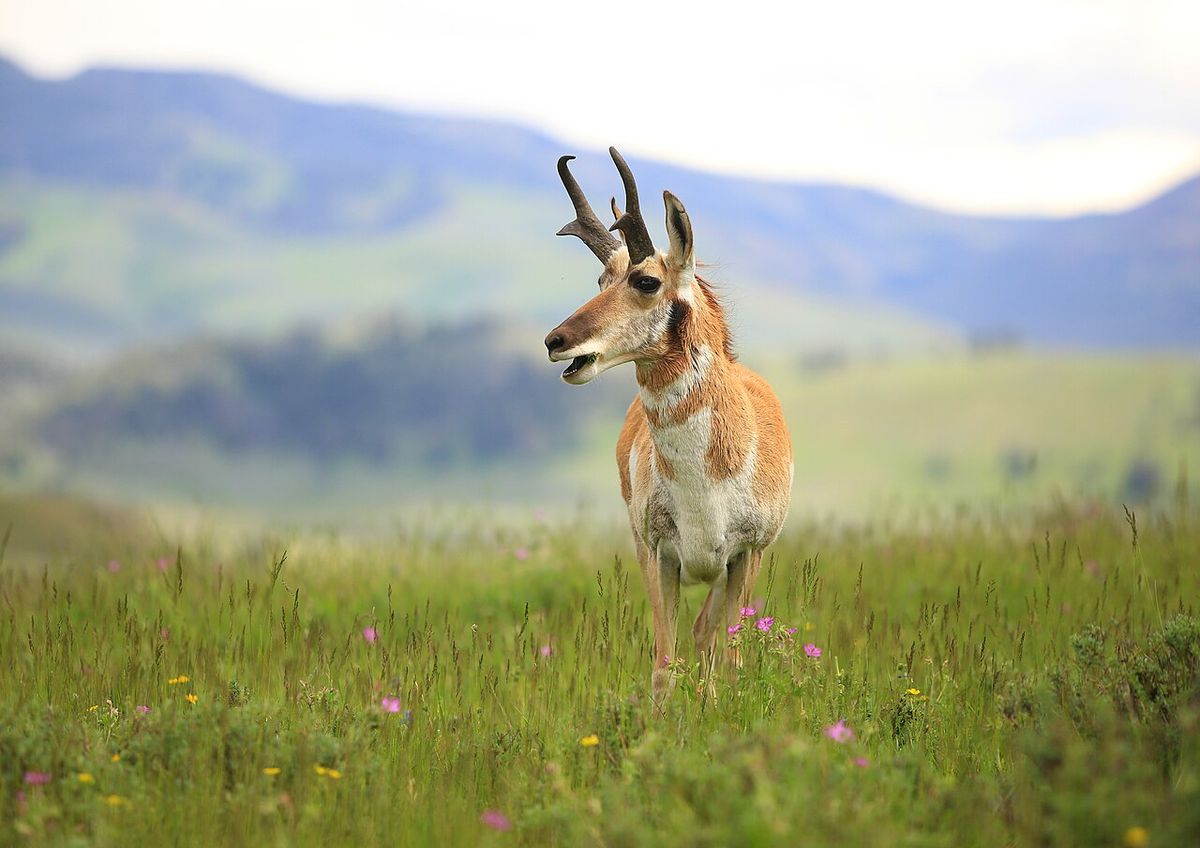
Pronghorn social organization changes with the seasons. They form mixed-sex herds in winter, which break up in early spring. Males then form bachelor groups or become solitary, while females form bands, and some female bands share the same summer range. Dominance hierarchies exist within female groups, with dominant individuals aggressively displacing others from prime feeding sites and few circular relationships observed. Adult males employ different mating strategies, often defending fixed territories that females enter or directly defending a harem of females. Territorial males use scent marking from glands on the jaw and rump, vocalizations, and direct challenges to intruders to maintain their space. In areas with higher precipitation, this territorial system is common, giving dominant males access to better resources than bachelor males.
Females also exhibit varied mating behaviours, which can change based on environmental or demographic conditions. These strategies include 'sampling' multiple males and switching at an increasing rate as estrus approaches, 'inciting' conflicts between males to then mate with the winners, or being 'quiet' and remaining with a single male in an isolated area throughout estrus. Females continue this mating behaviour for two to three weeks. When courting, a male approaches a female while softly vocalizing and waving his head side to side to display his cheek patches. A receptive female remains motionless, sniffs his scent gland, and then allows the male to mount her. This complex social and mating system ensures genetic diversity and adaptation to local conditions.
The breeding season occurs in mid-September, with a notably long gestation period of seven to eight months, about six weeks longer than that of white-tailed deer. Does give birth in late May, commonly to twin fawns, and females usually bear within a few days of each other. Newborns weigh between 2 and 4 kilograms, most commonly about 3 kilograms, and spend their first 21 to 26 days hiding in vegetation. Fawns interact with their mothers for only 20 to 25 minutes a day for nursing and grooming, a pattern that continues even when the fawn joins a nursery group. Females lead fawns to food and water and guard against predators, nursing the young about three times a day. Males are weaned 2-3 weeks earlier than females, and sexual maturity is reached at 15 to 16 months, though males rarely breed until three years old. Their typical lifespan is up to 10 years, rarely 15 years.
Conservation and Relationship with Humans
Pronghorns were a principal food source for many Plains Indians and Northwest Plateau tribes prior to European contact. The species was first described for Western science by the Lewis and Clark expedition in the early 1800s near the mouth of the Niobrara River in present-day Nebraska, with William Clark providing a detailed description of the first specimen he killed. Following European settlement, pronghorn populations declined dramatically due to overhunting and habitat loss, but conservation efforts in the 20th century, including regulated hunting and habitat protection, have allowed numbers to recover significantly across much of their range. Modern conservation challenges include habitat fragmentation, particularly from fencing and roads, which can impede their long-distance migrations and daily movements. In response, initiatives like those by the Arizona Antelope Foundation work to modify fences by removing the bottom barbed wire or installing a barbless bottom wire to allow pronghorns to pass underneath safely.
Several subspecies face specific threats. The Sonoran pronghorn (A. a. sonoriensis) and the Baja California pronghorn (A. a. peninsularis) are considered endangered and critically endangered, respectively, with small, isolated populations in Mexico and the southwestern United States. Other subspecies include the widespread Rocky Mountain pronghorn (A. a. americana), the Mexican pronghorn (A. a. mexicana), and the Oregon pronghorn (A. a. oregona). The pronghorn's ecological role as a grazer and browser, its status as a game species, and its representation of the North American West make it a continued focus of wildlife management and scientific study. Its image serves as the symbol of the American Society of Mammalogists, reflecting its importance within the field of mammalogy.
The animal's relationship with humans also involves its unique locomotion in human-altered landscapes. Since pronghorns are built for speed, not for jumping, they typically go under fences rather than over them, sometimes at high speed. This behaviour has directly informed fence modification programs across the West to reduce mortality and injury. Research by organizations like the Lava Lake Institute for Science and Conservation and the Wildlife Conservation Society continues to document and protect vital migration corridors, with scientists noting that these routes represent an increasingly rare phenomenon in the U.S. and worldwide. These efforts aim to preserve the pronghorn's long-distance movements that are essential for accessing seasonal ranges and maintaining healthy populations.
Subspecies and Population Status
The pronghorn is divided into several subspecies, each adapted to specific regions of North America. These subspecies vary slightly in size, colouration, and habitat preference, reflecting the diverse environments they occupy from the Canadian prairies to the Mexican desert. The population status of these subspecies ranges from abundant to critically endangered, highlighting the varied conservation challenges across the pronghorn's range. Monitoring these distinct populations is essential for preserving the genetic diversity and ecological resilience of the species as a whole, and conservation programs are often tailored to the needs of specific subspecies, particularly those with cross-border ranges.
- Rocky Mountain pronghorn (A. a. americana): The most widespread and numerous subspecies, found throughout the Great Basin and Rocky Mountain regions of the United States and into the Canadian prairies of Saskatchewan and Alberta.
- Sonoran pronghorn (A. a. sonoriensis): An endangered subspecies inhabiting the Sonoran Desert in Arizona, United States, and Sonora, Mexico, with a highly restricted range and an estimated population of only a few hundred individuals.
- Mexican pronghorn (A. a. mexicana): Native to the central plateau of Mexico, with populations in states like San Luis Potosí, facing ongoing threats from habitat loss and fragmentation.
- Oregon pronghorn (A. a. oregona): Historically found in eastern Oregon and surrounding areas, its range and numbers have contracted but it is not considered at immediate risk of extinction.
- Baja California pronghorn (A. a. peninsularis): A critically endangered subspecies restricted to the Vizcaíno Desert in Baja California Sur, Mexico, with perhaps fewer than 200 individuals remaining, making it one of the most threatened mammals in North America.
Conservation efforts for pronghorns involve habitat restoration, captive breeding and reintroduction programs for the most endangered populations. International cooperation is particularly important for subspecies whose ranges cross the United States and Mexico border. The survival of subspecies like the Sonoran and Baja California pronghorns depends heavily on managing water availability, forage, and human infrastructure in their harsh desert environments. The more abundant subspecies require ongoing management to ensure migration corridors remain open and populations remain genetically healthy across their extensive ranges. For example, the Arizona Antelope Foundation and others are in the process of modifying fences to be more pronghorn friendly.
Physiological and Behavioural Records
The pronghorn holds a number of notable biological and behavioural records within the Western Hemisphere, a result of its unique evolutionary path. These attributes are integral to its survival in open, predator-rich landscapes. From its locomotive capabilities to its sensory systems, the pronghorn exhibits specializations that distinguish it from other North American ungulates. These records are not merely curiosities but are directly linked to its feeding ecology, predator avoidance, and social communication strategies in the grassland ecosystems it inhabits.
- Speed: Fastest land mammal in the Americas, with a top recorded speed of 88.5 kilometres per hour (55 mph) for 800 metres.
- Stamina: Can sustain a speed of 56 km/h (35 mph) for over 6.5 kilometres (4 mi), and 42 mph (68 km/h) for 1.5 kilometres (1 mi), far exceeding the endurance of the African cheetah.
- Vision: Possesses an extremely wide 320-degree field of vision due to its large, high-set eyes and prominent orbits.
- Gait Variety: Has been observed using at least 13 distinct gaits, including one reaching nearly 7.3 metres (24 ft) per stride.
- Horn Growth: The only animal that sheds and regrows its keratinous horn sheaths annually, a characteristic not found in the bovine family.
- Gestation: Has the longest gestation period (7-8 months) of any North American ungulate, relative to its body size.
- Migration: Undertakes some of the longest overland migrations in the contiguous United States, with documented routes over 260 kilometres (160 mi) long, as studied in Idaho.
These extraordinary traits are the result of millions of years of evolution in North America's dynamic environments. The pronghorn's speed and endurance are supported by a large windpipe, heart, lungs, and blood volume, along with an extremely light bone structure and hollow hair. Its varied gaits allow efficient movement across different terrains, while its unique horn cycle and communication systems facilitate social structure and reproduction. These combined adaptations explain why the pronghorn is considered a living relic and a priority for conservation, ensuring its continued presence across the western landscapes.
European Discovery and Scientific Description
Pronghorns were first seen and described by Spanish explorers in the 16th century during their expeditions into the interior of North America. However, the species was not formally recorded or scrutinized by Western science until the Lewis and Clark Expedition of 1804 to 1806. Captain Meriwether Lewis and Second Lieutenant William Clark encountered the pronghorn near the mouth of the Niobrara River, in present-day Nebraska. Clark provided a detailed account of his experience killing one, describing its size, colour, horn structure, and resemblance to the antelope or gazelle of Africa. His written description noted the animal's light grey colour, black markings behind the ears and down the neck, white face and neck, and short white tail, and he specifically mentioned its pair of hoofs per foot and active nature.
Based on the observations and specimens collected during that expedition, the pronghorn was first officially described scientifically by American ornithologist George Ord in 1815. Ord gave it the binomial name Antilocapra americana, placing it in its own unique genus. The animal gets its common name from the forward-pointing tine or prong on the horn sheaths of males, a feature distinct from the unbranched horns of animals in the ox family Bovidae. This early documentation came at a time when pronghorn populations were still vast, but it paved the way for later scientific study as the species faced significant population declines in the following century due to westward expansion and market hunting. The Lewis and Clark account remains a valuable historical record of the pronghorn's morphology and distribution at the time of early European-American contact, and Clark's comparison to Old World antelopes was perceptive, noting the convergent evolution that led the pronghorn to fill a similar ecological niche.
Pronghorns were first seen and described by Spanish explorers in the 16th century, but the species was not formally recorded until the expedition of Captain Meriwether Lewis and Second Lieutenant William Clark from 1804 to 1806. Following the discovery of a few subspecies of the sharp-tailed grouse, Lewis and Clark came across the pronghorn near the mouth of the Niobrara River in present day Nebraska. Clark was among the first Euro Americans to publish the experience of killing a pronghorn and provided a detailed description of the animal. The pronghorn was first officially described by American ornithologist George Ord in 1815.
Questions about Pronghorn
Are pronghorns native to Canada?
Yes, pronghorns are native to Canada. Their current range includes the grasslands of southern Saskatchewan and southern Alberta. Historically, they also inhabited parts of Manitoba, but they have been extirpated from that province. The Canadian populations are part of the northern extent of the species' overall range, which stretches down through the western United States into Mexico. These animals are well-adapted to the open, semi-arid prairie conditions found in these regions.
How fast can a pronghorn run?
The pronghorn is the fastest land mammal in the Western Hemisphere. Its top speed can reach 88.5 kilometres per hour (55 mph) over a distance of 800 metres. More impressively, it can sustain high speeds over long distances, maintaining 56 km/h (35 mph) for over 6.5 kilometres and 68 km/h (42 mph) for 1.5 kilometres. This endurance running ability, supported by a large heart and lungs, surpasses that of the African cheetah, which is faster in short bursts but cannot maintain its top speed.
What is the difference between a pronghorn and an antelope?
Despite being commonly called the American antelope, the pronghorn is not a true antelope. True antelopes, like those found in Africa and Asia, belong to the bovine family (Bovidae). The pronghorn is the sole living member of the family Antilocapridae. A key physical difference is that pronghorns shed and regrow the keratinous sheath covering their horns every year, while antelope horns are permanent, unbranched structures. Genetically, the pronghorn's closest relatives are the giraffe and okapi, not Old World antelopes.
What do pronghorns eat?
Pronghorns are herbivorous ruminants with a diverse diet that includes forbs (broadleaf plants), shrubs, grasses, and even cacti. Their diet varies by season and habitat. Studies show they often consume plants that are unpalatable or toxic to domestic livestock, such as certain shrubs and forbs. In one analysis, forbs made up 62% of their diet, shrubs 23%, and grasses 15%. In desert regions, they may rely heavily on cacti, which can comprise up to 40% of their intake, for both moisture and nutrients.
Why are pronghorns endangered in some areas?
Certain pronghorn subspecies are endangered due to habitat loss, fragmentation, drought, and historical overhunting. The Sonoran pronghorn, found in the Arizona and Sonora desert, is endangered with only a few hundred individuals, suffering from water scarcity and limited forage. The Baja California pronghorn is critically endangered, with perhaps fewer than 200 animals, due to its small, isolated range in the Vizcaíno Desert. Threats include fencing that blocks migration routes, human development, climate change, and the inherent vulnerability of small populations in harsh environments.
How long do pronghorns live and how do they reproduce?
In the wild, pronghorns typically live up to 10 years, though reaching 15 years is rare. They have a long gestation period of seven to eight months, and females commonly give birth to twin fawns in late May. Newborn fawns weigh 2 to 4 kilograms and are hidden in vegetation for their first few weeks. Pronghorns reach sexual maturity at 15 to 16 months, but males rarely breed successfully until age three when they can compete for mates. High fawn mortality due to predation is a major factor in population dynamics, balancing their relatively long lifespan for an ungulate of their size.
Sources and further reading
- Pronghorn (Wikipedia)
- Pronghorn (nwf.org)
- Pronghorn, Wind Cave (nps.gov)
- Antelope in Alberta? Pronghorn Species Profile (aiwc.ca)
- Pronghorn Antelope | Washington Department of Fish & ... (wdfw.wa.gov)
Checked by the Your Space Hamilton desk. Last updated 2026-10-20.